Introduction
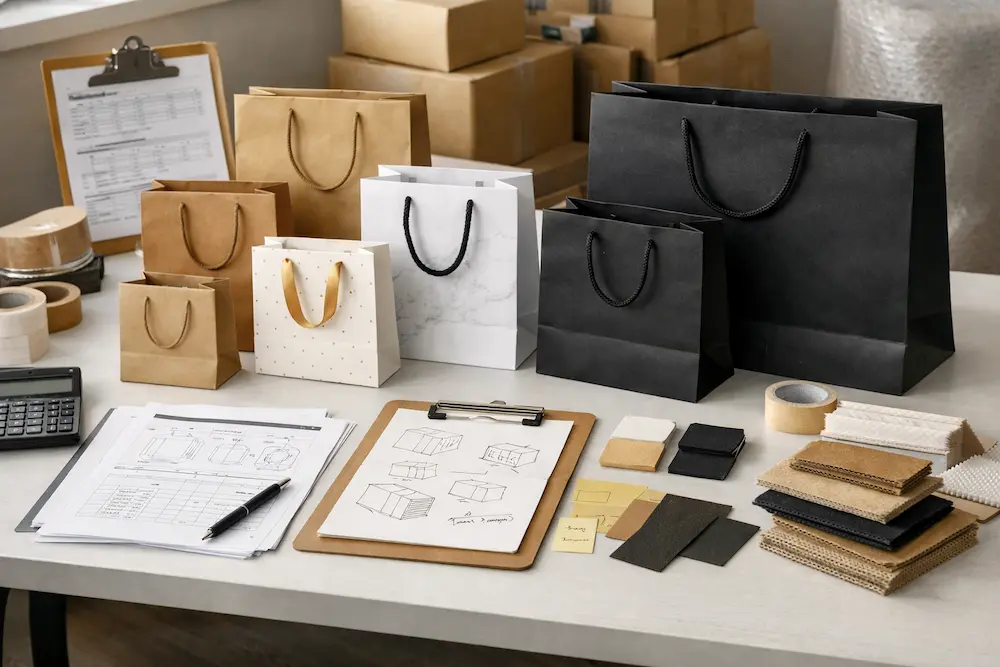
For importers, the MOQ for retail paper bags is rarely just one simple number. Many buyers ask suppliers, “What is your MOQ?” but that question alone usually does not produce a useful answer. The real MOQ for retail paper bags depends on the exact bag size, the handle type, the paper stock, the print method, the export packing plan, and whether the order is plain or fully customized. In practical sourcing, the better question is not just “What is the MOQ?” but “What is the paper bag MOQ for this exact retail bag with this exact structure and printing requirement?”
That is why retail paper bags for importers should never be treated like a generic off-the-shelf product. A plain stock shopping bag, a branded boutique bag, a seasonal gift bag, and a larger carry bag may all fall into the retail paper bag category, but their production logic is not the same. If importers want a reliable answer on the MOQ for retail paper bags, they need to define the bag first and ask about MOQ second.
For many buyers, MOQ becomes even more important when the bag is part of the brand image. If the bag is being developed not just for carrying products but also for stronger presentation, some buyers also compare custom paper bags with logo for distinct brand presentation when assessing how a more branded retail bag program may affect production setup, print planning, and therefore the final paper bag MOQ.
The Short Answer: MOQ Depends on the Bag, Not Just the Factory
A good starting point for importers is to understand that there is no single universal MOQ for retail paper bags. The MOQ for a plain stock retail bag may be very different from the MOQ for custom retail paper bags with a specific size, logo, handle style, and export carton standard.
That is because the factory is not only producing “a paper bag.” It is producing your paper bag. Once the bag becomes project-specific, the paper bag MOQ becomes project-specific too. This is one of the most important ideas for retail paper bags for importers. The MOQ does not come only from the factory’s policy. It comes from the real production threshold required to make that exact bag efficiently.
In other words, the MOQ for retail paper bags is usually not just a number to negotiate. It is a production signal. It tells you how much volume the supplier needs in order to make the bag economically and technically sensible.
Why MOQs Vary So Much in Retail Paper Bags
One reason MOQs vary is setup cost. A factory may need to prepare printing plates, organize paper stock, set the bag dimensions, confirm the handle type, arrange the export packing, and align the machine settings before production can really begin. If the order is too small, all of those setup costs are spread across too few bags. That is why the MOQ for retail paper bags usually rises as the bag becomes more customized.
A second reason is material purchasing. If the order needs a specific brown kraft, white kraft, black paper, recycled-content stock, or another less standard material direction, the supplier may need to buy paper in quantities that are already higher than the importer’s trial volume. This is why retail paper bags for importers often have a different MOQ depending on whether the material is common or specialized.
A third reason is printing complexity. A plain one-color logo on brown kraft usually creates a lower production threshold than a larger multi-color design, a cleaner white background, or a more presentation-led premium retail finish. In other words, the more complex the branding, the more likely the paper bag MOQ will rise.
The Biggest Factors That Affect the MOQ for Retail Paper Bags
1. Whether the Bag Is Plain or Custom Printed
Plain retail paper bags usually have a lower MOQ for retail paper bags than customized branded ones. That is because the supplier can often make plain bags more flexibly without having to dedicate the production line to one buyer’s branding.
Once the order becomes custom retail paper bags, the MOQ usually becomes more project-specific. This is especially true when the importer wants a defined logo position, a non-standard size, or stronger visual presentation. If the project leans more toward branded retail packaging, that often pushes the paper bag MOQ higher than a standard plain-bag order.
2. Bag Size and Capacity
Bag size matters more than many importers expect. A smaller retail bag, a standard shopping bag, and a very large carry bag do not use the same paper amount, the same carton space, or the same production rhythm.
If the project involves high-capacity carry bags, some buyers also compare large paper bags for high-capacity carry solutions when evaluating how a larger format may affect both usability and MOQ planning. In practical sourcing, a larger bag often changes not just unit cost, but the overall MOQ for retail paper bags because it changes paper use, packing efficiency, and machine output.
3. Paper Type and Color Direction
Brown kraft, white paper, black paper, and other specialty retail surfaces do not behave the same way in production. That means the MOQ for retail paper bags may change depending on the material direction you choose.
For example, black retail paper bags are often more presentation-led and may be treated as a more premium custom project. Buyers working on more premium-looking retail packaging sometimes also compare black paper bags for premium brand presentation when assessing how darker paper surfaces affect both brand image and production planning.
This is one reason retail paper bags for importers should never be quoted only by a generic description. The exact paper direction affects both the look of the bag and the paper bag MOQ behind it.
4. Handle Type and Structure
A retail paper bag with flat handles, twisted handles, rope handles, or a die-cut handle does not have the same converting process. Some structures are easier to run in higher volume. Others are more specialized and require more careful production control.
If the bag needs to balance function and retail visibility, some buyers also compare paper carrier bags for reliable carry and brand visibility when thinking about how structure, carry comfort, and branding logic should work together.
In simple terms, the more customized or presentation-led the handle structure becomes, the more likely the MOQ for retail paper bags will become less flexible.
5. Whether the Order Is a First Run or a Repeat Order
For importers, this is one of the most practical MOQ questions of all. A first run is usually less efficient than a repeat run because the size, paper, print, and packing plan still need to be stabilized.
Once the bag has already been approved and repeated successfully, the supplier may find it easier to price and schedule. That means the best paper bag MOQ for a first order and the best paper bag MOQ for a repeat order may not be the same. This is why retail paper bags for importers should usually be approached in stages rather than treated as one large commitment from the beginning.
Is a Lower MOQ Always Better?
Not necessarily. A low MOQ for retail paper bags sounds attractive, especially for new importers, but the lowest MOQ is not always the best buying decision.
A very small MOQ may mean:
- a much higher unit price
- less efficient printing
- less stable production
- limited paper choices
- weak repeat-order economics
A good MOQ for retail paper bags is the order size that helps you validate the right bag without locking too much money into the wrong specification. That is especially important for custom retail paper bags, where the bag may still be evolving during the first order.
For importers, the best MOQ is usually the one that matches the level of certainty. If the bag design is still changing, lower-volume validation is safer. If the bag has already been tested and approved, a larger MOQ may actually be the smarter commercial choice.
A Better Way to Ask About MOQ
Instead of asking only, “What is your MOQ for retail paper bags?”, importers usually get much more useful answers by asking more detailed questions such as:
- What is the MOQ for retail paper bags in this exact finished size?
- How does the paper bag MOQ change if I switch from plain bags to custom print?
- Does the MOQ change if I use white paper instead of brown kraft?
- Does the MOQ change if I use black paper or another specialty stock?
- Does the MOQ change if I increase the bag size or capacity?
- What MOQ gives the best balance between price and repeat-order stability?
These are the kinds of questions that help retail paper bags for importers become real sourcing decisions instead of vague quote comparisons.
MOQ for Retail Paper Bags in Different Retail Scenarios
Different retail scenarios often create different MOQ logic.
For supermarket and everyday retail programs, the MOQ for retail paper bags may be easier to justify at larger volume because those bags are often used more frequently and replaced more quickly. In more practical daily-use programs, some buyers also compare paper carrier bags for reliable carry and brand visibility when evaluating what structure supports repeat use without pushing the order into an unnecessarily premium cost range.
For premium black bags or higher-end brand presentation, the MOQ may be less flexible because the project often becomes more specific in material and finish. That is where a page like black paper bags for premium brand presentation reflects the kind of retail bag program that may carry a more project-specific MOQ.
For high-capacity retail carry formats, the MOQ may also change because the bag uses more paper and may have different carton efficiency. In those cases, large paper bags for high-capacity carry solutions is a useful comparison point for how larger retail bags affect both production logic and freight planning.
For promotional retail, event, or themed uses, the bag may function more like a campaign item than a standard shopping bag. In those cases, some buyers also compare paper party bags for cheerful celebrations and events when assessing whether the retail paper bag is really a standard replenishment item or more of a special-use packaging project. That difference can change the right MOQ decision as well.
Best Practice for First-Time Importers
For first-time importers, the best approach is usually:
First, lock the real end use.
Second, lock the finished size.
Third, confirm the paper type and color direction.
Fourth, confirm the handle and bottom structure.
Fifth, review a realistic sample.
Sixth, ask the supplier what MOQ for retail paper bags makes sense for that exact approved bag.
This sequence is much more reliable than starting with MOQ alone. For retail paper bags for importers, MOQ becomes meaningful only after the bag itself is clearly defined.
Practical Table: How Importers Should Think About MOQ
| Situation | How to think about MOQ |
|---|---|
| Plain stock retail paper bags | MOQ may be more flexible because the bag is less customized |
| Custom printed retail paper bags | MOQ usually becomes more project-specific |
| First order with changing specs | Keep MOQ more controlled until the bag is proven |
| Repeat order with approved bag | Larger MOQ may improve economics and stability |
| Premium black or specialty retail bags | MOQ may rise because the project becomes more customized |
| Large high-capacity retail bags | MOQ should be evaluated together with material use and freight logic |
| Event or campaign-style retail bags | MOQ may depend more on project-specific branding and timing |
The point is not to find the lowest MOQ in every situation. The point is to find the MOQ that best fits your product, your level of certainty, and your sales plan.
Conclusion
For importers, the MOQ for retail paper bags is usually not one fixed number that applies to every order. It changes with the bag size, the paper stock, the handle type, the print requirement, the intended use, and the supplier’s production logic. That is why the strongest buying decision usually comes from defining the bag clearly first and asking about MOQ second.
The most reliable approach is to treat the paper bag MOQ as part of a larger sourcing decision. When the end use, paper direction, print plan, packing logic, and branding requirements are all clear, the MOQ for retail paper bags becomes much easier to judge. That is how retail paper bags for importers stop being a vague quote request and become a more stable, commercially useful packaging program.
How Importers Should Think About MOQ for Retail Paper Bags
What MOQ really means: MOQ is not only a factory number. For importers, it is a production threshold that reflects how customized the retail paper bag is and how efficiently the supplier can make it.
Why the decision matters: A poor MOQ decision can lock buyers into the wrong bag size, wrong paper, or wrong retail concept too early. A better MOQ helps reduce testing risk while still keeping the order commercially practical.
How buyers should evaluate MOQ: Importers should judge the MOQ only after the finished size, paper direction, handle style, print requirement, and end use are already clear. The more project-specific the bag becomes, the more project-specific the MOQ usually becomes as well.
What usually makes sense in practice: Plain stock retail paper bags may allow more flexibility. Custom retail paper bags, premium black bags, larger carry bags, and campaign-style bags often need more careful MOQ planning because the production setup becomes more specific.
What importers should watch most carefully: The most important point is not only whether the MOQ looks low. It is whether that MOQ still makes sense once unit cost, repeat-order stability, paper choice, and market fit are considered together.
The larger takeaway: The best MOQ for retail paper bags is the one that matches the actual approved bag and the actual buying stage. That is how importers avoid confusing a low MOQ with a good sourcing decision.
FAQ
1. What is the MOQ for retail paper bags for importers?
The MOQ for retail paper bags is usually not one fixed number. It depends on the bag size, paper type, handle style, printing requirements, and how customized the project is. For importers, the real MOQ for retail paper bags is normally tied to the exact approved specification rather than a universal factory number.
2. Why does the MOQ for retail paper bags change from one project to another?
Because the paper bag MOQ is affected by production setup, paper purchasing, printing preparation, and packing efficiency. A plain stock bag and a fully customized printed retail bag do not create the same production threshold, so the MOQ often changes when the bag becomes more project-specific.
3. Are custom retail paper bags likely to have a higher MOQ than plain bags?
Yes, in many cases. Custom retail paper bags often need more specific size control, print setup, and material planning, which can push the MOQ higher than a plain stock bag. The more customized the paper, handle, or printing becomes, the more likely the MOQ will be less flexible.
4. Should importers focus only on getting the lowest MOQ?
No. A lower MOQ for retail paper bags is not always the best buying decision. For importers, the better MOQ is the one that balances testing risk, unit cost, repeat-order stability, and the chance of locking into the wrong bag specification too early.
5. Do food-related retail paper bags need extra review before approving bulk MOQ?
Yes. FDA explains that food contact substances include food packaging and packaging components such as adhesives and colorants, which means intended use matters for food-related retail bags. Importers should review the full bag structure before approving a food-related bulk MOQ.
References
- Basic Importing and Exporting — U.S. Customs and Border Protection — CBP
- Tips for New Importers and Exporters — U.S. Customs and Border Protection — CBP
- Importing into the United States — U.S. Customs and Border Protection — CBP
- Food Packaging & Other Substances that Come in Contact with Food: Information for Consumers — U.S. Food and Drug Administration — FDA
- Understanding How FDA Regulates Substances that Come into Contact with Food — U.S. Food and Drug Administration — FDA
- Packaging waste — European Commission — Directorate-General for Environment
- Packaging & Packaging Waste Regulation — European Commission — Directorate-General for Environment
- Guidance / timing materials for Regulation (EU) 2025/40 — European Commission
- What the FSC Labels Mean — Forest Stewardship Council — FSC
- Paper & Packaging — Forest Stewardship Council — FSC
- What do the FSC labels mean? — FSC US / FSC Canada resources
Original Knowledge Statement:This article is based on the packaging industry experience and product knowledge of Xiamen Youngpack Imp.and Exp.Co.,Ltd. All rights reserved.