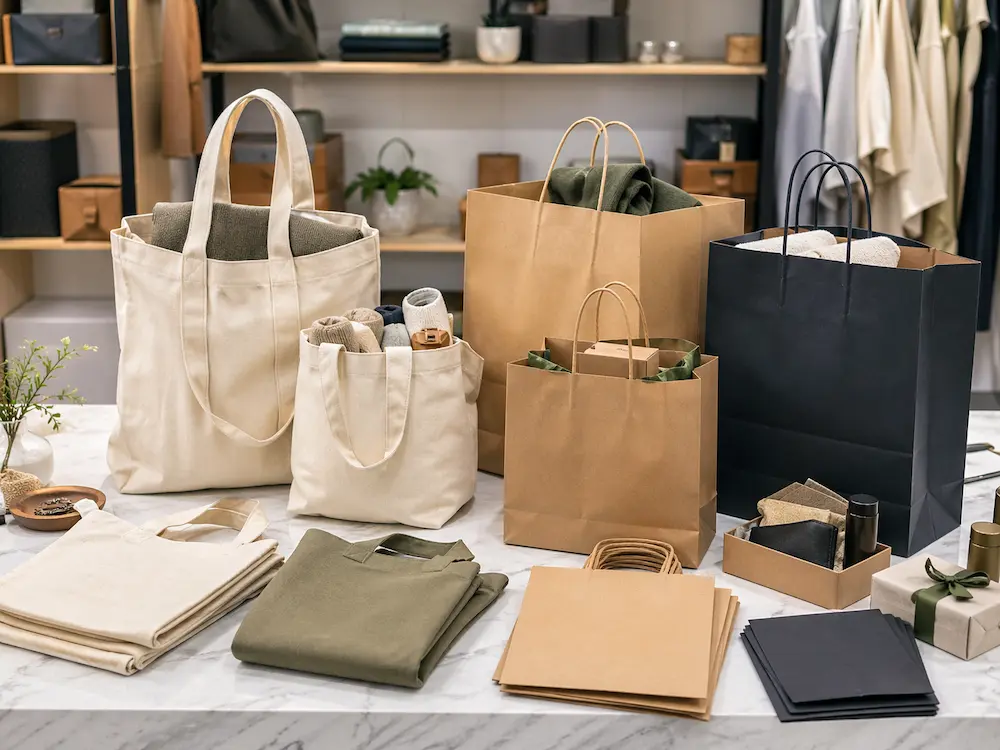
The question of tote bags vs paper bags is one of the most important retail packaging decisions today because the answer changes by store type, price point, customer expectation, and brand strategy. A paper bag and a tote bag may both carry a purchase home, but they do not play the same role afterward. One is usually part of the transaction. The other can become part of the customer’s daily routine.
That difference matters because retail is no longer only about checkout convenience. It is also about customer experience, sustainability positioning, and how the brand continues to exist once the buyer leaves the shop. A paper bag can look polished and appropriate at the point of sale. A tote bag can extend the relationship beyond the shop floor if the customer keeps using it. The stronger option depends on which of those outcomes matters more.
So the real comparison is not simply disposable versus reusable. It is retail moment versus longer-term brand life.
What Paper Bags Usually Do Better
Paper bags are usually strongest when the retail goal is short-term presentation and immediate convenience. They are familiar, easy to stack, easy to open, easy to pack at checkout, and usually more economical per unit in standard retail volume. This makes them especially suitable for boutiques, cafés, gift shops, takeaway retail, bookstores, cosmetics, and general merchandise where the customer mainly needs a clean and attractive way to carry products home.
Paper bags also make sense when the packaging should feel part of the buying ritual. A well-designed paper bag can create a polished customer experience right away. For many stores, especially those selling smaller or lighter products, that moment matters more than long-term reuse.
This is why paper bags remain common in fashion retail and food-related takeaway channels. They are efficient, visually tidy, and easy for staff to handle quickly.
What Tote Bags Usually Do Better
Tote bags are usually stronger when the brand wants the bag to remain useful after the original purchase. Instead of disappearing at home or being discarded quickly, a tote bag can continue moving through shops, cafés, offices, campuses, markets, and public transport. That extended life creates stronger public brand visibility and can justify a higher initial cost when the product is chosen well.
Tote bags also make more sense when the business wants to support reusable shopping habits, premium gifting, loyalty programs, bookstore merchandise, museum shops, retail resale, or broader sustainability-led product strategies. In those cases, the bag is no longer only packaging. It becomes part of the product experience.
That is one reason brands often move toward products such as custom printed tote bags when they want the bag to behave more like a long-term visible asset than a one-transaction carrier.
Retail Cost: Paper Usually Wins Upfront
If the comparison is immediate unit price, paper bags usually win. They are less expensive in many standard retail situations, especially when ordered in volume with straightforward sizes and handles. They also tend to fit neatly into checkout systems, which helps retailers control speed and labor efficiency.
This is one reason so many stores continue to rely on paper packaging. For businesses where the bag’s role ends once the customer gets home, paying significantly more for a tote can feel unnecessary. A paper bag solves the carry problem at the right moment, often with very good cost efficiency.
Still, lower unit price does not always mean better overall retail value. A paper bag may be economically correct for one store and strategically weak for another. The decision changes once the brand wants more than packaging.
Long-Term Value: Tote Bags Usually Pull Ahead
Tote bags are more expensive, but they often create better long-term value if the customer keeps using them. A tote bag can carry the brand well after the transaction ends. It can become part of someone’s shopping routine, commute, leisure activities, or daily carry pattern. That repeated exposure is difficult for paper bags to match.
This becomes especially important when the tote bag is good enough to feel like a product in its own right. A poorly chosen tote will not create strong long-term value. But a useful one often does.
For retailers building stronger reusable identity, products such as custom canvas tote bags often make more sense because they support both product durability and longer public brand presence.
| Retail Factor | Paper Bags | Tote Bags |
|---|---|---|
| Unit cost | Usually lower | Usually higher |
| Checkout convenience | Usually very strong | Depends on fold and presentation |
| Brand life after purchase | Usually short | Potentially long |
| Reuse potential | Limited | Usually much stronger |
| Best retail role | Transaction packaging | Reusable branded carry product |
Customer Perception: These Bags Send Different Signals
A paper bag usually signals clean retail service, simplicity, and immediate purchase presentation. It can feel elegant in fashion, gift, or café environments, especially when well printed and well proportioned. It does not usually suggest that the bag itself is something the customer is expected to keep using for long.
A tote bag sends a different signal. It often suggests that the store is offering something more reusable, more substantial, and more lifestyle-oriented. If the bag is attractive and practical, it can create stronger emotional and visual attachment to the brand. This is especially true in bookstores, museums, creative retail, organic stores, and brands with sustainability-led messaging.
The better signal depends on the retail story. A boutique gift purchase and a reusable lifestyle retail program do not need the same packaging language.
Brand Visibility: Tote Bags Usually Offer More
Brand visibility is one of the strongest reasons retailers choose tote bags. A paper bag is usually seen during the trip home and then disappears. A tote bag can continue showing the brand for weeks, months, or even longer if the customer actually likes using it. That makes the bag function more like moving media than simple packaging.
Large visible print panels and everyday usability give totes an advantage here. In public spaces, a tote bag tends to carry clearer brand signals for longer than a paper bag ever can. This is why retailers focused on reusable awareness often compare products such as custom printed canvas tote bags or personalised tote bags, especially when they want the brand to remain visible beyond the original sale.
Paper bags can still brand well, but the duration of exposure is usually much shorter.
Sustainability Positioning: Not Just a Material Question
This is where buyers often oversimplify. A paper bag may feel more obviously recyclable and less controversial in immediate perception, which can be useful in markets where disposable packaging is still expected to align with environmental messaging. But that does not automatically mean paper creates the strongest retail sustainability story over time.
A tote bag generally uses more material and costs more to produce, so its sustainability case depends heavily on actual reuse. If the customer uses the tote often, the long-term logic becomes much stronger. If the customer uses it once and forgets it, the reusable claim weakens quickly.
So the real sustainability comparison is not paper versus tote in the abstract. It is one-time use versus repeat use in the real retail environment. Businesses should be honest about what customers are likely to do, not what sounds ideal in marketing.
Load Type and Product Category Change the Answer
The right bag also depends on what the customer is buying. Small cosmetics, accessories, boutique apparel, takeaway items, and gifts often fit paper bags very well. Books, groceries, heavier merchandise, and multi-item lifestyle purchases often fit tote bags better, especially if the customer is expected to carry them regularly.
This matters because the bag should match not only the store’s brand, but also the physical demands of the purchase. A paper bag may feel appropriate until the product becomes heavier or more awkward. A tote may feel excessive if the customer only needs a small box and a brief walk.
Retailers should therefore define bag strategy by product category, not only by broad brand philosophy.
Where Tote Bags Make More Retail Sense
Tote bags usually make more sense in bookstores, museums, organic stores, lifestyle retail, sustainable product shops, corporate gifting, tourism merchandise, gift-with-purchase programs, and any retail setting where the bag is expected to become part of the customer’s routine. They also make more sense when the bag itself is sold or positioned as a branded product.
In some programs, tote bags even replace other reusable textile formats by being more visible and easier to integrate into daily shopping behavior. In others, the tote may sit alongside adjacent products such as cotton drawstring bags when the brand is building a wider reusable merchandise family.
In all of these cases, the tote is not only there to carry today’s purchase. It is there to keep the brand moving tomorrow.
Where Paper Bags Make More Retail Sense
Paper bags usually make more sense in boutiques, cafés, takeaway retail, gift shops, cosmetics, fashion retail, and general merchandise environments where the primary need is neat presentation, efficient checkout packing, and a clean customer handoff. They are often easier for staff to manage and easier for customers to accept as a normal part of the purchase.
They are also stronger when the bag is not expected to become a reusable item. If the business is not trying to build long-term carry behavior, paper often remains the more efficient answer.
Paper is often the right choice when the packaging moment is the main event and the carry demand is limited.
How Retailers Should Decide
The smartest way to choose is to ask four questions. Is the bag mainly for checkout efficiency or long-term reuse? Are the products light or heavy? Does the brand benefit more from immediate presentation or from ongoing public visibility? And are customers actually likely to reuse the bag enough to justify a tote program?
If the store values fast packing, lower cost, and a polished retail moment, paper often wins. If the store values repeated brand visibility, reusable identity, and longer carry life, totes often win. In some retail systems, both should exist for different categories and checkout paths.
The strongest answer is often not ideological. It is operational and realistic.
Conclusion
The answer to tote bags vs paper bags in retail is not one-size-fits-all. Paper bags usually win on cost, convenience, and clean transaction packaging. Tote bags usually win on reuse, brand visibility, and longer-term customer life. The better choice depends on whether the business wants packaging that ends at checkout or packaging that continues working afterward.
Retailers who define that clearly usually make better bag decisions. Retailers who do not often end up paying for the wrong type of value.
How Retailers Should Think About Tote Bags vs Paper Bags
What this comparison really measures: Tote bags and paper bags are not simply two packaging materials. They represent two different retail strategies. Paper bags are usually optimized for a clean transaction and immediate product handoff. Tote bags are usually optimized for reuse, longer customer life, and more visible brand presence after the sale.
Why many retailers choose the wrong one: The most common mistake is judging the bag only by upfront cost or by sustainability language. That misses the real question. A paper bag can be the smarter option if the retail moment is short and the products are light. A tote bag can be the smarter option if the brand wants to keep moving through public life after checkout. The right answer depends on what the bag must do after the customer walks out.
How buyers should compare the two properly: The strongest comparison method is to evaluate product weight, checkout speed, reuse likelihood, public brand value, and customer expectation together. A café, bookstore, boutique, museum shop, and grocery store may all need carry packaging, but they should not all use the same bag logic.
Options retailers usually weigh: Most businesses compare lower-cost transaction efficiency against higher-value reuse, immediate point-of-sale polish against long-term public visibility, and recyclable perception against practical repeat use. The better answer depends on whether the store is trying to optimize the purchase moment or the brand’s life after the purchase.
Considerations before rolling out a new bag program: Before placing a larger order, retailers should test what customers actually buy, how far they usually carry it, whether they are likely to reuse the packaging, and whether the bag contributes to the retail identity strongly enough to justify its cost. They should also decide whether one bag type can serve all departments, or whether different product categories need different carry solutions.
The broader takeaway: The best retail bag is the one that matches the store’s actual customer behavior. That is also where Youngpack naturally fits as a B2B manufacturing and export partner for retailers comparing tote bag and paper bag programs while needing practical guidance on reusable packaging, branding, and long-term commercial fit.
FAQ
1. Are tote bags better than paper bags for retail?
Not always. Tote bags are usually better when the retailer wants stronger reuse, longer brand visibility, and a bag that customers keep carrying after the purchase. Paper bags are usually better when the retailer wants lower unit cost, efficient checkout handling, and a clean short-term packaging solution. The better option depends on whether the retail goal is transaction efficiency or longer product life after the sale.
2. Why do many retailers still use paper bags?
Many retailers still use paper bags because they are practical, familiar, easy to pack quickly, and often more economical per unit. They work especially well for lighter purchases, fashion, gift retail, cafés, and stores where the bag’s role ends soon after checkout. Paper bags also help maintain a polished in-store presentation without requiring the higher cost or broader product strategy that tote bags usually involve.
3. When do tote bags make more sense than paper bags?
Tote bags make more sense when the retailer wants the bag to become part of the customer’s routine, create repeated brand visibility, or support a more reusable and lifestyle-oriented retail identity. They are especially strong in bookstores, museums, organic stores, premium gifting, sustainable retail, and branded merchandise programs. The more likely the customer is to reuse the bag, the stronger the tote bag case becomes.
4. Are paper bags more sustainable than tote bags?
Not automatically. Paper bags often have stronger immediate recyclable perception, but tote bags can create a better long-term sustainability case if customers actually reuse them often. The real answer depends on how long the tote stays in use and how the paper bag is handled after purchase. A reusable bag only creates stronger value when reuse is realistic. A one-time-use tote is not automatically a better sustainability outcome than a paper bag.
5. What should retailers check before choosing tote bags or paper bags?
Retailers should check product weight, checkout speed requirements, customer reuse behavior, brand visibility goals, cost tolerance, and whether the packaging is meant to be temporary or long-term. They should also think about whether one bag type can serve all departments or whether different retail categories need different bag solutions. The best decision usually comes from matching the bag to the actual store routine instead of relying on trend or assumption.
References
- Preferred Fiber and Materials Market Report — Textile Exchange — Textile Exchange.
- Textiles and the Environment — European Environment Agency — EEA.
- Green Guides for the Use of Environmental Marketing Claims — Federal Trade Commission — FTC.
- Sustainable Packaging Guidelines — Australian Packaging Covenant Organisation — APCO.
- Fashion on Climate — Global Fashion Agenda and McKinsey & Company.
- Responsible Sourcing and Product Communication in Textile Supply Chains — industry trade reference.
- Retail Packaging and Reusable Bag Sourcing Best Practices — professional sourcing reference.
- Guide to Reusable Bags and Long-Term Use Value — industry best-practice sourcing reference.
Original Content Notice:
This article was created by Xiamen Youngpack Imp.and Exp.Co.,Ltd. for informational purposes. Please do not copy, republish, or distribute it without prior written permission.