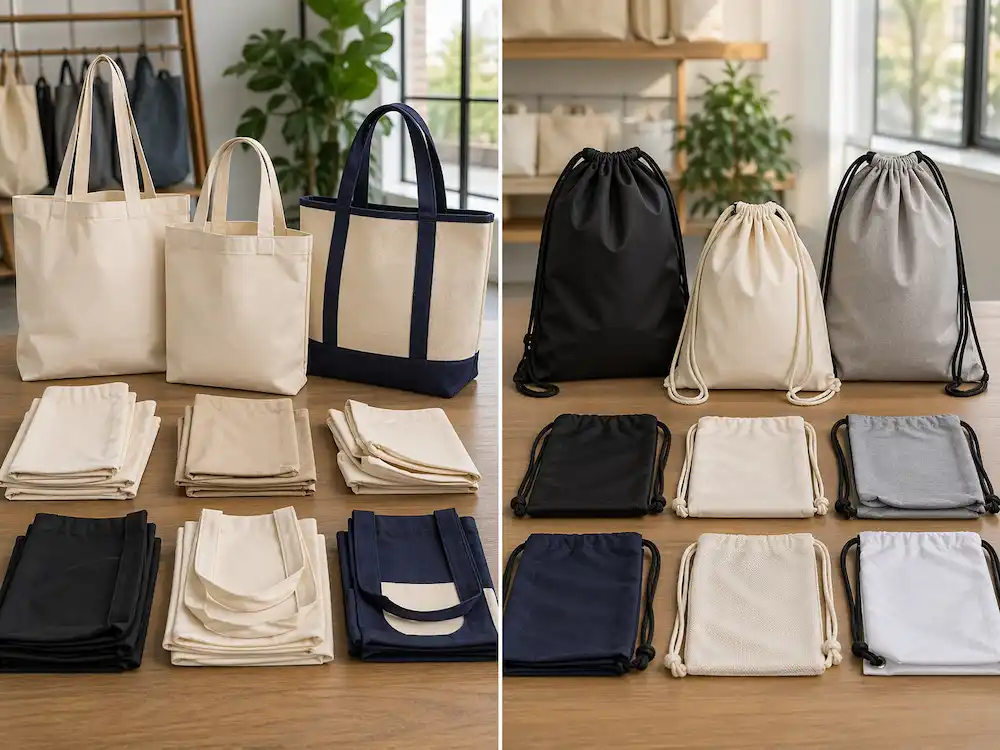
The comparison between tote bags vs drawstring bags is more important than it first appears because both categories often sit inside the same sourcing conversation. They are both reusable, both brandable, and both widely used in retail, promotions, schools, events, and merchandise programs. But they solve different problems once they are in the hands of real users.
A tote bag is usually chosen because it is open, accessible, visible, and easy to use for shopping, books, light groceries, and daily errands. A drawstring bag is usually chosen because it is lighter, more portable, easier to wear on the back, and often more economical for events, youth campaigns, sports, and broad promotional use. Neither category is automatically better. The better choice depends on how the bag will actually fit into the user’s routine.
This is why the decision should not be made by appearance alone. The bag category changes the product’s function, the branding behavior, and the long-term value the business gets from the item.
What Tote Bags Usually Do Better
Tote bags usually work better when the user needs simple access and flexible everyday carry. The open-top format makes it easy to load books, groceries, retail items, lunch, office basics, or general daily purchases. The bag can be carried by hand or over the shoulder, and it usually feels natural in shopping and city-lifestyle environments.
Totes also provide broad, open branding panels. That makes them especially strong for retail visibility, bookstore bags, museum merchandise, supermarket reuse programs, and lifestyle promotions where the logo or artwork should remain clearly visible in public.
For daily-use retail and visible brand carry, products like custom cotton tote bags often make more sense because the tote format fits naturally into everyday shopping and casual carry behavior.
What Drawstring Bags Usually Do Better
Drawstring bags usually work better when hands-free carry, portability, and lightweight use matter more than open-top access. They are easy to sling over the shoulders, easy to store, and often more compact in both use and bulk packing. This makes them especially useful in sports, school programs, gym kits, youth events, festivals, conferences, travel promotions, and general giveaway campaigns.
Drawstring bags also often perform better when the recipient is moving around a lot. Walking through an event, carrying light items on campus, moving between activities, or using the bag as a casual extra-carry product often feels easier with a drawstring format than with a tote.
This is why a product such as drawstring backpacks often becomes the stronger choice when the user needs portability and shoulder carry more than shopping-style access.
Access vs Portability: The Core Difference
The clearest functional difference is this: tote bags prioritize access, while drawstring bags prioritize portability. A tote is easier to open, easier to reach into, and easier to use when contents are being added and removed repeatedly. A drawstring bag is easier to carry on the back and easier to keep out of the hands when the user is moving.
This is why tote bags often feel stronger in shopping and casual retail use, while drawstring bags often feel stronger in movement-based or event-based use. Neither advantage is small. It shapes the whole user experience.
If the recipient will reach into the bag often and carry mixed items casually, totes usually win. If the recipient will move around a lot and wants both hands free, drawstring bags usually win.
| Comparison Area | Tote Bags | Drawstring Bags |
|---|---|---|
| Main strength | Open access and everyday carry | Hands-free portability and lightweight movement |
| Best use pattern | Shopping, books, casual daily use | Events, sports, schools, light mobile use |
| Brand visibility | Usually stronger and more open | Usually smaller or more segmented |
| Ease of storage | Moderate | Usually better |
| Hands-free use | More limited | Usually stronger |
Brand Visibility: Tote Bags Usually Win
From a branding perspective, tote bags usually provide a clearer and more readable surface. Their broad front and back panels make them ideal for logos, printed artwork, campaign slogans, and visual identity. This is one of the biggest reasons totes remain so common in retail and visibility-driven promotions.
Drawstring bags can still be branded well, but the bag shape, gathered opening, and cord structure often reduce the clean visual space. The branding can still work, especially for simple logos and bold event graphics, but the product does not usually behave like as large and flat a brand canvas as a tote.
That is why many businesses focused on public repeat visibility gravitate toward custom printed cotton tote bags or similar tote-based products when the logo needs to stay prominent during everyday use.
Comfort and Carry Style
Comfort depends on how the bag is used. Tote bags are usually comfortable for lighter shopping, books, and short-to-medium carry periods, especially when the load is not too heavy. But because they are usually carried by hand or on one shoulder, comfort declines when the weight rises or when the bag stays on the body for a long time.
Drawstring bags often feel better for light hands-free movement because the weight shifts to the back. But they are not automatically more comfortable in every case. Thin cords can become uncomfortable under heavier loads, and the format is best for light-to-moderate contents rather than dense everyday weight.
So the better comfort answer depends on the load pattern. For relaxed light shopping and easy access, tote bags are often more comfortable. For mobile hands-free light carry, drawstring bags often feel better.
Material and Product Feel
Tote bags often use cotton, canvas, or other textile materials that feel more product-like and more suitable for everyday public use. This gives them an advantage in retail, gifting, bookstores, cafés, and general lifestyle environments. The bag often feels more like a normal reusable product rather than a campaign giveaway.
Drawstring bags can also use cotton, canvas, or other reusable materials, but they are more often judged by convenience and portability than by polished retail feel. That is why products like custom canvas drawstring bags can be interesting: they combine the softer, more natural branding of textile materials with the portability of a drawstring format.
That said, even a canvas drawstring bag usually communicates a more casual and active-use message than a canvas tote does.
Cost and Bulk Distribution
Drawstring bags often make strong economic sense in bulk promotional programs because they are usually efficient to pack, easy to distribute, and practical for schools, events, sports campaigns, and youth-oriented merchandise. Their hands-free function also adds perceived usefulness without requiring as much material as some heavier tote constructions.
Tote bags can still be very efficient at scale, especially in simpler cotton formats, but they often make most sense when the business values broader visible branding and more everyday-use flexibility. In large distributions where visibility matters strongly, buyers often compare tote programs against options like custom canvas bags bulk because the bag can double as long-term advertising as well as utility.
The real cost question is not which one is cheaper. It is which one creates the better value once the bag reaches the user and starts being used.
| Commercial Factor | Tote Bags | Drawstring Bags |
|---|---|---|
| Typical unit logic | Stronger for visible reuse and retail feel | Stronger for portable promotional reach |
| Bulk packing efficiency | Moderate | Usually strong |
| Best marketing use | Brand visibility in daily public use | Events, youth campaigns, sports and movement-led use |
Best Use Cases for Tote Bags
Tote bags usually make more sense in bookstores, supermarkets, museum shops, cafés, gift-with-purchase programs, lifestyle retail, organic shops, premium promotions, and daily reusable bag programs. They also make more sense when the brand wants the recipient to use the bag repeatedly in shopping and casual day-to-day routines.
Totes are strongest when the bag should feel easy, familiar, visible, and integrated into normal daily life. If the product is meant to act like retail merchandise or a reusable everyday carry item, tote bags usually have the advantage.
Best Use Cases for Drawstring Bags
Drawstring bags usually make more sense in school campaigns, sports events, festivals, youth programs, gym promotions, travel kits, event giveaways, and lightweight corporate or nonprofit distributions where portability matters more than shopping-style use. They are also effective when the bag needs to be compact, easy to hand out, and useful in active movement settings.
In these cases, the drawstring format often creates better user fit than a tote because the bag is not fighting the context. It is matching it.
When the Branding Goal Changes the Answer
If the business wants maximum public logo visibility, tote bags usually win. If the business wants lightweight hands-free usefulness that encourages recipients to keep the bag around for practical situations, drawstring bags can become more effective. This is especially true in education, sports, and youth markets where the drawstring style feels more natural than a tote.
So the right category often depends less on material and more on who the user is and what their routine looks like. A bookstore customer and a school event attendee are not solving the same carry problem, even if both are being handed a branded bag.
How Buyers Should Choose
The smartest way to choose is to ask four questions. Will the user carry the bag by hand or on the back? Will they need quick open access or portable hands-free function? Does the campaign depend more on visible branding or on lightweight convenience? And will the bag be used in retail life, event life, or active movement?
If the answers point toward everyday shopping, open access, and visible branding, tote bags usually make more sense. If the answers point toward movement, portability, and practical promotional use, drawstring bags usually make more sense.
Once the buyer defines the user routine clearly, the bag choice is usually much easier than it first seemed.
How to Choose the Right Supplier
The right supplier should not just offer both product types with generic pricing. They should explain which format fits the intended use, how the branding will behave on each, how the bag will pack and ship, and what the likely user experience will be. That advice is often more valuable than a low quote alone.
Buyers should ask about material, print method, handle or cord comfort, pack-out efficiency, and whether the bag is likely to remain in use after the first distribution moment. A strong supplier should be able to explain why one category works better than the other for the actual project.
This is where Youngpack-style product logic matters. The stronger manufacturing partner usually adds value by preventing the wrong bag choice before production begins.
Conclusion
The answer to tote bags vs drawstring bags depends on what the bag is really supposed to do. Tote bags usually win when the goal is open access, everyday shopping, and strong public brand visibility. Drawstring bags usually win when the goal is hands-free portability, movement, and practical promotional convenience.
The better option is the one that matches the user’s real behavior after the bag is distributed. Buyers who define that behavior clearly usually make the right choice much faster.
How Buyers Should Think About Tote Bags vs Drawstring Bags
What this comparison really measures: Tote bags and drawstring bags are not just two bag categories. They represent two different carrying behaviors. Tote bags usually prioritize open access, shopping-style utility, and large visible branding panels. Drawstring bags usually prioritize portability, hands-free movement, and lightweight promotional practicality.
Why buyers often choose the wrong one: The most common mistake is choosing based on appearance or habit instead of actual user routine. A tote bag may look like the safer option, but it can be the wrong answer for a sports event or youth campaign where movement matters more than open access. A drawstring bag may feel promotional and useful, but it can be the wrong answer when the business wants long-term shopping behavior and larger visible logo space. The bag needs to fit the real-life use pattern.
How buyers should compare the two properly: The strongest comparison method is to evaluate how the bag will be carried, what it needs to hold, how often the recipient will use it, and whether the brand values portability or visibility more. A bookstore customer, a conference attendee, a school student, and a supermarket shopper may all receive branded bags, but they should not all receive the same category of bag.
Options businesses usually weigh: Most buyers compare open access against hands-free carry, retail everyday use against active movement use, and stronger logo presentation against more portable utility. The better choice usually becomes obvious once the business defines whether the bag is meant to live in shopping life or in movement-heavy promotional life.
Considerations before bulk approval: Before placing the order, businesses should test the real carry style, check handle or cord comfort, compare how the branding looks on the actual bag shape, and decide whether the user is more likely to carry the bag on the shoulder, by hand, or on the back. Those practical tests usually matter more than the category name itself.
The broader takeaway: The strongest promotional or retail bag program is the one that matches actual user behavior. That is also where Youngpack naturally fits as a B2B manufacturing and export partner for brands comparing tote and drawstring bag programs while needing practical guidance on customization, portability, and long-term brand value.
FAQ
1. Are tote bags better than drawstring bags?
Not always. Tote bags are usually better for shopping, books, casual daily use, and visible public branding because they are easy to open and provide larger print areas. Drawstring bags are usually better for events, sports, schools, and lightweight hands-free carry because they are easier to wear on the back. The better option depends on whether the user needs open access or portable movement.
2. When should a business choose drawstring bags instead of tote bags?
A business should usually choose drawstring bags when the recipients will be moving around a lot and need a lightweight, easy-to-carry bag they can wear on the back. This is common in sports events, school campaigns, festivals, youth promotions, travel kits, and active-use merchandise. Drawstring bags often work better than totes when convenience and portability matter more than shopping-style access and large visible branding panels.
3. Why are tote bags stronger for branding than drawstring bags?
Tote bags usually have larger, flatter, and more readable print areas, which makes logos and artwork more visible in public. The front and back panels are easier to brand cleanly, and the bag itself is often carried in ways that make the design easier to see. Drawstring bags can still be branded well, but the gathered shape and cord structure often reduce how clean and prominent the branding looks compared with tote bags.
4. Can drawstring bags work for eco-friendly branding?
Yes. Drawstring bags can work very well for eco-friendly branding when they use materials such as cotton or canvas and are designed for repeated lightweight use. They are especially useful when a brand wants a more portable alternative to a tote bag while still maintaining a reusable textile product image. The bag’s sustainability value depends on both material choice and whether recipients actually keep using it.
5. What should buyers check before choosing tote bags or drawstring bags in bulk?
Buyers should check how the recipient will carry the bag, what the bag needs to hold, whether public logo visibility matters more than portability, and whether the campaign is retail-focused or event-focused. They should also test real samples for handle or cord comfort, bag opening behavior, print effect, and storage efficiency. The right choice usually becomes clear once the bag’s real use pattern is defined honestly.
References
- Preferred Fiber and Materials Market Report — Textile Exchange — Textile Exchange.
- Textiles and the Environment — European Environment Agency — EEA.
- Green Guides for the Use of Environmental Marketing Claims — Federal Trade Commission — FTC.
- Sustainable Packaging Guidelines — Australian Packaging Covenant Organisation — APCO.
- Fashion on Climate — Global Fashion Agenda and McKinsey & Company.
- Responsible Sourcing and Product Communication in Textile Supply Chains — industry trade reference.
- Retail Packaging and Reusable Bag Sourcing Best Practices — professional sourcing reference.
- Guide to Reusable Bags and Long-Term Use Value — industry best-practice sourcing reference.
Source Credit Requirement:
If you would like to quote part of this article, please clearly credit Xiamen Youngpack Imp.and Exp.Co.,Ltd. as the original source. Full-text reproduction is not permitted.