Quick Summary:
Tote bags for supermarkets and retail chains should be designed around actual shopping loads, customer behaviour, store operations, and large-scale distribution. Cotton can support lightweight and high-volume programmes, while structured canvas and gusseted construction can provide greater capacity for groceries, books, and premium merchandise. Retail buyers should evaluate fabric weight, dimensions, gussets, handles, reinforcement, printing, landed cost, carton efficiency, warehouse allocation, store distribution, quality control, and repeat-order consistency before approving bulk production.
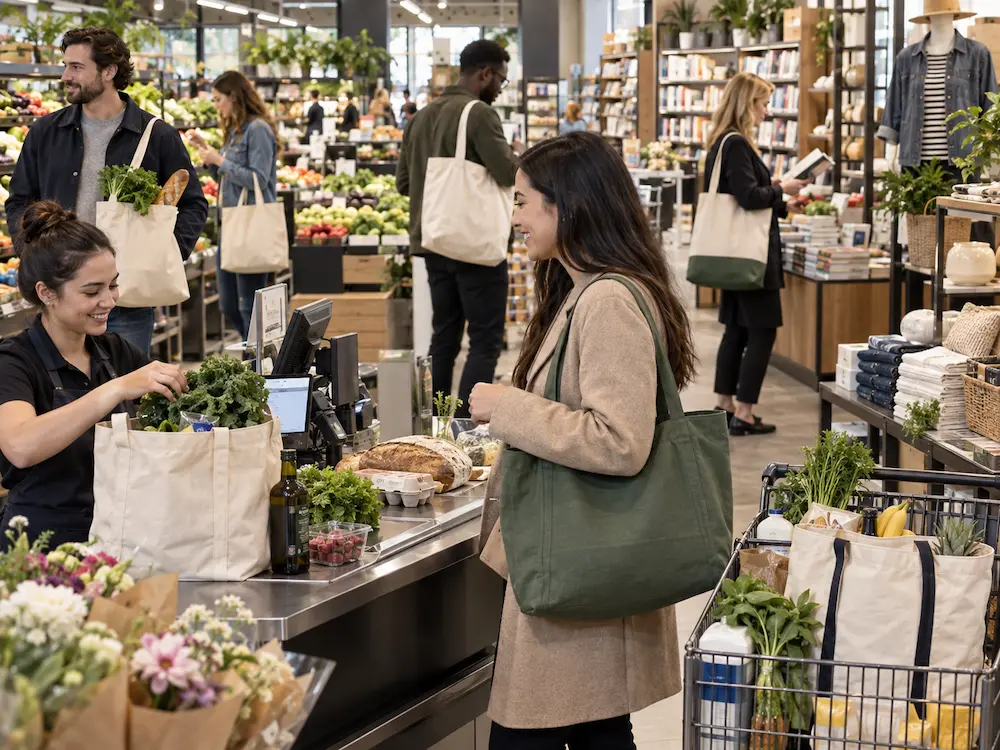
Why Tote Bags Matter for Supermarkets and Retail Chains
Tote bags have become a versatile part of modern retail operations.
Supermarkets can use them as reusable grocery bags. Fashion stores can sell them as branded merchandise. Bookstores can offer stronger canvas bags for books. Lifestyle retailers can integrate them into seasonal collections, membership programmes, loyalty campaigns, or reusable packaging systems.
For large retail chains, however, a tote bag is not simply a promotional product.
It can become part of the everyday customer experience.
A shopper may first encounter the bag at a checkout counter, purchase or receive it, fill it with products, carry it home, and then return with it during future shopping trips.
That means the bag needs to work beyond the moment of distribution.
It should be practical enough for repeated use while maintaining an appearance consistent with the retailer’s brand.
| Retail Environment | Typical Contents | Recommended Direction | Main Priority |
|---|---|---|---|
| Supermarket | Food, bottles, packaged goods | Gusseted strong tote | Capacity |
| Organic Grocery | Produce, jars, bread | Cotton/canvas | Reuse |
| Fashion Chain | Clothing, accessories | Medium cotton/canvas | Branding |
| Bookstore | Books, magazines | Strong canvas | Load support |
| Lifestyle Store | Mixed merchandise | Structured tote | Presentation |
| Department Store | Apparel, gifts, cosmetics | Medium-large tote | Versatility |
| Promotional Campaign | Lightweight merchandise | Cotton tote | Cost efficiency |
The correct specification depends on the store format, product mix, distribution method, and intended customer behaviour.
How Retail Tote Bags Differ from Promotional Giveaways
A promotional tote may only need to carry brochures or small gifts during a short event.
Retail bags often face more demanding conditions.
A supermarket customer may place inside:
- Bottled drinks
- Canned food
- Fruit
- Vegetables
- Packaged groceries
- Household products
A bookstore tote may carry several heavy books.
A fashion retailer may require a bag large enough for folded garments without being unnecessarily bulky.
This changes the specification.
Retail buyers should consider:
- Fabric weight
- Seam construction
- Handle reinforcement
- Gusset depth
- Finished dimensions
- Print durability
- Carrying comfort
A visually attractive bag that fails under normal shopping loads can damage the customer experience.
Where Tote Bags Fit in the Retail Customer Journey
Retail tote bags can interact with customers at several stages.
At the Checkout
The bag can function as reusable retail packaging.
As Merchandise
A retailer may sell the tote as a standalone product.
Through Loyalty Programmes
Members may receive reusable bags as part of a programme or promotional campaign.
During Store Openings
New locations can distribute limited-edition designs.
After the Purchase
The customer may continue carrying the bag in everyday life.
This final stage can be particularly valuable because the tote leaves the store environment.
The brand becomes visible in other public contexts when customers choose to reuse the product.
Supermarkets and Grocery Stores
Supermarket tote bags need to prioritise practical capacity.
Groceries are three-dimensional and often heavier than event materials.
The bag may need to hold:
- Bottles
- Cartons
- Produce
- Packaged food
- Cans
- Household products
A completely flat tote can work for light purchases but may become inefficient for a larger grocery basket.
Gusseted construction is therefore particularly useful.
Bottom and side gussets create a more practical loading space and can help the bag stand more naturally when packed.
Grocery Bag Capacity
Retail buyers should test capacity using real products.
Instead of specifying only:
“Large shopping bag”
a buyer can create a representative test load.
For example:
- 2 bottles
- 2 food cartons
- Several packaged items
- Produce
- One household product
The sample can then be evaluated for:
- Capacity
- Handle comfort
- Fabric deformation
- Seam performance
- Packing efficiency
This provides more useful information than dimensions alone.
Cotton Tote Bags for Large Retail Programmes
Cotton can provide a familiar textile appearance while remaining relatively easy to fold and store.
For large programmes, <a href=”/cotton-tote-bags-bulk-for-large-scale-brand-distribution/”>cotton tote bags bulk for large-scale brand distribution</a> can be appropriate when retailers need consistent products across many stores, campaigns, or geographic regions.
Potential applications include:
- Supermarket reusable bags
- Store-opening campaigns
- Loyalty programmes
- Fashion retail packaging
- Bookstore bags
- Customer merchandise
Fabric weight should be selected according to the intended load rather than simply choosing the lowest-cost specification.
Fashion and Lifestyle Retail Chains
Fashion and lifestyle retailers have different priorities from supermarkets.
The products carried may be lighter, but presentation becomes more important.
A tote can become an extension of the store’s visual identity.
Design elements may include:
- Minimal logos
- Seasonal artwork
- Typography
- Brand patterns
- Artist collaborations
- Limited-edition graphics
The bag may also be sold as merchandise.
In this situation, perceived quality can influence customer willingness to purchase and reuse the product.
Bookstores and Specialty Retail
Bookstores create demanding load conditions.
Books are compact but heavy.
A bag that appears strong may still fail if handle attachment or seam construction is inadequate.
Bookstore tote specifications may therefore include:
- Medium or heavy canvas
- Reinforced handles
- Strong seams
- Appropriate width
- Bottom gusset
- Comfortable shoulder straps
Specialty retailers selling bottles, ceramics, homeware, or packaged foods should perform similar product-specific testing.
Choosing Materials for Retail Tote Bags
Material selection affects cost, appearance, structure, printing, storage, and durability.
| Material | Structure | Relative Weight | Typical Retail Use |
|---|---|---|---|
| Lightweight Cotton | Soft | Low | Promotions |
| Medium Cotton | Moderate | Medium | General retail |
| 8 oz Canvas | Structured | Medium | Shopping/merchandise |
| 10 oz Canvas | Strong | Higher | Premium retail |
| 12 oz Canvas | Heavy | High | Heavy-duty merchandise |
| Lightweight Cloth | Flexible | Low | Fashion/promotional use |
There is no single best material for every retail chain.
Lightweight Cotton
Lightweight cotton can work for:
- Promotional distribution
- Light apparel
- Seasonal campaigns
- Membership programmes
Its advantages include lower weight and compact carton packing.
However, it may not be suitable for heavy grocery loads.
Retailers should avoid using a lightweight specification for applications that demand greater strength simply to reduce unit cost.
Medium-Weight Cotton
Medium-weight cotton can provide a useful balance between:
- Cost
- Durability
- Printability
- Storage
- Reusability
It can work for general shopping, apparel, books in moderate quantities, and everyday retail applications.
Canvas
Canvas is useful where structure and durability matter.
Common options may include:
- 8 oz
- 10 oz
- 12 oz
Heavier canvas generally creates a more substantial product but also increases material cost and shipping weight.
For premium retail programmes, canvas tote bag printing for sustainable brand visibility can combine a durable textile structure with a large printable surface.
Retailers should nevertheless avoid assuming that heavier automatically means better.
The specification should match the intended use.
Cloth Tote Bags for Everyday Retail
Not every retailer needs heavy canvas.
Fashion, beauty, lifestyle, and promotional programmes may benefit from lighter textile bags.
For these applications, cloth tote bags for everyday carry and brand display can provide a flexible alternative where everyday convenience and visual presentation are more important than heavy grocery capacity.
The material should still be tested against expected products.
Cotton vs Canvas for Retail Applications
| Factor | Cotton | Canvas |
|---|---|---|
| Weight | Usually lighter | Usually heavier |
| Structure | Softer | More structured |
| Folding | Easy | Moderate |
| Printing | Excellent | Excellent |
| Grocery Loads | Depends on weight | Often stronger |
| Merchandise Value | Moderate | Often higher |
| Freight Weight | Lower | Higher |
| Premium Appearance | Good | Strong |
The decision should reflect the actual retail environment.
A supermarket may prioritise load capacity.
A fashion chain may prioritise appearance.
A bookstore may prioritise handle reinforcement.
Choosing Fabric Weight
Fabric weight influences:
- Durability
- Structure
- Material cost
- Freight
- Customer perception
A heavier bag may feel more premium, but over-specification can create unnecessary cost.
Retailers should define a target load and then choose the fabric and construction required to support it.
Load Capacity and Construction
Load performance depends on more than GSM or ounces.
A strong fabric can still fail if the handle attachment is weak.
Important variables include:
- Stitch density
- Seam construction
- Handle material
- Reinforcement
- Bag dimensions
- Load distribution
For supermarket bags, load testing should simulate real shopping rather than only applying a theoretical weight.
Selecting the Right Bag Size
Retail bag dimensions should correspond to the product mix.
| Retail Use | Typical Direction | Important Feature |
|---|---|---|
| Light Fashion | Medium flat tote | Presentation |
| Grocery | Medium-large gusseted | Capacity |
| Books | Medium reinforced tote | Strength |
| Lifestyle | Medium gusseted | Versatility |
| Promotional | Standard flat tote | Cost efficiency |
| Premium Merchandise | Structured tote | Perceived value |
A common medium tote around 38 × 42 cm may provide a useful starting point.
However, supermarkets often benefit from greater depth.
Why Gussets Matter for Grocery Shopping
Gussets transform the usable internal volume.
A flat bag primarily provides width and height.
A gusset introduces depth.
This matters for:
- Bottles
- Milk cartons
- Cereal boxes
- Produce
- Packaged foods
- Household products
A 10–15 cm gusset can provide significantly more usable volume than a flat construction, depending on the overall bag design.
Retailers should test the finished dimensions with actual products before production.
Handle Length and Comfort
Long handles allow shoulder carrying.
This can be valuable when customers:
- Walk home
- Use public transport
- Carry several bags
- Shop for heavier products
Handle drop around 26–30 cm can be a practical reference for many shoulder-carry applications, but the ideal measurement depends on bag dimensions and customer requirements.
Wider handles may improve comfort for heavier loads.
Handle Reinforcement
Common reinforcement approaches include:
- Cross stitching
- Box-X stitching
- Multiple stitch lines
- Webbing handles
Heavy grocery or book applications should receive more attention to handle attachment than lightweight promotional programmes.
Printing and Retail Branding
A reusable retail bag provides a relatively large print surface.
Possible branding approaches include:
- Large central logo
- Small premium logo
- All-over artwork
- Seasonal illustration
- Store-specific graphics
- Campaign designs
- Typography
For retail chains wanting stronger logo recognition, promotional canvas tote bags with logo for brand visibility can support consistent presentation across stores and customer touchpoints.
Print design should consider how the bag looks both inside and outside the store.
Designing Bags Customers Will Reuse
Retailers should ask:
Would a customer voluntarily carry this bag again?
This is particularly important when the tote is intended to provide continued brand visibility.
Factors affecting reuse include:
- Appearance
- Size
- Comfort
- Durability
- Washability
- Storage convenience
- Brand design
Excessive promotional messaging can reduce lifestyle appeal.
A cleaner design may provide more long-term use even when the logo is smaller.
Tote Bags as Retail Merchandise
Retailers do not have to treat reusable bags only as packaging.
They can become products.
Examples include:
- Limited editions
- Seasonal collections
- Artist collaborations
- City-specific bags
- Anniversary designs
- Store-opening editions
A well-designed tote can generate direct revenue while also functioning as reusable brand merchandise.
Promotional Retail Campaigns
Promotional tote bags can support:
- New store openings
- Loyalty campaigns
- Product launches
- Seasonal promotions
- Member events
For campaigns focused on continued public visibility, promotional canvas tote bags for brand visibility and marketing can provide a durable format that moves beyond the original retail promotion.
Again, the actual exposure depends on customer reuse rather than distribution quantity alone.
Checkout and Point-of-Sale Distribution
The checkout area creates unique operational requirements.
Staff need to:
- Access bags quickly
- Open them easily
- Pack products efficiently
- Maintain checkout speed
A bag that looks attractive but is difficult to separate, unfold, or load may create operational friction.
Retailers should therefore include checkout staff in sample evaluation where possible.
Bulk Ordering for Retail Chains
Large retail programmes can involve:
- Thousands of bags
- Multiple warehouses
- Hundreds of stores
- Different regions
- Seasonal campaigns
- Repeated orders
Procurement must therefore consider consistency and logistics alongside unit price.
The lowest quotation does not necessarily represent the lowest total programme cost.
MOQ and Volume Pricing
Many custom cotton and canvas programmes can begin around an MOQ of 500 pieces, although actual minimum quantities depend on:
- Material
- Fabric colour
- Dimensions
- Printing
- Accessories
- Packaging
Large retail chains usually order considerably more.
As volume increases, fixed setup costs can be distributed across more units.
However, savings should be evaluated against storage and inventory risk.
Understanding Retail Tote Bag Costs
| Cost Driver | Cost Impact | Why |
|---|---|---|
| Fabric Weight | High | More material |
| Bag Size | High | More fabric |
| Gussets | Medium | Added construction |
| Reinforcement | Medium | Additional labour |
| Print Colours | Medium | Printing complexity |
| Large Print Coverage | Medium–High | Ink/process requirements |
| Pockets | Medium | Extra material/labour |
| Zippers | High | Hardware + sewing |
| Packaging | Variable | Retail requirements |
| Order Quantity | High | Scale efficiency |
| Freight | High | Weight/volume |
Procurement teams should compare landed cost, not factory unit price alone.
Standardising Bags Across Multiple Stores
Standardisation is particularly valuable for retail chains.
A master specification can document:
- Material composition
- Fabric weight
- Bag dimensions
- Gusset dimensions
- Handle length
- Handle width
- Stitching
- Logo dimensions
- Print position
- Pantone colours
- Packaging
- Carton quantity
This creates a repeatable production reference.
Without detailed documentation, small changes can appear between batches.
Sampling and Load Testing
A pre-production sample should be evaluated using real retail products.
Supermarket testing might include:
- Bottles
- Cans
- Cartons
- Produce
- Packaged goods
Bookstore testing should use actual books.
Fashion retailers should test the size with representative garments.
Buyers can evaluate:
- Capacity
- Handle comfort
- Shape
- Seam performance
- Print appearance
This makes approval more meaningful than visual inspection alone.
Artwork and Colour Approval
Large retail chains usually have strict visual identity requirements.
Artwork approval should document:
- Vector logo
- Print dimensions
- Position
- Pantone reference
- Print method
- Fabric colour
- Single- or double-sided printing
Colour can appear differently on natural cotton, dyed cotton, and canvas.
Physical sampling may therefore be important when brand colour accuracy is critical.
Quality Inspection
Retail chain orders should use defined inspection criteria.
| Inspection Point | What to Check |
|---|---|
| Material | Correct composition |
| Fabric Weight | Approved specification |
| Dimensions | Within tolerance |
| Gussets | Correct depth |
| Handles | Length and reinforcement |
| Stitching | Secure and consistent |
| Correct artwork | |
| Colour | Approved range |
| Cleanliness | No major marks |
| Packing | Correct quantities |
| Cartons | Correct labels/count |
Defects that appear minor at factory level can become significant when multiplied across thousands of units.
Carton Packing and Freight Efficiency
Large retail orders make carton efficiency important.
Consider two bags with similar function.
If one design requires substantially more carton volume because of unnecessary size, rigid construction, or inefficient folding, freight and warehouse requirements may increase.
Retail buyers should therefore request:
- Pieces per carton
- Carton dimensions
- Gross weight
- Net weight
- Carton volume
This information allows logistics teams to estimate transportation and storage requirements before production is completed.
Warehouse and Store Distribution
A national or regional retail chain may not want every bag delivered to one final destination.
Possible models include:
Factory → Central Distribution Centre → Stores
or
Factory → Regional Warehouses → Stores
Distribution planning can influence carton quantities.
For example, cartons containing 100 bags may be convenient for one retail network but inconvenient if individual stores require allocations of 60.
Procurement and logistics teams should therefore coordinate carton packing with store distribution requirements.
Inventory and Reorder Planning
Reusable retail bags can become recurring inventory items.
Retailers should monitor:
- Monthly consumption
- Store-level usage
- Seasonal peaks
- Remaining inventory
- Production lead time
- Freight lead time
A simple reorder model is:
Average Consumption × Replenishment Lead Time + Safety Stock
Large retailers can improve forecasting by analysing consumption by store rather than using only total network demand.
Multi-Store Consistency
Customers expect the same brand experience across locations.
If one store receives a different fabric colour, logo size, or handle length from another, the programme can appear inconsistent.
Retail chains should retain:
- Approved samples
- Artwork files
- Pantone references
- Technical specifications
- Packaging instructions
- Inspection standards
These documents can support repeat orders.
Sustainability and Reusable Retail Bags
Retailers increasingly discuss sustainability when introducing reusable shopping bags.
Claims should be made carefully.
A reusable bag still requires:
- Raw materials
- Manufacturing
- Printing
- Packaging
- Transportation
The strongest practical strategy is often to design a useful product that customers actually reuse.
Retailers should avoid vague claims such as:
- Zero impact
- Completely green
- 100% sustainable
unless they can be properly substantiated.
Specific information about material composition or certified attributes is generally more useful than broad environmental language.
Material Efficiency in Retail Bag Design
Retail chains can also consider whether every specification is necessary.
Examples include:
- Does the bag need 12 oz canvas?
- Does it need a zipper?
- Does it need individual packaging?
- Does it need oversized dimensions?
- Does it require full-coverage printing?
Removing unnecessary features can reduce cost, material use, production complexity, and freight requirements.
This is especially significant when an order contains tens of thousands of units.
Common Procurement Mistakes
| Mistake | Potential Result |
|---|---|
| Selecting only by unit price | Weak performance |
| Using flat bags for bulky groceries | Poor capacity |
| Choosing narrow handles for heavy loads | Customer discomfort |
| Ignoring reinforcement | Handle failure |
| Ordering oversized bags | Higher material/freight |
| Skipping physical samples | Specification problems |
| Not testing actual products | Wrong capacity |
| Ignoring carton dimensions | Higher logistics cost |
| Inconsistent artwork files | Branding variation |
| No reorder specification | Batch inconsistency |
| Excessive inventory | Storage/cash-flow pressure |
| Unsupported environmental claims | Credibility risk |
How Retail Buyers Can Build a Better RFQ
A professional RFQ should provide more than a photograph.
Include:
- Material
- Fabric weight
- Finished size
- Gusset
- Handle dimensions
- Print method
- Number of print colours
- Print size
- Accessories
- Packaging
- Quantity
- Delivery destination
For example:
Material: Natural cotton canvas
Fabric: 10 oz
Size: 40 × 42 × 12 cm
Handles: 3 × 65 cm
Printing: One-colour screen print, two sides
Construction: Reinforced handles
Quantity: 10,000 pcs
Packing: Bulk carton packing
This produces a much more meaningful quotation than:
“Please quote 10,000 cotton shopping bags.”
Building a Retail Tote Bag Specification
A complete specification can be divided into five areas.
Material Specification
Define:
- Fibre
- Fabric construction
- Weight
- Colour
Structural Specification
Define:
- Width
- Height
- Gusset
- Handles
- Reinforcement
- Pockets
- Closure
Branding Specification
Define:
- Artwork
- Print dimensions
- Position
- Colour
- Method
Packing Specification
Define:
- Folding
- Individual packaging if required
- Pieces per carton
- Carton marks
Quality Specification
Define:
- Measurement tolerances
- Print requirements
- Stitching expectations
- Inspection method
This makes supplier comparison more accurate.
Future Trends in Supermarket and Retail Tote Bags
Retail tote programmes continue to evolve beyond basic logo printing.
Merchandise-Quality Shopping Bags
Retailers can increasingly design bags that customers intentionally purchase rather than reluctantly add at checkout.
Limited-Edition Designs
Seasonal graphics and collaborations can create collectable retail products.
Greater Material Transparency
Retailers may provide more specific fibre and material information instead of relying on generic environmental terminology.
Standardised Multi-Store Programmes
Large chains can increasingly use centralised specifications while adapting artwork for individual markets.
More Efficient Construction
Material weight, carton volume, and freight efficiency can become part of product design rather than being considered only after manufacturing.
Data-Led Reordering
Store consumption data can improve purchasing schedules and reduce unnecessary inventory.
Conclusion
Tote bags for supermarkets and retail chains need to perform differently from short-term promotional giveaways.
They are part of a working retail environment.
A supermarket bag may carry bottles, canned products, packaged food, and fresh produce. A bookstore tote may need to support several kilograms of books. A fashion retailer may prioritise visual identity and presentation. A lifestyle chain may want a tote that functions simultaneously as packaging and merchandise.
For this reason, the sourcing process should begin with the actual retail application.
Buyers should define:
- What the bag will carry
- How customers will use it
- Required capacity
- Fabric weight
- Bag dimensions
- Gusset depth
- Handle construction
- Branding
- Packaging
- Order volume
Large retail chains must also think beyond the individual product.
A 20,000- or 100,000-piece programme creates questions about carton efficiency, warehouse allocation, store distribution, inventory, repeat orders, and specification consistency.
These operational details can have a significant effect on total programme cost.
A slightly cheaper bag that creates higher freight costs, fails under grocery loads, or varies between production batches may ultimately provide less value than a better-controlled specification.
Sampling is therefore essential.
A supermarket should test the sample with groceries. A bookstore should test it with books. A fashion retailer should place representative garments inside it. Handles, seams, capacity, comfort, printing, and overall presentation should be evaluated under realistic conditions.
For reusable retail programmes, the final objective should be simple:
Create a bag customers genuinely want to use again.
When material, dimensions, construction, branding, and logistics are planned together, a tote bag can move beyond disposable retail packaging and become a practical shopping product, reusable merchandise item, and recurring customer touchpoint across an entire retail network.
Building a Scalable Tote Bag Programme for Retail Chains
A successful supermarket or retail tote bag programme begins with the products customers actually need to carry. Grocery retailers should evaluate bottles, cartons, packaged foods, produce, and household products, while bookstores, fashion chains, and lifestyle stores should test representative merchandise from their own categories. These real-world loads provide a better basis for selecting fabric weight, dimensions, gussets, handles, and reinforcement than appearance alone.
For multi-store retailers, the sourcing process should also extend beyond product design. A documented master specification, approved physical sample, controlled artwork, defined colour references, quality standards, carton configuration, warehouse allocation, and reorder process can help maintain consistency as quantities increase and production is repeated.
The most effective retail tote is therefore not simply the cheapest bag or the heaviest bag. It is a product with enough capacity and durability for its intended use, efficient enough to manufacture and transport at scale, visually consistent with the retailer’s identity, and practical enough that customers choose to use it repeatedly after leaving the store.
FAQ
1. What type of tote bag is best for supermarkets and grocery stores?
The best supermarket tote bag depends on the products customers typically carry and the retailer’s distribution model. Medium-weight cotton or structured canvas can work well for reusable grocery shopping, while gusseted construction provides additional depth for bottles, cartons, packaged foods, produce, and household products. Handle reinforcement and carrying comfort are particularly important for heavier loads. Retailers should test samples with representative groceries before confirming bulk production rather than selecting a bag based only on fabric weight or dimensions.
2. What size should a reusable supermarket tote bag be?
There is no universal supermarket bag size because product mix and customer behaviour vary. A medium tote around 38 × 42 cm can provide a useful starting reference, while a bottom or side gusset of approximately 10–15 cm can add practical capacity for three-dimensional grocery products. Larger dimensions are not automatically better because oversized bags use more material, occupy more carton space, and can become uncomfortable when heavily loaded. The most reliable approach is to test the proposed dimensions with a representative shopping basket.
3. Is cotton or canvas better for retail shopping bags?
Both materials can be suitable. Cotton is generally softer, lighter, easy to fold, and practical for general retail or high-volume programmes. Canvas is typically more structured and can be appropriate for groceries, books, premium merchandise, and applications requiring greater perceived durability. Retailers should compare fabric weight, construction, handles, intended load, printing requirements, storage, freight, and target cost rather than selecting a material based on its name alone.
4. How can retail chains keep custom tote bags consistent across multiple stores?
Retailers should establish a master product specification covering fibre composition, fabric weight, dimensions, gussets, handle measurements, reinforcement, stitching, logo size, print position, colour references, packaging, carton quantity, and inspection requirements. Approved physical samples, artwork files, Pantone references, and technical specifications should be retained for future orders. This provides suppliers and quality-control teams with a repeatable reference when the same bag is produced for different regions or reordered later.
5. What should supermarkets check before ordering tote bags in bulk?
Buyers should check material, fabric weight, finished dimensions, gusset depth, handle length and reinforcement, seam construction, printing, colour, packaging, carton quantities, and expected load capacity. A pre-production sample should ideally be tested using actual groceries or retail merchandise. Large chains should also evaluate pieces per carton, carton dimensions, gross weight, warehouse requirements, store allocation, freight costs, production lead time, and reorder planning before approving a high-volume programme.
References
- ASTM International. Textile Standards and Test Methods Relevant to Fabric Strength, Seam Performance, and Textile Product Evaluation.
- International Organization for Standardization (ISO). Textile Testing and Quality Management Standards.
- OEKO-TEX®. STANDARD 100 by OEKO-TEX® — Textile Testing and Certification.
- Global Organic Textile Standard (GOTS). Organic Textile Processing and Certification Requirements.
- Textile Exchange. Preferred Fibers, Recycled Materials, and Textile Standards Resources.
- U.S. Federal Trade Commission. Guides for the Use of Environmental Marketing Claims (Green Guides).
- European Commission. Circular Economy and Sustainable Product Policy Resources.
- GS1. Supply Chain, Logistics, Product Identification, and Retail Standards Resources.
Editorial Rights Notice:
The editorial content on this page was prepared by Xiamen Youngpack Imp.and Exp.Co.,Ltd. for our website visitors and business partners. Please do not reuse it without written approval.