Tote Bags for Beach and Outdoor Activities — Quick Summary
Beach and outdoor tote bags should balance practical capacity, comfortable carrying, durable construction, and suitable cleaning characteristics. Cotton and canvas offer familiar textile appearances for resort merchandise and casual outdoor activities, while polyester, nylon, and mesh may suit lightweight or moisture-related applications. Buyers should evaluate bag dimensions, gussets, handle length, reinforced stitching, pockets, closures, sand management, printing durability, and expected loads. For B2B programmes, physical sampling, documented specifications, quality inspection, appropriate environmental claims, and reliable bulk manufacturing are essential for creating beach totes that remain useful beyond the original purchase or promotional event.
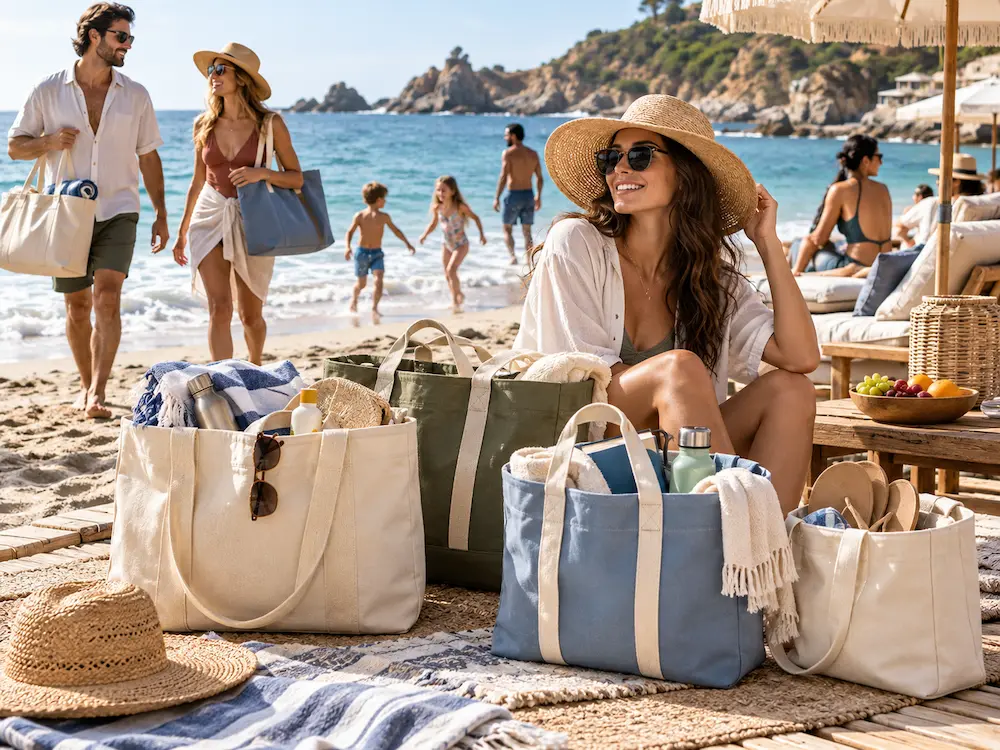
Why Tote Bags for Beach and Outdoor Activities Need Special Features
Beach and outdoor activities create different carrying requirements from ordinary shopping or office use.
A beach tote may need to hold towels, sunscreen, sunglasses, water bottles, sandals, snacks, spare clothing, and personal accessories. It may be carried across sand, placed on outdoor surfaces, exposed to sunlight, or used near water.
These conditions affect material selection, construction, size, and maintenance.
A lightweight cotton tote that works well for books may not be ideal for carrying damp towels. A heavy canvas tote may provide a premium appearance but become inconvenient when filled with bulky beach essentials.
The best outdoor tote should therefore be designed around its intended environment.
For manufacturers and B2B buyers, this means considering more than colour, printing, and dimensions.
The product should provide sufficient carrying capacity, appropriate durability, comfortable handles, and practical cleaning characteristics.
It should also match the expectations of the intended customer.
A resort gift-shop tote may prioritise visual appeal and everyday versatility. A family beach tote may need greater volume and internal organisation. An outdoor event giveaway bag may prioritise low weight, simple construction, and cost-efficient distribution.
These different applications require different specifications.
Key Features of Beach and Outdoor Tote Bags
| Feature | Why It Matters | Design Consideration |
|---|---|---|
| Large Capacity | Holds towels and accessories | Width, height, gusset |
| Durable Fabric | Supports repeated use | Material and construction |
| Comfortable Handles | Improves carrying | Length and width |
| Reinforced Stitching | Supports load-bearing areas | Handle and bottom seams |
| Easy Cleaning | Helps remove sand and dirt | Fabric and finishing |
| Moisture Management | Addresses damp belongings | Separate compartments |
| Secure Closure | Helps retain contents | Zipper or snap |
| Internal Pockets | Organises small items | Pocket position |
| Branding | Supports merchandise identity | Print durability |
| Foldability | Helps storage | Material weight |
The correct combination depends on whether the tote is intended for casual beach visits, retail merchandise, outdoor recreation, or promotional distribution.
What Makes a Good Beach Tote Bag?
A good beach tote must balance capacity with carrying comfort.
It should be large enough for the intended belongings without becoming difficult to handle.
The bag should also tolerate ordinary outdoor handling.
This does not mean every beach tote must be waterproof or manufactured from heavy-duty technical fabric.
Many cotton and canvas totes are suitable for dry beach accessories and casual outdoor activities.
However, buyers should understand their limitations.
Untreated cotton and canvas can absorb moisture. Sand can become trapped in seams and fabric textures. Repeated exposure to sunlight may affect colours and printed graphics.
For this reason, product claims should match the actual material specification.
Practical Carrying Capacity
The bag should accommodate realistic beach essentials.
Comfortable Shoulder Carrying
Handles should allow convenient carrying when the bag is filled.
Suitable Material
Fabric should match expected moisture exposure and cleaning requirements.
Reliable Construction
Handle attachments and bottom seams should be appropriately reinforced.
Useful Organisation
Pockets and compartments can help separate smaller belongings.
Best Materials for Beach and Outdoor Tote Bags
Material selection is one of the most important decisions.
Common options include cotton, canvas, polyester, nylon, mesh, and blended fabrics.
Each offers different characteristics.
Cotton Tote Bags for Beach Activities
Cotton tote bags provide a familiar textile appearance and can be suitable for casual beach outings.
They are often used for:
- Beachwear merchandise.
- Resort gift shops.
- Summer promotional campaigns.
- Casual outdoor shopping.
- Lightweight beach accessories.
Cotton offers a soft texture and broad printing possibilities.
For businesses seeking natural textile aesthetics and versatile branding, cotton totes for everyday carry and brand expression can provide a useful design direction for casual beach and outdoor merchandise.
However, untreated cotton is absorbent.
A cotton tote should not automatically be described as waterproof, water-resistant, or suitable for prolonged wet storage.
Lightweight Cotton
Lightweight cotton can be convenient for folding and carrying.
It may suit dry accessories, casual shopping, or promotional distribution.
However, its structure and carrying capacity should be evaluated carefully.
Medium-Weight Cotton
Medium-weight cotton can provide a useful balance between appearance and practical durability.
It may be suitable for beach towels, spare clothing, and general outdoor accessories when the construction is appropriately specified.
Canvas Tote Bags for Beach Use
Canvas is often selected for structured beach bags.
It can provide a substantial appearance and may support larger bag dimensions.
For brands developing durable outdoor merchandise, cotton canvas tote bags for durable brand carrying can support product concepts focused on practical construction and repeated use.
Common canvas specifications include 8 oz, 10 oz, and 12 oz.
However, fabric weight should not be treated as a complete measure of performance.
The final bag’s strength depends on fabric construction, stitching, handles, reinforcement, and finishing.
8 oz Canvas Beach Totes
An 8 oz canvas tote may provide a useful balance between structure and weight.
It can be suitable for casual beach merchandise and medium-sized bags.
10 oz Canvas Beach Totes
A 10 oz canvas tote can provide a more substantial feel.
It may be appropriate for larger bags carrying towels and outdoor accessories.
12 oz Canvas Beach Totes
A 12 oz canvas tote may be suitable for premium merchandise where a structured appearance is important.
However, heavier canvas increases product weight and may become less comfortable when filled.
Polyester and Nylon Outdoor Tote Bags
Polyester and nylon can be useful for lightweight outdoor accessories.
Depending on fabric construction and finishing, they may offer:
- Low weight.
- Compact folding.
- Faster drying than many cotton fabrics.
- Flexible construction.
- Compatibility with selected coatings.
However, performance varies.
A polyester tote is not automatically waterproof.
Water resistance depends on fabric construction, coatings, seams, and the finished product design.
Mesh Beach Tote Bags
Mesh panels or mesh bag construction can help sand and water drain from suitable compartments.
They may be useful for:
- Beach toys.
- Wet footwear.
- Swimming accessories.
- Sports equipment.
However, mesh provides limited protection from sand entering the bag and may not be suitable for small valuables.
A hybrid design can combine solid fabric with mesh compartments.
Cotton vs Canvas vs Polyester vs Mesh
| Material | Main Advantage | Main Limitation | Suitable Application |
|---|---|---|---|
| Lightweight Cotton | Soft and foldable | Absorbs moisture | Casual beach accessories |
| Medium Cotton | Balanced utility | Limited wet protection | Summer merchandise |
| 8 oz Canvas | Structured appearance | Less compact | General beach totes |
| 10 oz Canvas | Substantial construction | Increased weight | Large beach bags |
| 12 oz Canvas | Premium structure | Heavier | Retail merchandise |
| Polyester | Lightweight options | Performance varies | Travel and outdoor use |
| Nylon | Flexible construction | Specification-dependent | Packable outdoor bags |
| Mesh | Drainage and ventilation | Limited protection | Wet accessories |
Buyers should select materials based on intended contents and environmental conditions rather than assuming that one fabric is suitable for every outdoor application.
Choosing Fabric Weight for Outdoor Durability
Fabric weight affects appearance, flexibility, carrying weight, and material consumption.
However, heavier fabric does not automatically create a better beach tote.
A bag carrying bulky but lightweight towels may not require the same material specification as a bag intended for books, bottled drinks, or equipment.
The appropriate fabric should be selected according to:
- Expected load.
- Bag dimensions.
- Handle design.
- Desired structure.
- Foldability.
- Cleaning requirements.
- Target retail price.
Fabric Weight Selection Guide
| Intended Use | Possible Material Direction | Main Priority |
|---|---|---|
| Promotional Beach Giveaway | Lightweight cotton | Distribution efficiency |
| Casual Beach Shopping | Medium cotton | Versatility |
| Resort Merchandise | 8 oz canvas | Appearance |
| Large Beach Essentials | 10 oz canvas | Structure |
| Premium Lifestyle Bag | 10–12 oz canvas | Presentation |
| Packable Outdoor Bag | Lightweight polyester | Compact storage |
| Wet Accessories | Mesh or hybrid construction | Drainage |
These are illustrative design directions, not guaranteed load ratings.
Best Tote Bag Sizes for Beach Activities
Beach bags often need more space than ordinary shopping totes.
Towels, clothing, sandals, and other accessories can be bulky even when they are not particularly heavy.
A medium tote may be sufficient for one person.
A larger gusseted tote may be more practical for family outings.
Small Beach Tote Bags
Small totes may suit:
- Sunscreen.
- Sunglasses.
- Wallets.
- Small towels.
- Personal accessories.
They can be suitable for resort merchandise or short outings.
Medium Beach Tote Bags
Medium totes may carry:
- One towel.
- Spare clothing.
- Water bottle.
- Sunscreen.
- Light accessories.
A size around 40 × 38 cm can provide a useful starting point, depending on gusset depth.
Large Beach Tote Bags
Large totes may be suitable for:
- Multiple towels.
- Family accessories.
- Beach toys.
- Extra clothing.
- Snacks and drinks.
However, larger bags should have appropriately designed handles and bottom seams.
Beach Tote Size Comparison
| Size Category | Illustrative Dimensions | Typical Use |
|---|---|---|
| Small | 30 × 35 cm | Personal essentials |
| Medium | 40 × 38 cm | Individual beach trip |
| Large | 45 × 40 cm | Towels and accessories |
| Extra Large | 50 × 42 cm | Family beach outings |
Dimensions are examples and should be adjusted according to the intended product specification.
Gussets and Carrying Capacity
Gussets increase the usable depth of a tote.
They can be particularly helpful for beach bags because many beach items are bulky.
A flat tote may be sufficient for a towel and lightweight clothing.
A gusseted tote can accommodate bottles, footwear, and larger accessories more comfortably.
Common Gusset Options
- No gusset.
- 8 cm gusset.
- 10 cm gusset.
- 12 cm gusset.
- 15 cm gusset.
The best depth depends on bag dimensions and intended contents.
A gusset should not be added automatically.
It increases fabric consumption and can affect packing efficiency.
Comfortable Handles for Beach Carrying
Beach bags are often carried over the shoulder.
Comfortable handles are therefore essential.
Shoulder Handle Length
A handle drop of approximately 26–30 cm can be a useful starting point for many shoulder totes.
However, the final measurement should be tested against the bag’s dimensions and intended users.
Handle Width
Wider handles may distribute pressure more comfortably.
This can be useful when carrying towels, bottles, and accessories.
Handle Materials
Common options include:
- Cotton webbing.
- Self-fabric handles.
- Canvas straps.
- Polyester webbing.
- Rope handles.
Rope handles may create a distinctive resort appearance but should be evaluated for comfort and attachment strength.
Reinforced Stitching and Construction
Outdoor totes may experience repeated lifting, loading, and contact with rough surfaces.
Important construction areas include:
- Handle attachments.
- Bottom seams.
- Side seams.
- Gusset intersections.
- Fabric edges.
- Pocket attachments.
Box-X stitching or suitable reinforcement can improve handle attachment reliability when properly executed.
However, buyers should evaluate the complete bag rather than relying on a particular stitch pattern alone.
Construction Inspection Guide
| Area | Inspection Focus |
|---|---|
| Handle Attachment | Secure stitching |
| Bottom Seam | Load support |
| Side Seams | Consistency |
| Gussets | Alignment |
| Fabric Edges | Clean finishing |
| Pockets | Secure attachment |
| Closure | Functionality |
| Overall Shape | Balanced construction |
Open-Top vs Zipper Beach Tote Bags
The closure affects accessibility and content retention.
Open-Top Beach Totes
Open-top bags are convenient for:
- Towels.
- Clothing.
- Beach accessories.
- Casual shopping.
They provide easy access and simple construction.
Zipper Beach Totes
A zipper can help prevent contents from falling out.
It may be useful for:
- Travel.
- Resort shopping.
- Personal accessories.
- General outdoor activities.
However, zippers do not make a bag waterproof or theft-proof.
Snap Closures
Snap closures can provide a simple alternative.
Their suitability depends on the design and expected contents.
Internal Pockets and Wet/Dry Organisation
Beach totes often carry a mixture of dry and damp items.
Internal organisation can improve convenience.
Possible features include:
- Small zipper pocket.
- Phone compartment.
- Key loop.
- Bottle pocket.
- Separate mesh compartment.
- Removable pouch.
A separate compartment may help organise damp accessories.
However, a fabric pocket does not necessarily prevent moisture transfer.
If genuine water isolation is required, the manufacturer should specify and test an appropriate barrier material and construction.
Sand Management and Easy Cleaning
Sand is a practical concern for beach bags.
It can collect in corners, seams, pockets, and textured fabrics.
Smooth Fabric Surfaces
Some smoother fabrics may be easier to shake clean than heavily textured materials.
Mesh Compartments
Mesh can allow sand to escape from selected areas.
Simple Internal Construction
Fewer unnecessary compartments can reduce places where sand collects.
Cleaning Compatibility
Cleaning instructions should reflect the actual fabric, printing, and finishing.
Cotton and canvas may shrink or change appearance if washed improperly.
Machine washing should not be recommended without suitable testing.
Moisture Exposure and Outdoor Conditions
Beach bags may be exposed to:
- Damp towels.
- Wet clothing.
- Splashes.
- Humid conditions.
- Sunlight.
- Sand.
Material selection should reflect the expected environment.
Untreated cotton and canvas are generally absorbent.
Coated synthetic fabrics may provide water resistance, but performance depends on coating quality, seam construction, and product design.
Water-resistant and waterproof are not interchangeable claims.
If a buyer requires a waterproof beach bag, the finished product should be tested against an appropriate specification.
Beach Tote Bags for Different Outdoor Activities
Beach Holidays and Resort Visits
A resort beach tote may prioritise appearance, capacity, and comfortable carrying.
Neutral colours, natural canvas, and understated branding can create a versatile product.
Hotels and resorts may offer these bags as merchandise or guest gifts.
Outdoor Picnics
Picnic totes may need space for:
- Food containers.
- Bottles.
- Napkins.
- Small accessories.
- Lightweight picnic items.
A gusseted design may improve capacity.
However, ordinary cotton and canvas totes do not provide insulation.
Temperature-sensitive food requires appropriate insulated packaging.
Camping and Outdoor Recreation
Outdoor totes can help organise:
- Clothing.
- Lightweight equipment.
- Personal accessories.
- Dry supplies.
However, heavy equipment may require more specialised bags.
Load testing should match the intended contents.
Farmers Markets and Outdoor Shopping
Reusable totes are useful for outdoor shopping.
A practical design may include:
- Comfortable handles.
- Reinforced seams.
- Suitable capacity.
- Easy cleaning.
For businesses offering general-purpose outdoor merchandise, cloth tote bags for everyday carry and brand display can support product concepts that move between shopping, leisure, and outdoor activities.
Outdoor Festivals and Summer Events
Outdoor festivals often distribute promotional merchandise.
Tote bags can carry:
- Event programmes.
- Small gifts.
- Water bottles.
- Promotional materials.
- Personal accessories.
A lightweight bag may be sufficient for short events.
A more substantial canvas tote may be appropriate for premium merchandise.
Resort and Hospitality Merchandise
Beach totes can become part of a hotel’s or resort’s merchandise programme.
Potential applications include:
- Guest welcome gifts.
- Poolside accessories.
- Resort gift shops.
- Loyalty programmes.
- Seasonal promotions.
A successful resort tote should reflect the property’s visual identity while remaining useful outside the resort.
For large hospitality programmes, cotton tote bags in bulk for large-scale brand distribution can provide a relevant sourcing direction for coordinated quantities and consistent specifications.
Printing and Branding for Beach Tote Bags
Beach totes offer a visible branding surface.
However, printing should be selected according to the fabric and expected use.
Screen Printing
Screen printing can be suitable for:
- Simple logos.
- Limited-colour designs.
- Large quantities.
Digital Printing
Digital printing may support detailed artwork when compatible with the selected material.
Heat Transfer Printing
Heat transfer can be useful for selected graphics, but flexibility and durability should be tested.
Embroidery
Embroidery may create a premium appearance.
However, it adds stitching and can affect fabric flexibility.
For brands developing canvas merchandise with prominent graphics, canvas tote bag printing for sustainable brand visibility provides a relevant approach to planning artwork, print placement, and material compatibility.
Custom Logo Placement and Brand Visibility
Logo placement affects appearance and visibility.
Common positions include:
- Centre front.
- Upper front panel.
- Lower corner.
- Side panel.
- Woven label.
Large graphics can create strong visual impact.
Smaller logos may support a more understated lifestyle appearance.
For outdoor events and seasonal campaigns, promotional canvas tote bags with logos for brand visibility can support branded merchandise concepts designed for distribution and continued everyday use.
B2B Customisation Options
| Feature | Options | Purpose |
|---|---|---|
| Material | Cotton, canvas, polyester, mesh | Performance |
| Fabric Weight | Lightweight to heavy | Structure |
| Size | Small to extra large | Capacity |
| Gusset | Flat or expanded | Volume |
| Handles | Cotton, canvas, rope, webbing | Comfort |
| Closure | Open, zipper, snap | Retention |
| Internal, external, mesh | Organisation | |
| Printing | Screen, digital, transfer | Branding |
| Colour | Natural or custom | Visual identity |
| Packaging | Bulk or individual | Distribution |
The specification should match the intended market and budget.
Bulk Ordering and MOQ
Bulk beach tote programmes often involve:
- Fabric sourcing.
- Colour selection.
- Printing preparation.
- Sampling.
- Production scheduling.
- Quality inspection.
- Packing and shipping.
Many custom programmes may begin around 500 pieces, depending on the product specification.
Buyers should confirm the actual MOQ with the manufacturer.
Larger orders may improve unit cost efficiency, but inventory requirements should also be considered.
Cost Factors for Beach Tote Bags
| Cost Driver | Potential Impact |
|---|---|
| Fabric Type | High |
| Fabric Weight | High |
| Bag Dimensions | High |
| Gussets | Medium |
| Handle Construction | Medium |
| Reinforcement | Medium |
| Pockets | Medium |
| Zippers | Medium |
| Printing | Variable |
| Quantity | High |
| Packaging | Variable |
| Freight | High |
Buyers should compare total landed costs rather than factory unit prices alone.
Quality Testing for Beach and Outdoor Tote Bags
Outdoor totes should be tested for their intended applications.
Possible evaluations include:
- Handle attachment strength.
- Seam strength.
- Load carrying.
- Dimensional accuracy.
- Print durability.
- Cleaning compatibility.
- Colour performance.
- Closure function.
- Moisture-related performance where relevant.
A fabric’s nominal weight does not establish the finished bag’s load capacity.
Testing should reflect realistic contents.
Sampling and Pre-Production Approval
A physical sample allows buyers to evaluate:
- Fabric appearance.
- Bag proportions.
- Handle comfort.
- Gusset depth.
- Printing.
- Pocket placement.
- Closure function.
- Overall construction.
The sample should be filled with representative beach essentials.
For example:
- Towel.
- Sunscreen.
- Water bottle.
- Sandals.
- Spare clothing.
This can reveal whether the dimensions and handles are practical.
Cleaning and Maintenance
Beach bags may become dirty more quickly than ordinary shopping totes.
Cleaning requirements depend on:
- Fabric composition.
- Dyeing.
- Printing.
- Coating.
- Accessories.
- Construction.
A supplier should provide care recommendations based on the finished product.
For cotton and canvas bags, shrinkage and print durability should be considered before recommending machine washing.
Environmental Claims and Repeated Use
Reusable beach totes are often marketed as environmentally preferable alternatives to disposable bags.
However, environmental impact depends on:
- Material production.
- Fabric weight.
- Manufacturing.
- Printing.
- Transportation.
- Frequency of use.
- Product lifespan.
- Disposal or recycling.
Brands should avoid unsupported claims such as “100% eco-friendly” or “zero environmental impact”.
Specific material and recycled-content claims should be documented.
A practical objective is to develop a bag that users want to keep and reuse.
Common Beach Tote Bag Design Mistakes
| Mistake | Potential Problem | Better Approach |
|---|---|---|
| Using overly heavy fabric | Uncomfortable carrying | Match expected use |
| Bag too small | Insufficient capacity | Test actual contents |
| Handles too narrow | Shoulder discomfort | Evaluate handle width |
| Weak handle attachment | Durability problems | Reinforce and test |
| No gusset | Limited volume | Consider expanded construction |
| Poor pocket placement | Difficult access | Test organisation |
| Unsupported waterproof claims | Misleading expectations | Verify performance |
| Difficult cleaning | Reduced usability | Confirm care requirements |
| Poor print durability | Faded appearance | Approve samples |
| No physical testing | Unexpected defects | Test prototypes |
Outdoor Tote Bag Product Development Trends
Practical Multi-Purpose Designs
Bags suitable for beach trips, shopping, and everyday leisure may offer broader appeal.
Lightweight Structured Construction
Manufacturers may seek designs that balance capacity and comfort without unnecessary weight.
Better Organisation
Pockets and compartments can support outdoor activities when they provide genuine functional value.
Fashion-Oriented Beach Merchandise
Resort and lifestyle brands may increasingly treat beach totes as retail accessories rather than temporary promotional packaging.
Material Transparency
Clearer descriptions of fibre composition and documented recycled content can improve product communication.
Seasonal Customisation
Colours, prints, and limited-edition designs can support summer merchandise programmes.
Conclusion
The best tote bags for beach and outdoor activities combine suitable capacity, comfortable handles, durable construction, and practical maintenance.
Cotton can provide a soft textile appearance for casual beach merchandise. Canvas can offer greater structure for towels and outdoor accessories. Polyester, nylon, and mesh may be useful when lightweight construction, drainage, or specific moisture-related features are required.
However, material selection should reflect the intended environment.
A beach tote designed for dry towels and shopping may not need waterproof construction. A bag intended for wet swimming accessories may require different materials and compartments.
Size, gussets, handle length, reinforcement, closures, and pockets should be selected according to realistic use.
For B2B buyers, product development should include clear specifications, physical samples, load testing, print approval, and consistent quality inspection.
The strongest beach tote programmes combine functional design with attractive branding and reliable manufacturing.
A well-designed outdoor tote can serve customers during beach holidays, resort visits, picnics, festivals, and everyday leisure activities while remaining useful beyond the original event or purchase.
Developing Beach Tote Bags for Practical Outdoor Use
A successful beach tote bag should be designed around realistic outdoor activities rather than appearance alone. Beach holidays, resort visits, picnics, festivals, and outdoor shopping create different requirements for carrying capacity, fabric weight, handle comfort, gussets, and internal organisation. The right specification should accommodate the intended belongings while remaining comfortable to carry and practical to maintain.
Cotton and canvas can provide attractive textile constructions for casual beach merchandise, while polyester, nylon, and mesh may be useful for lightweight or moisture-related applications. Reinforced handles, suitable seams, practical closures, and well-positioned pockets can improve usability when they address genuine customer needs. Claims concerning waterproof performance, recycled content, and environmental benefits should be supported by appropriate testing or documentation.
For retailers, hospitality businesses, promotional merchandise buyers, and wholesalers, successful bulk beach tote programmes depend on approved physical samples, clear product specifications, consistent printing, realistic load testing, quality inspection, and reliable delivery planning. A well-designed beach tote can provide practical value during outdoor activities and remain useful for everyday carrying after the original trip or event.
FAQ
1. What material is best for beach tote bags?
Cotton and canvas are popular for casual beach totes because they provide a familiar textile appearance and good customisation options. Canvas can offer greater structure, while lightweight cotton is easier to fold. Polyester, nylon, and mesh may be more suitable when low weight, faster drying, or drainage is important. The best material depends on expected moisture exposure, contents, cleaning requirements, and desired appearance.
2. What size tote bag is best for a beach trip?
A medium beach tote may be sufficient for one person’s towel, sunscreen, water bottle, and personal accessories. Larger gusseted bags can accommodate multiple towels, spare clothing, and family items. Dimensions around 40 × 38 cm may be a useful starting point for a medium design, but the ideal size should be confirmed by testing actual contents.
3. Are canvas tote bags waterproof?
Standard untreated canvas tote bags are generally not waterproof. Cotton canvas can absorb moisture, and water may pass through fabric and seams. Water resistance requires suitable materials, finishes, and construction. Buyers should not describe a canvas bag as waterproof unless the finished product has been tested to support that claim.
4. Should a beach tote bag have a zipper or mesh pocket?
A zipper can help retain belongings, while mesh pockets can provide ventilation or drainage for selected beach accessories. However, neither feature is essential for every design. Open-top totes may be more convenient for towels and casual shopping. Buyers should choose features based on intended contents, user convenience, manufacturing cost, and maintenance requirements.
5. What should businesses check before ordering custom beach tote bags in bulk?
Businesses should confirm fabric composition, weight, dimensions, gussets, handles, reinforcement, printing, logo placement, pockets, closures, packaging, and quantity. Physical samples should be evaluated with representative beach essentials. Buyers should also confirm MOQ, quality inspection standards, production lead time, carton specifications, and delivery deadlines.
References
- ASTM International — Textile testing methods for fabric strength, tear resistance, colourfastness, and related material performance.
- International Organization for Standardization (ISO) — Textile testing standards and quality management systems.
- OEKO-TEX® — STANDARD 100 textile testing and certification information.
- Textile Exchange — Preferred fibre resources, recycled materials, and textile standards.
- Global Organic Textile Standard (GOTS) — Organic textile processing and certification requirements.
- U.S. Federal Trade Commission (FTC) — Guides for the Use of Environmental Marketing Claims (Green Guides).
- European Commission — EU Strategy for Sustainable and Circular Textiles.
- United Nations Environment Programme (UNEP) — Life cycle assessment resources and environmental considerations for reusable products
Content Use Policy:
You are welcome to reference this article with proper attribution, but copying, republishing, or modifying the full content without permission is not permitted.