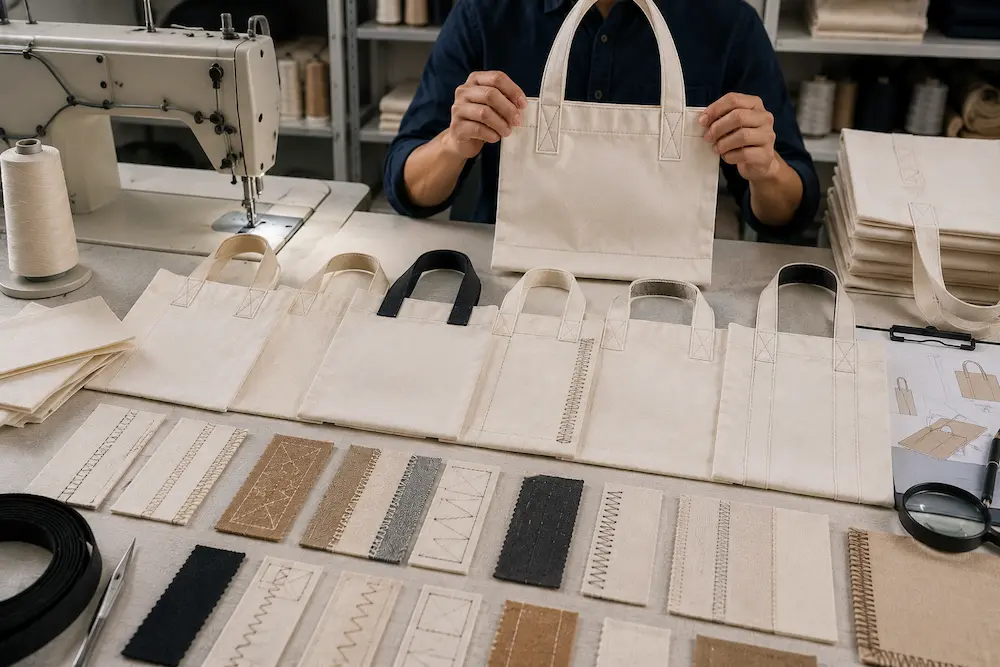
Tote bag stitching types directly affect durability, load capacity, product appearance, and long-term reusable performance. Many buyers focus first on fabric weight, printing method, and bag size, but stitching is often what decides whether a tote bag survives repeated daily use or fails after only a few carries.
A tote bag can use strong cotton canvas fabric and still fail early if the handles are poorly stitched. A lightweight bag can also perform well when the seam construction matches its intended use. That is why stitching should never be treated as a small production detail.
For B2B buyers, stitching quality matters because it affects customer satisfaction, brand perception, product lifespan, and reorder confidence. A tote bag that tears at the handle does not only create a product problem. It creates a brand problem.
Why Stitching Matters in Tote Bag Manufacturing
The highest stress areas on most tote bags are not the fabric panels themselves. They are usually the seams and handle attachment points.
Common failure areas include handle ends, side seams, bottom corners, gusset joints, pocket corners, and zipper edges. When the bag carries books, groceries, samples, or retail products, pulling force concentrates in these areas.
This is why reusable bags need stronger seam construction than simple event giveaway bags. A bag designed for daily use needs stitching that supports repeated carrying, movement, folding, and weight stress.
For everyday-use products such as cotton tote bags for everyday carry and brand expression, stitching should support comfort, reliability, and repeated public use rather than only low-cost production.
Single Stitching
Single stitching uses one row of stitches along the seam line. It is the most basic and economical tote bag stitching method.
Single stitching is commonly used for lightweight promotional tote bags, event giveaways, conference bags, and low-cost marketing items. It keeps production fast and affordable.
The advantage is clear: lower cost, faster sewing, less thread usage, and good efficiency for large-volume orders.
The limitation is also clear: single stitching is not ideal for heavy loads or long-term repeated use. Under stress, the seam may loosen faster than reinforced constructions.
This does not mean single stitching is always wrong. It simply belongs to lighter applications. For example,tote bags printed for brand visibility and promotion may use simpler stitching when the main purpose is lightweight brand exposure.
Double Stitching
Double stitching uses two parallel stitch lines to strengthen the seam. This is one of the most practical upgrades for reusable tote bags.
Double stitching improves load distribution, reduces seam failure risk, and gives the bag a cleaner, stronger appearance. It is commonly used for cotton totes, canvas totes, bookstore bags, retail bags, and reusable shopping bags.
Compared with single stitching, double stitching increases labor time slightly, but it usually gives much better durability. For most mid-range and premium tote bags, this upgrade is worth the cost.
Double stitching is especially useful when the tote bag will be reused frequently, carried in public, or associated with a brand’s quality image.
Cross Stitching and X-Box Reinforcement
Cross stitching, also called X-box stitching, is mainly used at handle attachment points. This is one of the most important reinforcement methods in tote bag manufacturing.
Handles are usually the first part of a tote bag to fail because they carry the full weight of the contents. X-box stitching spreads pulling force across a wider area, reducing the chance of tearing.
This method is especially important for grocery totes, heavy canvas bags, large shopping bags, travel totes, and premium promotional bags.
For stronger visible-brand products such as promotional canvas tote bags for brand visibility and marketing reinforced handle stitching is important because the bag is expected to stay in public use longer.
Bartack Stitching
Bartack stitching uses dense, short stitches at high-stress points. It is common in backpacks, luggage, workwear, outdoor bags, and heavy-duty textile products.
On tote bags, bartack stitching is usually used at handle ends, pocket corners, zipper joints, and strap attachment points.
Bartack reinforcement helps prevent seam separation under repeated stress. It is a small detail visually, but it can dramatically improve long-term durability.
Premium reusable tote bags often combine double stitching, cross stitching, and bartack reinforcement for stronger performance.
Overlock Stitching
Overlock stitching wraps thread around raw fabric edges to prevent fraying. It is commonly used inside tote bags for cleaner internal finishing.
Overlock stitching improves edge stability, internal appearance, and long-term seam cleanliness. It is not always the main load-bearing stitch, but it helps protect the fabric edges from unraveling.
Low-quality tote bags may skip proper internal finishing to reduce cost. This can lead to fraying, loose threads, and a cheaper overall feel.
For higher-quality custom bags, overlock stitching is usually part of professional finishing.
Boxed Bottom and Gusset Stitching
Bottom seams are critical for tote bags designed to carry groceries, books, bottles, boxed retail items, or heavier products.
Boxed bottom stitching and reinforced gusset seams help distribute weight more evenly. They also help the bag maintain shape when filled.
Flat tote bags may work well for documents, samples, and lightweight promotions. But bags designed for grocery or retail use usually benefit from gusset reinforcement.
A large tote bag without reinforced bottom seams can look fine when empty but perform poorly when loaded.
Thread Quality and Stitch Density
Stitching durability depends not only on stitch type but also on thread quality and stitch density.
Good thread should resist breaking, fraying, fading, and loosening. Polyester thread and reinforced blended thread are common choices for reusable tote bags.
Stitch density also matters. Too few stitches may weaken the seam. Too many stitches may damage the fabric or create puckering. Professional sewing teams balance stitch spacing, tension, needle size, and fabric weight.
For canvas-based projects such as canvas tote bag printing for sustainable brand visibility, stitching quality should match the higher product expectations created by the fabric and print.
Stitching and Brand Perception
Customers may not know technical sewing terms, but they notice poor stitching quickly.
Loose threads, crooked seams, weak handles, and uneven stitch lines make a tote bag feel cheap. Clean reinforced stitching makes the same bag feel more professional and reliable.
This matters especially for custom logo tote bags for consistent visual identity, because the tote bag becomes part of the brand’s public image.
If the stitching fails, the brand impression fails with it.
How Buyers Should Inspect Tote Bag Stitching
Before approving bulk production, buyers should inspect the sample carefully.
Key areas to check include handle attachment, side seams, bottom seams, gusset joints, internal edge finishing, stitch density, thread trimming, and overall seam alignment.
A good test is to load the bag with realistic weight and observe whether the handles pull, seams stretch, or bottom corners distort.
For reusable bags, visual approval alone is not enough. Real carry testing is much more useful.
Common Stitching Mistakes
The most common mistake is choosing fabric weight without checking seam structure. Strong fabric does not guarantee strong bags.
Another mistake is enlarging the tote bag size without upgrading handle reinforcement. Larger bags naturally encourage heavier loading, so stitching must match the capacity.
A third mistake is focusing only on the lowest unit price. Very cheap quotes often reduce stitch density, reinforcement time, thread quality, or quality inspection.
Best Stitching by Tote Bag Type
| Tote Bag Type | Recommended Stitching |
|---|---|
| Lightweight event tote | Single stitching |
| Daily cotton tote | Double stitching |
| Grocery tote | Double stitching + cross stitching |
| Premium canvas tote | Double stitching + bartack reinforcement |
| Heavy-duty reusable tote | Reinforced seams + X-box + bartack |
| Retail logo tote | Clean double stitching + internal finishing |
Conclusion
Tote bag stitching types are central to durability, comfort, appearance, and reusable performance. Single stitching may work well for lightweight promotional bags, but reusable retail and grocery tote bags usually need stronger reinforcement.
The best tote bags are not only made from good fabric. They are built with the right stitching system for the real use case.
For B2B buyers, the smartest approach is simple: match stitching strength to expected load, reuse frequency, brand positioning, and product lifespan.
How Buyers Should Think About Tote Bag Stitching and Durability
What stitching really controls: Tote bag stitching affects far more than seam appearance alone. It controls handle strength, seam stability, weight distribution, load-bearing performance, and long-term reusable durability. Weak stitching can shorten product lifespan even when high-quality canvas or cotton fabric is used.
Why many tote bag programs fail: Some buyers focus mainly on fabric GSM and logo printing while ignoring reinforcement stitching. But the highest-stress areas, especially handles, bottom corners, and gusset seams, are often the first places where structural failure happens during repeated carrying use.
How businesses should compare stitching structures: Single stitching may work for lightweight promotional totes, while reusable shopping and grocery bags usually require double stitching, bartack reinforcement, and cross stitching for better durability. The correct seam structure depends on real-world carrying conditions rather than appearance alone.
What businesses should evaluate before production: Buyers should inspect stitch density, handle reinforcement, seam consistency, bottom seam construction, and thread quality before approving mass production. Proper load testing is also important for reusable retail and grocery tote bag programs.
The broader takeaway: Durable tote bags are built through intelligent structural engineering, not simply thicker fabric. Youngpack, operated by Xiamen Youngpack Imp. and Exp. Co., Ltd., supports B2B brands seeking stronger tote bag construction standards, better reinforcement stitching, and more reliable reusable bag manufacturing for retail, promotional, and sustainable packaging applications.
FAQ
1. What is the strongest stitching type for tote bags?
Double stitching combined with cross stitching and bartack reinforcement is one of the strongest construction systems for reusable and heavy-duty tote bags.
2. Why do tote bag handles fail first?
Handles carry most of the load. If the handle attachment area lacks X-box stitching or bartack reinforcement, it may tear before the fabric itself fails.
3. Is single stitching enough for tote bags?
Single stitching can be enough for lightweight promotional tote bags, but it is usually not ideal for reusable shopping, grocery, or heavy-duty tote bags.
4. What does bartack stitching do?
Bartack stitching reinforces high-stress points such as handle ends, zipper corners, and pocket edges to reduce seam separation during repeated use.
5. Does stitching affect tote bag branding?
Yes. Clean, reinforced stitching improves perceived quality and helps the tote bag represent the brand more professionally in public use.
References
- 1.Textile Seam Engineering and Reinforcement Guide
- Industrial Sewing and Stitch Density Standards
- Reusable Shopping Bag Durability Study
- Canvas Tote Bag Manufacturing Best Practices
- Retail Packaging and Carry Bag Structural Analysis
- Heavy-Duty Textile Construction Handbook
- Promotional Product Quality Control Standards
- Sustainable Reusable Packaging Engineering Research
Content Ownership:
The text, structure, and packaging insights shared in this article belong to Xiamen Youngpack Imp.and Exp.Co.,Ltd. Please contact us before reusing any part of this content.