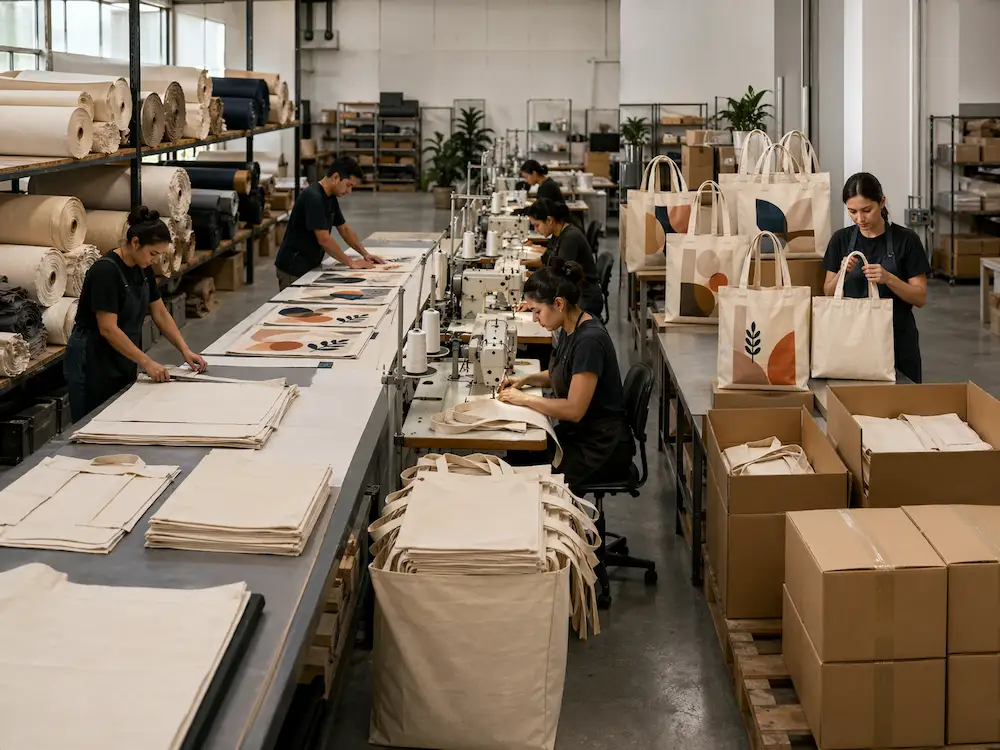
Most buyers see only the beginning and the end of a tote bag order. They see the quotation, the sample, and finally the finished cartons. What they do not always see clearly is the manufacturing process in between. That gap causes problems. If a buyer does not understand how the bag is made, it becomes much harder to judge why one specification costs more, why one supplier asks certain questions, or why some production issues happen repeatedly.
The reality is straightforward: tote bags may look simple, but good tote bags are not made casually. Every detail—fabric, pattern, print method, handle construction, seam strength, finishing, and packing—depends on a sequence of production steps that need to be handled correctly. A strong factory follows that sequence with discipline. A weak one cuts corners and hopes the customer will not notice until later.
Understanding the tote bag manufacturing process step by step helps buyers ask better questions, compare suppliers more intelligently, and avoid the most common mistakes in custom bag production.
Step 1: Product Brief and Use-Case Definition
The manufacturing process should begin with a clear product brief, not with fabric cutting. This is where many weak projects already go wrong. The supplier needs to know what the bag is for, what it will carry, how often it will be reused, what material feel the brand wants, how the logo should appear, and what market the bag is meant for. A tote bag for supermarket reuse does not follow the same logic as a tote bag for museum retail or a trade-show giveaway.
If the brief is unclear, every later step becomes weaker. The factory may still produce something, but the product may not match the commercial goal. This is why stronger suppliers ask more questions before quoting seriously. They are not being slow. They are trying to prevent production from starting on a weak foundation.
For branded carry programs, products like custom logo tote bags only succeed when the brief clearly defines what the bag must do beyond just carrying a logo.
Step 2: Material Selection
Once the product role is clear, the next step is material selection. This is one of the most important stages because material affects feel, cost, printing, durability, and customer perception. Cotton, canvas, and other textile directions may all work, but they do not behave the same way in production or in the market.
The supplier and buyer should confirm fabric type, approximate GSM or weight level, color, surface feel, and whether the material needs any special treatment. The right material is not the one that sounds best in a quotation. It is the one that matches the bag’s expected use and brand position.
For softer and more story-led branding, products such as custom cotton tote bags often begin with a material choice that supports natural feel and daily use, rather than simply chasing the cheapest cloth available.
Step 3: Size, Pattern, and Construction Planning
After material comes structure. This step turns the concept into a real bag shape. The factory creates or confirms the bag dimensions, gusset, bottom width, handle length, stitching positions, seam allowance, and any extra construction features such as inside pockets, lining, zipper, snap closure, woven label, or base reinforcement.
This stage matters more than many buyers realize. Two tote bags with the same front size can perform very differently because one has a gusset and stronger handles while the other does not. Pattern planning determines how the bag will behave once it is filled and carried, not just how it looks when laid flat.
Good factories treat this step carefully because changing construction later in production is expensive and disruptive.
| Manufacturing Stage | Main Purpose | Buyer Risk If Ignored |
|---|---|---|
| Product brief | Define use case and market fit | Wrong bag concept from the start |
| Material selection | Set feel, cost, and durability direction | Bag does not match use or price point |
| Pattern and construction | Turn concept into a workable structure | Weak carrying performance or awkward design |
| Sampling | Test the real product before bulk production | Mass production of the wrong specification |
Step 4: Sampling and Prototype Approval
Before bulk production begins, a proper sample or prototype should be made. This is the step where the buyer can see whether the bag actually works in physical form. The sample checks size, handle comfort, print layout, material feel, structure, stitching, and whether the product still makes sense once it exists outside a drawing or mockup.
This is one of the most important control points in the whole manufacturing process. A product that looks acceptable on screen can feel completely wrong in hand. A good sample reveals that early. A rushed or skipped sampling stage usually creates bigger and more expensive problems later in mass production.
For stronger retail-facing bag programs like custom canvas tote bags, sampling is especially important because the customer is not only judging the bag as packaging. They are judging it as a product.
Step 5: Artwork Preparation and Print Planning
While or just after the sample stage, the artwork should be prepared for production. This means confirming logo file quality, print size, placement, color references, and the print method itself. A bag may use screen printing, digital printing, or another route depending on the design and order quantity.
This stage is where suppliers should confirm technical print details, not improvise them later on the production floor. Good factories will review whether the artwork suits the material, whether the print position aligns with the pattern, and whether the chosen method can actually deliver the desired result at the intended quantity.
That is why stronger brand-led products such as custom printed tote bags require proper print planning before sewing starts. Printing is part of manufacturing logic, not decoration added at the last minute.
Step 6: Fabric Cutting
Once the specification is approved, bulk material is prepared for cutting. Fabric rolls are spread, measured, aligned, and cut according to the approved pattern. Accurate cutting matters because every later stage depends on it. If panels are cut incorrectly, handles may sit unevenly, seams may twist, and print placement may not align properly.
Factories using standardized cutting control usually reduce waste and improve consistency. Weak cutting control often leads to bags that technically pass inspection at a glance but feel visually off when compared side by side.
Cutting is one of those quiet production steps buyers rarely see, but it strongly influences final quality.
Step 7: Printing Before or During Assembly
Depending on the product and printing method, the bag panels may be printed before final assembly. This is common because flat fabric panels are easier to print accurately than finished bags. The print shop applies the logo or artwork according to the approved production file and color direction.
At this stage, quality checks should focus on print placement, ink consistency, color accuracy, registration, and whether the artwork sits correctly relative to the bag dimensions. Poor print control can ruin otherwise well-made bags, especially in visible promotional or retail programs.
For programs where the bag itself acts as moving media, products like tote bags printed need this stage handled with care because public brand performance depends on visual clarity.
Step 8: Sewing and Assembly
After cutting and often after printing, the panels move into sewing and assembly. This is where the tote becomes a real product. Handles are attached, front and back panels are joined, gussets are sewn, bottoms are shaped, inside labels are inserted if required, and additional components such as pockets or zips are added.
Sewing quality is one of the clearest differences between a reliable tote bag and a weak one. Clean seams, reinforced stress points, even handle positioning, and correct edge finishing all matter. A strong fabric with weak stitching is still a weak bag. This is why serious tote factories do not treat sewing as simple labor. It is the stage where much of the bag’s usable life is decided.
For premium or visible-use products, factories often reinforce handle attachments because that is one of the most common stress points in daily use.
| Assembly Area | What Happens | Why It Matters |
|---|---|---|
| Handle attachment | Handles sewn and reinforced | Major stress point in real use |
| Side and bottom seams | Bag body joined and shaped | Controls capacity and structure |
| Gusset formation | Depth and volume created | Improves carrying practicality |
| Add-on details | Pockets, labels, zips, snaps | Changes function and product value |
Step 9: Trimming, Cleaning, and Finishing
After sewing, the bags usually go through finishing. Loose threads are trimmed, edges are checked, excess material is cleaned away, and the bag is prepared to look presentable and consistent. Some products may also be pressed or shaped more carefully before final inspection.
This finishing stage is often underestimated, but it strongly affects first impression. A bag can be structurally fine and still look cheap if finishing is careless. Thread ends, uneven edges, or poor cleaning all weaken perceived quality fast, especially in retail-facing products.
A well-finished tote usually looks more expensive than a poorly finished one, even before the customer tests its strength.
Step 10: Quality Inspection
Before packing, the bags should be checked against the approved standard. Inspection may include fabric consistency, color, print quality, dimensions, handle attachment, stitching quality, cleanliness, and overall workmanship. For export orders, this step is often essential because once the shipment leaves the factory, small mistakes become much more expensive to correct.
A serious supplier should not only inspect randomly at the end. Better factories use checks during material intake, printing, sewing, and final packing. This reduces defect accumulation and avoids discovering whole-batch problems too late.
Good inspection does not guarantee zero defects, but it usually prevents the most avoidable production failures.
Step 11: Folding, Packing, and Carton Loading
Once the bags pass inspection, they are folded and packed according to the order requirements. This may include simple bulk packing, individual polybags, size bundling, barcode labels, export cartons, or branded retail packaging depending on the customer’s needs.
Packing is not just a logistics detail. It affects freight cost, warehouse efficiency, and how the product arrives. A well-made tote bag can still create problems if carton density is poor, labels are wrong, or the bags arrive crushed or inconsistently packed.
This is why experienced suppliers plan carton dimensions and bag folding logic carefully. Good packing protects both product quality and landed cost.
Step 12: Export Documentation and Shipment
The final stage is shipment preparation. For international orders, this usually includes carton marking, packing list, commercial invoice, and any shipping coordination needed for sea, air, or courier export. The factory or trading partner must make sure the goods leave in a condition that matches the order and the documentation.
This stage often looks administrative, but in export business it is part of product delivery quality. A factory that makes decent bags and handles shipment badly is still creating risk for the buyer. Strong suppliers know that production is not finished until the shipment is correctly prepared and moving through the agreed channel.
For many B2B buyers, the manufacturing process is only truly complete when the bags are produced, checked, packed, and shipped with the same level of discipline.
Where Manufacturing Problems Usually Happen
Most tote bag production problems happen in predictable places. Weak product briefs create wrong specifications. Weak sampling creates wrong approvals. Weak cutting creates inconsistent shapes. Weak print control creates bad branding. Weak sewing creates weak bags. Weak inspection creates unpleasant surprises after shipment.
The important point is that most of these failures are preventable. They are not mysterious. They usually happen because one of the process steps was rushed, skipped, or handled without enough control.
That is why buyers who understand the step-by-step process usually manage suppliers better. They know where to look and what to question.
How Buyers Should Use This Process Knowledge
Understanding the manufacturing process is not about becoming a factory manager. It is about becoming a better buyer. When buyers understand how the bag is made, they can ask more useful questions about sampling, print timing, seam reinforcement, material roll issues, carton efficiency, and production risk.
They can also compare suppliers more honestly. A factory that gives vague answers about process control is usually weaker than one that can explain each step clearly. Manufacturing transparency often reflects manufacturing discipline.
This is where Youngpack-style sourcing logic matters. A good partner does not only make bags. They help buyers understand which process decisions actually protect product quality and commercial value.
How Buyers Should Think About the Tote Bag Manufacturing Process
What this process really represents: Tote bag manufacturing is not just sewing fabric into shape. It is a full production system that begins with product definition and ends with packed export cartons. Every stage—material choice, pattern planning, printing, assembly, and inspection—affects how the bag performs in real use and how the brand is judged afterward.
Why buyers often misunderstand it: Many buyers only see the quote, the sample, and the finished shipment. That can make tote bag production look simpler than it really is. In practice, most bag failures come from very specific process weaknesses such as poor sampling, weak sewing control, inconsistent cutting, or rushed inspection. These are not random problems. They usually reflect a weak manufacturing sequence.
How buyers should use process knowledge properly: The strongest buyers do not try to manage the factory directly, but they do understand the critical control points. They know why sampling matters, why printing should be planned early, why seam reinforcement changes the product’s usable life, and why carton packing influences total cost. That knowledge helps them approve better specifications and question weak production choices before they become expensive.
Options businesses usually weigh: Most buyers compare lighter promotional tote production against stronger retail-oriented production, simpler stock-based processes against more customized product routes, and basic event bags against higher-value merchandise totes. The better production path depends on whether the bag is mainly for broad distribution or for longer-term public use as a more visible brand product.
Considerations before mass production: Before approving bulk production, businesses should review the real sample carefully, confirm material and print details, understand how the bag will be sewn and inspected, and make sure packaging and export handling are clear. These checks often matter more than last-minute price pressure because they prevent avoidable defects and shipment problems later.
The broader takeaway: The strongest tote bag programs come from understanding that production quality is built step by step, not at the end. That is also where Youngpack naturally fits as a B2B manufacturing and export partner for buyers who need stronger product logic, better factory communication, and more dependable tote bag production from concept to shipment.
Conclusion
The tote bag manufacturing process step by step is not complicated once it is explained honestly. It begins with product definition, moves through material choice, pattern planning, sampling, printing, cutting, sewing, finishing, inspection, packing, and shipment. Every stage affects the final result.
Buyers who understand that sequence usually make better decisions, avoid weak specifications earlier, and work with suppliers more effectively. A tote bag may be a simple product in appearance, but good tote bag manufacturing is still a system. When the system is strong, the product usually is too.
FAQ
1. What is the first step in manufacturing tote bags?
The first real step is defining the product clearly. Before any fabric is cut, the supplier needs to understand what the tote bag is for, what it will carry, how it should look, and how the branding should work. This product brief determines the material, structure, print method, and quality level. If the first step is weak, the rest of the manufacturing process usually becomes weaker as well.
2. Are tote bags printed before or after sewing?
In many cases, tote bag panels are printed before final sewing because flat fabric is easier to print accurately than a finished bag. This helps with logo placement, artwork clarity, and production efficiency. However, the exact print timing depends on the print method, the bag construction, and the design. What matters most is that the print plan is confirmed before mass production begins.
3. Why is sampling important in tote bag manufacturing?
Sampling is important because it allows the buyer to test the real product before full production starts. A tote bag can look good in a digital mockup and still fail in real life if the size feels wrong, the handles are uncomfortable, or the print does not suit the fabric. Sampling helps catch those issues early, when they are still cheap to fix. Skipping this step often creates expensive problems later.
4. What part of the manufacturing process affects tote bag strength the most?
Strength depends on several steps working together. Material weight matters, but sewing quality, handle reinforcement, seam construction, and pattern design often matter just as much. A heavy fabric bag can still fail if the handles are poorly attached. The strongest tote bags usually come from good material choice combined with disciplined sewing and proper stress-point reinforcement.
5. What should buyers check before approving a bulk tote bag order?
Buyers should check the approved sample, fabric type, size, gusset, handle length, print placement, stitching quality, packing method, and whether the supplier has clear inspection control before shipment. They should also confirm how the bag will be packed and exported. The best time to prevent production mistakes is before bulk manufacturing begins, not after the cartons are already on the way.
References
- Preferred Fiber and Materials Market Report — Textile Exchange — Textile Exchange.
- Retail Packaging and Reusable Bag Sourcing Best Practices — professional sourcing reference.
- Responsible Sourcing and Product Communication in Textile Supply Chains — industry trade reference.
- Guide to Reusable Bags and Long-Term Use Value — industry best-practice sourcing reference.
- Sustainable Packaging Guidelines — Australian Packaging Covenant Organisation — APCO.
- Textiles and the Environment — European Environment Agency — EEA.
- Fashion on Climate — Global Fashion Agenda and McKinsey & Company.
- Green Guides for the Use of Environmental Marketing Claims — Federal Trade Commission — FTC.
Original Knowledge Statement:
This article is based on the packaging industry experience and product knowledge of Xiamen Youngpack Imp.and Exp.Co.,Ltd. All rights reserved.