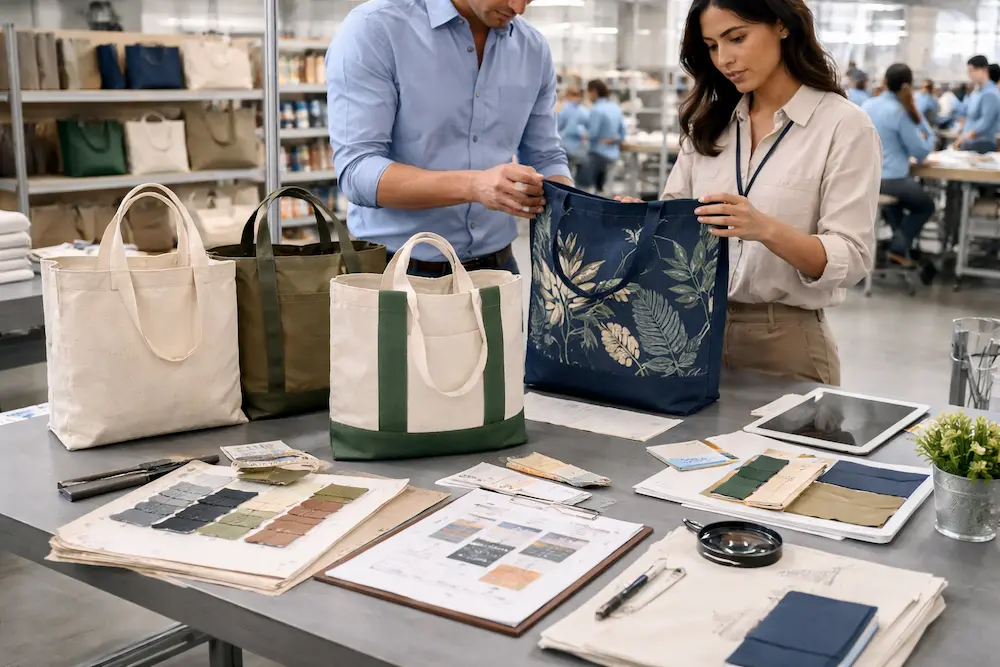
Finding the right tote bag manufacturers is one of those decisions that looks easy from the outside and becomes much harder as soon as real sourcing begins. Many factories can send attractive photos, polished quotations, and sample promises. Far fewer can maintain stable material quality, controlled printing, consistent stitching, workable lead times, and repeat-order reliability when volumes increase.
This is why buyers should not treat tote bag supplier selection as a simple quote comparison. A tote bag may look like a straightforward textile product, but commercial production is shaped by fabric sourcing, cutting accuracy, sewing control, print method, packing efficiency, compliance awareness, and export execution. If the supplier is weak in any one of these areas, the finished bag may still reach the customer, but not at the quality level the brand expected.
That problem becomes even more visible in OEM projects. Once the bag is customized for a specific brand, campaign, or retail program, production consistency matters more than ever. The buyer is no longer just buying a bag. They are buying a repeatable product system that needs to perform across sample approval, mass production, and future reorders. That is the real difference between a generic sewing vendor and a reliable OEM manufacturing partner.
What OEM Tote Bag Manufacturing Really Means
OEM tote bag production means the supplier manufactures bags to the buyer’s specifications rather than offering only stock products. That usually includes custom size, fabric, handles, stitching details, printing, labels, packaging, and sometimes unique bag structures or accessories. In many cases, the buyer is building a product that must match a particular brand identity or campaign logic rather than simply sourcing a low-cost generic tote.
This changes the whole sourcing process. Stock bags can often be compared mainly by size and fabric. OEM bags require deeper evaluation. The buyer needs to know whether the manufacturer can interpret specifications correctly, recommend suitable materials, control artwork execution, manage tolerances, and hold the same standard over repeat production.
That is why tote bag OEM projects often split into two categories. One category is functional customization, where the bag is adjusted for size, load use, or general branding. The other is brand-driven customization, where the product itself is expected to act as a long-life extension of the brand. In the second category, the supplier needs to understand more than sewing. They need to understand visual consistency, commercial use, and how the bag will perform in public after distribution.
Why Many Tote Bag Suppliers Fail at OEM Work
A surprising number of suppliers can produce a decent first sample and still fail at OEM supply. The reasons are predictable. Some cannot hold fabric consistency across large runs. Some do not manage print registration well. Some subcontract too loosely, which creates variation in stitching and finishing. Some communicate clearly at the quotation stage but poorly once production starts. Others are fine with simple stock bags but struggle when the project requires multiple custom details at once.
This is why buyers should look past sales language. “Factory direct” and “professional manufacturer” do not mean much unless the supplier can explain production logic in a practical way. A strong OEM partner should be able to explain fabric choices, printing limitations, reinforcement methods, MOQ logic, sample stages, and repeat-order control with confidence and detail.
For example, when a buyer needs a softer, more natural-looking product for long-term brand storytelling, the supplier should be able to discuss formats such as custom printed canvas bags rather than treating every project as the same plain cotton tote with a logo added later.
How to Evaluate Manufacturing Capability Properly
Manufacturing capability is not just about owning sewing machines. Buyers should assess whether the supplier can produce the right type of tote bag consistently at the intended commercial scale. That requires looking at material handling, cutting accuracy, sewing control, print management, finishing standards, and how clearly the supplier can translate a brief into an actual production plan.
At a minimum, the supplier should be able to discuss fabric type, GSM or ounce ranges, handle structure, gusset options, printing method, packing method, and typical lead time. If the answers are vague, the buyer is usually dealing with a trading intermediary or a weakly managed production system rather than a strong OEM factory.
Capability should also be judged by the supplier’s ability to recommend what not to do. If the buyer asks for an overbuilt bag for a light campaign use, the supplier should say so. If the buyer wants a premium printed bag on a fabric that will not support the desired print clarity, the supplier should explain the trade-off. Good OEM suppliers do not simply say yes to everything. They reduce risk before production starts.
Material Control: The First Real Test of a Supplier
Material inconsistency is one of the most common reasons OEM tote bag programs go wrong. A bag may be approved in one sample run and then feel noticeably different in mass production because the fabric weight, weave, shade, or finishing has changed. This creates problems not only for durability, but also for printing, foldability, and perceived value.
Reliable tote bag manufacturers should be able to define material clearly. That includes cotton type, canvas weight, recycled blend ratio where relevant, color base, and finish character. It also means they should understand which materials fit different end uses. A bag for retail resale, a bag for giveaways, and a bag for grocery-style reuse should not automatically use the same construction logic.
When the project is more visibility-driven, suppliers should also know when a softer cotton format is commercially enough. In lighter promotional programs, many buyers compare options such as printed cotton tote bags before moving into heavier canvas structures. A good OEM supplier should be able to explain that difference rather than pushing one format for every project.
| Material Option | Typical OEM Use | Main Strength | Main Risk if Poorly Controlled |
|---|---|---|---|
| Light cotton | Events, basic promotions, lightweight retail use | Lower cost and easier bulk distribution | Inconsistent feel and weak carry confidence |
| Standard cotton | General custom tote programs | Balanced cost and reuse value | Print and body feel may vary between runs |
| Heavy canvas | Retail-ready, grocery, premium brand projects | Stronger structure and longer use life | Higher freight cost and greater QC pressure |
| Recycled cotton blend | Sustainability-led OEM programs | Supports responsible brand positioning | Variation in texture, shade, and print response |
Print Capability Is a Bigger OEM Filter Than Buyers Expect
Printing often separates real OEM manufacturers from weaker suppliers. Tote bags are large-format brand surfaces, so any error in print alignment, ink quality, artwork sharpness, or shade consistency is immediately visible. A supplier that cannot control printing well is rarely a reliable OEM choice for serious branded projects.
Buyers should ask which print methods the manufacturer actually controls well, not just which ones they claim to offer. Screen printing is often the most practical route for cotton and canvas bags, especially at volume. Transfer or digital methods may be suitable for more detailed art depending on fabric and quantity. Embroidery can work for premium marks, but not for every design. The key question is whether the supplier understands when and why to use each method.
Print capability also matters because some OEM projects are effectively brand campaigns, not just bag orders. For larger-scale promotional supply, many buyers compare manufacturing options against programs such as custom canvas bags bulk because high-volume campaign work requires better print consistency, stronger packing logic, and more repeatable execution than one-off sample jobs.
OEM Sampling: What Buyers Should Actually Test
Too many buyers treat sampling as a visual approval step only. That is a mistake. A real OEM sample should test function, material feel, print behavior, handle comfort, size accuracy, stitching standard, and how the bag behaves with intended contents inside.
If the tote bag is meant for retail products, the sample should be loaded with those products. If the bag is meant for grocery use, it should be tested under realistic grocery weight. If the bag is part of an event or campaign, the buyer should check whether the design still looks commercially strong once the bag is filled and carried rather than laid flat on a table.
Sampling is also where the buyer should observe communication quality. Does the manufacturer interpret changes clearly? Do they confirm revised specs properly? Do they advise against weak design choices? Strong sample handling usually predicts stronger bulk execution.
MOQ, Lead Time, and Bulk Production Logic
MOQ is not just a sales tactic. In OEM tote bag manufacturing, it reflects material procurement, print setup, cutting efficiency, sewing workflow, and carton planning. Very small runs often create higher unit prices because the supplier is spreading fixed setup costs over too few units. That is normal. What matters is whether the supplier explains MOQ logic honestly and recommends the right order structure for the project rather than forcing the buyer into a quantity that does not fit the use case.
Lead time should also be evaluated in layers. Buyers should ask separately about sample development, pre-production confirmation, mass production, and shipping readiness. Suppliers that promise very fast delivery without discussing artwork, material lead time, or production capacity usually create more risk than confidence.
For some projects, the tote bag is only one product in a broader OEM textile range. If the brand also needs alternative formats, the supplier’s ability to handle related products can be useful. In sustainability-focused brand programs, some buyers compare suppliers that can also produce linked formats such as custom canvas drawstring bags so that the visual system and sourcing logic remain more consistent across the whole product family.
| OEM Factor | Why It Matters | What Buyers Should Ask |
|---|---|---|
| MOQ | Affects unit cost and production efficiency | What setup factors drive the MOQ? |
| Lead time | Affects event, retail, or campaign planning | What are the separate timings for sample and bulk? |
| Material sourcing | Affects quality and repeat consistency | How stable is the base material across reorders? |
| Print method | Affects artwork quality and cost | Which method best fits the design and quantity? |
| Packing method | Affects freight, warehouse use, and presentation | How many bags per carton and what folded format? |
Export Experience and Communication Quality
Strong OEM supply is not just about factory production. It is also about export handling and communication. A supplier that can sew well but cannot manage shipping documents, labeling requirements, packing clarity, or repeat communication under deadline pressure is still a risky OEM partner.
Buyers should look for suppliers that communicate in a structured way. That means confirming specifications clearly, summarizing revisions accurately, identifying approval checkpoints, and giving realistic updates rather than reactive excuses. In export-oriented projects, this becomes even more important because delays and misunderstandings can affect freight booking, warehouse intake, and seasonal campaign timing.
Reliable suppliers also tend to ask better questions. They do not only ask for artwork and quantity. They ask about market, end use, target customer, load expectations, print goals, and how the product will be distributed. That kind of questioning usually reflects a stronger OEM mindset.
Red Flags When Comparing Tote Bag Manufacturers
The first red flag is vague material language. The second is unclear print recommendations. The third is extreme pricing that seems disconnected from the product requirements. The fourth is weak sample discipline. The fifth is poor response quality once technical details are introduced.
Another warning sign is when a supplier treats every project as interchangeable. OEM work is not generic. A conference tote, a premium retail bag, a grocery bag, and a promotional giveaway may all use similar textile formats, but they should not be quoted and built as though they were the same product. Suppliers that flatten all of those categories into one standard answer usually create trouble later.
How Buyers Should Build a Reliable OEM Supplier Shortlist
The strongest shortlist usually includes suppliers that can explain product logic clearly, respond well to specification changes, provide commercially realistic guidance, and demonstrate repeat-order thinking. Buyers should compare more than price. They should compare how the manufacturer thinks.
A practical shortlist process often starts with four questions. Can the supplier define the right fabric and structure for the use case? Can they recommend the correct print route? Can they explain MOQ and lead time honestly? Can they show signs of stable export and reorder capability? If the answer is weak on any of those points, the supplier may still be able to sell a bag, but not necessarily to support a reliable OEM program.
Conclusion
The best tote bag manufacturers are not the ones that only send fast quotations or attractive photos. They are the ones that can turn brand requirements into stable OEM production with the right material, the right construction, the right printing logic, and the right communication discipline behind it.
For serious buyers, the question is not only who can make a tote bag. It is who can make the right tote bag repeatedly, at the required scale, without quality drift, print inconsistency, or avoidable production confusion. That is the real definition of a reliable OEM supplier.
Once buyers start evaluating manufacturers that way, weak suppliers become much easier to filter out. The decision stops being about the cheapest sample and becomes about the strongest long-term manufacturing partner. That is the standard Youngpack, or any serious export-oriented OEM tote bag supplier, should be expected to meet.
How Buyers Should Think About OEM Tote Bag Manufacturers
What an OEM supplier really provides: A reliable OEM tote bag manufacturer is not just a source of production capacity. It is a partner that can convert product requirements into stable, repeatable manufacturing. That includes material control, stitching consistency, print execution, packing logic, and clear communication through sampling and bulk production.
Why supplier evaluation matters so much: Most sourcing problems do not begin with dramatic factory failure. They begin with small gaps in material clarity, weak print control, vague sample standards, or unrealistic lead time promises. Those gaps usually become more expensive once order volume increases. That is why supplier quality should be judged before price becomes the main decision driver.
How buyers should compare manufacturers: The strongest comparison method is to evaluate fabric, construction, print capability, MOQ logic, export readiness, and repeat-order stability together. A supplier that can explain how these pieces work together is usually much stronger than a supplier that only reacts to a specification sheet with a quick quote.
Options buyers often weigh: Businesses usually compare stock suppliers against true OEM manufacturers, lighter cotton projects against heavier canvas programs, and small flexible runs against larger repeat production. The right manufacturing partner depends on whether the product is mainly functional, mainly promotional, or intended to behave like long-life branded merchandise.
Considerations before long-term cooperation: Before approving a supplier, buyers should confirm sample discipline, material consistency, print reasoning, pack-out planning, and whether the supplier can repeat the same standard across future runs. A good first sample is useful, but stable future production is what defines real OEM reliability.
The broader commercial takeaway: The best tote bag manufacturer is rarely the one that only looks cheapest on paper. It is the one that reduces risk, supports the brand, and keeps production stable over time. That is also where Youngpack fits naturally as a B2B manufacturing and export partner for OEM tote bag programs that require customization, quality control, and long-term supply discipline.
FAQ
1. What is the difference between a tote bag supplier and an OEM tote bag manufacturer?
A general tote bag supplier may sell stock products or coordinate simple sourcing, while an OEM tote bag manufacturer is expected to produce bags according to the buyer’s own specifications. That usually includes custom fabric, size, handles, printing, labels, packaging, and repeat-order control. OEM work is more demanding because the supplier must translate a product brief into stable production rather than simply offering a standard bag.
2. What should buyers check first when comparing tote bag manufacturers?
Buyers should first check material clarity, production capability, print control, sample quality, MOQ logic, and communication quality. Price is important, but it should not be the first filter in OEM sourcing. If a supplier cannot explain fabric, construction, and production reasoning clearly, there is a higher chance that quality problems will appear later in bulk orders.
3. Are bigger factories always better OEM suppliers?
Not always. Larger factories may have stronger capacity, but that does not automatically mean they manage customization, communication, or quality control better. Some mid-sized factories are much stronger at detailed OEM execution because they run tighter production systems and communicate more clearly. The better supplier is the one that can hold quality consistently at the volume the buyer actually needs.
4. How do MOQs affect OEM tote bag projects?
MOQs affect OEM projects because custom production includes setup costs in fabric sourcing, cutting, print preparation, sewing workflow, and packing. Small runs usually carry higher unit costs because those fixed costs are spread across fewer pieces. Once the product specification is stable, larger orders generally improve unit economics and production consistency. Buyers should evaluate MOQ together with storage, forecast accuracy, and reorder plans.
5. What is the biggest mistake when choosing a tote bag manufacturer?
The biggest mistake is choosing only by quote without checking whether the supplier can maintain the same standard after sample approval. Many suppliers can make a good-looking first sample, but fewer can keep fabric quality, stitching, print accuracy, and packing consistency stable in mass production and future reorders. Buyers should evaluate long-term production reliability, not only first-order appearance.
References
- Preferred Fiber and Materials Market Report — Textile Exchange — Textile Exchange.
- Textiles and the Environment — European Environment Agency — EEA.
- Green Guides for the Use of Environmental Marketing Claims — Federal Trade Commission — FTC.
- Sustainable Packaging Guidelines — Australian Packaging Covenant Organisation — APCO.
- Fashion on Climate — Global Fashion Agenda and McKinsey & Company.
- Responsible Sourcing and Product Communication in Textile Supply Chains — industry trade reference.
- Retail Packaging and Reusable Bag Sourcing Best Practices — professional sourcing and merchandising reference.
- Guide to Reusable Bags and Long-Term Use Value — industry best-practice sourcing reference.
Content Use Policy:
You are welcome to reference this article with proper attribution, but copying, republishing, or modifying the full content without permission is not permitted.