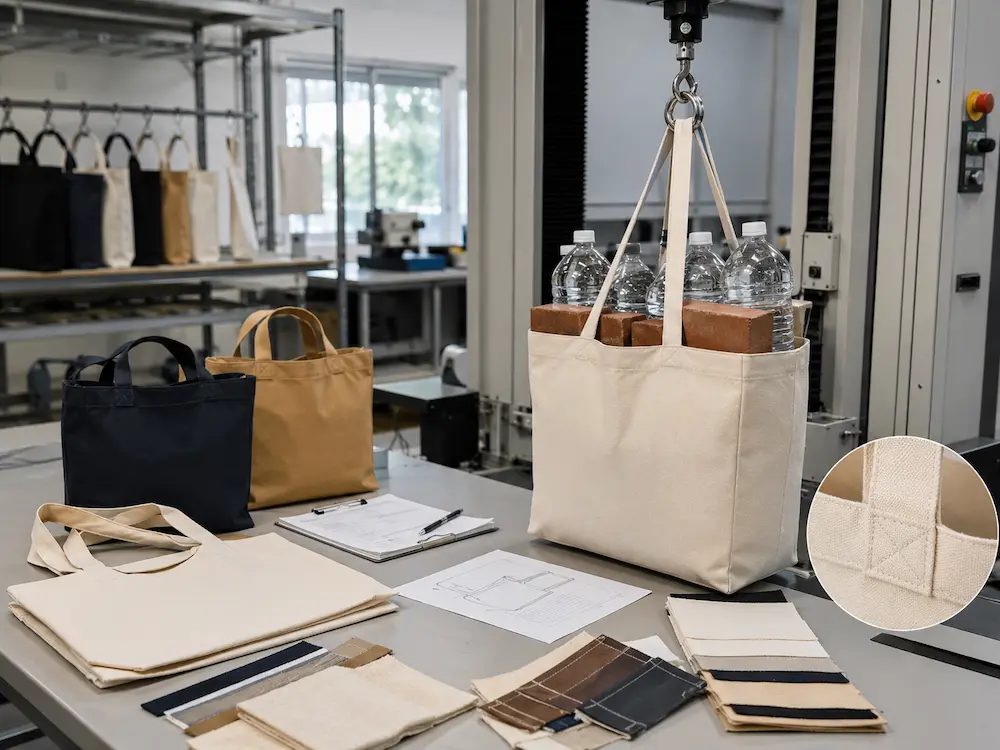
When buyers source tote bags, they often focus on logo printing, fabric colour, and unit cost. However, one of the most important performance factors is often overlooked: load capacity.
A tote bag may look attractive, but if it cannot comfortably carry the intended weight, customers will stop using it. This reduces customer satisfaction, damages brand perception, and weakens the value of the promotional investment.
Whether you are sourcing tote bags for retail stores, supermarkets, bookstores, trade shows, corporate gifts, or promotional campaigns, understanding tote bag load capacity helps ensure that the bag performs well in real-world conditions.
The amount of weight a tote bag can carry depends on much more than fabric thickness. Construction quality, handle attachment, stitching reinforcement, bag dimensions, and intended usage all play critical roles.
What Is Tote Bag Load Capacity?
Tote bag load capacity refers to the amount of weight a bag can safely and comfortably carry during normal use.
Load capacity is not simply the point at which a bag breaks.
Instead, it should be viewed as the weight range that allows:
- Comfortable carrying
- Safe handle performance
- Reliable stitching durability
- Long-term reuse
- Consistent customer experience
For example:
| Application | Typical Weight |
|---|---|
| Promotional literature | 2–4 kg |
| Trade show materials | 3–6 kg |
| Apparel shopping | 3–8 kg |
| Books and magazines | 5–10 kg |
| Grocery shopping | 8–15 kg |
| Heavy-duty retail use | 15 kg+ |
Different tote bag designs are suitable for different weight ranges.
Why Load Capacity Matters for Brands
Load capacity directly influences how customers perceive quality. A bag that tears under moderate weight creates a negative impression of the brand printed on it.
This is especially important for products such as custom logo tote bags for consistent visual identity, where the tote bag functions as a long-term branding tool.
If the bag remains useful for months or years, brand exposure continues. If the bag fails quickly, the marketing value disappears.
The Five Main Factors That Determine Tote Bag Strength
Most tote bag performance comes from five key elements:
| Factor | Influence on Capacity |
|---|---|
| Fabric Weight | High |
| Handle Construction | Very High |
| Stitching Quality | Very High |
| Bag Dimensions | Medium |
| Gusset Design | Medium-High |
Many buyers assume fabric weight alone determines strength. This is incorrect. A poorly stitched 12 oz canvas tote can fail earlier than a properly reinforced 8 oz canvas tote.
Fabric Weight and Load Capacity
Fabric weight is usually measured in ounces (oz) or GSM (grams per square metre).
Common tote bag fabric weights include:
| Fabric Weight | Approximate Use |
|---|---|
| 5 oz Cotton | Lightweight promotions |
| 6 oz Cotton | Trade shows and events |
| 8 oz Cotton | Everyday retail use |
| 10 oz Canvas | Reusable shopping |
| 12 oz Canvas | Heavy-duty retail |
| 14 oz+ Canvas | Premium grocery applications |
Generally speaking:
Higher fabric weight provides:
- Better tear resistance
- Better shape retention
- Greater durability
- Improved carrying performance
However, weight alone does not guarantee higher load capacity. Construction remains equally important.
Cotton vs Canvas Load Capacity
One of the most common sourcing questions is whether cotton or canvas carries more weight.
| Material | Typical Capacity |
|---|---|
| 5–6 oz Cotton | 3–6 kg |
| 8 oz Cotton | 5–8 kg |
| 10 oz Canvas | 8–12 kg |
| 12 oz Canvas | 10–15 kg |
| Heavy Canvas | 15 kg+ |
Products such as cotton tote bags for natural brand storytelling often perform very well for everyday use, while heavier canvas options are preferred for grocery and retail applications.
Canvas generally offers:
- Greater structural stability
- Better abrasion resistance
- Higher long-term durability
Cotton offers:
- Lower weight
- Softer feel
- Lower cost
- Easier folding
Why Handles Fail Before Fabric
In most tote bags, handles fail before the main body fabric. This is because handles experience concentrated stress.
Every kilogram carried transfers force directly into:
- Handle stitching
- Handle attachment points
- Upper side seams
Poor handle design can dramatically reduce carrying capacity.
Common handle problems include:
- Narrow attachment area
- Weak stitching
- Single-line sewing
- Low-quality thread
- Short reinforcement depth
Handle Construction Comparison
| Handle Type | Capacity Performance |
|---|---|
| Basic Cotton Strap | Standard |
| Reinforced Cotton Strap | Better |
| Canvas Self-Material Handle | Strong |
| Cotton Webbing Handle | Very Strong |
| Extended Body Handle Construction | Excellent |
The strongest designs typically extend the handle deeper into the bag body rather than attaching it only at the top edge.
The Importance of Stitching Reinforcement
Professional tote bag manufacturers use reinforcement techniques to increase load capacity.
Common methods include:
Cross Stitch Reinforcement
Creates multiple stress distribution points.
Box Stitch Reinforcement
Adds structural support around handle attachment areas.
X-Stitch Reinforcement
Common in heavy-duty tote bags.
Double Needle Stitching
Improves seam durability.
Load Capacity by Stitching Type
| Stitching Method | Relative Strength |
|---|---|
| Single Stitch | Basic |
| Double Stitch | Strong |
| Box Stitch | Stronger |
| Cross Stitch | Very Strong |
| Box + X Stitch | Maximum |
This is one reason why high-quality promotional products such as custom printed tote bags for impactful brand presence maintain performance even during repeated daily use.
How Bag Size Affects Carrying Capacity
Many buyers assume larger bags automatically carry more weight.
In reality, larger bags increase stress.
When bag dimensions increase:
- Fabric experiences greater tension
- Handles support larger leverage forces
- Bottom panels receive higher stress
Large bags therefore require stronger construction.
| Size Category | Typical Capacity |
|---|---|
| Small Tote | 3–6 kg |
| Medium Tote | 5–10 kg |
| Large Tote | 8–15 kg |
| Heavy Duty Grocery Tote | 15 kg+ |
Gusseted Tote Bags Carry More Efficiently
A gusset is the side or bottom panel that creates depth.
Benefits include:
- Better weight distribution
- Improved structural stability
- Reduced seam stress
- Increased volume
| Design | Capacity Performance |
|---|---|
| Flat Tote | Standard |
| Bottom Gusset | Better |
| Side Gusset | Better |
| Full Gusset | Best |
This is why grocery tote bags almost always use gusset construction.
Typical Load Capacity by Tote Bag Category
Promotional Tote Bags
Common range:
3–6 kg
Used for:
- Flyers
- Brochures
- Event materials
Retail Tote Bags
Common range:
5–10 kg
Used for:
- Apparel
- Accessories
- Consumer products
Grocery Tote Bags
Common range:
10–15 kg
Used for:
- Food
- Bottles
- Household items
Heavy-Duty Tote Bags
Common range:
15–20 kg+
Used for:
- Bulk shopping
- Books
- Trade inventory
Load Capacity and Printed Tote Bags
Printing itself does not significantly affect carrying capacity. However, some print methods may slightly stiffen the fabric surface.
Products such as tote bags printed for brand visibility and promotion maintain essentially the same carrying performance as unprinted bags when proper materials and stitching are used.
The load-bearing capability comes from construction rather than artwork.
Load Capacity and Personalised Tote Bags
Personalisation does not usually change weight performance.
Whether the bag features:
- Names
- Individual graphics
- Event artwork
- Corporate branding
the load capacity remains dependent on:
- Fabric weight
- Handle design
- Stitching quality
- Bag dimensions
This applies equally to personalised tote bags for distinct brand expression used for retail merchandise, gifts, and branded campaigns.
How Manufacturers Test Tote Bag Strength
Professional factories may perform several tests.
Static Load Test
Weight is placed in the bag for a specified period.
Dynamic Carry Test
Simulates walking and movement.
Handle Pull Test
Measures handle attachment strength.
Seam Strength Test
Evaluates seam durability under load.
Repeated Use Testing
Assesses long-term performance.
Real-World Load Capacity Examples
| Product Type | Recommended Weight |
|---|---|
| Exhibition Tote | 3–5 kg |
| Bookstore Tote | 5–8 kg |
| Fashion Retail Tote | 4–8 kg |
| Corporate Gift Tote | 4–7 kg |
| Grocery Tote | 10–15 kg |
| Heavy Duty Shopping Tote | 15–20 kg |
The correct specification depends on intended usage rather than appearance.
Common Buyer Mistakes
Choosing Based Only on Fabric Weight
Heavy fabric alone does not guarantee durability.
Ignoring Handle Reinforcement
Most failures begin at handle attachment points.
Using Promotional Bags for Grocery Applications
Promotional bags are not designed for heavy loads.
Oversizing Without Strengthening Construction
Larger bags need stronger engineering.
Skipping Sample Testing
Real load testing provides valuable insight before mass production.
Buyer Checklist Before Ordering
Before placing a bulk order, ask suppliers:
| Question | Why Important |
|---|---|
| What fabric weight is used? | Determines base strength |
| How are handles attached? | Major durability factor |
| Is cross stitching used? | Improves load capacity |
| Are gussets included? | Better weight distribution |
| Has load testing been performed? | Verifies performance |
| What application is recommended? | Matches customer usage |
How to Choose the Right Load Capacity
Choose based on actual use:
| Application | Recommended Construction |
|---|---|
| Trade Shows | 5–6 oz cotton |
| Corporate Events | 6–8 oz cotton |
| Fashion Retail | 8–10 oz cotton/canvas |
| Bookstores | 10 oz canvas |
| Grocery Stores | 12 oz canvas with gusset |
| Heavy Retail Use | 12–14 oz reinforced canvas |
The goal is not to maximize strength unnecessarily. The goal is to match construction to customer expectations. A lightweight promotional tote does not require the same reinforcement as a heavy-duty grocery bag, just as a premium retail tote may prioritize appearance and comfort over extreme load capacity. The most effective design balances durability, usability, and cost to suit the intended application. When construction matches real customer needs, the tote bag delivers better performance, stronger user satisfaction, and more efficient use of materials and production resources.
Conclusion
Tote bag load capacity is determined by a combination of fabric weight, handle design, stitching quality, bag dimensions, and reinforcement methods.
A well-constructed tote bag can safely carry significantly more weight than a poorly designed bag made from heavier fabric.
For brands, load capacity directly affects customer satisfaction, product longevity, and brand exposure. Whether sourcing promotional tote bags, retail merchandise, corporate gifts, or grocery bags, buyers should evaluate real carrying performance rather than focusing only on appearance or price.
The strongest tote bag is not always the thickest one. It is the bag whose materials, stitching, handles, and structure are designed to work together under real-world conditions.
FAQ
1. How much weight can a cotton tote bag carry?
Most cotton tote bags carry between 3 kg and 8 kg depending on fabric weight, handle construction, and stitching quality.
2. How much weight can a canvas tote bag carry?
Heavy canvas tote bags can typically carry 10–15 kg, while reinforced heavy-duty canvas designs may exceed 20 kg.
3. Do thicker tote bags always carry more weight?
No. Handle attachment, stitching reinforcement, and bag construction are often more important than fabric weight alone.
4. Are gusseted tote bags stronger?
Yes. Gussets improve weight distribution and reduce stress on seams, making the bag more stable under load.
5. Which part of a tote bag usually fails first?
The handle attachment area is usually the first point of failure if reinforcement stitching is insufficient.
References
- ASTM Textile Strength Testing Standards
- Cotton Incorporated Fabric Performance Guide
- Textile Exchange Material Durability Report
- ISO Textile Testing Methods Reference
- Reusable Shopping Bag Performance Standards Guide
- Industrial Sewing and Reinforcement Handbook
- Retail Packaging Durability Research Report
- International Textile Manufacturing Quality Manual
Professional Content Notice:
This article is part of the original packaging content developed by Xiamen Youngpack Imp.and Exp.Co.,Ltd. Please respect the originality of the work when sharing or referencing it.