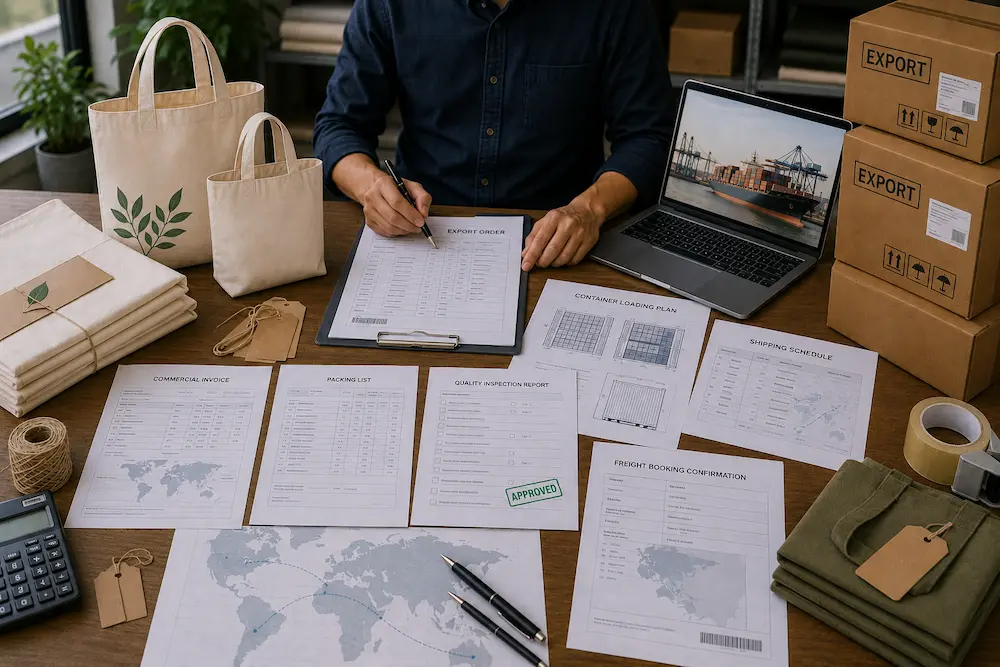
Importing custom tote bags can appear complicated for first-time buyers. Between production schedules, export documentation, shipping arrangements, and customs procedures, there are many moving parts that must work together successfully.
However, professional tote bag export projects generally follow a structured process that minimizes risk and helps products move efficiently from the factory to the final destination.
Understanding the complete export process allows international buyers to plan more accurately, avoid delays, reduce costs, and improve supply chain reliability.
Whether you are sourcing promotional tote bags, retail merchandise, reusable shopping bags, or branded corporate gifts, understanding each stage of the export journey is essential.
Why Understanding the Export Process Matters
Typical Tote Bag Export Workflow:
| Export Stage | Main Objective | Responsible Party |
|---|---|---|
| Inquiry & Quotation | Confirm specifications and pricing | Buyer & Supplier |
| Sampling | Approve quality and design | Supplier |
| Production Planning | Prepare materials and schedules | Factory |
| Mass Production | Manufacture products | Factory |
| Quality Inspection | Verify production quality | QC Team |
| Export Documentation | Prepare shipping paperwork | Exporter |
| International Shipping | Transport products overseas | Freight Forwarder |
| Customs Clearance | Import approval | Importer & Broker |
Many sourcing problems occur because buyers focus only on manufacturing.
In reality, exporting involves much more than production.
A successful tote bag export project requires coordination between:
- Product development
- Production planning
- Quality control
- Documentation
- Freight forwarding
- Customs clearance
- Final delivery
When one stage is overlooked, the entire schedule can be affected. Professional planning reduces delays and improves predictability.
Step 1: Product Inquiry and Quotation
Every export project begins with a detailed inquiry.
Buyers usually provide:
- Product dimensions
- Fabric requirements
- Printing artwork
- Quantity
- Packaging requirements
- Destination country
The supplier then prepares a quotation based on these specifications.
Products such as custom cotton tote bags supporting everyday brand use often require detailed discussions regarding fabric weight, handle construction, and printing methods before final pricing can be confirmed.
A clear quotation stage helps prevent misunderstandings later in the project.
Step 2: Sample Development and Approval
Typical Sample Development Timeline:
| Sample Type | Lead Time | Purpose |
|---|---|---|
| Stock Sample | 1–3 Days | Material evaluation |
| Custom Sample | 3–7 Days | Artwork and construction approval |
| Pre-Production Sample | 5–10 Days | Mass production confirmation |
Before mass production begins, buyers usually approve a sample.
The sample confirms:
- Material quality
- Printing appearance
- Dimensions
- Stitching
- Packaging details
Typical sample lead times range from:3–7 days
depending on complexity. Sample approval is one of the most important stages because production specifications become fixed after confirmation. Changes made later often create delays and additional costs.
Step 3: Production Planning
After sample approval, the factory begins production planning.
This stage includes:
- Material procurement
- Capacity scheduling
- Printing preparation
- Packaging preparation
Factories often reserve production lines in advance to ensure delivery schedules remain achievable.
Products such as custom canvas bags bulk for high-volume marketing campaigns may require dedicated production scheduling because larger volumes can significantly affect factory capacity planning.
Step 4: Mass Manufacturing
Mass production usually includes:Fabric Preparation Materials are inspected and prepared.
Printing
Artwork is applied using:
- Screen printing
- Digital printing
- Heat transfer
- Other decoration methods
Cutting:Fabric panels are cut according to approved dimensions.
Sewing
Factories assemble:
- Body panels
- Handles
- Gussets
- Pockets
- Closures
Finishing:Products undergo cleaning and thread trimming.
Typical mass production lead times:15–30 days depending on quantity and complexity.
Step 5: Quality Inspection
Quality control is critical for export projects.
Professional inspections often include:
- Dimension checks
- Fabric verification
- Print quality inspection
- Stitching inspection
- Packaging verification
Factories may perform:
- In-line inspections
- Final inspections
- Random sampling inspections
Products such as custom printed cotton tote bags for natural brand expression often receive additional print quality reviews because branding accuracy is particularly important. Quality inspections help identify issues before goods leave the factory.
Step 6: Export Packaging
After inspection, products move to packaging.
Common export packaging methods include:
- Bulk packing
- Individual polybags
- Paper sleeves
- Retail packaging
- Gift packaging
Export cartons are designed to:
- Protect products
- Maximize container utilization
- Reduce shipping damage
Carton markings usually include:
- Product codes
- Quantities
- Carton numbers
- Destination details
Proper packaging reduces transportation risks.
Step 7: Export Documentation
Essential Export Documents:
| Document | Purpose |
|---|---|
| Commercial Invoice | Transaction and customs declaration |
| Packing List | Carton and quantity information |
| Bill of Lading | Sea freight transport document |
| Air Waybill | Air freight transport document |
| Certificate of Origin | Country of manufacture verification |
| Insurance Certificate | Cargo protection document |
Documentation is one of the most important export stages.
Common documents include:
Commercial Invoice:Shows product descriptions, values, and transaction details.
Packing List:Provides carton and quantity information.
Bill of Lading:Issued by the shipping carrier.
Air Waybill:Used for air freight shipments.
Certificate of Origin:May be required in some countries.
Other Documents
Depending on destination requirements:
- Testing reports
- Compliance declarations
- Insurance documents
Accurate documentation helps prevent customs delays.
Step 8: International Shipping
International buyers generally choose between three shipping methods.
Express Courier
Transit time:3–7 days
Best for:
- Samples
- Small urgent shipments
Air Freight
Transit time:5–12 days
Best for:
- Medium-sized orders
- Time-sensitive projects
Sea Freight
Transit time:20–45 days
Best for:
- Large orders
- Cost-sensitive imports
Many buyers importing custom printed canvas bags for natural brand expression choose sea freight because freight costs become more economical at higher volumes.
Step 9: Customs Clearance
Upon arrival, shipments enter customs clearance procedures.
Requirements vary by country but generally include:
- Import documentation review
- Duty assessment
- Tax calculation
- Cargo release procedures
Buyers should understand:
- Local import regulations
- Product classifications
- Customs requirements
Working with experienced customs brokers often simplifies the process.
Step 10: Final Delivery
After customs clearance, products move to their final destination.
This may include:
- Distribution centers
- Warehouses
- Retail stores
- E-commerce fulfillment centers
Delivery timing depends on local transportation networks and destination locations. At this stage, the export process is complete.
Common Export Risks:Several issues can affect international sourcing projects.
Production Delays
Caused by:
- Material shortages
- Artwork changes
- Peak season demand
Documentation Errors
Incorrect paperwork may delay customs clearance.
Shipping Disruptions
Examples include:
- Port congestion
- Weather events
- Carrier schedule changes
Quality Issues:Insufficient inspections increase risk.
Customs Delays:Import procedures vary by country and may affect schedules. Understanding these risks allows buyers to plan more effectively.
How International Buyers Can Improve Export Efficiency
Finalize Specifications Early
Frequent changes increase delays.
Approve Samples Quickly
Faster approvals help maintain production schedules.
Plan Ahead
Allow sufficient time for:
- Production
- Inspection
- Shipping
- Customs clearance
Work with Experienced Suppliers
Professional suppliers help coordinate manufacturing and export processes.
Choose Appropriate Shipping Methods
Balance delivery speed and transportation cost.
Products such as printed cotton tote bags for brand visibility and promotion are often ordered for events and marketing campaigns where delivery timing is critical, making early planning particularly important.
Tote Bags and Related Textile Product Exports
Many suppliers export multiple textile product categories simultaneously.
For example, buyers sourcing tote bags may also purchase complementary products such as custom canvas drawstring bags for eco-friendly branding to consolidate shipments and improve freight efficiency.
Combining product categories can often reduce overall logistics costs.
Conclusion
The tote bag export process involves much more than manufacturing.
Successful international projects typically follow a structured workflow:
- Inquiry and quotation
- Sample development
- Production planning
- Manufacturing
- Quality inspection
- Export packaging
- Documentation preparation
- International shipping
- Customs clearance
- Final delivery
Understanding each stage helps international buyers reduce risks, improve planning accuracy, and build more reliable supply chains. For most buyers, the key to successful importing is early planning, clear communication, strong quality control, and working with experienced export suppliers.
How International Buyers Should Approach Tote Bag Imports
Export success depends on planning: Manufacturing is only one part of the process. Documentation, inspections, shipping, and customs procedures are equally important.
Quality control reduces risk: Thorough inspections before shipment help prevent costly problems after goods arrive.
Shipping strategy matters: Choosing the right transportation method can significantly affect both cost and delivery schedules.
The key takeaway: Buyers who understand the complete export workflow can make better sourcing decisions, improve delivery reliability, and build stronger international supply chains.
FAQ
1. What documents are required for tote bag exports?
Common export documents include the commercial invoice, packing list, bill of lading or air waybill, and sometimes certificates of origin or compliance documents.
2. How long does the tote bag export process take?
Production typically requires 15–30 days, while the complete process including shipping may take between 3 and 8 weeks depending on destination and transport method.
3. Which shipping method is most economical?
Sea freight is usually the most economical option for large-volume tote bag orders.
4. Why are quality inspections important before export?
Quality inspections help identify production issues before shipment and reduce the risk of receiving defective products.
5. How can buyers reduce export risks?
Early planning, clear specifications, fast sample approvals, quality inspections, and accurate documentation help minimize export risks.
References
- International Trade Documentation Guide
- Export Logistics Management Handbook
- Customs Compliance and Import Procedures Manual
- Global Supply Chain Planning Guide
- Freight Forwarding Best Practices Handbook
- Textile Product Export Standards Guide
- International Shipping and Incoterms Reference
- Quality Control for Export Manufacturing Manua
Intellectual Property Notice:
All original written content published here remains the intellectual property of Xiamen Youngpack Imp.and Exp.Co.,Ltd. Any unauthorized reuse is strictly prohibited.