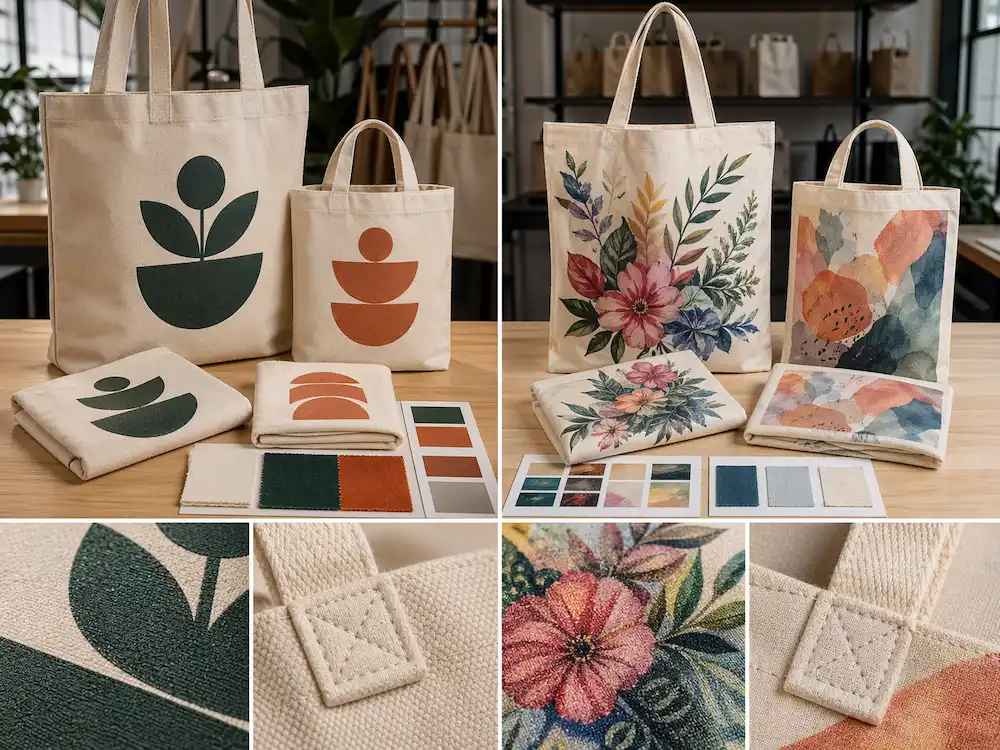
The comparison between screen printing vs digital printing on tote bags is one of the most important production decisions in branded bag sourcing because the print method affects much more than the logo. It changes unit cost, setup cost, artwork flexibility, lead time, color handling, and how the final product feels in real use. Many buyers make the mistake of choosing a print method only by price. That usually leads to the wrong result.
Screen printing is often the best answer when the artwork is simple, the color count is controlled, and the order volume is large enough to make setup worthwhile. Digital printing is often the best answer when the artwork is detailed, the quantity is small or mixed, and the design needs photo-like color variation or fast changes between versions. Neither is better in every case. The right answer depends on what the bag needs to communicate and how the job will be produced.
This is why print method should be chosen as part of the product strategy, not as a last technical detail after the bag is already designed.
What Screen Printing Actually Does Best
Screen printing usually works best for strong, clean, high-impact branding. It is especially effective when the design uses solid colors, simple shapes, clear logos, and repeatable artwork across a larger order. The print often looks bold and deliberate, which is one reason it remains so common in promotional, retail, supermarket, event, and reusable bag programs.
The main commercial strength of screen printing is efficiency at scale. Once the setup is complete, larger runs become more economical, especially when the design is not overly complicated. It is also well suited to canvas and cotton tote bags where the brand wants a crisp, visible logo rather than a photographic image.
That is why many larger branding programs eventually move toward products like custom printed tote bags, where simple, high-visibility graphics matter more than artwork complexity.
What Digital Printing Actually Does Best
Digital printing usually works best when the artwork is more detailed, more colorful, or more varied from bag to bag. It is especially useful for gradients, illustrations, full-color images, short-run retail designs, artist collaborations, limited-edition campaigns, and projects where the buyer does not want to pay screen setup costs for many colors.
Its biggest strength is flexibility. Digital printing can handle more complex artwork without the same setup burden as screen printing. That makes it attractive for smaller orders, highly visual campaigns, and design-led tote bag projects where the artwork is the main selling point.
This does not mean digital printing is always the premium answer. It means it is often the smarter answer when the design itself is more complex than the economics of screen printing can support efficiently.
The Core Difference: Setup Logic vs Artwork Freedom
The simplest way to understand the difference is this: screen printing favors repetition, while digital printing favors flexibility. Screen printing asks the buyer to commit to the design and quantity. Digital printing allows more artwork freedom with less setup burden, but usually with different economics at scale.
This is why the print method often reflects the business model. A promotional campaign with one logo across thousands of bags often points toward screen printing. A retail capsule collection with several illustrated designs or a smaller test run often points toward digital printing.
Once buyers understand this, many quoting problems disappear. The print method starts making sense because it matches the production logic of the project.
Artwork Complexity: Where Digital Usually Has the Advantage
If the artwork includes gradients, photographic effects, fine detail, multiple shades, or highly detailed illustration, digital printing usually has the advantage. Trying to force that kind of design through screen printing can be expensive, limited, or visually compromised, especially if the number of print colors becomes too high.
Digital printing allows the bag to carry more visual information without treating every color as a separate setup burden. That makes it especially useful for creative designs, artist-led retail, event graphics with rich image content, and any project where the branding is more expressive than just a logo.
In design-led retail, especially on premium reusable textiles, this becomes highly relevant for products like custom printed canvas tote bags, where the bag is expected to behave like a product, not only a carrier.
| Comparison Area | Screen Printing | Digital Printing |
|---|---|---|
| Best artwork style | Simple logos, solid colors, bold shapes | Detailed graphics, gradients, complex full-color designs |
| Best order size | Medium to large runs | Small to medium runs |
| Setup cost | Usually higher upfront | Usually lower upfront |
| Per-unit cost at scale | Usually stronger | Usually less efficient at very large scale |
| Color flexibility | More limited by color count | Much more flexible |
| Best commercial role | Repeatable branding and promotional scale | Art-led, short-run, or multi-design flexibility |
Color Handling: Spot Precision vs Full-Color Range
Screen printing is usually stronger when the brand depends on simple, controlled, repeatable spot colors. It can produce very clear logo presentation when the design is disciplined. This matters for corporate identities, supermarket reuse programs, exhibitions, schools, and broad promotional applications where the logo must look consistent and easy to read.
Digital printing is stronger when the design relies on many colors or tonal changes. It handles visual richness more naturally than screen printing. This is especially useful for illustration, nature-inspired patterns, multi-color retail graphics, and highly expressive promotional designs.
The better method depends on whether the project is color-controlled branding or visual storytelling. The artwork itself usually gives the answer.
Fabric Suitability and Print Behavior
Both methods can work on tote bags, but the bag material influences the result. Screen printing often works especially well on cotton and canvas because the print can sit boldly on the surface without relying on excessive image complexity. It is one reason branding-focused cotton and canvas projects remain strongly screen-printed across the market.
Digital printing can also work very well on cotton and canvas, especially when the fabric surface is even enough to support detailed image transfer. But the result still depends on fabric texture, color, and how the design interacts with the base material.
For a more natural and brand-led finish on reusable textiles, buyers often compare their options against custom canvas tote bags because the heavier material supports both print presence and product value. The choice between screen and digital should always be considered together with the fabric, not afterward.
Cost Structure: Why Order Quantity Changes Everything
This is where most tote bag printing decisions are won or lost. Screen printing usually carries a higher setup cost because each color and design preparation stage adds production work. But once the order is large enough, that setup becomes easier to spread across the quantity, making the per-unit cost more attractive.
Digital printing usually avoids much of that setup burden, which makes it very appealing for smaller orders or multi-design runs. But once the order becomes very large and the artwork stays simple, digital printing often loses its economic advantage.
The right cost question is not “Which print method is cheaper?” It is “Which print method is cheaper for this exact combination of artwork and quantity?”
| Cost Scenario | Usually Better Option | Main Reason |
|---|---|---|
| Small run, complex artwork | Digital printing | Lower setup burden and better artwork freedom |
| Large run, simple logo | Screen printing | Better unit economics after setup |
| Many colors, low quantity | Digital printing | No need to separate each color into setup cost |
| One or two colors, high quantity | Screen printing | Strong repeat efficiency |
Lead Time and Production Flexibility
Digital printing is often faster for shorter and more flexible runs because it reduces some of the preparation steps involved in screen-based production. This can be useful for urgent events, product tests, seasonal launches, and short-run promotional ideas.
Screen printing can still be very efficient in organized production, but it rewards planning. When the artwork is already approved and the order is large, it can run very effectively. But if the design changes repeatedly or multiple small variants are needed, screen printing becomes less convenient.
So if the project needs agility more than scale, digital often has the advantage. If the project needs stable repeat production more than design flexibility, screen often becomes the stronger long-term route.
Branding Strategy: Visual Impact vs Product Flexibility
Screen printing often creates stronger simple impact. The logo looks direct, bold, and easy to read. This is one reason it remains so common for awareness campaigns, large promotional distributions, and high-visibility reuse bags.
Digital printing often creates stronger design flexibility. The tote can support illustration, photography, rich color transitions, and more editorial or creative brand expression. This makes it especially useful for retail, lifestyle products, museum merchandise, creative events, and artist collaborations.
For more identity-driven programs, especially where the customer should feel the bag reflects their own taste or the brand’s visual personality, products like personalised tote bags often align more naturally with digital printing because the value sits heavily in artwork individuality rather than only repeat logo visibility.
When Lightweight Bag Formats Affect the Decision
Sometimes the comparison is not happening on classic totes alone. It can also extend to adjacent products like lightweight drawstring bags and hybrid promotional formats. These often favor simpler or more flexible printing depending on the artwork and order logic.
For example, cotton drawstring bags may work very well with screen printing if the artwork is simple and the order is high-volume, but digital may become more attractive when the design is more illustrative or when the quantity is limited.
The lesson is the same. The print method should follow the product role, not just the bag category name.
When Screen Printing Is Usually the Better Choice
Screen printing is usually the better choice when the order is large, the logo is simple, the brand wants bold clean visibility, and the bag is part of a repeatable promotional or retail program. It is especially strong for exhibitions, supermarkets, schools, nonprofit campaigns, conferences, company giveaways, bookstore branding, and long-run reusable bag production where artwork consistency matters more than image complexity.
It also makes more sense when the buyer wants a stable print route that can be repeated across future production with similar design logic.
When Digital Printing Is Usually the Better Choice
Digital printing is usually the better choice when the order is smaller, the design is visually rich, the brand wants more artwork freedom, or the project needs quicker setup and easier short-run flexibility. It is especially strong in limited-edition retail, boutique merchandising, artist collaborations, museums, lifestyle products, and test campaigns where each design matters as much as the bag itself.
It also makes more sense when the bag is being sold as a product, not only distributed as a promotion, because the visual design can carry more product value in its own right.
How Buyers Should Choose the Right Supplier
The right supplier should not just ask for a logo file and quantity. They should ask what the bag is for, how many colors are involved, whether the design is fixed or variable, what fabric is being used, and whether the order will repeat in the future. A serious supplier should explain when screen printing is more sensible and when digital printing is simply the better route.
Buyers should compare suppliers by artwork judgment, fabric knowledge, sample quality, color discipline, and whether the recommendation actually matches the commercial purpose of the bag. The stronger partner is not the one that pushes only one print route. It is the one that can explain why a specific route fits this exact project better.
This is where Youngpack-style sourcing logic matters. The best result usually comes from choosing the print method that matches both the design and the business model, not just the lowest unit quote.
Conclusion
The answer to screen printing vs digital printing on tote bags is not universal. Screen printing usually wins when the artwork is simple, the quantity is high, and the project depends on bold, repeatable visibility. Digital printing usually wins when the design is complex, the run is smaller, and the bag needs more visual flexibility or faster setup.
The better print method is the one that fits the artwork, the quantity, and the role of the bag at the same time. Buyers who define those three factors clearly usually make the right decision. Buyers who choose only by habit often do not.
How Buyers Should Think About Screen Printing vs Digital Printing on Tote Bags
What this comparison really measures: Screen printing and digital printing are not just production techniques. They represent two different ways of building value into a tote bag. Screen printing usually supports repeatable bold branding at scale. Digital printing usually supports visual freedom, lower setup burden, and greater flexibility for complex designs.
Why buyers often choose the wrong one: The most common mistake is choosing based only on price without matching the method to the design. A complex illustration forced into screen printing can become expensive or visually compromised. A simple high-volume logo project handled digitally can become less efficient than it needs to be. The better method is usually obvious once the buyer defines artwork, quantity, and product role together.
How buyers should compare the two properly: The strongest comparison method is to evaluate order size, color count, design detail, repeat-order plans, and fabric type at the same time. A trade show giveaway, a museum tote, a bookstore product, and an artist collaboration may all be printed tote bags, but they do not need the same production route.
Options businesses usually weigh: Most buyers compare large-run repeat efficiency against short-run flexibility, bold simple visibility against full-color expression, and lower unit cost at scale against lower setup cost at small quantity. The better option depends on whether the bag is mainly solving a brand reach problem or a design expression problem.
Considerations before bulk approval: Before placing the order, businesses should check how the artwork behaves on the real fabric, compare actual sample quality, and make sure the print route still makes sense at the intended quantity. They should also consider whether the design might change across versions, because that can quickly shift the economics in favor of digital printing. A real sample usually clarifies the decision faster than quoting alone.
The broader takeaway: The best tote bag printing method is the one that matches the product strategy, not just the artwork file. That is also where Youngpack naturally fits as a B2B manufacturing and export partner for brands comparing tote bag print methods while needing practical guidance on quantity, branding, and long-term product performance.
FAQ
1. Is screen printing better than digital printing for tote bags?
Not always. Screen printing is usually better for large runs, simple logos, and bold solid-color branding because it becomes more economical at scale and gives strong visual impact. Digital printing is usually better for small batches, detailed artwork, and full-color designs because it allows more flexibility without heavy setup cost. The better option depends on quantity, artwork complexity, and the role of the bag.
2. Why is screen printing often cheaper for large orders?
Screen printing often becomes cheaper for large orders because the setup cost is spread across more units. Once the screens are prepared, repeating the same design across a high quantity usually lowers the effective cost per bag. This is especially true when the artwork is simple and uses only a limited number of colors. That is why screen printing remains common for large promotional and retail programs.
3. When should buyers choose digital printing on tote bags?
Buyers should usually choose digital printing when the order is smaller, the design has many colors or fine details, or the project needs greater artwork freedom. Digital printing is especially useful for illustrations, photo-style designs, short-run retail collections, artist collaborations, and test campaigns where screen setup would be too limiting or too expensive for the quantity involved.
4. Which print method lasts longer on tote bags?
Durability depends on the print quality, fabric type, and how the bag is used. A well-executed screen print is often very durable and can handle repeated use very well, especially for simple logos on cotton or canvas. Digital prints can also perform well when produced properly, but their long-term feel and wear behavior may differ depending on the ink and fabric combination. The key issue is production quality, not only the printing label.
5. What should buyers check before choosing screen or digital printing?
Buyers should check artwork complexity, color count, order volume, fabric type, budget logic, and whether the design may change between versions. They should also test a real sample if the bag is important to branding or retail presentation. The strongest print decision usually becomes obvious once the buyer defines whether the bag needs repeatable visibility or more flexible graphic expression.
References
- Preferred Fiber and Materials Market Report — Textile Exchange — Textile Exchange.
- Textiles and the Environment — European Environment Agency — EEA.
- Green Guides for the Use of Environmental Marketing Claims — Federal Trade Commission — FTC.
- Sustainable Packaging Guidelines — Australian Packaging Covenant Organisation — APCO.
- Fashion on Climate — Global Fashion Agenda and McKinsey & Company.
- Responsible Sourcing and Product Communication in Textile Supply Chains — industry trade reference.
- Retail Packaging and Reusable Bag Sourcing Best Practices — professional sourcing reference.
- Guide to Reusable Bags and Long-Term Use Value — industry best-practice sourcing reference.
Copyright Notice:
All content on this page is the property of Xiamen Youngpack Imp.and Exp.Co.,Ltd. and is protected by copyright. Unauthorized use or reproduction is not permitted.