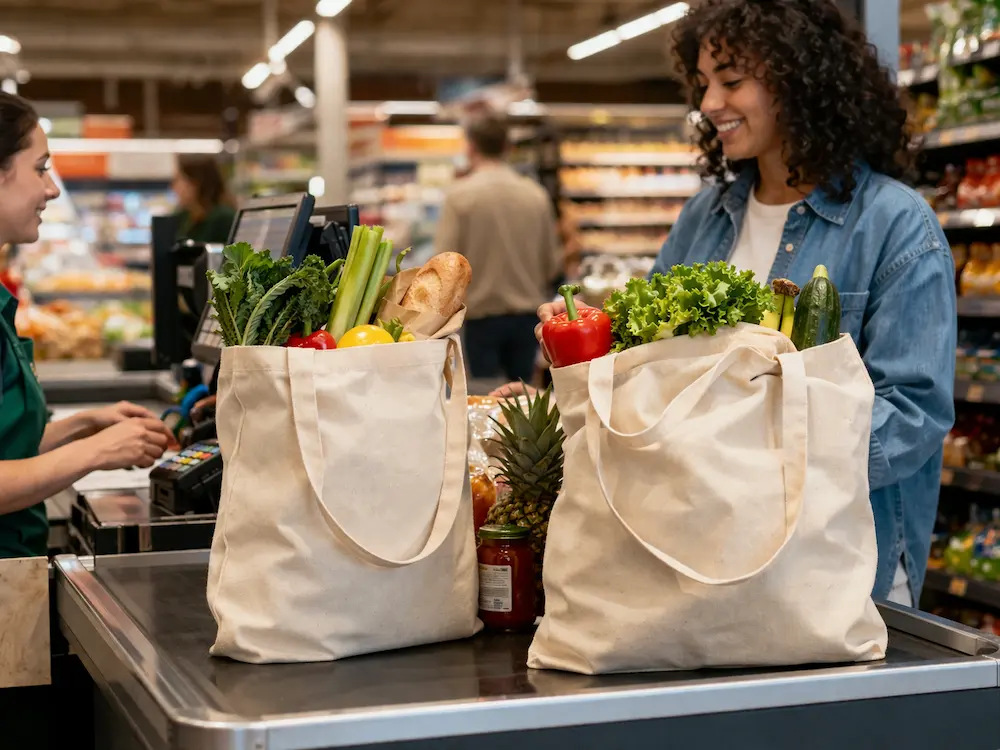
Reusable shopping tote bags have become a practical necessity for supermarkets, not just a branding extra. As retailers reduce dependence on single-use packaging and shoppers become more used to carrying their purchases in long-life bags, supermarkets need bag designs that perform under real load, fit fast checkout operations, and still look good after repeated use. That changes the buying decision completely. The right bag is no longer just a low-cost packaging item. It is part of store operations, customer experience, and brand visibility.
Supermarket tote bags face harder conditions than many other reusable bags. They carry mixed groceries, boxed goods, bottles, produce, and household items. They need to open quickly at checkout, hold shape well enough for easy packing, and remain comfortable in the hand when the basket is heavier than expected. A bag that looks fine in a showroom sample may fail quickly if the fabric is too soft, the handles are not reinforced, or the gusset is too narrow for real supermarket use.
That is why supermarkets should think about tote bags in the same way they think about other retail infrastructure. The right design improves convenience, supports reusability, strengthens customer perception, and creates repeated public brand exposure. The wrong design creates complaints, replacement cost, and weakens the whole sustainability message. For some retailers, that also means comparing standard grocery-style bags with more structured options such as custom canvas bags with logo when the bag is expected to function as both a practical shopping tool and a stronger branding asset.
What Supermarkets Really Need from Reusable Shopping Tote Bags
Supermarkets do not need generic tote bags. They need bags designed around supermarket behavior. That means the bag should handle mixed products, support quick filling at checkout, store efficiently before use, and survive regular repeat trips. In practical terms, the best design is usually the one that balances load capacity, shape, comfort, and cost rather than focusing too heavily on any one feature alone.
Some supermarkets use reusable tote bags mainly as a low-cost branded add-on. Others want them to become a visible part of the store identity. Some bags are sold near checkout as reusable shopping solutions. Others are used in promotions, loyalty rewards, or seasonal campaigns. These different commercial roles affect the best design choice. A basic bag for broad distribution will not be identical to a stronger bag meant for everyday customer reuse.
That is also why many buyers eventually move beyond generic stock products and evaluate custom made tote bags when they want the supermarket bag to reflect a more specific store identity, price tier, or customer lifestyle positioning.
Why Design Matters More in Grocery Use Than in General Promotions
A tote bag used in a supermarket has to work harder than a tote bag handed out at an event. Grocery bags carry uneven weight. A customer may put fruit, bottles, cartons, cleaning items, and chilled products in the same bag. That creates pressure on the bottom seam, handle attachment, gusset width, and overall body stability. If the design is too light or too narrow, the bag may technically carry the load once, but it will not feel dependable enough for long-term reuse.
Supermarket customers also care about speed and convenience. Bags that collapse too easily can slow checkout. Bags with short or awkward handles are less comfortable when carrying heavier groceries. Bags with insufficient depth may not accommodate standard store purchases well. Design is therefore not only about appearance. It directly affects how the bag functions during the shopping trip.
This is one reason stronger constructions such as cotton canvas tote bags are often considered for supermarket programs that want better durability, stronger everyday carry performance, and a more dependable reusable product than thinner general-purpose totes.
Best Materials for Supermarket Reusable Tote Bags
Material choice determines much of the bag’s performance. Cotton, canvas, recycled cotton blends, and other cloth-based structures are all used in reusable shopping programs, but they do not deliver the same result. Supermarkets should think about material in terms of load performance, softness, washability, print behavior, and cost efficiency.
Lighter cotton or cloth bags may work well for everyday casual carry, light basket purchases, or value-oriented promotions. They are easy to fold, easy to store, and often carry a softer, more natural visual message. For supermarkets that want a simpler reusable option with easier everyday handling, cotton tote designs can still be a useful reference point, especially when the bag is intended for lighter grocery use, pharmacy-style shopping, or softer brand presentation.
Canvas, however, is often the stronger option for supermarket environments because it offers better structure, stronger body feel, and more confidence under load. A heavier cotton-canvas construction can make a big difference when customers are carrying mixed groceries rather than light promotional materials. Recycled blends may also work well where sustainability messaging is important, but they should still be evaluated on strength and consistency rather than on environmental story alone.
| Material Type | Typical Use in Supermarkets | Main Benefit | Main Limitation |
|---|---|---|---|
| Light cloth or cotton | Light shopping, promotional reuse, community programs | Lower cost, easy storage, softer feel | Less structure for heavier grocery loads |
| Standard cotton | General everyday reuse | Balanced cost and usability | May feel too soft for heavier supermarket baskets |
| Heavy canvas | Full grocery use, repeat retail carry | Better strength and longer use life | Higher material and freight cost |
| Recycled cotton blend | Sustainability-led retail programs | Supports responsible brand story | Possible texture and shade variation |
Best Structural Designs for Supermarket Tote Bags
The strongest supermarket tote bag designs are usually the ones that solve practical problems first. That means sufficient width, useful depth, a stable base, comfortable handles, and construction that does not twist or collapse too easily when loaded.
Wide Gusset Designs
Gussets are critical in grocery use because they determine how well the bag can open, stand, and hold boxed or bulky items. A bag without enough side or bottom gusset may technically carry products, but it will be harder to pack efficiently and less stable when standing on a counter or in a car.
Reinforced Handle Attachment
Handles are the most common failure point in reusable shopping bags. Supermarket buyers should look for strong cross-stitching, reinforced handle seams, and handle length that works both in-hand and over-the-forearm for heavier loads. A strong body with weak handles is still a weak bag.
Flat Base or Structured Bottom
A stable base helps the bag stand open during packing and reduces product shift during transport. This is especially useful in supermarkets where checkout speed matters. Bags that open naturally and stay stable during packing are easier for staff and customers alike.
Comfortable Everyday Form
The bag also needs to feel easy to reuse outside the store. Customers are more likely to keep bringing it back if it works well beyond one shopping trip. That is why the best supermarket tote bag is often not the most decorative design, but the one that feels easiest to use week after week.
How Printing and Branding Should Work in Supermarket Programs
Supermarket tote bags are not only functional. They are also mobile brand surfaces. Once customers leave the store, the bag continues to represent the supermarket in public spaces. That gives supermarkets a valuable branding opportunity, but only if the design is durable enough and the print is clear enough to stay presentable over time.
Simple, bold branding often works best. Grocery environments do not usually need complicated visual design. They need logos, store colors, and perhaps a short message that remains clear after repeated use. Print should support the bag, not overload it. If the design is too crowded, too fine, or too delicate, it may lose impact once the bag enters real daily use.
Some supermarkets also want the bag to look more premium or more lifestyle-driven, especially if the store targets higher-value shoppers or natural and organic positioning. In those cases, the bag can move beyond simple store packaging and become part of a stronger visual retail identity.
Cost Structure and Bulk Buying Logic for Supermarkets
Supermarket buyers rarely buy reusable bags in small numbers. They need larger, more stable supply programs. That changes the cost logic. Unit price matters, but so do storage efficiency, repeat-order consistency, freight density, and how long the bag actually stays in use.
Fabric weight, gusset size, handle reinforcement, print coverage, and order quantity all affect cost. A larger bag with stronger construction naturally costs more than a basic light tote. But the correct comparison is not always between cheaper and more expensive. It is between lower-cost short-life bags and slightly stronger bags that create better customer satisfaction and more repeat use.
For chain supermarkets, regional retail groups, and large-scale promotional rollouts, sourcing cotton tote bags bulk or similar repeat-use bag programs often makes more commercial sense once the required size, structure, and branding are already defined. Large-scale distribution works best when the specification is stable enough to support consistent production and predictable replenishment.
| Cost Driver | Effect on Supermarket Program | Practical Buying Consideration |
|---|---|---|
| Fabric weight | Heavier fabric raises cost but improves strength | Match weight to real grocery loads |
| Gusset and size | Larger bags use more material and carton space | Avoid oversizing if the basket profile is moderate |
| Handle reinforcement | Improves performance but adds labor | Usually worth it in grocery use |
| Printing | More colors and coverage raise setup cost | Keep branding commercially practical |
| Order volume | Higher volume often reduces unit cost | Plan against store rollout and warehouse capacity |
Packing Efficiency and Store Operations
One mistake supermarket buyers make is evaluating the bag only as a product and forgetting the operational side. The bag also needs to store efficiently in back rooms, work at checkout counters, and move through distribution without creating unnecessary volume or handling problems.
Heavier reusable bags naturally take more storage space than lighter single-use packaging. That does not make them a bad decision, but it does mean carton count, folded size, and replenishment planning should be considered early. A bag that works perfectly for the customer but causes ongoing storage inefficiency for the retailer still has a hidden cost.
The strongest suppliers help supermarkets think about both the customer-facing and the warehouse-facing side of the bag program. That includes how the bag folds, how many fit per carton, how the print is protected in shipping, and how easy the bags are to distribute across multiple store locations.
How Supermarkets Should Evaluate Suppliers
A supermarket tote bag supplier should do more than quote by size and quantity. They should ask how the bag will be used, what the average basket weight looks like, whether the program is for resale or promotion, how many stores are involved, and whether the bag needs to fit a premium, value, or sustainability-focused brand position.
Supermarkets should evaluate suppliers across material clarity, construction standards, sampling discipline, print control, export readiness, and repeat-order stability. A good supplier should be able to explain why a certain fabric, gusset size, handle method, or packing style makes sense. A weaker supplier often only confirms that they “can do it” without explaining whether it is actually the best choice.
This is where Youngpack-style supplier logic matters. The right manufacturing partner is usually the one that can connect bag design, load logic, printing, packing, and repeat supply into one stable supermarket program rather than simply competing on headline price.
Common Design Mistakes Supermarkets Should Avoid
The first mistake is underestimating load. Grocery bags often end up carrying more than expected. The second is using a bag shape designed for general retail rather than for food and household shopping. The third is focusing only on appearance and forgetting operational convenience. The fourth is overcomplicating the print. The fifth is choosing a bag that looks sustainable in concept but is not durable enough to stay in real use.
Another common mistake is treating every store format the same. A supermarket, premium food hall, discount grocery chain, and neighborhood organic store may all need reusable shopping bags, but not the same one. Good design should reflect real store behavior and customer expectations, not just internal purchasing templates.
Conclusion
The best reusable shopping tote bags for supermarkets are the ones that make shopping easier, hold up under real load, and remain useful enough for customers to keep using them again and again. That means strong materials, sensible dimensions, stable gussets, reinforced handles, and branding that still looks good after repeat trips.
For supermarkets, the right bag is not simply a reusable version of an old shopping bag. It is a retail tool that affects checkout efficiency, customer convenience, sustainability perception, and long-term brand visibility. Buyers who treat the tote bag as part of store infrastructure usually make better decisions than those who treat it as a low-priority packaging item.
The strongest supermarket bag program is not built around the cheapest possible unit. It is built around the most suitable design, supplied consistently, at the right scale, with a structure that supports real grocery use and long-term customer retention. That is the standard a supplier like Youngpack should be expected to meet.
How Supermarkets Should Think About Reusable Shopping Tote Bags
What these bags really are: Reusable shopping tote bags are not only supermarket packaging. They are part of checkout operations, part of customer convenience, and part of long-term brand visibility. The best supermarket bag behaves like a reliable retail tool rather than a short-life promotional item.
Why design matters so much: Grocery shopping places more pressure on a bag than many buyers expect. Mixed product loads, quick packing, repeated carry, and public reuse all test whether the bag’s structure is genuinely fit for supermarket use. That is why handles, gussets, and fabric strength are just as important as branding.
How buyers should compare options: The strongest comparison method is to evaluate supermarket basket profile, expected load, checkout speed, storage efficiency, and brand positioning together. A bag that works well for an organic neighborhood market may not be the right answer for a large discount grocery chain, even if both stores want reusable bags.
Options supermarkets usually weigh: Buyers often compare lighter cotton bags against heavier canvas structures, promotional-use totes against long-life grocery bags, and low-cost distribution models against more durable resale or loyalty-driven programs. The best option depends on whether the bag is meant to solve a simple packaging need or become a visible, repeat-use retail asset.
Considerations before scaling up: Before moving into larger volume purchasing, supermarkets should verify real load performance, bag opening and packing behavior, handle comfort, carton efficiency, and whether the supplier can maintain consistent quality across repeat orders. Those details determine whether the bag program stays commercially useful or becomes a source of operational friction.
The broader takeaway: A strong supermarket tote bag program is built around real shopping behavior. The best results come from choosing a bag that customers want to keep using, staff can pack quickly, and the retailer can reorder with confidence. That is also where Youngpack fits naturally as a B2B manufacturing and export partner for supermarket and retail bag programs that need customization, durability, and stable supply support.
FAQ
1. What is the best material for reusable shopping tote bags in supermarkets?
The best material depends on how heavy the average shopping load is and how long the retailer expects the bag to stay in use. Standard cotton can work for lighter everyday shopping and soft brand presentation, while heavier canvas is usually better for full grocery use, stronger repeat carry, and higher perceived durability. The better choice is the one that matches actual supermarket behavior rather than just price or appearance.
2. Why are gussets so important in supermarket tote bag design?
Gussets matter because they affect how well the bag opens, stands, and carries bulky or boxed groceries. A bag with a useful side or bottom gusset is easier to pack at checkout and usually feels more stable during transport. Supermarket bags without enough gusset may still carry products, but they tend to be less efficient and less convenient in real grocery use.
3. Should supermarkets choose cotton or canvas tote bags for repeat shopping use?
Cotton can work well when the supermarket wants a softer, lighter reusable bag for moderate shopping needs or promotional use. Canvas is usually the stronger choice when the bag must carry heavier groceries and survive repeated weekly use. Supermarkets should compare average basket weight, customer expectations, and branding goals before deciding which structure is more appropriate.
4. How should supermarkets buy reusable shopping tote bags in bulk?
Supermarkets should buy in bulk only after the bag’s size, fabric, gusset, handle construction, and print requirements are clearly defined. Bulk buying improves cost efficiency and supply consistency when the specification is stable, but it can create waste if the design is not properly tested first. The best approach is usually to confirm samples under real load conditions and then scale the order based on store count, turnover, and warehouse capacity.
5. What should buyers check before approving a supermarket tote bag supplier?
Buyers should check material clarity, handle reinforcement, stitching quality, print consistency, sample accuracy, packing method, lead time reliability, and repeat-order stability. A strong supplier should be able to explain why a certain bag design suits grocery use, not just confirm that it can be produced. The goal is to choose a supplier that understands both product performance and supermarket operations.
References
- Green Guides for the Use of Environmental Marketing Claims — Federal Trade Commission — FTC.
- Preferred Fiber and Materials Market Report — Textile Exchange — Textile Exchange.
- Textiles and the Environment — European Environment Agency — EEA.
- Sustainable Packaging Guidelines — Australian Packaging Covenant Organisation — APCO.
- Fashion on Climate — Global Fashion Agenda and McKinsey & Company.
- Retail Packaging and Reusable Bag Sourcing Best Practices — professional retail and sourcing reference.
- Responsible Sourcing and Product Communication in Textile Supply Chains — industry trade reference.
- Guide to Reusable Bags and Long-Term Use Value — industry best-practice sourcing reference.
Intellectual Property Notice:
All original written content published here remains the intellectual property of Xiamen Youngpack Imp.and Exp.Co.,Ltd. Any unauthorized reuse is strictly prohibited.