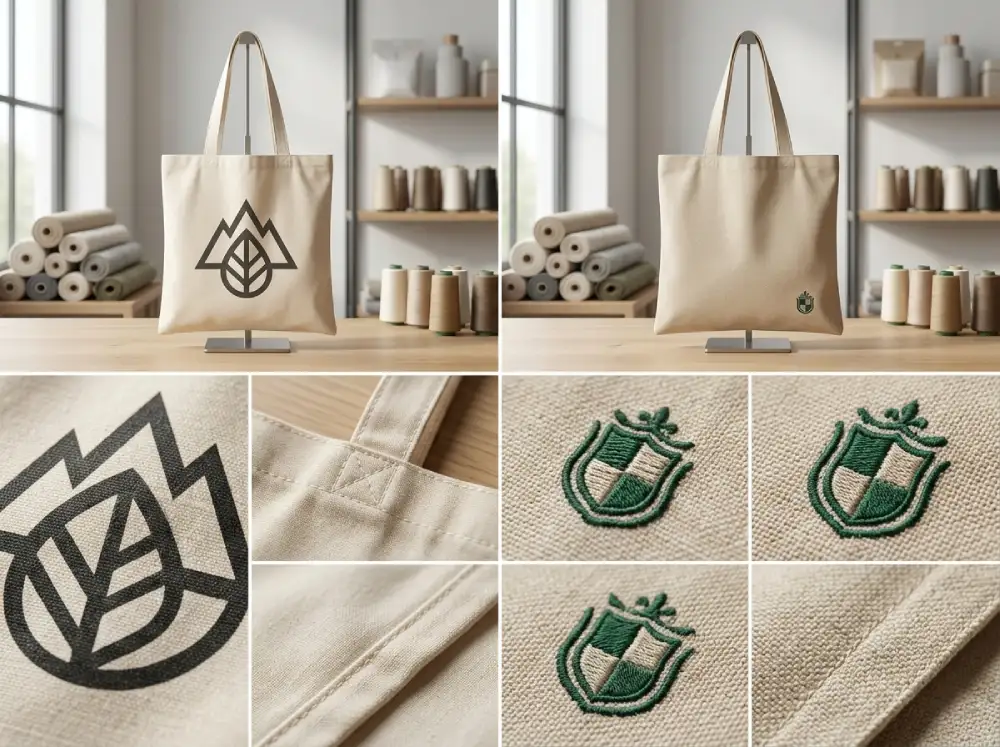
The choice between printed vs embroidered tote bags is one of the most practical decisions in branded bag sourcing. Both methods can work well, and both can go badly wrong if they are matched with the wrong fabric, artwork, or business goal. Buyers often treat the decision as a simple design preference, but it is much more than that. It changes the look, feel, cost, lead time, and even the market position of the finished bag.
A printed tote bag usually works best when the brand wants clear graphics, bold logos, larger artwork, or efficient volume production. An embroidered tote bag usually works best when the brand wants texture, a more premium feel, and a cleaner, more understated logo treatment. Neither is automatically better. The right choice depends on what the bag is expected to do after it reaches the customer.
This matters because a tote bag is rarely just a bag. It may be a promotional item, a retail product, an event gift, a branded reusable shopping bag, or part of a larger merchandise system. The decoration method should support that purpose, not fight against it.
What Printed Tote Bags Usually Do Better
Printed tote bags usually excel when the design needs visibility, scale, and graphic flexibility. If the artwork includes larger logos, slogans, illustrations, or stronger color coverage, printing is often the more practical choice. It is especially useful for exhibitions, events, retail promotions, campaigns, school programs, supermarket reuse bags, and high-volume branded distribution where the bag must communicate clearly from a distance.
Printing also offers more freedom in artwork size and placement. It is easier to create broader front-panel branding, stronger campaign graphics, and more obvious retail messaging with print than with embroidery. This is one reason many large-volume programs are built around products such as custom printed tote bags, where the bag’s main role is visible brand presence rather than subtle decoration.
For many marketing-led bag projects, printing is not just the cheaper choice. It is the more strategically appropriate one because the bag needs to function as a moving advertisement as much as a carrying product.
What Embroidered Tote Bags Usually Do Better
Embroidery usually performs better when the brand wants a more refined and product-like finish. A stitched logo often feels more durable, more tactile, and more premium than a simple print, especially when the artwork is relatively small and clean. Embroidery can also help the bag feel more like merchandise or a gift item rather than a standard promotional carrier.
This is especially useful in corporate gifting, employee merchandise, boutique retail, premium event kits, campus merchandise, and fashion-adjacent products where the bag itself should feel elevated. Embroidery usually works best for smaller marks rather than large graphics. A simple monogram, brand icon, or understated wordmark can look strong in embroidery if the base bag quality supports it.
The mistake is using embroidery just because it sounds premium. If the artwork is too large, too detailed, or too aggressive, embroidery can make the bag heavier, more expensive, and less visually clean than a well-executed print would have been.
How Artwork Style Changes the Decision
Artwork is one of the clearest filters in this comparison. Large logos, complex illustrations, multiple colors, campaign slogans, and detailed graphics usually point toward printing. Small logos, clean monograms, short text marks, and brand icons usually point more naturally toward embroidery.
This is not only a technical limitation. It is also a brand-positioning issue. Printing usually creates stronger visual reach. Embroidery usually creates stronger product perception. If the bag needs to shout, print usually wins. If the bag needs to look quietly high-quality, embroidery often wins.
That is why buyers should never choose decoration method before reviewing the actual artwork. The design should drive the method, not the other way around.
Which Method Works Better on Different Tote Bag Materials?
Not every tote bag material supports print and embroidery equally well. The base bag changes everything. A light cotton bag behaves differently from a structured canvas bag. A soft lightweight fabric may print beautifully but feel less suitable for embroidery if the stitching pulls or distorts the surface. A heavier canvas bag may support embroidery more comfortably because the structure can absorb the stitching with better visual stability.
For brands that want a stronger reusable product with clean, visible branding, custom printed canvas tote bags are often the most direct solution because canvas gives printing a stable base while still keeping the finished bag visibly durable and reusable. At the same time, premium canvas can also work well for embroidery when the logo is small enough and the bag is positioned more like branded merchandise.
| Bag Material | Printing Performance | Embroidery Performance | Best Fit |
|---|---|---|---|
| Light cotton | Very strong for simple and bold prints | Can work for small logos, but may distort | Promotions, light retail, events |
| Standard cotton | Strong all-round print base | Good for moderate logo embroidery | Everyday reusable bags |
| Canvas | Excellent for durable visible branding | Strong for premium smaller logos | Retail, merchandise, premium reuse |
| Very soft or lightweight fabrics | Usually better with print | More limited unless logo is very controlled | Lightweight carry and giveaways |
Cost: Printing Usually Wins on Efficiency
Printing usually wins on cost when the order is larger and the bag is intended for broad distribution. It is generally more efficient for medium to large artwork, especially when the design is simple enough to suit screen printing or other scalable print methods. The more pieces the buyer orders, the more commercially sensible printing usually becomes.
Embroidery is often more expensive because it adds stitching time, thread use, and tighter production limitations. The cost rises even more if the logo is larger, more detailed, or placed in difficult positions. For this reason, embroidery often makes sense when the order volume is smaller, the logo is compact, or the premium value of the final bag justifies the added cost.
When the order is a large campaign and the bag’s job is broad brand reach, buyers often compare directly against options like custom canvas tote bags with print-based branding, because at that scale the economics of embroidery become much harder to justify unless the logo is extremely minimal and the product position is high enough.
Perceived Value: Embroidery Often Feels More Premium
Perceived value is where embroidery often outperforms print. A stitched logo generally feels more intentional and more durable, especially to customers who associate embroidery with apparel, premium accessories, and longer-life merchandise. Even a very small embroidered mark can make the bag feel more expensive.
But perceived value should not be confused with universal superiority. A cheap bag with embroidery can still feel mismatched if the base product quality is weak. A well-made printed bag can still feel premium if the design is well judged and the bag material is strong enough. The decoration method is only one part of the whole impression.
Still, if the brand wants the tote bag to feel closer to a gift item or a retail product than to a campaign handout, embroidery often gives that shift more effectively than printing.
Durability: Which Holds Up Better Over Time?
Embroidery usually has the advantage in perceived decoration durability because thread does not fade or crack the way some poor-quality prints can. If the logo is stitched properly and the bag fabric is stable enough, embroidery can remain visually strong through long-term use.
Printing durability depends heavily on the print method, ink quality, bag fabric, and how the bag is washed or handled. A well-executed print on the right fabric can still hold up very well. But poor printing is usually more obvious over time than poor embroidery. It may crack, fade, or lose sharpness faster if the product was not produced properly.
That said, embroidery is not risk-free. On thin or soft fabrics, it can distort the panel or create puckering if the stabilisation is poor. So the better durability answer still depends on whether the decoration method suits the bag itself.
Branding Strategy: Visibility vs Refinement
This is often the real decision behind the technical discussion. Print usually supports visibility. Embroidery usually supports refinement.
If the goal is to make the logo obvious, readable, and impactful across large distribution, print usually wins. If the goal is to make the bag feel more special and more brand-owned without shouting, embroidery often wins. This is why buyers planning broad awareness campaigns often stay with printing, while buyers building more selective merchandise, gifts, or retail bags often consider embroidery more seriously.
For highly visible campaigns, products such as custom printed tote bags usually offer stronger message clarity. For more subtle branded identity, embroidery can create a quieter but more upscale result.
When a Drawstring Format Changes the Answer
Sometimes the buyer is not only deciding between print and embroidery. They are also deciding whether the tote bag is the right format at all. For lightweight giveaways, youth campaigns, schools, gyms, and event kits, a different bag structure may shift the decoration choice.
For example, cotton drawstring bags often work better with printing when the goal is casual, flexible, and low-to-medium cost promotion. Embroidery can still work, but the softer structure and more active-use context usually make printing the more practical option. Decoration should therefore be chosen with both the artwork and the bag format in mind.
Best Use Cases for Printed Tote Bags
Printed tote bags are usually the smarter choice in trade shows, conferences, retail promotions, bookstore bags, supermarket reusable bags, nonprofit campaigns, awareness events, and high-volume giveaway programs. They are also strong when the bag carries larger branding or when the campaign depends on visibility from a distance.
They usually make the most sense when the bag is part of a broader brand-reach strategy and the buyer needs the decoration method to scale efficiently.
Best Use Cases for Embroidered Tote Bags
Embroidered tote bags usually make more sense in corporate gifts, employee kits, premium merchandise, boutique retail, school merchandise, hospitality gifting, and curated event programs. They are also stronger when the bag should feel understated, long-lasting, and more product-like than promotional.
Embroidery works best when the logo is disciplined and the base bag is good enough to support the higher-value perception.
How to Choose the Right Supplier
The right supplier should not simply say yes to both methods and wait for the artwork file. They should explain which option suits the logo, which suits the fabric, what the cost difference really means, and where the technical limits are. A good supplier should also say when embroidery is unnecessary or when print will not deliver the premium feel the buyer expects.
This matters because decoration problems are usually expensive to fix once the order is already in production. A bag with the wrong decoration method can still be “finished,” but it may never look commercially right.
This is where Youngpack-style product logic becomes useful. The stronger supplier is usually the one that connects artwork, fabric, use case, and price level into one recommendation instead of treating print and embroidery as interchangeable upsell options.
Conclusion
The choice between printed vs embroidered tote bags is really a choice between visibility and refinement, scale and texture, graphic impact and product-like finish. Printing usually wins when the design is larger, the order is bigger, and the campaign depends on clear visual reach. Embroidery usually wins when the logo is smaller, the bag needs to feel more premium, and the product is expected to behave more like a gift or merchandise item.
So which should you choose? Choose the method that fits the bag’s actual job. If the tote is there to broadcast, print it. If the tote is there to feel elevated, embroider it. Most bad outcomes come from asking one method to behave like the other.
How Buyers Should Think About Printed vs Embroidered Tote Bags
What this comparison really measures: Printing and embroidery are not just decoration techniques. They represent two different branding strategies. Printing usually supports visibility, scale, and graphic flexibility. Embroidery usually supports refinement, texture, and a more merchandise-like product feel. The right choice depends on what the bag is supposed to communicate after distribution.
Why the wrong method creates weak results: Buyers often choose decoration by habit or by which option sounds more premium. That causes avoidable mistakes. A large campaign logo embroidered onto the wrong bag can look heavy and awkward. A small premium brand mark printed on a low-value bag can feel too temporary. The artwork, bag, and purpose need to be judged together.
How buyers should compare the two properly: The strongest way to compare print and embroidery is to look at logo size, fabric structure, quantity, budget, and intended product role together. A conference giveaway, a bookstore bag, a customer gift tote, and a staff merchandise bag may all use tote bags, but they should not all use the same branding method.
Options businesses usually weigh: Most buyers compare large visible printed graphics against smaller embroidered marks, high-volume efficiency against premium finish, and campaign reach against product perception. The clearer the commercial goal is, the easier the decoration decision becomes.
Considerations before bulk approval: Before placing the order, buyers should review actual samples, not just digital proofs. They should check how the logo sits on the real fabric, how the bag behaves when carried, whether the print or embroidery distorts the panel, and whether the final result still fits the budget logic. These details decide whether the method feels commercially right in the real world.
The broader takeaway: The best decoration method is the one that fits the bag’s job most honestly. That is also where Youngpack naturally fits as a B2B manufacturing and export partner for brands comparing printed and embroidered tote bag programs and needing practical guidance on artwork, product feel, and long-term brand value.
FAQ
1. Is printing or embroidery better for tote bags?
Neither is better in every case. Printing is usually better for large logos, bold graphics, and high-volume promotional orders because it offers more visual flexibility and stronger cost efficiency. Embroidery is usually better for small logos, refined branding, and premium tote bags where the bag needs to feel more like merchandise or a gift item. The right choice depends on artwork style, order volume, bag material, and how premium the finished product needs to feel.
2. Does embroidery last longer than printing on tote bags?
Often yes, but not automatically. Embroidery usually creates a more durable logo surface because stitched thread does not fade or crack as easily as lower-quality print can. However, embroidery still needs the right fabric and stabilisation. On soft or thin bags, embroidery can distort the panel if it is not done well. High-quality printing on the right bag material can also last very well, so the real answer depends on both the method and the production quality.
3. Is embroidery more expensive than printing for tote bags?
In most cases, yes. Embroidery usually costs more because it adds stitching time, thread usage, and tighter technical limits, especially for larger or more detailed logos. Printing is usually more efficient for large-volume orders and broader artwork. Embroidery makes the most commercial sense when the logo is small and the added premium feel of the finished bag is worth the extra cost.
4. What kinds of logos work best with embroidery on tote bags?
Embroidery usually works best with small, simple logos, monograms, icons, or short wordmarks. It is strongest when the design is clean and does not require large filled areas or fine graphic detail. Complicated artwork, long slogans, and large illustrated layouts are usually much better suited to printing. The simpler the embroidery design, the cleaner and more premium the final bag usually feels.
5. What should buyers check before choosing print or embroidery for a tote bag order?
Buyers should check the artwork size and detail, bag fabric, order volume, budget, brand position, and whether the bag is meant for broad promotion or more premium reuse. They should also review a real sample, not only a mockup, because fabric and decoration interact differently in production than they do on a screen. The right decision usually becomes obvious once the logo, bag, and commercial purpose are considered together.
References
- Preferred Fiber and Materials Market Report — Textile Exchange — Textile Exchange.
- Textiles and the Environment — European Environment Agency — EEA.
- Green Guides for the Use of Environmental Marketing Claims — Federal Trade Commission — FTC.
- Sustainable Packaging Guidelines — Australian Packaging Covenant Organisation — APCO.
- Fashion on Climate — Global Fashion Agenda and McKinsey & Company.
- Responsible Sourcing and Product Communication in Textile Supply Chains — industry trade reference.
- Retail Packaging and Reusable Bag Sourcing Best Practices — professional sourcing reference.
- Guide to Reusable Bags and Long-Term Use Value — industry best-practice sourcing reference.
Website Content Notice:
Unless otherwise stated, all original articles published on this website are owned by Xiamen Youngpack Imp.and Exp.Co.,Ltd. and may not be copied or republished without authorization.