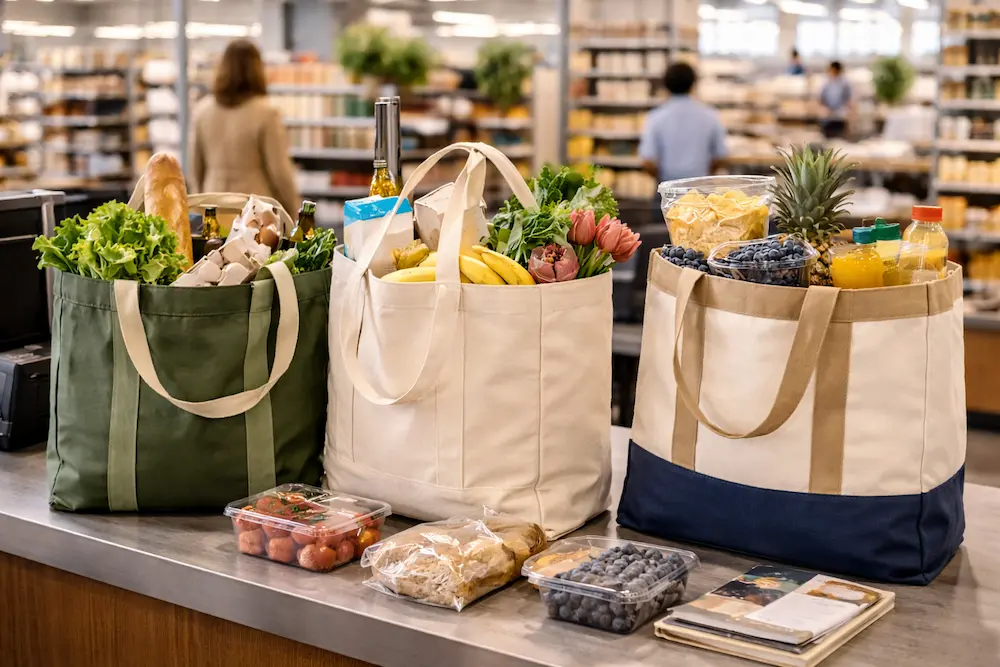
Large capacity tote bags are easy to get wrong. Many buyers assume that making a tote bag bigger automatically makes it better for retail and grocery use. In practice, larger size only helps if the bag still holds shape, carries weight comfortably, and remains easy to pack, store, and reuse. A large bag without enough structure often becomes awkward, collapses too easily, and feels less dependable under real shopping loads.
That is why bag capacity should never be treated as a simple size question. In grocery and retail environments, the bag must carry mixed products, boxed items, bottles, produce, clothing, or general store purchases without becoming unstable or uncomfortable. The best large-capacity design is usually not the largest possible bag. It is the one that balances width, depth, base support, handle comfort, and material strength in a way that actually works during repeated real-world use.
Large tote bags are also highly visible products. Once shoppers leave the store, the bag keeps representing the retailer in public. That means capacity and branding often need to work together. A bag that feels practical and durable is more likely to stay in circulation, and that makes the branding more valuable over time.
What Large Capacity Tote Bags Really Need to Do
For retail and grocery use, a large-capacity tote bag needs to do four things well. It must hold a larger volume of products without feeling unstable. It must remain comfortable enough to carry. It must support quick packing at checkout or in-store handling. And it must be durable enough that customers trust it for repeat use rather than treating it as a one-time carrier.
That requirement changes by store type. Grocery retailers often need wider bags with stronger bases and more dependable handles because customers carry mixed loads and heavier items. Retail stores may need larger totes for apparel, boxed products, beauty items, or seasonal shopping, but with more attention to visual presentation. Bookstores and gift shops may need a large bag with stronger vertical support rather than wide grocery-style capacity. The correct bag depends on what is actually going inside it.
Not every large bag needs heavy-duty grocery performance. Some buyers still compare softer everyday-use alternatives such as cloth tote bags when the bag is meant for lighter daily carry, broader lifestyle branding, or more casual store presentation rather than heavier retail loading.
Why Size Alone Does Not Define Capacity
Many poor tote bag designs fail because the buyer focuses on flat dimensions and ignores structure. A taller and wider bag may look more generous on paper, but if the gusset is too narrow, the base is unstable, or the fabric is too soft, it may actually perform worse than a slightly smaller bag with better geometry.
Capacity is about usable internal space, not just external measurement. A bag that opens well, stands more naturally, and supports mixed product shapes will usually be more practical than a visually large bag that collapses during packing. This matters especially at grocery checkouts or busy retail counters where speed and predictability matter.
That is why larger bags should be designed around real store packing behavior, not just sample-room appearance. A bag that looks impressive in a product photo but folds into an awkward soft shape under load is not delivering real capacity value.
Best Materials for Large Capacity Tote Bags
Material choice becomes more important as bag size increases because larger dimensions place more stress on the body panels, seams, and handles. A soft lightweight fabric can work well in smaller or lighter-use totes, but once the bag gets bigger, material weakness becomes more obvious.
Standard cotton may still work for medium-load retail use if the construction is balanced properly. Heavier canvas usually performs better for grocery and larger retail purchases because it offers stronger body support, better shape retention, and more confidence under load. Recycled cotton blends can work in sustainability-led retail programs, but they should be tested carefully because larger bags reveal consistency problems more quickly than smaller ones.
Material choice also affects branding potential. Heavier bags often support cleaner presentation and longer service life, which is important when the bag doubles as a public brand surface. For brands that want a stronger reusable product with more refined graphics, canvas tote bag printing becomes especially relevant because the print quality only matters if the larger bag remains attractive and reusable over time.
| Material Type | Best Use in Large Bags | Main Advantage | Main Limitation |
|---|---|---|---|
| Light cloth or cotton | Light retail carry, casual oversized bags | Softer feel and lower cost | Less structural confidence in large formats |
| Standard cotton | General retail use, medium-load bags | Balanced cost and versatility | May feel too soft for heavier grocery loads |
| Heavy canvas | Grocery, larger shopping loads, premium retail reuse | Better structure and stronger long-term use | Higher material and freight cost |
| Recycled cotton blend | Sustainability-focused store programs | Supports responsible brand messaging | Can vary more in shade and texture |
Best Structural Features for Large Retail and Grocery Tote Bags
Large tote bags need better structure than smaller ones because the load shifts more easily inside a wider bag. The best designs usually rely on a combination of gusset depth, stable base shape, stronger handle anchoring, and fabric that can support the larger form without collapsing too aggressively.
Wide Gussets
Side and bottom gussets are one of the biggest design upgrades for large-capacity bags. They allow the bag to open wider, hold more practical volume, and support boxed or bulky goods more efficiently. In grocery use, gussets also make the bag easier to fill at checkout and easier to stand in a car trunk or store basket area.
Reinforced Handles
The larger the bag, the more stress the handles must absorb. Large bags without stronger handle attachment are one of the most common failure points in retail and grocery programs. Cross-stitching, boxed-X reinforcement, and better seam depth usually matter more here than decorative handle styling.
Stable Base Behavior
A larger bag should not twist too easily under weight. A more stable base improves packing speed and helps mixed items sit more naturally during transport. This is especially important in supermarkets and general merchandise stores where customers may be carrying items with very different shapes and densities.
Practical Carry Shape
A large bag still has to feel comfortable in daily use. If it is too wide, too deep, or too floppy, customers may stop reusing it even if the volume is technically generous. Good large-bag design is about usable capacity, not maximum empty dimensions.
Best Large Capacity Tote Bag Options by Retail Use Case
In grocery retail, large bags usually need wider gussets, heavier material, and better handle reinforcement because the load is uneven and often heavier than expected. Grocery bags also benefit from stable opening behavior so they can be packed faster during checkout.
In fashion and lifestyle retail, large capacity may matter more for apparel, soft goods, or multiple purchases rather than dense weight. Here the bag may not need full grocery-style reinforcement, but it still needs enough structure that it does not look weak or collapse too dramatically once filled.
In bookstore and gift environments, the bag often needs vertical support more than extreme width. Books, catalogs, or boxed gifts put more concentrated strain on the base and handles, so the bag should feel sturdy even if the overall volume is slightly more controlled than a grocery tote.
For campaign-driven or store-branded reuse programs, some retailers also compare more visibility-led formats such as promotional canvas tote bags with logo when the bag is expected to do more than carry products. In those cases, the bag needs to perform as both shopping tool and long-term brand surface.
How Branding Should Work on Large Capacity Bags
Large tote bags offer more printable surface, but that does not mean they need more visual complexity. In fact, larger bags usually benefit from cleaner, more balanced branding because the bag itself is already visually noticeable. A logo or graphic that is too large or too crowded can make the bag feel more like a temporary promotion than a reusable product.
Retailers often get better results with simple branding, strong placement, and controlled color use. Grocery and daily-use shoppers usually respond better to bags that feel useful first and branded second. If the bag stays in circulation for longer, the brand gains more visibility anyway.
For broader campaign use, promotional canvas tote bags are often relevant comparisons because larger-capacity bags can become highly visible moving media once customers reuse them beyond the original store or event context.
Retailers with a softer, more natural visual style may also lean toward custom printed canvas bags when they want the bag to feel more like a reusable lifestyle product than a basic shopping carrier. In those cases, print style, fabric texture, and bag shape need to feel aligned.
Cost Structure and Bulk Buying Logic
Large capacity tote bags naturally cost more than smaller ones because they use more fabric, take more carton space, and often require stronger construction. The real question is whether that additional cost creates enough value in use, convenience, and repeat visibility to justify itself.
For retailers and grocery chains, the answer often depends on how the bag is distributed. A sold reusable bag, a loyalty reward bag, and a free promotional bag should not be judged by the same cost model. If the bag is expected to stay in circulation and reduce replacement frequency, stronger construction may be worth the extra spend. If the bag is mainly for short-term distribution, overbuilding may reduce efficiency.
| Cost Driver | Effect on Large Bag Programs | Practical Buying Note |
|---|---|---|
| Fabric weight | Raises cost but improves structure | Use only as much strength as real load needs |
| Bag dimensions | Increases material and carton volume | Avoid oversizing without a real packing reason |
| Gusset depth | Improves capacity but adds material and labor | Usually worthwhile in grocery use |
| Handle reinforcement | Improves performance and reliability | Important in large-capacity formats |
| Printing coverage | Raises setup and QC demands | Large bags usually benefit from simpler branding |
Packing Efficiency and Storage Considerations
Larger bags often create hidden cost through storage and freight if the design is not planned well. A bag can be commercially reasonable in unit price and still become inefficient if folded size, carton count, or pallet density are poorly considered. This matters especially for retail chains and supermarkets with limited back-room space.
Heavier and larger bags naturally consume more storage, but that does not make them the wrong choice. It simply means the buyer needs to compare use value against handling cost. A well-designed folded pack-out can reduce some of the pressure, while poor carton planning can make the program harder to manage even if the bag itself is good.
Strong suppliers should be able to discuss not only bag design, but also folded packing, bag count per carton, and how the product will move through warehouse and store environments.
How to Choose the Right Supplier for Large Capacity Tote Bags
The right supplier should understand that large-capacity bags are performance products, not just oversized totes. They should be able to explain which material suits the use case, how the gusset affects bag behavior, how handles should be reinforced, and how the bag should be packed for larger-scale retail distribution.
Buyers should compare suppliers by material clarity, structural reasoning, sample discipline, print consistency, packing logic, and repeat-order reliability. A good supplier will explain why a certain large-bag shape works better than another. A weak supplier often only confirms that the requested dimensions can be produced.
This is where Youngpack-style supplier logic becomes valuable. A strong manufacturing partner usually adds more value by shaping a workable specification than by simply quoting a large bag at face value.
Common Mistakes Buyers Make with Large Tote Bags
The first common mistake is assuming larger size automatically means better usability. The second is underestimating how much structure matters once the bag volume increases. The third is using insufficient gusset depth. The fourth is weakening the handle construction in an attempt to save cost. The fifth is adding too much print simply because the bag surface is larger.
Another common mistake is failing to match the bag to the store type. Grocery bags, fashion retail totes, bookstore bags, and event-driven store programs may all need more capacity, but not the same kind of capacity. Better buying starts by defining what the bag needs to carry, not by deciding on a flat dimension first.
Conclusion
The best large capacity tote bags for retail and grocery use are the ones that turn size into usable function. That means the bag needs the right material, better gussets, stronger handles, stable packing behavior, and branding that still feels appropriate after repeated use.
Large tote bags are not automatically better just because they are bigger. They become better when the larger format is engineered properly for real carrying conditions. Once that happens, the bag does more than hold more products. It becomes a more useful retail tool and a more valuable reusable brand asset.
How Buyers Should Think About Large Capacity Tote Bags
What large capacity really means: A large-capacity tote bag is not simply a bigger tote. It is a bag that turns extra size into usable function. That means the added volume must still be easy to pack, comfortable to carry, and stable enough for repeated retail or grocery use.
Why design matters so much more at larger sizes: As bag size increases, structural mistakes become more visible. Weak handles, shallow gussets, soft fabric, and unstable bases cause larger bags to fail faster than smaller ones. Good large-capacity design is therefore much more about engineering than appearance alone.
How buyers should compare options: The strongest comparison method is to evaluate material, gusset depth, handle reinforcement, expected load, and store behavior together. A large bag for grocery use should not be sourced the same way as a large bag for fashion retail or promotional distribution, even if the flat dimensions look similar.
Options retailers and grocers usually weigh: Buyers often compare standard cotton against heavier canvas, simpler reusable formats against more structured shopping bags, and branding-led bags against more functional store-use designs. The right choice depends on whether the bag is mainly solving a carry problem, building reusable store identity, or doing both.
Considerations before bulk approval: Before approving a larger order, businesses should test real packing behavior, verify handle comfort, confirm carton efficiency, and make sure the supplier can hold the same standard over repeat runs. Those practical checks matter more than flat sample dimensions because they determine how well the bag actually works in daily use.
The broader takeaway: The best large capacity tote bag program is built around useful volume, not exaggerated size. Buyers who treat these bags as functional retail tools usually make better choices than those who only chase visual scale. That is also where Youngpack naturally fits as a B2B manufacturing and export partner for larger-format tote bag programs that need customization, structural reliability, and repeat-order consistency.
FAQ
1. What is the best material for large capacity tote bags?
The best material depends on what the bag is expected to carry. Standard cotton can work well for larger bags used in lighter retail situations, but heavier canvas is usually the better choice when the bag must support grocery loads, boxed items, or repeated shopping use. The larger the bag becomes, the more important structure and fabric strength become. Buyers should choose material based on real load behavior rather than only on appearance or price.
2. Why are gussets so important in large tote bag design?
Gussets are important because they turn a flat bag into usable internal space. A larger tote bag without enough gusset often becomes harder to pack, less stable, and less comfortable under load. Side and bottom gussets help the bag open properly, hold boxed or bulky products more naturally, and reduce strain concentration during carrying. In grocery and general retail use, gussets are usually one of the most important functional upgrades.
3. Are large capacity tote bags always good for grocery stores?
Not always. They are useful for grocery stores when they are designed properly, but an oversized bag with weak material or poor structure can be less practical than a slightly smaller, better-built bag. Grocery use places uneven stress on the bag, especially with bottles, produce, cartons, and mixed household items. The best grocery tote is usually the one that balances capacity, shape, and carry comfort instead of simply maximizing size.
4. How should buyers compare large tote bag options for retail and grocery use?
Buyers should compare material, gusset depth, handle reinforcement, base stability, print needs, and packing efficiency together. A bag that looks large in a flat sample may not perform well if it collapses too easily or becomes awkward under load. The strongest comparison method is to evaluate how the bag behaves in realistic store use rather than comparing only dimensions and price.
5. What should businesses check before ordering large capacity tote bags in bulk?
Businesses should check material type, fabric weight, gusset size, handle attachment, seam quality, folded pack-out, carton efficiency, and whether the supplier can maintain the same standard in repeat runs. They should also test the sample using real products or grocery items to confirm that the bag performs as expected. A large-capacity bag should be approved based on practical load behavior, not only visual size.
References
- Preferred Fiber and Materials Market Report — Textile Exchange — Textile Exchange.
- Textiles and the Environment — European Environment Agency — EEA.
- Green Guides for the Use of Environmental Marketing Claims — Federal Trade Commission — FTC.
- Sustainable Packaging Guidelines — Australian Packaging Covenant Organisation — APCO.
- Fashion on Climate — Global Fashion Agenda and McKinsey & Company.
- Retail Packaging and Reusable Bag Sourcing Best Practices — professional sourcing reference.
- Responsible Sourcing and Product Communication in Textile Supply Chains — industry trade reference.
- Guide to Reusable Bags and Long-Term Use Value — industry best-practice sourcing reference.
Copyright Notice:
All content on this page is the property of Xiamen Youngpack Imp.and Exp.Co.,Ltd. and is protected by copyright. Unauthorized use or reproduction is not permitted.