Many buyers assume tote bag pricing is simple. They often compare quotes from different suppliers without fully understanding what is actually included in the cost structure. But tote bag pricing is not based on one factor alone. A small design change can significantly affect production cost, freight efficiency, labor time, or printing complexity.
This is why experienced buyers do not only ask for the cheapest quotation. They ask how the quotation is built.
A tote bag that looks similar in photos may have completely different pricing depending on fabric weight, stitching quality, handle reinforcement, print coverage, accessories, packaging standards, and order volume.
Understanding these cost drivers helps businesses calculate pricing more accurately and avoid sourcing mistakes that damage product quality or profitability later.
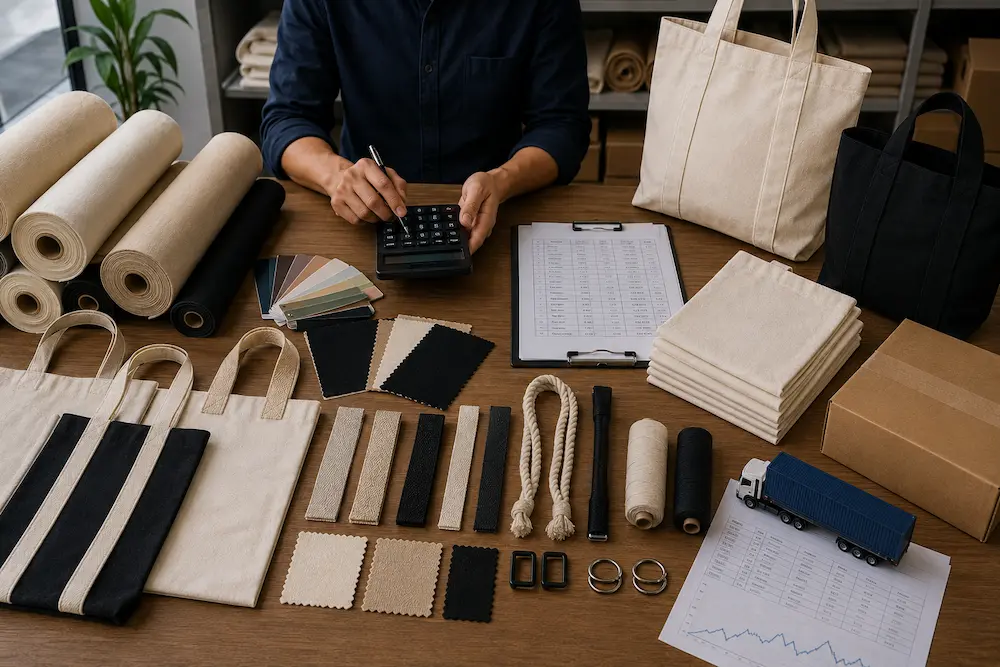
The Main Components of Tote Bag Pricing
Tote bag pricing is usually built from several major cost categories working together:
- Fabric material cost
- Bag size and material consumption
- Printing method and print coverage
- Handle construction
- Sewing and labor complexity
- Packaging requirements
- Sampling and setup costs
- Order quantity
- Shipping and freight
- Supplier operating margin
The final unit price is the result of all these combined rather than one isolated factor.
Fabric Cost Is Usually the Largest Pricing Factor
Fabric is often the single biggest cost component in tote bag production. Heavier fabric uses more raw material, increases shipment weight, and may require stronger sewing reinforcement.
For example, lightweight promotional bags cost much less than heavy-duty reusable grocery totes because the material consumption is significantly different.
Products such as cotton tote bags may vary substantially in price depending on GSM, cotton quality, weave density, and finishing treatment.
Larger bags also naturally consume more fabric, increasing both material cost and freight weight.
Bag Size Directly Changes Material Consumption
A small tote bag and a large-capacity shopping tote may use dramatically different amounts of fabric. Even a few centimeters added to width, height, or gusset size can noticeably affect total material usage when multiplied across large production quantities.
This is why experienced suppliers calculate material consumption very carefully before finalizing quotations.
Buyers sometimes underestimate how quickly larger dimensions increase total production cost, especially on heavy canvas materials.
Printing Is One of the Most Variable Cost Factors
Printing cost depends on several variables:
- Printing method
- Number of colors
- Print size
- Print position
- Artwork complexity
- Ink coverage
- Print quantity
A simple one-color logo is far cheaper than full-color edge-to-edge artwork. Screen printing, digital printing, heat transfer, embroidery, and other techniques all have different pricing structures.
Branded products such as custom printed canvas tote bags often carry higher pricing because printing quality and visual consistency become more important to the final presentation.
Large print areas also increase labor time and production complexity.
Handle Construction Changes Labor and Material Cost
Many buyers overlook handle pricing. But handles can significantly affect total cost depending on the material, reinforcement style, stitching structure, and handle length.
Simple self-fabric handles are usually more economical. Reinforced cotton webbing, padded handles, rope handles, or full-wrap reinforced handles increase both material and labor cost.
Premium branding-focused products such as personalized canvas tote bags often use upgraded handle structures because they improve product feel and perceived value.
Stronger handles also usually require additional sewing reinforcement, adding labor time.
Sewing Complexity Impacts Production Efficiency
The more complicated the tote bag design becomes, the more sewing time is required. Basic flat tote bags are relatively fast to produce. But features such as gussets, pockets, zippers, lining, magnetic closures, reinforced bottoms, inside labels, piping, or adjustable straps all increase labor complexity.
Production efficiency strongly affects final pricing because labor remains a major cost factor in textile manufacturing.
Even small structural additions can slow production speed considerably at large order quantities.
| Design Feature | Pricing Impact | Reason |
|---|---|---|
| Heavier fabric | Higher | More material consumption and freight weight |
| Large print area | Higher | More ink and labor time |
| Simple flat construction | Lower | Faster sewing efficiency |
| Reinforced handles | Higher | Additional materials and stitching |
| Large bag size | Higher | Greater fabric usage |
| High-volume order | Lower unit cost | Better production efficiency |
Order Quantity Strongly Affects Unit Pricing
One of the biggest factors in tote bag pricing is MOQ and total production volume. Higher quantities usually reduce unit cost because setup costs, labor organization, printing preparation, and material purchasing become more efficient.
This is why large promotional programs often achieve much lower pricing per bag than small custom projects.
Products developed for broad brand campaigns such as custom tote bags often benefit significantly from scale efficiency when ordered in larger quantities.
Small orders usually carry proportionally higher setup and labor costs.
Packaging Requirements Also Affect Pricing
Packaging is another commonly ignored pricing factor. Simple bulk carton packing is the most economical option. Individual polybags, barcode stickers, hangtags, custom inserts, retail-ready packaging, or export display packaging all increase cost.
Retail-ready presentation especially increases both labor and material expense because packing processes become slower and more detailed.
Some buyers unintentionally increase costs heavily through packaging requirements rather than the tote bag itself.
Shipping and Freight Are Part of Real Pricing
Many sourcing mistakes happen because buyers focus only on FOB production pricing while ignoring freight economics.
Heavy canvas bags occupy more shipment weight and volume than lightweight promotional bags. Air shipping, sea freight, express delivery, pallet packing, and destination duties all affect landed cost.
This is one reason why lightweight alternatives such as cotton drawstring bags remain attractive for some event and promotional programs where freight efficiency matters heavily.
The real product cost is not only factory cost. It is the total delivered cost.
Printing Setup Costs Matter on Small Orders
Some printing methods involve setup fees that become more noticeable on lower quantities. Screen preparation, color separation, plate making, embroidery digitizing, and sampling costs are often spread across the total order quantity.
This means very small custom orders can appear disproportionately expensive because fixed setup costs are divided across fewer units.
Larger runs distribute these costs much more efficiently.
Sampling Costs Are Usually Separate
Professional tote bag sourcing usually includes sample development before bulk production. Sample costs may include material sourcing, labor, printing setup, courier charges, and pattern adjustment.
Complex custom designs naturally require more sample work than standard bag styles.
Experienced buyers view sample cost as a product development investment rather than simply an extra charge.
Cheap Quotes Often Hide Quality Reductions
One of the most important pricing lessons in tote bag sourcing is that extremely cheap quotations usually involve trade-offs somewhere.
Lower pricing may result from:
- Lighter fabric
- Weaker stitching
- Lower print quality
- Smaller actual dimensions
- Poorer reinforcement
- Reduced inspection standards
- Simplified packaging
This does not mean low-cost production is always bad. But buyers should clearly understand what is being reduced before comparing quotations.
Strong suppliers explain cost structure transparently rather than simply offering unrealistic pricing to win orders.
How Buyers Should Calculate Tote Bag Pricing Properly
The best approach is to separate pricing into layers:
- Base material cost
- Construction and labor cost
- Printing and branding cost
- Packaging cost
- Freight and logistics cost
- Import duty and landed cost
Once these layers are understood individually, pricing comparisons become much more accurate and easier to evaluate commercially.
Products focused on stronger long-term brand value such as custom canvas tote bags may justify higher pricing if the durability, branding visibility, and reusable life create stronger overall marketing value.
Conclusion
Calculating tote bag pricing requires understanding the full production structure, not just comparing factory quotes blindly. Fabric weight, bag size, printing, handles, labor complexity, packaging, quantity, and freight all influence the final cost.
The smartest buyers do not only ask “What is the price?” They ask “Why is the price built this way?”
How Buyers Should Think About Tote Bag Pricing
What tote bag pricing really includes: Tote bag pricing is not only about fabric cost. Real pricing combines material consumption, sewing labor, printing complexity, handle construction, packaging requirements, freight efficiency, and production scale together. A small design change can affect multiple cost layers at the same time.
Why many buyers miscalculate pricing: Some buyers compare quotations without checking whether the specifications are actually equivalent. Lower prices may involve lighter fabric, weaker reinforcement, reduced inspection standards, or simplified printing. Accurate price comparison only works when material, construction, packaging, and production quality are aligned properly.
How businesses should compare quotations properly: Strong sourcing decisions separate pricing into material cost, labor cost, printing cost, packaging cost, and landed logistics cost individually. This allows buyers to understand where cost differences originate instead of treating all quotations as directly interchangeable.
Options businesses commonly evaluate: Most buyers compare lightweight promotional tote bags against heavier reusable retail bags, simple one-color printing against premium full-color branding, and low-cost mass production against stronger long-term product durability. The correct pricing structure depends on whether the goal is broad promotional reach, premium retail presentation, or long-term reusable value.
Considerations before approving production: Before confirming an order, businesses should evaluate freight efficiency, print consistency, fabric durability, stitching reinforcement, and total landed cost together. A cheap factory quotation that creates quality problems or freight inefficiency later is rarely the best commercial decision.
The broader takeaway: Strong tote bag sourcing is not about chasing the lowest visible unit price. It is about understanding how pricing is built and whether the product delivers real long-term commercial value. That is also where Youngpack naturally fits as a B2B manufacturing and export partner for brands seeking better balance between production quality, scalable pricing, and reliable tote bag sourcing strategy.
FAQ
1. What is the biggest factor in tote bag pricing?
Fabric cost is usually the largest pricing factor because material weight, fabric quality, and bag size directly affect raw material consumption and freight weight. Heavier canvas and larger bags naturally increase total production cost more than lightweight promotional tote bags.
2. Why do custom printed tote bags cost more?
Custom printed tote bags often cost more because printing adds setup fees, labor time, ink usage, and production complexity. The final cost depends on the printing method, number of colors, print size, and artwork detail. Large full-color designs are usually more expensive than simple one-color logos.
3. How does order quantity affect tote bag pricing?
Higher order quantities usually reduce unit pricing because production setup, printing preparation, labor organization, and material sourcing become more efficient at scale. Small orders often carry proportionally higher costs because fixed production expenses are divided across fewer units.
4. Why do some tote bag suppliers quote much lower prices?
Lower pricing may come from lighter fabrics, weaker stitching, lower print quality, simplified packaging, or reduced quality control standards. Extremely low quotations are not always directly comparable unless the specifications are carefully reviewed side by side.
5. Should shipping cost be included when calculating tote bag pricing?
Yes. Real tote bag pricing should include total landed cost, not only factory production cost. Freight, shipping method, packaging volume, import duties, and destination logistics can significantly affect the final commercial cost, especially for heavy canvas bags or large-volume orders.
References
- Cotton and Canvas Material Cost Analysis — textile sourcing reference.
- Reusable Bag Manufacturing and Cost Structure Guide — packaging industry reference.
- Screen Printing and Textile Decoration Cost Factors — printing production reference.
- Soft Goods Manufacturing Efficiency Study — industrial sewing reference.
- Freight Optimization for Textile Products — export logistics reference.
- Retail Packaging and Product Cost Engineering — merchandising reference.
- MOQ and Production Scaling in Textile Manufacturing — sourcing operations reference.
- Reusable Tote Bag Product Development Standards — industry trade reference.
Copyright Notice:
All content on this page is the property of Xiamen Youngpack Imp.and Exp.Co.,Ltd. and is protected by copyright. Unauthorized use or reproduction is not permitted.