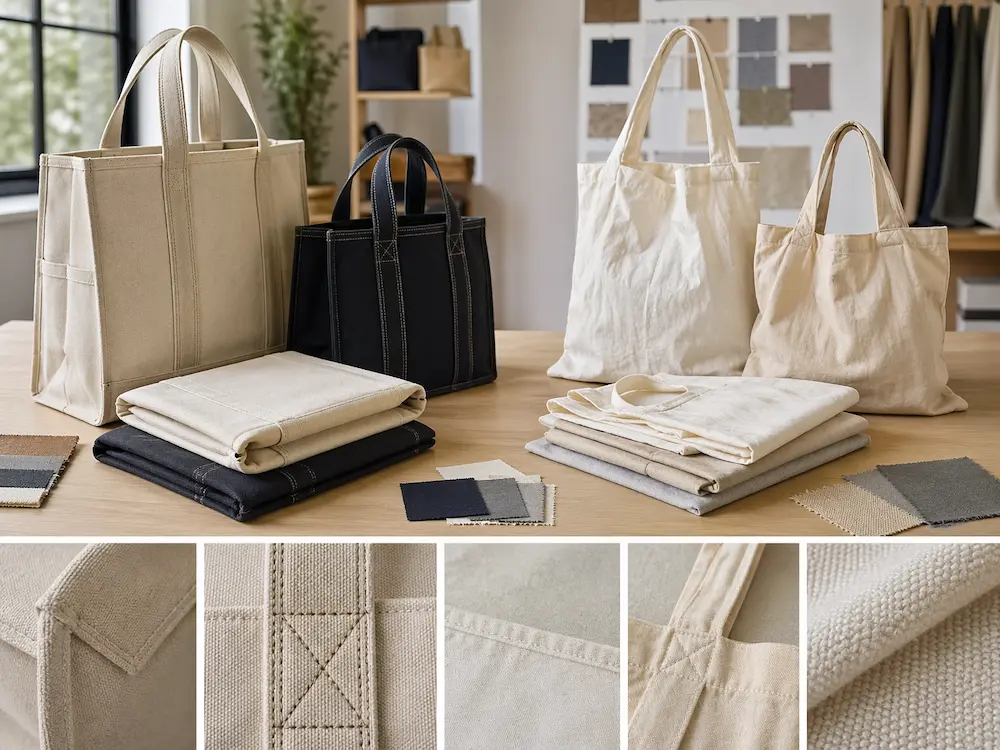
The comparison between heavy duty vs lightweight tote bags is one of the most practical decisions in bag sourcing. Many buyers assume that stronger automatically means better. That is a mistake. A heavy-duty tote can be unnecessarily expensive, bulky, and inefficient if the actual use case is light. A lightweight tote can be a smart and effective choice if the bag only needs to carry brochures, lunch, light retail goods, or promotional materials. The wrong decision usually happens when buyers source based on assumptions instead of real product use.
What matters is not whether the bag looks stronger in a sample room. What matters is how the bag will actually be used once it leaves the factory. Will it carry groceries? Books? Bottles? Clothing? Event materials? Giveaways? Will it be used once, a few times, or every week for months? Those answers decide whether heavy duty or lightweight is the smarter choice.
The real value of this comparison is that it helps businesses stop overbuying and underbuying at the same time. A correctly specified bag usually creates better performance, better brand value, and better total cost than either an overbuilt bag or an underbuilt one.
What Heavy Duty Tote Bags Really Mean
Heavy duty tote bags are usually designed for repeated carrying of heavier or more demanding loads. They often use stronger cotton, thicker canvas, reinforced handles, better seam construction, and a more stable body shape. They are not just “thicker bags.” They are bags built with the expectation that customers will ask more from them.
This usually makes them suitable for groceries, books, bottles, repeated retail shopping, employee kits, bookstore use, farmers’ markets, and premium reusable bag programs. The bag is expected to survive more strain, not just look more substantial in the product photo.
In many cases, heavy-duty totes are closely aligned with products such as cotton canvas tote bags because the combination of stronger fabric and better structure makes sense when the bag is expected to remain useful for a long time.
What Lightweight Tote Bags Really Mean
Lightweight tote bags are designed for lower load demands, easier storage, and broader distribution efficiency. That does not mean poor quality. It means the product is built for a different role. Lightweight totes usually work well for conferences, exhibitions, community events, retail handouts, simple gift bags, schools, nonprofit campaigns, cafés, and everyday light shopping where the user is unlikely to carry dense or heavy loads regularly.
They are often easier to fold, easier to pack in bulk, and more cost-efficient for large-volume distribution. In many programs, that makes them the better commercial answer. If the bag is mainly there to create reach, provide light utility, and keep cost under control, a lightweight tote can be exactly right.
For lighter daily brand use, a softer cotton tote often makes more sense than a heavier bag because the customer is not actually asking for grocery-grade strength.
Why the Weight Difference Matters More Than Buyers Expect
Weight changes everything. It affects material cost, freight efficiency, carton density, handle comfort, how the bag folds, how it prints, and how the customer perceives the product. A heavier bag feels more dependable and more premium in many retail contexts, but it also costs more to ship and store. A lighter bag improves distribution efficiency, but it may feel too soft or underbuilt if the user expects repeated everyday carry.
This is why heavy-duty and lightweight totes should never be compared by price alone. The bag’s performance after delivery matters just as much. A cheap light bag that fails in grocery use is expensive in the wrong way. A premium heavy bag that is handed out once at an exhibition and never reused is also expensive in the wrong way.
The strongest sourcing logic comes from understanding where the bag’s real value begins: at first use, or after many uses.
Structure and Carry Confidence
One of the biggest differences between heavy-duty and lightweight tote bags is structure. Heavy-duty totes usually stand better, hold shape more naturally, and feel more stable when loaded. This makes them easier to use for groceries, books, and mixed retail items because the bag does not collapse as easily or twist under weight.
Lightweight totes usually feel softer, flatter, and more casual. That can be a major advantage when the goal is simple, everyday, low-pressure carry. A lighter bag can feel more relaxed and easier to keep nearby. But once the load increases, that relaxed structure can become a limitation.
| Comparison Area | Heavy Duty Tote Bags | Lightweight Tote Bags |
|---|---|---|
| Typical load | Moderate to heavy repeated use | Light to moderate occasional use |
| Structure | Usually stronger and more stable | Usually softer and more flexible |
| Freight efficiency | Lower | Higher |
| Perceived value | Usually higher in retail and gifting | Usually better for approachable mass distribution |
| Best use pattern | Long-term reuse | Broad reach and light carry |
Handle Strength and Comfort
Heavy-duty tote bags usually need stronger handles because the user is more likely to carry books, groceries, bottles, or denser retail goods. Better handle attachment and more reinforced stitching are often essential, not decorative. A heavy bag with weak handles is still a weak bag.
Lightweight bags can use simpler handles because the load expectation is lower. That helps reduce cost and improve flexibility, but it also means the buyer must be realistic. If the bag is going into a program where users are likely to overload it, lightweight handle logic becomes risky very quickly.
This is why the right question is not “How strong are the handles?” It is “How much weight will customers actually ask these handles to carry?”
Best Use Cases for Heavy Duty Tote Bags
Heavy-duty totes are usually strongest in supermarkets, bookstores, markets, employee kits, tourism merchandise, gift shops, repeat-use shopping programs, grocery retail, and premium promotional merchandise. They are especially useful when the customer is likely to keep using the bag regularly and the brand wants that reuse to continue for months or longer.
They also make sense when the bag itself is part of the value being delivered. If the tote is a product, a gift, or a visible sign of quality, heavy-duty construction is often easier to justify because the customer feels the difference immediately.
For tailored programs where the bag itself must play a more distinctive brand role, buyers often move toward products such as custom made tote bags. In those cases, the bag is expected to behave more like merchandise than simple packaging.
Best Use Cases for Lightweight Tote Bags
Lightweight totes are strongest in conferences, exhibitions, nonprofit events, educational campaigns, school programs, cafés, light retail promotions, and general awareness marketing where the goal is visibility plus simple utility. They are also strong in giveaway programs where the bag only needs to carry light materials or create a low-cost but useful customer takeaway.
They often make more sense when the campaign depends on volume. A bag that is easy to ship, easy to store, and affordable at scale can outperform a better-looking heavy bag if the real objective is reach rather than long-term carry performance.
For relaxed daily-use branding in lighter-use environments, products such as cloth tote bags can be especially relevant because they support softer everyday carry without forcing the customer into a heavier-use product they may not need.
Cost and Freight: Where Lightweight Bags Usually Win
Lightweight bags usually win on initial price and shipping efficiency. They use less material, take less carton space, and create lower freight cost per unit. That is why they remain attractive in large campaigns and broad distribution programs.
Heavy-duty bags usually cost more to make and more to move. The extra fabric, stronger construction, and bulkier packing all raise landed cost. But that higher cost can be worthwhile when the bag is genuinely used more often, creates stronger brand recall, and avoids fast failure in demanding use cases.
So the better cost question is not “Which one is cheaper?” It is “Which one creates the right total cost for how the bag will actually be used?”
| Commercial Factor | Heavy Duty | Lightweight |
|---|---|---|
| Unit cost | Usually higher | Usually lower |
| Shipping efficiency | Lower | Higher |
| Best economic logic | Higher value through longer reuse | Wider reach through lower cost |
| Risk if misused | Overbuilding and wasted budget | Underperformance and early failure |
Branding Differences: Visibility vs Value Perception
Heavy-duty totes often create better value perception. The fabric feels more substantial, the handles feel more reliable, and the bag looks like something worth keeping. This helps when the brand wants the tote to act like merchandise or a reusable product that keeps carrying the logo in public.
Lightweight totes often create better reach. Because they are cheaper to distribute, more people can receive them. This makes them useful in awareness campaigns, broad events, and high-volume promotions where visibility through volume matters more than perceived premium quality.
So the branding difference is not only visual. It is strategic. Heavy-duty bags often strengthen brand value through product quality. Lightweight bags often strengthen brand reach through distribution scale.
When Buyers Overbuild the Bag
Overbuilding happens when a heavy-duty tote is chosen for a use case that simply does not require it. This is common in events, light retail promotions, and basic information-carry situations. The result is higher cost, lower freight efficiency, and sometimes a product that feels too serious for the actual environment.
A heavy bag is not automatically more impressive. If the bag is too bulky or too expensive for the campaign, the product becomes inefficient. Overbuilding is especially risky in mass distribution because the cost penalty multiplies quickly across volume.
The best bag is not the strongest possible bag. It is the bag that is strong enough for the job.
When Buyers Underbuild the Bag
Underbuilding happens when a lightweight tote is chosen for a use case that really needs stronger performance. This is common in grocery retail, bookstore use, employee kits with multiple items, and any daily-use program where the bag will face repeated loading. The bag may look fine at first, but the weaknesses appear quickly under real use.
That creates a worse outcome than overbuilding in some cases, because the brand loses both product trust and visibility. A bag that breaks or feels unreliable is not just a weak bag. It becomes a negative product experience.
So if the bag must survive real daily stress, underbuilding is usually the more dangerous mistake.
How to Choose the Right Supplier
A good supplier should not simply ask for size and quantity. They should ask what the bag will carry, how often it will be reused, what the brand expects from it, and whether the product is mainly there for reach or long-term use. That discussion usually decides whether heavy-duty or lightweight is the right path.
Buyers should ask about fabric weight, handle reinforcement, packing method, load expectation, and where the product starts to lose efficiency. The right supplier is the one that can explain not only what the bag is, but what the bag is really for.
This is where Youngpack-style sourcing logic matters. The stronger manufacturing partner usually adds more value by preventing the wrong specification than by simply quoting the cheapest or heaviest option available.
Conclusion
The difference between heavy duty vs lightweight tote bags is not really about stronger versus weaker. It is about fit. Heavy-duty totes are usually better when the bag must survive repeated load, daily use, and stronger brand expectations. Lightweight totes are usually better when the bag must be affordable, flexible, easy to distribute, and good enough for lighter real-world carry.
The best result comes from matching the bag to the routine, not the label. Buyers who define that routine clearly usually avoid both wasted budget and avoidable product failure.
How Buyers Should Think About Heavy Duty vs Lightweight Tote Bags
What this comparison really measures: Heavy duty and lightweight tote bags are not simply two quality levels. They usually represent two different product strategies. Heavy duty bags are built for stronger repeated carry and longer service life. Lightweight bags are built for simpler, lower-cost, and more distribution-efficient use. The better answer depends on the real job of the bag.
Why buyers often get this wrong: The most common mistake is believing that stronger automatically means better. That causes overbuilding. The second mistake is choosing by low price without checking the real carrying load. That causes underbuilding. Both mistakes waste money, but underbuilding often damages brand trust faster because the bag fails in real use.
How buyers should compare the two properly: The strongest comparison method is to evaluate load type, reuse frequency, customer expectation, freight logic, and visible brand role together. A conference giveaway, a bookstore bag, a grocery tote, and a retail gift bag may all use tote bag formats, but they should not all be sourced at the same strength level.
Options businesses usually weigh: Most buyers compare lower-cost broad reach against stronger long-term value, softer flexible carry against more dependable structure, and lightweight promotional efficiency against heavy-duty reusable confidence. The better option becomes much clearer once the business decides whether the bag is mainly solving a distribution problem or a repeat-use product problem.
Considerations before bulk approval: Before placing the order, businesses should test actual loads in the sample, confirm handle behavior under real weight, compare landed cost, and check whether the heavier or lighter build still makes sense once the bag reaches the user. The most accurate answer usually comes from practical use testing, not from fabric labels or assumptions.
The broader takeaway: The strongest bag program is the one that matches the user’s real carrying routine. That is also where Youngpack naturally fits as a B2B manufacturing and export partner for brands comparing heavy-duty and lightweight tote bag programs while needing practical guidance on durability, cost, and long-term brand value.
FAQ
1. Are heavy duty tote bags always better than lightweight totes?
No. Heavy duty tote bags are only better when the use case actually demands stronger structure, better handle reinforcement, and repeated heavier carry. If the bag is only meant for brochures, light shopping, or event giveaways, a lightweight tote is often the smarter and more economical choice. The better option depends on the load, reuse pattern, and brand purpose.
2. What are heavy duty tote bags best used for?
Heavy duty tote bags are usually best for groceries, books, markets, daily retail use, employee kits, and long-term branded reusable bag programs. They make the most sense when the customer is likely to carry moderate to heavy items repeatedly and when the brand wants the bag to stay in visible use for a long time. Their value comes from durability and stronger customer confidence in repeated everyday use.
3. When should buyers choose lightweight tote bags?
Buyers should choose lightweight tote bags when the bag is meant for lighter loads, easier bulk distribution, lower freight cost, and broader campaign reach. They work especially well in events, conferences, school programs, simple retail promotions, and nonprofit distribution where the bag mainly carries light materials and does not need to function like a grocery or daily heavy-use product.
4. How do heavy duty and lightweight tote bags affect branding?
Heavy duty bags usually strengthen perceived brand value because they feel more substantial, more durable, and more worth keeping. Lightweight bags usually strengthen brand reach because they are cheaper and easier to distribute at scale. So the branding difference is often about value versus volume. The right choice depends on whether the business wants deeper long-term product presence or broader short-term distribution.
5. What should buyers check before ordering heavy duty or lightweight tote bags in bulk?
Buyers should check what the bag will actually carry, how often it will be reused, whether the brand wants a premium or practical product feel, and how much freight efficiency matters. They should also test material, handle comfort, seam strength, and sample load behavior. The right bag usually becomes obvious once the real customer routine is defined instead of the buyer guessing from price or appearance alone.
References
- Preferred Fiber and Materials Market Report — Textile Exchange — Textile Exchange.
- Textiles and the Environment — European Environment Agency — EEA.
- Green Guides for the Use of Environmental Marketing Claims — Federal Trade Commission — FTC.
- Sustainable Packaging Guidelines — Australian Packaging Covenant Organisation — APCO.
- Fashion on Climate — Global Fashion Agenda and McKinsey & Company.
- Responsible Sourcing and Product Communication in Textile Supply Chains — industry trade reference.
- Retail Packaging and Reusable Bag Sourcing Best Practices — professional sourcing reference.
- Guide to Reusable Bags and Long-Term Use Value — industry best-practice sourcing reference.
Content Use Policy:
You are welcome to reference this article with proper attribution, but copying, republishing, or modifying the full content without permission is not permitted.