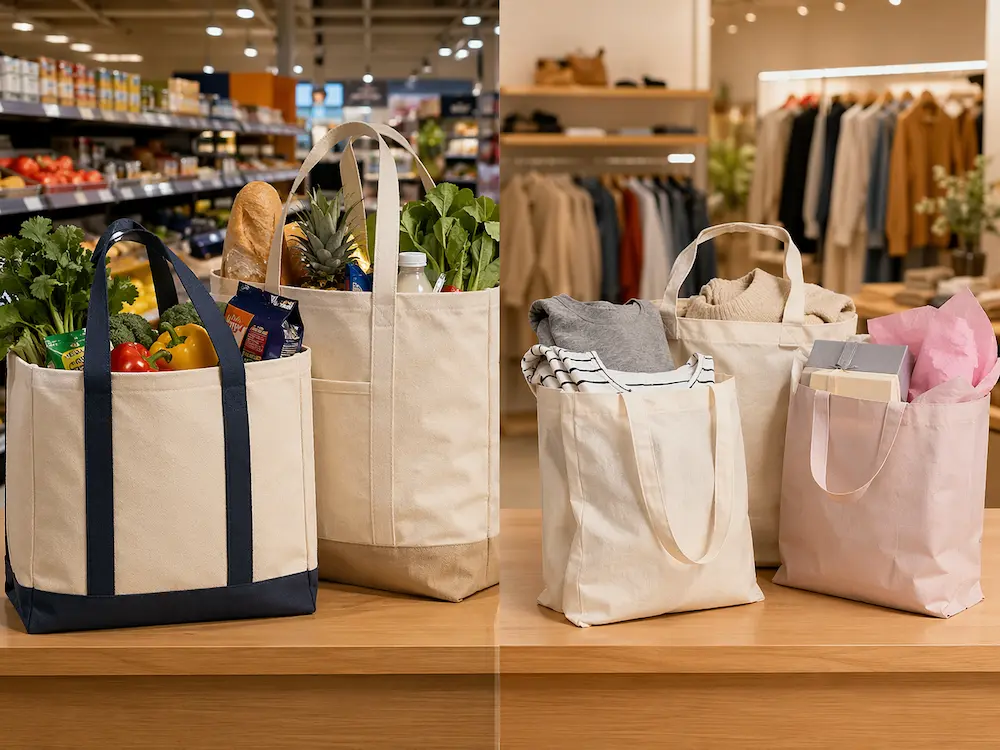
The comparison between grocery tote bags vs shopping bags is more important than it looks. Many buyers treat them as interchangeable because both are used to carry purchases. In real commercial use, they solve different problems. Grocery tote bags are usually designed for heavier loads, more repeated use, and a more practical carry experience. Shopping bags are usually designed for retail presentation, lighter goods, and broader customer-facing style.
This matters because the wrong bag creates the wrong result. A soft shopping bag used for grocery loading may feel weak, awkward, or unreliable. A heavy grocery tote used in a premium boutique may feel too functional and not refined enough for the retail experience. The difference is not only about size or fabric. It is about how the bag works once it leaves the store.
The best sourcing decisions begin by asking what the bag really needs to do. If the bag must hold dense weight repeatedly, support supermarket behavior, and become part of a reusable shopping habit, the answer usually points toward grocery totes. If the bag is mainly for fashion, gifting, boutique purchases, or lighter retail use, a more general shopping bag may make more sense.
What Grocery Tote Bags Are Designed to Do
Grocery tote bags are usually built around function first. They need to carry mixed items such as bottles, produce, cans, cartons, boxed goods, bakery products, and household purchases without failing or becoming uncomfortable. That means the bag must support uneven weight distribution, wider packing space, and more reliable handles and seams.
In most cases, grocery totes benefit from stronger fabric, wider gussets, better base shape, and more deliberate handle reinforcement. They are often used in supermarkets, organic stores, food markets, co-ops, specialty grocery retail, and reusable bag programs where customers are expected to keep using the same bag again and again.
This is one reason fabric-based options such as cloth tote bags can become relevant in lighter reusable food-retail programs, especially when the business wants the bag to feel both practical and brand-visible beyond the checkout moment.
What Shopping Bags Are Designed to Do
Shopping bags usually have a broader role. They are often designed not only to carry purchases, but also to support product presentation, customer experience, and store identity. Their load profile is often lighter and more variable than grocery totes. Apparel, beauty items, gifts, books, accessories, stationery, and general retail goods usually do not require the same kind of structural support as groceries.
This gives shopping bags more flexibility in shape, style, and finish. A shopping bag can prioritize visual appeal, softer structure, or more controlled branding because it is not always being asked to perform like a weight-bearing everyday utility bag.
That does not mean shopping bags are weak. It means they are often designed with different priorities. They may need to look cleaner, feel more refined, or match the retail environment more closely than a grocery tote would.
Why Grocery Tote Bags Usually Need Better Structure
The key difference is load type. Grocery purchases create dense, awkward, and inconsistent weight. Bottles sit low in the bag. Cartons shift. Produce takes volume. Sharp corners from packaging can create pressure points. A bag that feels acceptable for clothing or brochures can become obviously underbuilt once groceries are packed inside.
That is why grocery tote bags usually need more structural thinking. They often need a wider opening, stronger bottom support, more reliable handles, and enough body strength that the customer feels confident using the bag again. In many cases, heavier fabric or stronger textile construction improves not only function but also trust. Customers keep using the bag because it feels dependable.
When a retailer also wants stronger long-term reusable branding, products related to promotional canvas tote bags often become relevant because the bag is expected to remain in public use after the groceries are unpacked.
| Comparison Area | Grocery Tote Bags | Shopping Bags |
|---|---|---|
| Main job | Carry heavier mixed purchases repeatedly | Carry lighter retail purchases with better presentation |
| Typical load | Dense, uneven, practical, daily-use | Lighter, more controlled, category-dependent |
| Structure need | Higher | Moderate to lower, depending on retail type |
| Brand role | Reusable visibility through daily use | Retail identity and purchase presentation |
| Best environment | Supermarkets, food retail, markets, everyday shopping | Boutiques, bookstores, gift stores, fashion and lifestyle retail |
Material Differences and Why They Matter
Material choice usually reflects the intended role of the bag. Grocery tote bags often need cotton canvas, stronger woven cloth, or heavier textile construction because the product must hold up over repeated use. Shopping bags can still use strong materials, but they have more flexibility. A shopping bag may use lighter cotton or cloth when the goods are lighter and the visual tone is more important than heavy-duty function.
The material also affects how customers perceive the bag. A stronger grocery tote often feels more substantial and reusable, while a softer shopping bag may feel more elegant or relaxed depending on the store context. Neither is automatically better. The right choice is the one that fits the store’s actual customer behavior.
For retailers that want stronger natural presentation and repeat use, custom printed canvas bags can sit closer to the grocery-tote side of the spectrum because the bag is expected to function as a durable product as well as a branded carry item.
Handle Design and Carry Comfort
Handle design is one of the clearest functional differences. Grocery totes usually need stronger attachment and better comfort under weight. Narrow or lightly attached handles may be acceptable on a boutique shopping bag carrying small items, but they can become uncomfortable very quickly when used with canned food, glass bottles, or multiple household products.
A well-designed grocery tote usually has handles that feel more secure and more balanced under load. That matters because repeated strain often reveals the true quality of the bag. Shopping bags can sometimes prioritize visual simplicity over heavy-carry comfort because they are not expected to behave like weekly-use grocery tools.
This is one reason why serious grocery and supermarket programs should not source by appearance alone. The handle is often the first place the wrong bag reveals itself.
Branding Goals Are Also Different
Grocery tote bags and shopping bags do not carry branding in the same way. A grocery tote often becomes long-term moving brand media because it stays in repeated use across supermarkets, parking lots, markets, offices, and daily routines. A shopping bag may still support branding, but the visibility pattern is often shorter and more tied to the original retail moment.
This means grocery totes can deliver stronger long-term exposure if the bag is genuinely reusable and well made. Shopping bags usually deliver stronger point-of-sale identity and customer experience at the moment of purchase.
Retailers that want reusable product plus public visibility often compare options such as promotional canvas tote bags with logo because these sit close to the point where the bag is both practical and strongly branded over time.
Printing and Visual Presentation
Shopping bags often allow more flexibility in visual styling because they are not always built around heavy-duty function. A boutique or bookstore bag can use cleaner print, lighter material, or softer color logic while still working well. Grocery totes can also be visually strong, but the design usually needs to respect the more functional nature of the product.
For example, if the bag is expected to support long-term sustainable visibility, canvas tote bag printing becomes especially relevant because the branding needs to survive not only the checkout experience but ongoing repeated use.
That is the real difference. Grocery tote branding often has to live longer. Shopping bag branding often has to look right sooner.
Cost Structure and Practical Economics
Grocery tote bags usually cost more when they are built properly because they often require stronger material, better stitching, wider gussets, and more dependable handles. But that extra cost can make sense if the bag reduces replacement frequency and stays in visible public use for much longer.
Shopping bags can often be sourced more economically when the product only needs moderate structure and lighter use performance. This makes them attractive for broad retail categories where style and price balance matter more than heavy carry durability.
Still, cost should be judged against purpose. A cheaper bag is not better if it fails under groceries. A heavier bag is not better if the retail customer only carries a scarf and a notebook home once. Buyers should compare total job fit, not just factory price.
| Commercial Factor | Grocery Tote Bags | Shopping Bags |
|---|---|---|
| Typical upfront cost | Usually higher when properly built | Usually more flexible across price tiers |
| Repeat-use value | Usually higher | Depends heavily on retail category |
| Freight efficiency | Lower if bags are heavier and bulkier | Often better if materials are lighter |
| Best economic logic | Longer reuse and lower replacement | Presentation plus moderate utility |
When Grocery Tote Bags Are the Better Choice
Grocery tote bags are the better choice when the bag needs to carry food, beverages, household goods, pantry items, or mixed supermarket purchases repeatedly. They are also the better choice when the store wants to build a reusable-bag culture and benefit from longer public brand visibility.
They usually make the most sense in supermarkets, food halls, farmers’ markets, organic stores, co-ops, and any retail environment where the customer load is dense, practical, and recurring.
If the customer is likely to use the bag as part of regular shopping behavior, the grocery tote format usually pays for itself more clearly.
When Shopping Bags Are the Better Choice
Shopping bags are the better choice when the bag is mainly supporting lighter retail purchases, store identity, and customer presentation rather than repeated heavy carry. This includes boutiques, bookstores, gift stores, lifestyle retail, museums, cosmetics, and many event-related product sales.
They also make more sense when the bag is part of the purchase experience itself and does not need to function as a long-life grocery tool. In those environments, the bag’s visual tone and customer impression may matter more than the bag’s ability to carry multiple bottles comfortably.
The shopping bag wins when the retail moment is more important than load-bearing repetition.
How Buyers Should Decide
The smartest way to decide is to ask what the customer is really taking home. Dense mixed goods or lighter curated purchases? Weekly-use utility or one-time retail experience? Brand visibility over months or impression at checkout? The answers usually point clearly in one direction.
If the bag is expected to carry food and household goods repeatedly, source it like a grocery tote. If the bag is expected to support purchase presentation and lighter carry, source it like a shopping bag. Problems begin when buyers try to make one bag type do both jobs without adjusting structure, material, and cost logic accordingly.
Conclusion
The key difference in grocery tote bags vs shopping bags is not only what they carry. It is how they are expected to perform, how often they are reused, and what kind of brand role they play afterward. Grocery tote bags usually win on durability, repeated utility, and long-term carry confidence. Shopping bags usually win on presentation, flexibility, and retail experience.
The better bag is the one that fits the real customer routine. When buyers source based on that routine instead of general category names, the result is usually much stronger.
How Buyers Should Think About Grocery Tote Bags vs Shopping Bags
What this comparison really measures: Grocery tote bags and shopping bags are not simply two names for the same product. They usually reflect two different retail needs. Grocery totes are built around repeated utility and heavier mixed loads. Shopping bags are built more around presentation, lighter purchases, and the customer’s immediate retail experience.
Why the wrong bag causes problems: Buyers often choose a bag because it looks right in a catalogue without checking what it will actually carry. That is where mistakes happen. A softer shopping bag may feel weak under grocery weight. A heavy grocery tote may feel too practical or too rough in a premium retail environment. The better decision comes from understanding the real carry behavior first.
How buyers should compare the two properly: The strongest comparison method is to evaluate product weight, purchase type, reuse frequency, brand role, and customer expectation together. A supermarket, a bookstore, a boutique, and a food market may all need reusable bags, but they should not all use the same bag logic.
Options businesses usually weigh: Most buyers compare stronger structure against more refined presentation, long-term public reuse against point-of-sale identity, and practical carrying performance against retail aesthetics. The more often the customer will reuse the bag for heavy loads, the more the answer tends to move toward grocery totes rather than general shopping bags.
Considerations before bulk approval: Before placing the order, businesses should test real product loads, confirm handle comfort, check gusset behavior, review the bag’s visual fit with the store environment, and make sure the supplier understands the actual retail routine. The best product is not the one that sounds right by category name. It is the one that performs correctly in the customer’s hands.
The broader takeaway: The strongest bag choice comes from product honesty. That is also where Youngpack naturally fits as a B2B manufacturing and export partner for retailers comparing grocery tote bags and shopping bags while building reusable bag programs that need practical structure, branding clarity, and repeat-order consistency.
FAQ
1. What is the main difference between grocery tote bags and shopping bags?
The main difference is their intended use. Grocery tote bags are usually designed for heavier, more repeated carry such as food, bottles, and household items. Shopping bags are usually designed for lighter retail purchases and often place more emphasis on presentation and store image. Both can be reusable, but they are usually built around different customer behaviors and load expectations.
2. Are grocery tote bags stronger than normal shopping bags?
In many cases, yes. Grocery tote bags are usually built with stronger structure, more reliable handles, and better support for mixed and uneven loads. They often need wider gussets and more stable bottom behavior because groceries are heavier and more awkward to pack than clothing or gift items. Shopping bags can still be strong, but they are not always designed for repeated heavy carry.
3. Which bag type is better for branding?
It depends on the branding goal. Grocery tote bags are usually better for long-term public visibility because they stay in repeated daily use. Shopping bags are usually better for point-of-sale presentation and immediate retail experience. If the brand wants repeated exposure over time, grocery totes often have the advantage. If the brand wants a polished in-store customer moment, shopping bags often work better.
4. Can one bag work for both grocery and shopping use?
Sometimes, but only if the specification is chosen carefully. A stronger cotton or canvas tote with balanced structure can work across both categories in some stores. However, many problems happen when a lighter shopping bag is expected to carry groceries or when a heavy grocery tote is forced into a premium boutique environment where it feels too functional. Dual-use bags can work, but they require more thoughtful design than category-specific bags.
5. What should buyers check before ordering grocery or shopping bags in bulk?
Buyers should check what the bag needs to carry, how often it will be reused, whether the customer values utility or presentation more, and how important long-term brand visibility is. They should also test material, handle comfort, gusset behavior, print quality, and whether the supplier understands the retail environment. The best bag choice usually becomes obvious once the real carrying routine is defined clearly.
References
- Preferred Fiber and Materials Market Report — Textile Exchange — Textile Exchange.
- Textiles and the Environment — European Environment Agency — EEA.
- Green Guides for the Use of Environmental Marketing Claims — Federal Trade Commission — FTC.
- Sustainable Packaging Guidelines — Australian Packaging Covenant Organisation — APCO.
- Fashion on Climate — Global Fashion Agenda and McKinsey & Company.
- Responsible Sourcing and Product Communication in Textile Supply Chains — industry trade reference.
- Retail Packaging and Reusable Bag Sourcing Best Practices — professional sourcing reference.
- Guide to Reusable Bags and Long-Term Use Value — industry best-practice sourcing reference.
Intellectual Property Notice:
All original written content published here remains the intellectual property of Xiamen Youngpack Imp.and Exp.Co.,Ltd. Any unauthorized reuse is strictly prohibited.