Introduction
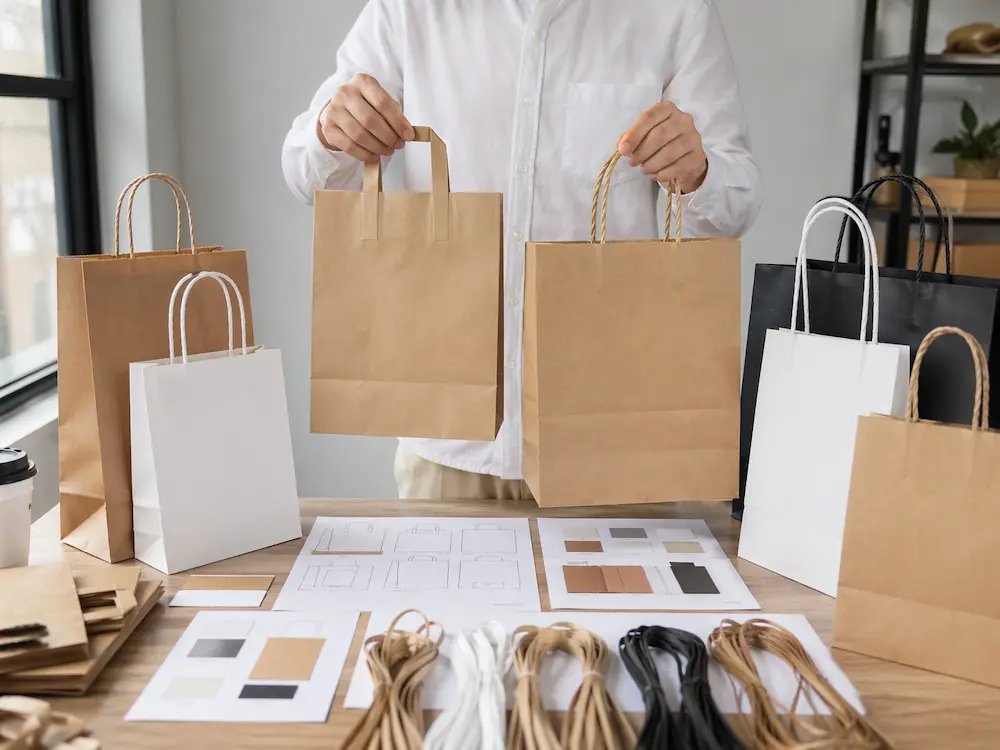
For brand owners, choosing between flat handle paper bags and twisted handle paper bags is not a small packaging detail. It affects how the bag looks, how it feels in the customer’s hand, how efficiently staff can pack it, how well it supports the brand image, and how suitable it is for bulk purchasing. In real commercial use, the decision between flat handle paper bags vs twisted handle paper bags often comes down to one practical question: what does your business really need the bag to do?
Some businesses need paper bags with handles that work quickly in takeaway, bakery, grocery, or pharmacy environments. Other businesses need paper bags with handles that feel more polished, more retail-ready, and more aligned with premium brand presentation. That is why there is no one universal answer for every brand. The better answer depends on product type, sales channel, customer expectation, and daily operational needs.
For brand owners, the strongest packaging choice is usually not the bag that looks best in isolation. It is the bag that works best in real use. In some cases, that will be a practical flat handle format. In others, it will be a more presentation-led twisted handle format. The key is to match the handle style to the business model, not just to personal preference.
Why this comparison matters for brand owners
When brand owners compare flat handle paper bags vs twisted handle paper bags, they are really comparing two different packaging roles.
A flat handle bag is often chosen because it is efficient, straightforward, and service-friendly. It usually works well when speed, practicality, and clean everyday use matter most. A twisted handle bag is usually chosen because it feels more complete as a retail bag. It often supports a stronger customer carry experience and a more polished visual impression.
This means the handle choice affects more than comfort. It changes:
- the overall brand impression
- the perceived product value
- the daily packing workflow
- the suitability for short-carry or longer-carry use
- the cost logic of the packaging programme
- the kind of retail experience the customer takes away
For brand owners, that makes flat handle paper bags vs twisted handle paper bags an important buying decision rather than a minor style preference.
What flat handle paper bags do best
Flat handle paper bags are usually the stronger choice when the bag needs to work efficiently in daily service conditions. They are common in takeaway, bakery, grocery, pharmacy, café, and fast-moving retail programmes because they are easy to open, easy to stack, and easy to use in higher-speed packing environments.
In practical use, flat handle paper bags often perform well because they support:
- quicker order loading
- easier storage and stacking
- a cleaner, simpler service flow
- a more straightforward paper-bag format
- a practical everyday brand image
For many brand owners, flat handle bags work best when the bag is mainly a service tool with branding added to it, rather than a premium presentation piece with secondary functional value.
This is why some businesses first compare more universal carry formats such as <a href=”https://sc1184.searchtestsite.com/products/paper-bags-with-handles-for-easy-carry-and-brand-display/”>paper bags with handles for easy carry and brand display</a> when deciding whether a simpler, more practical handle structure fits their brand better. In many daily-use retail environments, flat handle paper bags are strong because they feel efficient, dependable, and commercially sensible.
What twisted handle paper bags do best
Twisted handle paper bags are usually the stronger option when the bag needs to feel more like a shopping bag and less like a simple service carrier. They tend to suit fashion retail, cosmetics, gifting, boutique stores, lifestyle brands, and brand-led shopping environments because they often feel more finished, more comfortable to carry, and more visually complete.
For brand owners, twisted handle paper bags often work best when the bag is part of the customer experience rather than only a functional carry format. They usually support:
- a more polished retail appearance
- a stronger premium impression
- better carry comfort in many shopping scenarios
- a more balanced brand presentation
- a more recognisable shopping-bag format
This does not mean twisted handles are automatically better. It means they are often better when the bag needs to support a stronger sense of retail value.
Quick comparison table
| Comparison Point | Flat Handle Paper Bags | Twisted Handle Paper Bags |
|---|---|---|
| Overall impression | Practical, service-led, simple | More polished, retail-led, more presentable |
| Best for | Takeaway, bakery, grocery, pharmacy, everyday retail | Fashion, beauty, gifting, boutique, premium retail |
| Packing speed | Usually faster | Usually slightly less service-focused |
| Carry comfort | Good for shorter everyday use | Often better for longer carry |
| Brand tone | Clean, efficient, understated | More refined, more customer-facing |
| Storage efficiency | Usually very practical | Still practical, but more retail-oriented |
| Use in bulk programmes | Strong for operational efficiency | Strong for branded shopping experiences |
| Typical buyer reason | Function first | Experience and presentation first |
For brand owners, this table is often more useful than asking which handle is “better” in general. The better choice is usually the one that fits the real business environment.
Which handle is better for takeaway, bakery, and fast service businesses
For takeaway, bakery, café, pharmacy, and grocery-style businesses, flat handle paper bags are often the better business choice. The reason is not only cost. It is workflow.
In fast-service environments, staff usually need bags that:
- open easily
- hold shape well during quick loading
- work efficiently at the counter
- stack neatly in storage
- fit routine everyday use without slowing service
In those settings, flat handle paper bags vs twisted handle paper bags often becomes a question of operational fit. Flat handle bags usually win because they are more naturally suited to speed and repetition. When the bag is being used constantly throughout the day, simplicity becomes a strength.
This is especially true when the bag is used for food, takeaway boxes, baked goods, or general day-to-day distribution. A brand owner may still want the bag to look good, but the first priority is usually that the bag works without friction.
Which handle is better for boutique, lifestyle, and premium retail brands
For fashion, beauty, boutique gifting, lifestyle retail, and more presentation-led shopping experiences, twisted handle paper bags are often the better option. These brands usually want paper bags with handles that do more than carry the product. They want the bag to support the visual identity of the purchase.
In those environments, the bag often acts as:
- part of the storefront experience
- part of the product’s perceived value
- a visible branded object in the customer’s hand
- an extension of the retail identity
This is where twisted handle paper bags usually feel stronger. The handle shape often looks more complete and more shopping-oriented, which supports a more refined carry experience.
For brand owners comparing flat handle paper bags vs twisted handle paper bags, this usually means twisted handles become more attractive as the product value, retail setting, and customer expectation increase.
How brand image changes the decision
Brand image is one of the biggest deciding factors in flat handle paper bags vs twisted handle paper bags.
A simple food-service brand, local bakery, practical grocery line, or casual takeaway concept may actually benefit from the cleaner and more direct tone of flat handles. In those cases, twisted handles may feel unnecessarily formal or too retail-heavy.
By contrast, a boutique retail brand, premium self-care brand, cosmetics label, or elevated gifting programme may find that flat handles feel too service-led and not polished enough for the intended customer experience.
For brand owners, the real decision is not only “Which handle looks nicer?” It is:
- Which handle feels more appropriate for the brand?
- Which handle matches the customer’s expectation?
- Which handle makes the bag feel more believable in its actual retail setting?
That is why some buyers also review <a href=”https://sc1184.searchtestsite.com/products/brown-paper-bags-with-handles-for-natural-and-reliable-carry/”>brown paper bags with handles for natural and reliable carry</a> when deciding how a more natural-looking bag can still deliver strong everyday brand presentation. In many real retail programmes, the right handle choice is the one that makes the bag feel consistent with the brand, not more decorative than necessary.
Cost logic and volume purchasing
From a commercial standpoint, brand owners should never compare flat handle paper bags vs twisted handle paper bags only by unit price. The real decision includes:
- packing efficiency
- storage efficiency
- customer experience
- repeat-order consistency
- how many bag types the business really needs
- whether the handle type supports the actual retail or service model
Flat handle bags are often chosen because they are highly practical in bulk and usually support high-speed operations well. Twisted handle bags are often chosen because they create stronger retail value, even if the brand uses them in more selective product lines.
This is where scale matters. Buyers planning larger supply volumes sometimes review <a href=”https://sc1184.searchtestsite.com/products/bulk-paper-bags-with-handles-for-efficient-carry-and-distribution/”>bulk paper bags with handles for efficient carry and distribution</a> when comparing how handle style, carry format, and packaging consistency affect long-term purchasing logic. For high-volume packaging programmes, the stronger choice is usually the one that works best across repeated use, not only the one that looks good in the first sample.
Customer carry experience matters more than many brands expect
One of the easiest mistakes in packaging development is judging the bag while it is empty. Customers never experience the bag that way. They experience it when it is loaded, lifted, carried, and seen in public.
That is why brand owners should ask:
- Does the handle feel comfortable after loading?
- Does the bag remain balanced in the hand?
- Does the top opening behave well during packing?
- Does the handle style match the weight and shape of the product?
- Does the bag still feel on-brand once carried away from the store?
In many everyday retail uses, flat handle paper bags are completely sufficient and commercially smarter. In more shopping-led or premium environments, twisted handle paper bags often feel more appropriate because they support a better carry experience over longer or more visible use.
This is one of the most useful ways to think about flat handle paper bags vs twisted handle paper bags: not by empty bag appearance, but by loaded customer use.
One handle type is not always enough for one business
Some brand owners assume they need to choose only one handle type forever. In reality, many businesses benefit from using more than one bag structure depending on product line or sales channel.
For example:
- flat handle bags for takeaway or practical service use
- twisted handle bags for branded retail purchases
- simpler bulk-use bags for distribution
- stronger presentation bags for gifting or premium collections
This kind of split often creates a smarter bag programme because it aligns packaging with actual customer needs. A one-size-fits-all handle strategy is often less efficient than a small, well-planned packaging range.
Common mistakes brand owners should avoid
The most common mistakes in choosing flat handle paper bags vs twisted handle paper bags include:
- choosing by appearance only
- assuming twisted handles are always more premium and therefore always better
- assuming flat handles are only for cheap packaging
- ignoring the real service environment
- testing the bag empty instead of loaded
- choosing one handle type for all use cases without checking customer behaviour
- comparing handle formats by price alone
For brand owners, the best decision usually comes from matching handle type to the real business model, not from packaging habits or assumptions.
Which is better for your business?
So, flat handle paper bags vs twisted handle paper bags: which is better for your business?
The better answer is:
- Flat handle paper bags are usually better when your business values speed, practicality, service efficiency, and straightforward everyday carry.
- Twisted handle paper bags are usually better when your business values stronger retail presentation, a more polished customer experience, and a more shopping-led brand impression.
For takeaway, bakery, grocery, pharmacy, and fast-moving service environments, flat handles are often the stronger business choice.
For fashion, beauty, boutique, lifestyle, gifting, and more presentation-led retail, twisted handles are often the stronger business choice.
Conclusion
For brand owners, the choice between flat handle paper bags and twisted handle paper bags should be based on real use, not habit. The strongest bag is not simply the one that looks nicer on its own. It is the one that fits the product, the store environment, the customer carry experience, and the long-term packaging strategy.
When comparing flat handle paper bags vs twisted handle paper bags, the best decision usually comes from understanding what the bag has to do every day. If the priority is speed, service, and practical everyday performance, flat handles often win. If the priority is presentation, customer perception, and a more refined retail finish, twisted handles often win.
For most brand owners, better packaging decisions come from better alignment. When the handle type, bag structure, brand message, and real business use all support each other, the bag stops being just a carry item and becomes a more effective part of the brand itself.
How Brand Owners Should Choose Between Flat and Twisted Handle Paper Bags
What the handle decision really means: Choosing between flat handle paper bags and twisted handle paper bags is not only about appearance. It affects packing speed, carry comfort, customer perception, and how well the bag fits the real business environment.
Why this matters for brand owners: A handle style that looks good in isolation may still be the wrong choice if it slows service, feels awkward in use, or sends the wrong message about the product.
How brands should compare options: Flat handles usually suit service-led and practical retail use, while twisted handles usually suit more presentation-led shopping and branded retail environments.
What usually works best in practice: Flat handle paper bags often perform better in takeaway, grocery, bakery, and pharmacy-style use. Twisted handle paper bags often perform better in fashion, beauty, gifting, boutique, and other more polished retail settings.
What brand owners should watch most carefully: The strongest choice usually depends on the real customer journey, the actual loading pattern, and whether the bag is meant to act mainly as a service carrier or as part of the brand experience.
The larger takeaway: The better handle type is usually the one that fits the business model best, not the one that simply looks more premium on its own.
FAQ
1. Are flat handle paper bags better for takeaway and fast-service businesses?
Usually, yes. For many takeaway, bakery, grocery, and other fast-service businesses, flat handle paper bags are often the better choice because they tend to suit quick packing, straightforward loading, and practical everyday use. This is a commercial packaging judgment rather than a legal rule, but it aligns with the broader direction toward better-designed and more functional packaging.
2. Are twisted handle paper bags better for premium retail brands?
In many cases, yes. Twisted handle paper bags are often better for fashion, beauty, gifting, boutique, and other presentation-led retail settings because they usually feel more polished and more shopping-oriented than flat-handle formats. This is a commercial judgment based on retail presentation and carry experience rather than a regulatory requirement.
3. Which handle type is usually more cost-effective for brand owners?
For many everyday-use programmes, flat handle paper bags are often the more cost-effective option because they are commonly used in efficient service-led bag formats. But the stronger commercial choice still depends on whether the bag is meant to prioritise speed and practicality or a more premium customer-facing experience.
4. Do handle types affect brand perception?
Yes. The handle changes how the bag feels in the hand and how it is perceived at the point of carry. Flat handles usually signal practicality and straightforward service, while twisted handles often signal a more polished retail experience. For brand owners, the better option is usually the one that matches the product category and customer expectation.
5. Should brands think about sustainability claims when choosing handle styles?
Yes, but carefully. The FTC says marketers should avoid broad, unqualified claims like “green” or “eco-friendly” and should use clear, specific claim language, while FSC says its labels stand for sustainable sourcing. That means brands should not assume one handle type automatically creates a stronger environmental claim; the full bag structure and sourcing story matter more.
References
- Packaging Waste Regulation — European Commission. The Commission says the PPWR will begin to apply from mid-2026 and is designed to improve packaging design and the broader packaging framework.
- Environmental Claims: Summary of the Green Guides — Federal Trade Commission. The FTC says marketers should not make broad, unqualified general environmental benefit claims like “green” or “eco-friendly,” and should qualify claims clearly and specifically.
- What the FSC Labels Mean — Forest Stewardship Council. FSC says its labels stand for sustainable sourcing and explain FSC 100%, FSC Mix, and FSC Recycled label meanings.
- 2026 PPWR guidance materials — European Commission. The Commission’s 2026 guidance repeats that Regulation (EU) 2025/40 entered into force on 11 February 2025 and applies from 12 August 2026.
Content Use Policy:You are welcome to reference this article with proper attribution, but copying, republishing, or modifying the full content without permission is not permitted.