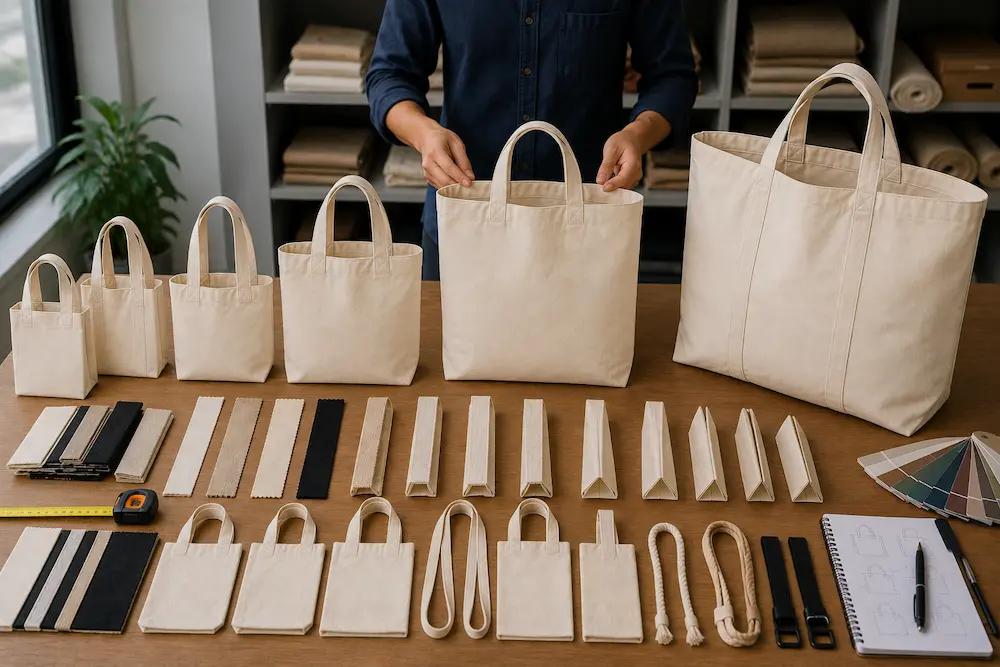
Many businesses focus heavily on fabric, printing, and color selection when sourcing tote bags, but size is often the decision that affects usability the most. A tote bag that is too small may feel impractical for shopping, retail packaging, or daily carrying. A bag that is too large may become uncomfortable to carry, difficult to store, and inefficient for shipping or retail display.
This is why experienced buyers do not select tote bag sizes randomly. They carefully match dimensions to the intended carrying purpose, customer usage habits, branding goals, and freight efficiency. A grocery tote, bookstore bag, promotional giveaway, and fashion retail tote all require different sizing logic. The best size depends on how customers will actually use the bag in daily life.
The right tote bag size improves both functionality and long-term brand exposure because customers are more likely to reuse bags that feel natural and practical. A properly designed Custom Tote Bag should balance carrying capacity, comfort, and visual proportion instead of simply maximizing size.
Size also directly affects production cost and logistics. Larger bags require more fabric, reduce carton packing efficiency, and increase shipping cost. In many cases, a medium-sized Custom Tote Bag creates better long-term usability and stronger repeat visibility than an oversized design that customers rarely carry.
Why Tote Bag Size Matters in Real Business Use
Tote bag size affects much more than carrying capacity. It influences:
- Material consumption
- Printing visibility
- Weight distribution
- Customer comfort
- Freight efficiency
- Retail presentation
- Production cost
- Storage efficiency
Even small size adjustments can noticeably change how customers actually use the bag. A few centimeters added to the width, height, or gusset can affect carrying comfort, storage capacity, visual balance, and overall practicality in daily situations.
For example, a tote bag intended for trade shows usually prioritizes lightweight construction, document storage, and easy distribution at events. In contrast, a grocery tote often requires deeper gussets and stronger structure to support heavier products. A bookstore bag may need proportions that comfortably fit books or magazines without bending the corners, while a fashion retail tote often focuses more on appearance, shoulder comfort, and brand presentation.
Different usage environments create different sizing priorities. That is why experienced buyers evaluate tote bag dimensions based on real customer behavior instead of choosing sizes only from factory templates or previous orders.
Understanding Standard Tote Bag Dimensions
Tote bag sizes are usually measured using three dimensions:
- Width
- Height
- Gusset depth
The gusset is especially important because it determines how much internal volume the bag can hold. Flat tote bags without gussets may look cleaner visually but hold fewer bulky items.
Most custom tote bag programs fall into three broad categories:
- Small promotional sizes
- Medium everyday sizes
- Large-capacity retail or grocery sizes
Small Tote Bags for Promotions and Retail Packaging
Small tote bags are commonly used for cosmetics, gifts, event merchandise, boutique packaging, trade shows, jewelry packaging, and lightweight promotional distribution.
These bags are easier to distribute in large quantities because they use less fabric and occupy less freight volume.
Smaller bags also create lower production cost in many cases, especially for lightweight promotional programs.
However, buyers should avoid making promotional bags excessively small because customers may stop reusing them if they cannot carry practical everyday items.
Branded products such as custom printed canvas bags often balance compact size with enough usable capacity to encourage long-term reuse.
Medium Tote Bags Are the Most Versatile Option
Medium-sized tote bags are often considered the most commercially flexible category because they work for daily shopping, bookstores, office carry, casual commuting, exhibitions, and lifestyle retail.
These dimensions usually provide enough space for notebooks, tablets, water bottles, groceries, and personal items without becoming bulky.
This is one reason medium tote bags are extremely popular for brand marketing campaigns. They combine practical everyday use with strong logo visibility.
Products such as custom cotton tote bags are frequently produced in medium sizes because they match broad consumer usage patterns effectively.
Large Tote Bags Support Grocery and Heavy Retail Use
Large tote bags are designed for higher carrying volume. They are common in supermarkets, grocery programs, beach bags, travel totes, warehouse retail, and oversized shopping applications.
These bags usually include wider gussets and stronger reinforced handles because larger capacity naturally encourages heavier loading.
However, larger tote bags also increase:
- Fabric consumption
- Shipping volume
- Production cost
- Carrying weight
This means oversized bags should only be selected when the usage situation truly requires the additional volume.
Gusset Size Changes Capacity Dramatically
Many buyers underestimate how important gussets are. Increasing gusset depth can significantly improve carrying volume without making the tote bag visually much wider.
Wide gussets help tote bags stand more naturally and support box-shaped products more effectively.
Grocery bags, wine totes, and retail shopping totes commonly use larger gussets because they improve stability and internal organization.
Flat bags without gussets remain popular for lightweight events and simple promotional distribution because they fold more easily and reduce freight volume.
| Tote Bag Size Category | Typical Use | Main Advantage | Main Limitation |
|---|---|---|---|
| Small | Promotions, gifts, cosmetics | Lower cost and portability | Limited carrying capacity |
| Medium | Daily use and branding | Balanced versatility | Moderate volume only |
| Large | Groceries and retail shopping | High carrying capacity | Higher freight and material cost |
| Flat tote | Events and lightweight carry | Easy folding and storage | Reduced internal space |
| Wide gusset tote | Heavy retail applications | Improved stability | Higher fabric consumption |
Printing Area Depends on Tote Bag Size
Tote bag size directly affects branding visibility. Larger bags naturally offer larger printable areas, allowing bigger logos, artwork, and promotional graphics.
But extremely large bags can sometimes make logos appear visually disconnected if the artwork scale is not adjusted properly.
Products designed for stronger public branding exposure such as custom printed cotton tote bags often require careful balance between bag proportions and print placement.
The goal is not simply maximizing print size. It is creating visually balanced branding during actual carrying use.
Handle Length Must Match Bag Size
Larger tote bags usually require longer and stronger handles because the carrying load increases significantly during real-world use. A large-capacity bag with short narrow handles may look acceptable in product photos, but it often becomes uncomfortable once customers begin carrying groceries, books, clothing, or promotional materials. Poor handle design can reduce the overall usability of an otherwise well-made bag.
Handle proportions should always scale together with tote bag dimensions. As the bag body becomes wider, deeper, or taller, the handle width, stitching strength, and handle drop should also be adjusted to maintain carrying comfort and structural balance. A properly designed Custom Tote Bag should feel stable and comfortable whether carried by hand or over the shoulder.
Many sourcing problems happen because buyers enlarge the bag dimensions while keeping lightweight handle structures originally designed for smaller bags. This creates imbalance in both comfort and durability. Thin handles may dig into the hand, reinforcement stitching may fail under heavier loads, and the bag may lose its shape during use.
Experienced buyers evaluate the tote bag as a complete product system rather than treating the body and handles as separate components. A durable Custom Tote Bag depends not only on strong fabric, but also on properly matched handle construction that supports long-term daily use
Shipping Efficiency Changes with Tote Bag Dimensions
Larger tote bags naturally occupy more shipping volume. This affects:
- Container loading efficiency
- Air freight cost
- Warehouse storage
- Retail shelf organization
- Distribution logistics
Freight optimization becomes especially important for large international promotional campaigns where shipment volume can heavily influence total landed cost. Even small differences in tote bag dimensions can affect carton loading quantity, pallet efficiency, warehouse storage, and container utilization across large-scale shipments.
This is why some buyers intentionally reduce dimensions slightly to improve packing efficiency while still maintaining practical everyday usability. A small adjustment in width, height, or gusset depth may allow more bags per export carton, reduce freight cost per unit, and improve overall supply chain efficiency without noticeably affecting customer experience.
Industry Use Cases Often Determine Size Standards
Different industries typically favor different tote bag dimensions, and these preferences are usually driven by real usage scenarios rather than visual design alone:
- Bookstores often prefer medium vertical Custom Tote Bag styles because they fit books and magazines more efficiently.
- Supermarkets tend to choose wide gusset grocery totes to support heavier loads and irregular product shapes.
- Luxury retail brands usually adopt structured medium bags that maintain a premium silhouette during customer carry.
- Trade shows often rely on lightweight flat totes for easy distribution and stacking efficiency.
- Fashion brands may prefer oversized lifestyle silhouettes to enhance visual impact in public settings.
Understanding the actual end-use environment helps businesses avoid choosing sizes based only on appearance. A well-planned Custom Tote Bag strategy ensures that dimensions align with customer behavior, product category requirements, and long-term brand positioning rather than short-term visual appeal.
Custom Sizing Allows Better Brand Positioning
Custom dimensions can help businesses create stronger product differentiation instead of relying on generic market sizes that look similar across multiple brands. A thoughtfully sized tote bag often feels more intentional, more functional, and more connected to the customer experience.
Some brands intentionally design proportions around specific customer behaviors, packaging systems, or retail environments. A cosmetics retailer may prefer a compact vertical Custom Tote Bag for smaller boxed products, while a bookstore may choose wider dimensions that better support magazines and hardcover books. Different retail categories require different sizing logic based on how customers actually carry and reuse the bag.
Fashion brands often use taller proportions to create a cleaner visual appearance when customers carry the bag in public. A well-designed Custom Tote Bag is not only functional but also part of the overall brand presentation, helping businesses create stronger visual identity and long-term customer recognition.
Large promotional programs such as custom canvas bags bulk production may standardize sizing to improve carton efficiency, reduce freight cost, and simplify warehouse handling across multiple distribution locations. In contrast, premium retail brands may prioritize distinctive proportions that strengthen visual identity and make the bag feel less generic in the market.
The correct sizing strategy depends on the actual business objective. Some companies focus on shipping efficiency and low distribution cost, while others focus more on customer experience, retail presentation, or long-term reusable value. Experienced buyers evaluate tote bag dimensions not only from a production perspective, but also from branding, logistics, and everyday usability considerations.
Foldability and Storage Should Also Be Considered
Very large tote bags may become less convenient for everyday carrying because they are harder to fold and store.
Customers often prefer tote bags that can easily fit into backpacks, cars, office drawers, or luggage when not in use.
This is one reason why lightweight portable alternatives such as custom canvas drawstring bags remain popular for certain promotional applications where compact storage matters heavily.
How Businesses Should Choose the Right Tote Bag Size
The best method is to start with the actual usage situation rather than aesthetics alone.
- What items will customers carry most often?
- Will the bag be used daily or occasionally?
- Is freight efficiency important?
- Does the product prioritize branding visibility?
- Will customers carry the bag by hand or shoulder?
- Does the tote need structured stability or flexible foldability?
Once those practical questions are answered clearly, the correct size category for a Custom Tote Bag becomes much easier to define, because real-world function takes priority over visual preference.
A well-planned Custom Tote Bag strategy ensures that every dimension decision is grounded in usage behavior, logistics requirements, and brand positioning, rather than being chosen randomly from standard templates.
Ultimately, when functional requirements are clearly understood, selecting the right Custom Tote Bag becomes a structured decision rather than a subjective choice, leading to better usability, stronger branding performance, and more efficient logistics planning.
Conclusion
Custom Tote Bag sizes should always be selected based on real carrying behavior, branding strategy, and commercial logistics rather than appearance alone. Small, medium, and large tote bags all serve different business purposes, from lightweight promotional use to premium retail packaging and heavy-duty shopping applications.
The most effective Custom Tote Bag size is not necessarily the largest or most visually impressive option. It is the size that customers genuinely continue using in everyday life because it feels practical, comfortable, and well suited to their daily routines.
How Businesses Should Think About Tote Bag Sizes
What tote bag size really affects: Tote bag size influences far more than carrying capacity alone. It affects customer comfort, logo visibility, freight efficiency, storage practicality, production cost, and how frequently customers actually reuse the bag in daily life.
Why many businesses choose the wrong dimensions: Some buyers focus mainly on visual appearance without considering real-world carrying behavior. Oversized bags may increase freight cost and become uncomfortable, while undersized bags may feel impractical and reduce long-term reuse value.
How companies should compare tote bag size options: Small tote bags usually work best for lightweight promotions and retail packaging, medium sizes support everyday branding use, while large-capacity tote bags fit grocery and heavy retail applications. Gusset depth, handle proportions, and print balance should always be evaluated together rather than separately.
Options businesses commonly evaluate: Most buyers compare portability against carrying volume, branding visibility against freight efficiency, and structured stability against foldability. The ideal tote bag dimensions depend heavily on whether the product is intended for retail shopping, exhibitions, commuting, grocery use, or lifestyle branding.
Considerations before production approval: Before finalizing tote bag dimensions, businesses should test carrying comfort, handle balance, print placement, shipping carton efficiency, and actual customer usage scenarios together. A tote bag that looks attractive but feels inconvenient during daily use often loses long-term branding value quickly.
The broader takeaway: Strong tote bag design is not only about printing or fabric selection. Correct sizing plays a major role in whether customers continue reusing the bag publicly over time. That is also where Youngpack naturally fits as a B2B manufacturing and export partner for brands developing tote bag programs that require stronger balance between usability, logistics efficiency, branding visibility, and scalable production quality.
FAQ
1. What is the most popular tote bag size for businesses?
Medium-sized tote bags are usually the most popular because they balance portability, branding visibility, and everyday usability. They are commonly used for shopping, bookstores, exhibitions, retail promotions, and lifestyle marketing campaigns.
2. Why do gussets matter on tote bags?
Gussets increase the internal carrying volume of a tote bag and improve stability for bulkier items. Wider gussets are especially useful for grocery bags, retail shopping bags, and larger-capacity tote bags designed for heavier loads.
3. Are larger tote bags always better for branding?
Not necessarily. Larger tote bags provide more print area, but oversized dimensions can reduce comfort, increase freight cost, and make the bag less practical for daily use. The best branding results usually come from balancing size with real-world usability.
4. How does tote bag size affect shipping cost?
Larger tote bags increase both shipment volume and overall freight weight. This affects container loading efficiency, warehouse storage, and transportation cost. Even small dimension adjustments can significantly affect total logistics expense at large order quantities.
5. Should handle size change with tote bag dimensions?
Yes. Larger tote bags usually require longer and stronger handles to support heavier carrying loads comfortably. Handle proportions should always match the overall tote bag size and expected carrying weight.
References
- Reusable Tote Bag Dimension Standards — textile manufacturing reference.
- Retail Packaging and Carry Bag Engineering Guide — packaging industry reference.
- Consumer Carry Behavior and Bag Ergonomics Study — usability reference.
- Freight Optimization for Textile Products — logistics industry reference.
- Soft Goods Manufacturing and Material Consumption Analysis — industrial sewing reference.
- Retail Merchandising and Promotional Product Design Standards — marketing reference.
- Reusable Shopping Bag Capacity and Structural Performance Study — sourcing reference.
- Textile Product Development and Size Standardization Guide — export manufacturing reference.
Website Content Notice:
Unless otherwise stated, all original articles published on this website are owned by Xiamen Youngpack Imp.and Exp.Co.,Ltd. and may not be copied or republished without authorization.