Introduction
Buying cotton tote bags wholesale looks simple until real production issues start to appear. One supplier offers a low quote but changes fabric weight between orders. Another produces a decent sample but fails to keep the same stitching standard in mass production. A third communicates well in the early stage yet struggles with print alignment, export packing, or delivery timing when the order scales up. For wholesalers, importers, retailers, promotional merchandise distributors, and brand owners, the real challenge is not finding a supplier. It is finding the right one.
This matters because cotton tote bags are no longer treated as low-value accessories. They are now widely used in retail packaging, event distribution, branded merchandise, bookstore sales, supermarket promotions, loyalty programs, conferences, and everyday reusable carry. A good tote bag can support a brand for months through repeated public use. A poor one can damage product perception in a single day. That is why supplier choice is not a purchasing detail. It is a strategic decision.
For many buyers, the starting point is cost. That is understandable, but it is also where many sourcing mistakes begin. The lowest quote often hides weaker fabric, fewer stitches, lower print control, unstable lead times, or poor carton efficiency. The better supplier is usually the one that helps buyers align product quality, branding needs, and wholesale planning from the beginning rather than the one that simply promises the cheapest unit price.
What Cotton Tote Bags Wholesale Really Means
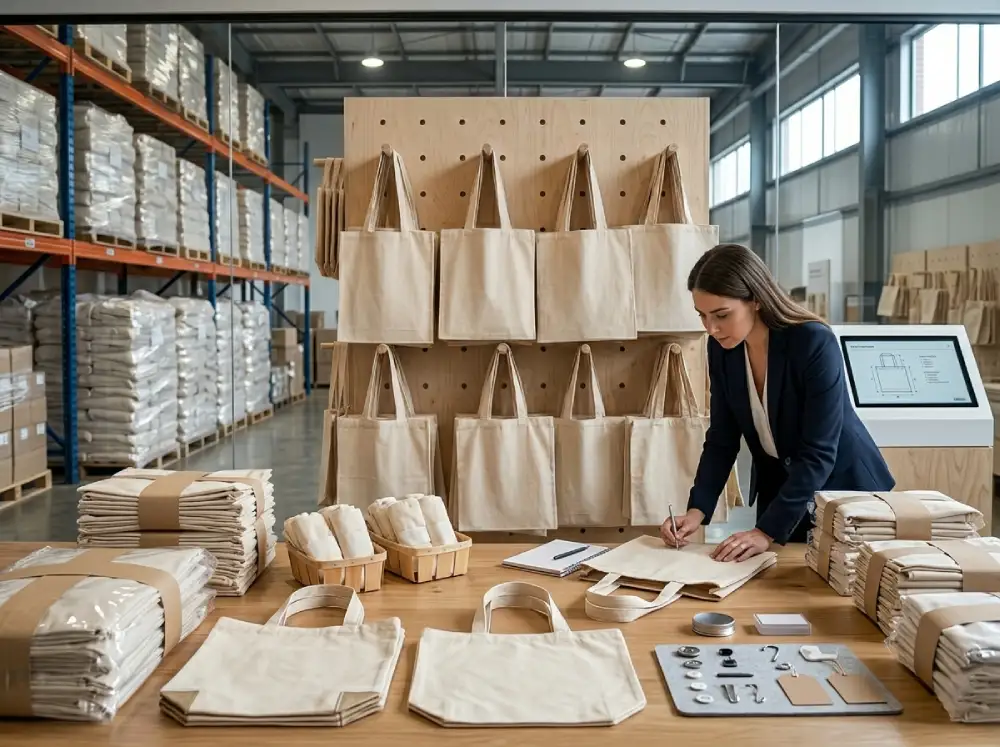
Cotton tote bags wholesale means sourcing tote bags in larger commercial quantities for resale, promotional distribution, retail packaging, private label programs, or branded campaigns. In theory, wholesale buying lowers unit cost and improves consistency. In practice, those benefits only appear when the product specification is clear and the supplier has the ability to repeat that specification at scale.
Some wholesale buyers need simple everyday bags for low-cost distribution. Others need stronger bags with cleaner finishing for retail resale or brand visibility. Some want plain stock products with short lead times. Others need detailed customisation, reinforced handles, gussets, inside labels, care tags, zipper closures, or premium print finishes. These differences affect cost, MOQ, production time, shipping volume, and quality control requirements.
That is also why many buyers eventually move beyond standard stock items and start evaluating custom made tote bags when the bag is expected to support a more tailored brand identity. Once the product becomes part of a longer-term retail or marketing strategy, the sourcing decision becomes far more demanding than a basic bulk purchase.
Why Supplier Choice Matters More Than Most Buyers Expect
The wrong supplier usually creates the same five problems: unstable material quality, weak sewing, inconsistent printing, unreliable delivery, and poor communication. All of these become more expensive as order volume grows. A sample may look acceptable, but if the supplier cannot maintain the same standard across 5,000, 20,000, or 50,000 pieces, the commercial risk becomes serious.
In wholesale production, a supplier is not only making a tote bag. They are managing fabric sourcing, cutting accuracy, sewing quality, print registration, packing efficiency, export documentation, and shipment readiness. If any of those steps are weak, the buyer may end up with shade variation, uneven seams, skewed logos, broken handles, inaccurate dimensions, or compressed cartons that damage presentation.
This becomes even more important when the bag is meant to support brand visibility. Some projects need a simple reusable bag. Others need a more structured product with higher perceived value. In those cases, the supplier should be able to recommend whether a plain cotton bag is enough or whether the project should move toward solutions such as custom canvas bags with logo to achieve stronger visual impact and a more premium branded result.
Materials, Fabric Weight, and Construction Standards
Not all cotton tote bags are equal, even when product photos look similar. Fabric composition, weave density, basis weight, finishing, stitching, and handle attachment all influence how the bag performs. Buyers should never rely on general phrases such as “good quality cotton” without asking for measurable details.
Common Cotton Material Options
Typical choices include standard cotton sheeting, heavier cotton canvas, recycled cotton blends, and organic cotton. Standard cotton is often used for general promotions and lower-cost retail applications. Recycled cotton can support sustainability-focused programs, though appearance and hand feel may vary by blend ratio. Organic cotton may suit brands with stricter sourcing requirements. Heavier cotton-canvas construction is usually preferred when the bag is expected to carry more weight, hold its shape better, or deliver a longer service life.
For buyers that need a stronger everyday-use product, cotton canvas tote bags are often a more reliable choice because they balance durability, better structure, and higher perceived value. This is especially useful when the bag is intended for retail reuse, bookstore carry, supermarket shopping, or long-term brand exposure.
Fabric Weight and Performance
Fabric weight affects feel, durability, and cost. Lightweight cotton bags may work well for brochures, event materials, or short-term promotions. Medium-weight bags are more suitable for daily carry and general retail use. Heavier canvas bags are better when buyers want a product that behaves more like merchandise than a giveaway.
| Bag Type | Typical Fabric Range | Common Use | Main Benefit | Main Limitation |
|---|---|---|---|---|
| Light cotton tote | 120–150 gsm | Events, leaflets, simple promotions | Lower cost, easy distribution | Lower structure and durability |
| Standard cotton tote | 140–180 gsm | Retail promotions, everyday use | Balanced cost and reuse value | Less premium than heavier canvas |
| Cotton-canvas tote | 220–340 gsm | Retail resale, bookstores, grocery carry | Stronger body and better longevity | Higher unit cost |
| Recycled cotton blend tote | 140–220 gsm | Sustainability-led campaigns | Supports responsible brand story | Variation in texture and appearance |
Construction Details Buyers Should Verify
Fabric alone does not determine quality. Buyers should also verify stitch density, seam reinforcement, handle cross-stitching, gusset accuracy, top-edge folding, and trimming quality. A medium-weight bag with strong construction can outperform a heavier bag with weak sewing. Handle attachment deserves special attention because this is one of the most common failure points in mass production.
Printing, Branding, and Product Presentation
For many wholesale buyers, branding performance matters just as much as construction quality. A tote bag is a large-format visual surface, so poor print quality is immediately visible. Buyers should confirm print method, artwork positioning tolerance, ink durability, and expected shade consistency across bulk runs.
Screen printing is often the most practical choice for cotton and canvas when the design is simple and color count is controlled. Heat transfer or digital methods may be used for more detailed artwork depending on the supplier’s capability and the bag material. Embroidery can add a premium touch for some retail-style programs, though it changes cost and production time.
Brand positioning also affects bag selection. A lightweight unbleached cotton bag may suit a value-conscious or natural brand image. A heavier canvas bag with clean print and stronger finishing may better support premium retail presentation. Buyers should decide whether the bag is meant to function as packaging, promotion, merchandise, or all three at the same time.
MOQ, Bulk Orders, and Real Cost Structure
MOQ exists because custom tote bag production has setup logic. Fabric sourcing, cutting layout, screen preparation, print calibration, sewing setup, quality checks, and carton planning all create fixed costs before the full run begins. This is why very small custom orders often have high unit prices, while repeat larger orders become much more efficient.
For larger campaigns, store programs, and multi-location rollouts, sourcing cotton tote bags bulk usually makes more commercial sense because it improves unit economics, production planning, and print consistency across the whole order. Bulk production also helps reduce the risk of mixed shade variation between separate small runs.
Buyers should think about total landed cost rather than just ex-factory unit price. Real cost is influenced by fabric weight, bag size, gusset depth, handle length, print colors, finishing details, carton count, freight density, and quality rejection risk. A slightly better-made bag may cost more upfront but save money by reducing complaints, reorders, and packaging failures.
| Cost Driver | Impact on Wholesale Order | Buyer Consideration |
|---|---|---|
| Fabric weight | Higher weight increases material cost | Match strength to real use case |
| Bag dimensions | Larger bags consume more fabric and carton space | Avoid oversizing for simple campaigns |
| Printing complexity | More colors and detail increase setup and QC time | Keep artwork commercially realistic |
| Construction details | Gussets, pockets, zippers, labels add labor | Use only where the project benefits |
| Order quantity | Larger volume usually lowers unit cost | Balance MOQ with storage and forecast |
Lead Time, Sampling, and Repeat-Order Stability
Wholesale buyers often focus heavily on first-order price and not enough on repeat-order stability. That is a mistake. A strong tote bag supplier should be able to handle sampling, artwork confirmation, pre-production approval, bulk scheduling, and repeat orders without resetting the process from the beginning each time.
Sampling should not be treated as a formality. It is the stage where buyers verify size, fabric feel, stitching quality, handle comfort, print appearance, and whether the product matches the intended commercial use. If the supplier cannot produce a clear and accurate sample process, that is often a warning sign for mass production as well.
Lead time should also be discussed honestly. Buyers should ask for separate expectations for sample development, production, and shipping readiness. Suppliers that promise unrealistic speed are often the same ones that later shift dates when material or print issues appear.
Everyday Use Matters More Than Catalog Claims
Many wholesale projects succeed or fail based on whether the bag fits real daily use. A tote bag may look fine in a catalog but still be the wrong choice if the handle drop is uncomfortable, the fabric is too thin for grocery use, or the print fades too quickly in repeated carrying situations.
That is why buyers should think in terms of actual use scenes. A simple cotton tote may be perfect for bookstores, campus programs, exhibitions, and light retail applications where repeated everyday visibility matters more than heavy load performance. A stronger cotton-canvas construction may be necessary for supermarket use, premium merchandise, or retail resale.
When the bag is meant to stay in public circulation, comfort and practicality are part of branding. People only keep using the product if it works well in real life.
How to Evaluate a Cotton Tote Bag Supplier Properly
The strongest suppliers do not only answer questions. They ask the right ones. A reliable factory or export supplier should want to know the intended bag size, expected load, brand positioning, print method, order volume, target market, and whether the product is for promotion, packaging, or resale. If a supplier jumps straight to a price without clarifying any of this, the buyer is probably not getting serious guidance.
Buyers should evaluate suppliers across six areas:
Material clarity: Can the supplier explain cotton types, fabric weight, weave differences, and suitable options for the project?
Construction control: Can they show clear sewing standards, reinforcement logic, and finishing consistency?
Print capability: Can they explain artwork limits, print methods, and color consistency expectations?
Sampling process: Do they have a structured sample approval workflow?
Export readiness: Can they manage packing, documentation, and repeat shipment planning properly?
Communication quality: Do they provide commercial answers, or only generic promises?
For B2B buyers, a good supplier should behave like a production partner rather than a quote machine. That is where manufacturers such as Youngpack, or any serious export-oriented tote bag supplier, should be judged: not by slogans, but by how clearly they manage product logic, quality expectations, and repeat-order reliability.
Wholesale Buying Mistakes to Avoid
The first common mistake is choosing only by price. The second is approving a sample without defining tolerances for bulk production. The third is treating every cotton tote bag as interchangeable. The fourth is underestimating packing and freight impact. The fifth is using vague quality language instead of measurable specifications.
Another major mistake is failing to align the bag with the business model. A promotional handout bag does not need the same construction as a retail resale bag. A bookstore tote does not need the same structure as a supermarket reusable bag. A premium branded gift bag does not need the same cost logic as a simple wholesale event bag. Buyers should choose the right product category before comparing suppliers.
Conclusion
The best cotton tote bags wholesale supplier is not automatically the cheapest, the fastest, or the one with the nicest sample photos. It is the supplier that can repeatedly produce the right bag for the right commercial purpose with stable material quality, dependable stitching, controlled printing, realistic lead times, and clear communication.
Wholesale sourcing works best when buyers define what the bag is expected to do: carry light items, support daily use, strengthen retail branding, serve as merchandise, or distribute at scale. Once that purpose is clear, the right supplier becomes much easier to identify.
For serious B2B buyers, the real goal is not only to buy bags. It is to build a repeatable supply program that supports product quality, brand consistency, and long-term commercial use. That is the standard a supplier like Youngpack should be measured against, and it is the standard buyers should expect before placing a wholesale order.
How Wholesale Buyers Should Think About Cotton Tote Bag Suppliers
What wholesale sourcing really involves: Cotton tote bag wholesale is not just a volume purchase. It is a supply decision that affects fabric consistency, print quality, delivery reliability, and how the finished bag represents the brand in everyday use. The right supplier should be able to support both product quality and repeat-order stability.
Why supplier choice matters: Buyers usually see the first warning signs too late, after production has already started or shipments have already arrived. That is why supplier evaluation should happen before price comparison becomes the main decision driver. Material clarity, sewing standards, printing control, and export readiness are usually far more important than the lowest initial quote.
How buyers should compare options: The most reliable comparison method is to evaluate bag purpose, fabric weight, construction strength, branding needs, MOQ structure, and repeat-order planning together. A lightweight promotional tote, a bookstore bag, and a retail resale tote may all look similar at first, but they require different production standards and different supplier strengths.
Options that typically matter most: Buyers often choose between standard cotton and heavier cotton-canvas construction, between stock products and custom development, and between short-term event bags and long-life branded carry bags. The right option depends on whether the project is driven by price, visibility, durability, or long-term reuse.
Considerations before placing a large order: Businesses should confirm sample accuracy, production tolerances, printing expectations, carton efficiency, freight planning, and whether the supplier can scale without changing quality. They should also decide whether the bag is mainly for promotion, packaging, retail resale, or brand merchandise, because each purpose changes what “good quality” actually means.
The broader commercial takeaway: The strongest wholesale program is usually not built around the cheapest bag. It is built around the most suitable bag supported by the most dependable supplier. For B2B buyers developing reusable and custom tote bag programs, Youngpack fits naturally into that conversation as a manufacturer focused on clear specifications, customization support, and export-ready production consistency.
FAQ
1. What should buyers check first when sourcing cotton tote bags wholesale?
Buyers should first check fabric type, fabric weight, stitching quality, handle construction, printing method, MOQ structure, and the supplier’s ability to maintain the same standard in bulk production. Price matters, but it should come after the product specification is clear. A supplier that cannot explain material and construction details clearly is usually a higher risk than one with a slightly higher quote but stronger production control.
2. Are cotton canvas tote bags better than standard cotton tote bags?
Not always, but they are often better for heavier use, stronger carry performance, and a more premium retail feel. Standard cotton tote bags can work very well for promotions, events, bookstores, and light everyday use. Cotton-canvas bags are usually more suitable when the bag is expected to support groceries, repeated shopping, long-term brand visibility, or resale-style use. The better option depends on the intended use case and budget.
3. How do MOQs affect cotton tote bag wholesale orders?
MOQs affect wholesale orders because custom tote bag production involves setup costs for fabric sourcing, cutting, printing, sewing preparation, and packing. Small runs often carry higher unit costs because those setup costs are spread over fewer bags. Larger orders usually improve unit economics and consistency, especially when the product specification is stable and the buyer is planning repeat distribution or retail use.
4. What is the biggest mistake when choosing a tote bag supplier?
The biggest mistake is choosing only by price without verifying whether the supplier can maintain quality at scale. Many buyers approve a sample, assume mass production will match it, and then discover differences in fabric weight, print alignment, or stitching consistency after shipment. The better approach is to evaluate how the supplier manages materials, sampling, production control, and repeat-order stability before approving the order.
5. Can cotton tote bags work for both promotions and retail resale?
Yes, but the bag specification should change depending on the purpose. A promotional tote may focus on lower cost, simpler printing, and lighter carry use. A resale or premium retail tote usually needs stronger material, better finishing, more consistent print quality, and higher perceived value. The same general product category can serve both roles, but buyers should not assume one specification suits every commercial use.
References
- Green Guides for the Use of Environmental Marketing Claims — Federal Trade Commission — FTC.
- Sustainable Packaging Guidelines — Australian Packaging Covenant Organisation — APCO.
- Preferred Fiber and Materials Market Report — Textile Exchange — Textile Exchange.
- Textiles and the Environment — European Environment Agency — EEA.
- Fashion on Climate — Global Fashion Agenda and McKinsey & Company.
- Guide to Reusable Bags and Long-Term Use Value — industry best-practice sourcing reference.
- Environmental Claims in B2B and Consumer Branding — professional sustainability compliance guidance.
- Responsible Sourcing and Product Communication in Textile Supply Chains — industry trade and sourcing reference.
Editorial Rights Notice:
The editorial content on this page was prepared by Xiamen Youngpack Imp.and Exp.Co.,Ltd. for our website visitors and business partners. Please do not reuse it without written approval.