Introduction
Cheap tote bags in bulk can be a smart sourcing decision or an expensive mistake in disguise. The difference depends on how buyers define “cheap.” If cheap means commercially efficient, fit for purpose, and consistent enough to support a campaign or retail program, then bulk tote bag buying can work extremely well. If cheap only means the lowest quote on paper, the result is often weak fabric, poor stitching, unstable printing, and a bag that fails before it creates any real value.
This matters because tote bags are often expected to do more than carry products once. They are used for promotions, retail packaging, event distribution, branded merchandise, community programs, bookstore sales, supermarket use, and everyday public carry. A bag that looks affordable but feels unreliable can damage the customer’s impression immediately. A bag that is simple but well judged can create much better long-term value even at a slightly higher unit cost.
The real question is not how to buy the cheapest tote bag. It is how to buy the most cost-effective tote bag for the intended use. That means understanding where cost can safely be reduced and where cutting too hard creates avoidable quality problems.
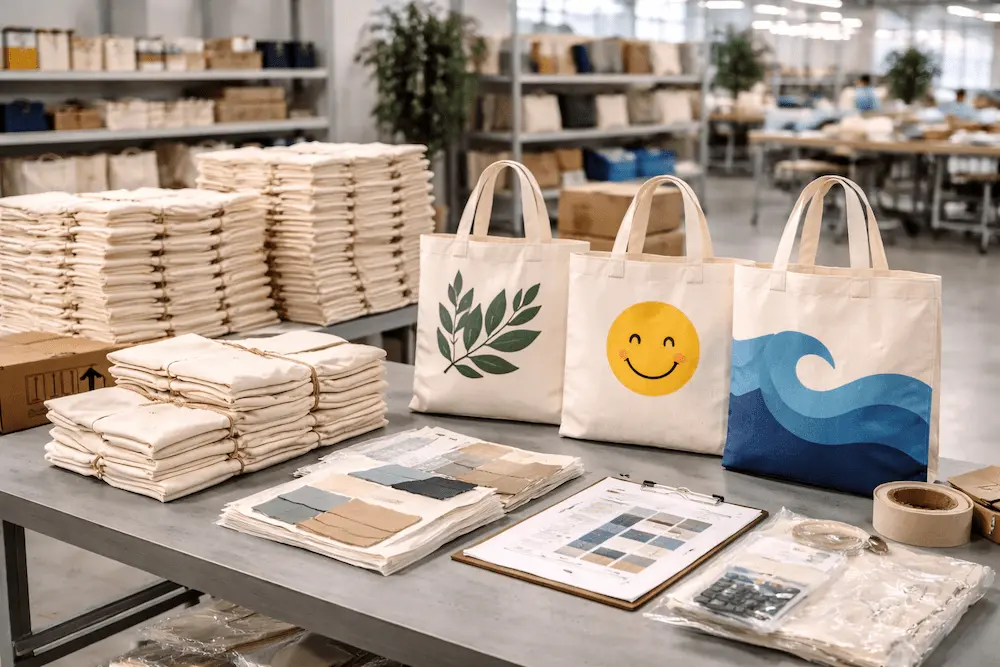
What “Cheap” Should Really Mean in Bulk Tote Bag Buying
In professional sourcing, cheap should not mean badly made. It should mean efficient. A cheap tote bag program is successful when the bag is inexpensive relative to its commercial purpose. A simple event bag does not need the same construction as a grocery-use bag. A broad awareness campaign does not need the same finish as a premium retail tote. But neither should feel obviously underbuilt if the brand expects people to carry and reuse the product.
This is why buyers should start with use case, not quote comparison. If the tote bag is mainly for lightweight distribution, the specification can stay simple. If it is meant to support everyday reuse, stronger fabric and better handles usually make more commercial sense. Some buyers find that standard reusable formats such as cotton tote bags create better total value than ultra-cheap bags because they are more likely to stay in real use after the first handout or purchase.
Cheap buying works when the specification is simplified intelligently. It fails when the product is stripped down without respecting how the bag will actually be used.
Why the Lowest Quote Is Often Not the Lowest Cost
A low quote can look attractive because it reduces the visible purchase price. But real cost includes more than the invoice amount. A weak bag may create quality complaints, early breakage, lower reuse rates, poor print appearance, and weaker brand perception. If the bag is part of a campaign, those failures reduce the value of the whole program.
There is also the cost of inconsistency. Some suppliers quote aggressively by lowering fabric weight, simplifying stitching, reducing print quality, or packing the goods inefficiently. The bag arrives, the price looks low, and then the buyer discovers that the product feels weaker than expected or cannot support repeat orders reliably. At that point, the original saving often disappears.
The better comparison is not between the cheapest quote and the highest quote. It is between the lowest practical specification that still works and the lowest impractical specification that starts damaging the outcome.
Best Materials for Low-Cost Bulk Tote Bag Programs
Material is usually the biggest cost driver, so it is the first place buyers look for savings. That is reasonable, but material choice has to stay connected to purpose.
Lighter cotton or cloth bags are often the most practical option for cost-sensitive campaigns because they are foldable, easy to store, and well suited to simple branding. They work especially well when the bag is intended for brochures, light retail items, educational programs, community events, and general handout distribution. For projects that prioritize lower weight and softer everyday carry, related formats such as cotton drawstring bags can also be part of the same low-cost reusable strategy when the buyer wants more than one lightweight textile option in the product mix.
Standard cotton usually offers a better balance between softness, print compatibility, and reuse value than very thin bargain-grade fabrics. Heavier canvas increases cost but also improves structure and carry confidence. For that reason, canvas is not always the right choice in cheap bulk buying, unless the bag is meant to support stronger reuse or more premium presentation.
| Material Type | Best Budget Use | Main Advantage | Main Limitation |
|---|---|---|---|
| Light cloth or cotton | Events, handouts, low-cost campaigns | Lower material cost and easy packing | Less structure and lower perceived value |
| Standard cotton | Everyday promotions, soft reusable use | Better balance of cost and reuse | Still softer than canvas under heavier load |
| Canvas | Premium campaigns, stronger retail use | Higher durability and better structure | Higher material and freight cost |
| Recycled cotton blend | Sustainability-led budget programs | Supports responsible positioning | Possible variation in feel and appearance |
Where Buyers Can Reduce Cost Safely
Not every feature deserves the same spending level. Some elements can be simplified with little real downside, while others should not be cut too aggressively.
One safe place to reduce cost is artwork complexity. A cleaner one-color design is often more effective on a tote bag than a complicated print that adds setup cost without improving visibility. Another safe place is bag size. Many buyers choose oversized bags because they look more generous, but oversized bags use more fabric, increase carton volume, and are often less convenient in daily use. A right-sized bag can reduce cost and improve practicality at the same time.
Packaging efficiency is another area where cost can be controlled intelligently. Folded packing method, carton count, and bag thickness all affect freight and warehouse cost. If the bag is simple and low-cost by design, there is usually no reason to add unnecessary inner labels, complicated closures, or overly ambitious finishing unless the program clearly benefits from them.
Where Buyers Should Not Cut Too Aggressively
There are three areas where over-cutting usually creates problems: stitching, handle attachment, and print clarity. These are the parts users notice fastest when the bag is in real use.
Weak handles are one of the most common failures in cheap bulk tote bags. The bag body may survive, but if the handle seam tears or twists too easily, the product instantly feels low-value. Basic but solid reinforcement is usually worth protecting, even in budget-driven orders.
Print quality also matters more than some buyers assume. A slightly lower-cost bag can still work if the logo is clear, centered, and commercially clean. But a badly printed bag with blurred or skewed branding makes the whole program look poorly managed. If the bag is meant to support ongoing brand visibility, buyers should consider whether a stronger product family would serve the purpose better, including options such as custom tote bags that are designed more deliberately around repeat brand exposure rather than one-time price minimisation.
How Printing Affects Budget Tote Bag Economics
Printing can quietly reshape the whole cost structure. A simple screen print is usually the most efficient option for budget bulk orders, especially when the artwork is limited to one or two colors. More complex print methods, large coverage, fine detail, gradients, or special finishes all add setup and quality-control pressure.
For many cheap tote bag programs, the smartest branding is direct and restrained. Bold logos, simple messages, and high-contrast layouts often produce the best cost-to-visibility result. That is because the bag remains easy to print, easy to repeat, and easy to recognize in public use.
Still, some budget-conscious buyers want a more polished or natural branded result without moving into fully premium territory. In those cases, personalized canvas tote bags or custom printed canvas tote bags may serve as comparison points, especially when the program is meant to support a stronger sustainability message or a more elevated brand presentation. The key is to use those formats only when the commercial goal justifies the higher product value.
MOQ, Order Volume, and Why Bulk Changes Everything
Bulk buying lowers cost because setup expenses are spread across more units. Fabric sourcing, cutting, print preparation, sewing setup, and carton planning all become more efficient once the order reaches a workable production scale. That is why the same bag can look “too expensive” in a small run and much more viable in a larger one.
This also means buyers should not judge bulk pricing without thinking about forecast and distribution logic. A large order only creates real savings if the bag is actually needed, the design is stable, and storage can be managed. Overstocking a poorly planned cheap bag program is still expensive, even if the unit price looked excellent.
| Order Stage | Typical Buying Logic | Main Advantage | Main Risk |
|---|---|---|---|
| Small run | Testing, pilot campaign, local event | Lower commitment | Higher unit cost |
| Mid-volume run | Regional rollout or repeat event use | Better balance of cost and flexibility | Needs clearer forecast |
| Large bulk run | Stable campaign or ongoing distribution | Lowest practical unit cost | Higher inventory and storage pressure |
How to Test Quality Without Overbuying
One of the best ways to balance cost and quality is to test the product before scaling up. A sample should not only be checked visually. Buyers should assess handle strength, seam quality, fabric feel, print appearance, and whether the bag suits the real use case. If the tote bag is meant for retail, the buyer should place real products inside it. If it is for events, the intended contents should be loaded into the sample bag. If it is for everyday reuse, the buyer should look at comfort and practicality rather than only cost.
Sampling is also where supplier quality becomes clearer. A good supplier will explain what the product can and cannot do at the chosen price point. A weak supplier often agrees to everything and leaves the buyer to discover the limitations later.
How to Choose the Right Supplier for Budget Tote Bag Orders
Reliable low-cost sourcing depends as much on supplier discipline as on product design. The best supplier for a budget tote bag program is usually not the one with the lowest first quote. It is the one that can deliver a sensible low-cost specification consistently, without shifting fabric quality, print position, or sewing standard between runs.
Buyers should compare suppliers across five practical areas: material clarity, stitching consistency, print capability, MOQ logic, and communication quality. A good supplier should be able to explain where cost can be reduced safely and where it should not be cut further. That advice is often more valuable than a slightly lower price from a supplier who is only trying to win the order.
This is where Youngpack-style manufacturing logic matters. The stronger supply partner is usually the one that can connect price, function, branding, and repeat production into one stable recommendation rather than simply offering the thinnest bag at the cheapest number.
Common Mistakes Buyers Make with Cheap Bulk Tote Bags
The first mistake is choosing by unit price alone. The second is approving a sample without defining what quality must stay the same in mass production. The third is oversizing the bag unnecessarily. The fourth is using overly complex artwork on a budget product. The fifth is expecting a very low-cost bag to behave like premium merchandise.
Another common mistake is forgetting the real objective. If the goal is simple distribution, the bag does not need to be overbuilt. If the goal is long-term public brand visibility, it should not be underbuilt. The right answer depends on function first and cost second, not the other way around.
Conclusion
The best cheap tote bags in bulk are not the cheapest bags available. They are the bags that deliver the right level of quality for the lowest sensible total cost. That means choosing the right material, simplifying the right features, protecting the important ones, and working with a supplier that can keep the standard stable.
Cost and quality do not need to be enemies. In bulk tote bag sourcing, the strongest results usually come from clear commercial thinking rather than aggressive cost cutting. Buyers who know where to save and where not to save usually end up with a better bag, a better campaign, and a better long-term result.
How Buyers Should Think About Cheap Tote Bags in Bulk
What “cheap” should really mean: In bulk tote bag sourcing, cheap should mean commercially efficient rather than poorly made. A good low-cost bag is one that does the job it was designed for at the lowest sensible total cost, without creating avoidable quality problems or weakening the brand.
Why cost and quality are linked: The lowest quote is not always the lowest real cost. A bag that tears early, prints badly, or feels obviously disposable can reduce campaign value, customer confidence, and long-term reuse. A slightly better bag often creates stronger return because it stays useful and visible for longer.
How buyers should compare options: The smartest comparison method is to evaluate use case, fabric weight, stitching, print complexity, size, and packing efficiency together. A low-cost event bag should not be judged by the same standard as a reusable retail bag or a brand-led promotional product, even if the product category looks similar at first glance.
Options buyers usually weigh: Most buyers compare light cloth or cotton against standard cotton, simple printed giveaways against stronger branded totes, and small test runs against larger bulk programs. The right answer depends on whether the tote bag is meant for one-time distribution, everyday carry, or longer-term brand presence.
Considerations before bulk approval: Before placing a large order, buyers should confirm sample quality, handle strength, print clarity, folded packing method, and whether the supplier can maintain the same standard in future production. Those details matter more than a headline low price because they shape how the bag performs in real commercial use.
The broader takeaway: The best cheap tote bag program is built around control, not compromise. Buyers who know where to simplify and where to protect quality usually end up with a better product and a better total result. That is also where Youngpack fits naturally as a B2B manufacturing and export partner for bulk tote bag programs that need practical cost control, customization, and repeat-order consistency.
FAQ
1. What is the best material for cheap tote bags in bulk?
The best material depends on the intended use. Light cotton or cloth is often the most practical choice for low-cost event bags, educational programs, and broad promotional distribution because it keeps material and freight cost lower. Standard cotton usually offers a better balance of affordability and reuse value. Canvas is stronger and more structured, but it is usually better suited to projects that need higher durability or stronger brand presentation rather than the lowest initial cost.
2. How can buyers reduce tote bag cost without ruining quality?
Buyers can usually reduce cost safely by simplifying artwork, choosing a more appropriate bag size, avoiding unnecessary add-on features, and planning bulk orders more efficiently. They should be more careful when cutting handle reinforcement, stitching quality, or print clarity, because those are the areas users notice fastest in real use. The safest savings usually come from simplifying the design intelligently rather than lowering every part of the product at once.
3. Are cheap tote bags in bulk still good for branding?
Yes, if the bag is fit for purpose and the branding is clear. A simple, affordable tote bag can still work very well for brand visibility when the logo is readable, the print is stable, and the bag is useful enough to be reused. The problem begins when the bag feels too weak or too disposable to stay in circulation. A cheap bag can still support branding, but only if the product survives long enough to be seen repeatedly.
4. Why do tote bag prices vary so much between suppliers?
Prices vary because suppliers may be quoting different fabric weights, construction standards, print methods, bag sizes, packing methods, and quality tolerances even when the product looks similar in photos. Some very low quotes are based on weaker fabric or looser production control. That is why buyers should compare specifications and production logic, not just the final number on the quotation sheet.
5. What should buyers test before placing a large bulk tote bag order?
Buyers should test fabric feel, stitching, handle attachment, bag size, print quality, and how the bag performs with the real items it is meant to carry. They should also confirm whether the supplier can repeat the same standard in bulk production. A sample should be treated as a performance check, not just a visual approval, because many quality problems only become obvious once the bag is handled realistically.
References
- Preferred Fiber and Materials Market Report — Textile Exchange — Textile Exchange.
- Green Guides for the Use of Environmental Marketing Claims — Federal Trade Commission — FTC.
- Textiles and the Environment — European Environment Agency — EEA.
- Sustainable Packaging Guidelines — Australian Packaging Covenant Organisation — APCO.
- Fashion on Climate — Global Fashion Agenda and McKinsey & Company.
- Responsible Sourcing and Product Communication in Textile Supply Chains — industry trade reference.
- Retail Packaging and Reusable Bag Sourcing Best Practices — professional sourcing reference.
- Guide to Reusable Bags and Long-Term Use Value — industry best-practice sourcing reference.
Publication Rights Notice:
This content is published exclusively by Xiamen Youngpack Imp.and Exp.Co.,Ltd. for our official website and related business communication. Redistribution without permission is not allowed.