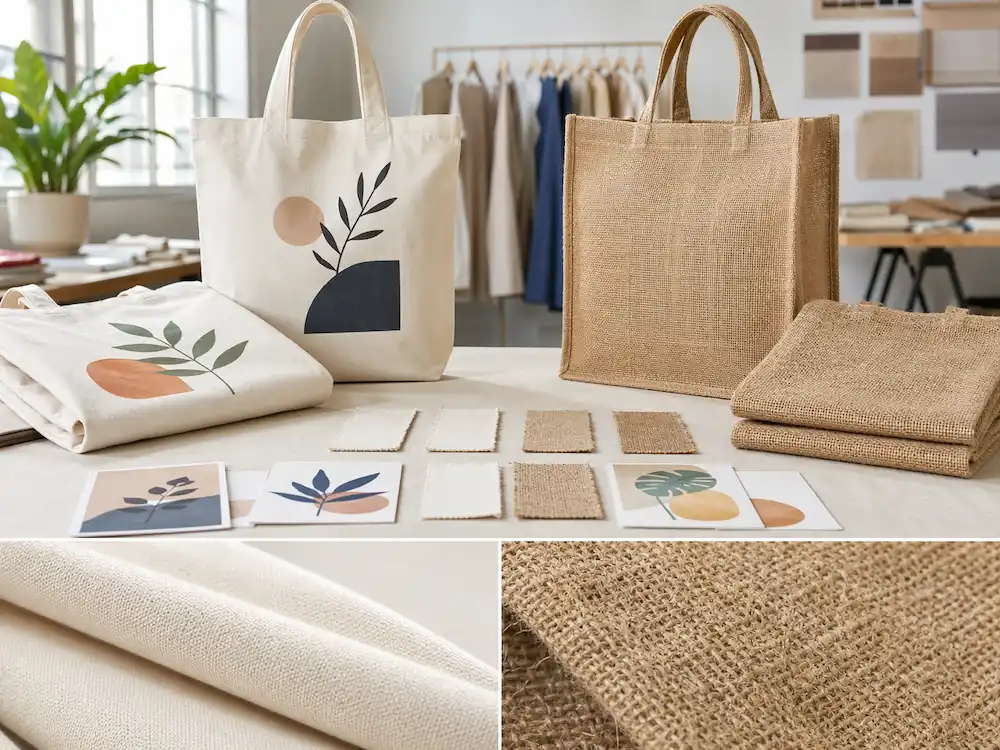
The comparison between canvas tote bags vs jute bags is one of the most useful material decisions in branded bag sourcing because both products sit close to the “natural reusable bag” category while behaving very differently in the real world. Many buyers assume that both are simply sustainable-looking textile bags with similar performance. They are not. Canvas and jute create different product experiences, different branding results, and different practical trade-offs in retail, promotional, and everyday use.
A canvas tote bag usually feels softer, smoother, and more familiar as an everyday bag. It tends to support cleaner print results, broader lifestyle appeal, and more flexible use across retail, gifting, events, and repeated daily carry. A jute bag usually feels more textured, more rigid, and more visually rustic. It often creates a stronger natural-material impression immediately, but it can also feel less refined, less soft, and less universally comfortable in some applications.
That is why the decision should not be made only by “eco” appearance. The better material is the one that matches the bag’s actual job and the brand’s actual tone.
What Canvas Tote Bags Really Offer
Canvas tote bags are usually chosen when the brand wants strength, reusability, and a more polished natural-textile feel. Canvas often gives the bag better body than lightweight cotton, while still remaining soft enough for comfortable daily carry. It usually feels more product-like than simple giveaway fabric and more lifestyle-friendly than rougher natural fibres.
This makes canvas especially useful in bookstores, supermarkets, cafés, gift shops, premium promotions, museum stores, daily reusable shopping programs, and branded merchandise where the bag should look natural but also feel refined enough for regular public use.
For stronger sustainable visibility, canvas tote bag printing is often central to the decision because canvas supports a cleaner balance between durability and branding quality than many rougher natural materials.
What Jute Bags Really Offer
Jute bags are usually chosen when the brand wants a stronger raw-natural impression and a more obviously earthy or rustic visual language. Jute often feels stiffer and more textured than canvas, which helps it stand out immediately as a “natural fibre bag” rather than a typical textile tote. That can be a strong advantage in food retail, produce markets, wine gifting, organic stores, eco-themed campaigns, and rustic-style packaging programs.
Jute can also create stronger structure in some shopping formats because of its naturally firmer body. But that same quality can make it feel less soft, less comfortable, or less versatile in everyday carry compared with canvas. Jute is often more about natural identity than everyday ease.
This is why products such as custom jute bags are often used when the bag itself is meant to send a very direct sustainability or natural-origin message the moment it is seen.
Surface Feel: Soft Utility vs Rustic Texture
The difference in surface feel is one of the clearest practical differences. Canvas usually feels smoother and more comfortable in hand. It drapes more naturally, folds more easily, and tends to feel more familiar for repeated daily use. This matters because customers often keep using bags that feel easy and comfortable.
Jute usually feels rougher, stiffer, and more textured. That can be part of its appeal because it creates stronger natural authenticity. But it also makes the bag less soft in direct contact and sometimes less suitable for relaxed lifestyle use where the bag is carried often and casually.
So if comfort and broad everyday usability matter, canvas usually pulls ahead. If strong rustic character matters more than softness, jute often becomes more attractive.
| Comparison Area | Canvas Tote Bags | Jute Bags |
|---|---|---|
| Hand feel | Softer and smoother | Rougher and more textured |
| Visual tone | Clean natural textile look | Rustic and earthy natural look |
| Print friendliness | Usually stronger | More limited by texture |
| Everyday use comfort | Usually higher | Usually lower |
| Immediate eco perception | Strong | Very strong |
| Product versatility | Very broad | More style-specific |
Print Quality and Brand Expression
Canvas usually wins when clean printing matters. The smoother and more even surface helps logos and artwork appear more controlled, more legible, and more visually refined. This is especially important in retail and promotional programs where the branding needs to feel consistent and high quality.
That is why options like custom printed canvas bags are often favored when the goal is natural material plus professional brand presentation. The canvas surface allows the logo to feel integrated into the product rather than fighting against the material texture.
Jute can still be branded effectively, but the material’s rough texture and stronger weave can reduce print precision and make the result feel less clean. That may be acceptable or even desirable in rustic food, wine, produce, or craft-oriented environments. But for cleaner lifestyle branding, canvas is usually the easier material to work with.
Structure and Shape Retention
Jute often has the advantage in natural stiffness. Many jute bags hold their shape more visibly when standing or when lightly loaded. This can be useful in shopping and gift contexts where the bag should feel upright, sturdy, and immediately structured.
Canvas can also have strong structure, especially at heavier weights, but it usually feels more flexible than jute at the same general bag size. That flexibility is one reason it is more comfortable for repeated public use and easier to integrate into daily life.
So the structural question is simple. If the bag should feel rigid and rustic, jute often fits. If the bag should feel stable but still soft enough for routine carry, canvas often fits better.
Durability in Real Use
Canvas usually performs better as an everyday-use material because it combines strength with comfort and flexibility. It can handle repeated carrying, folding, loading, and general public use without feeling too fragile or too stiff. That is why canvas is so common in long-life reusable bag programs.
Jute can also be durable, but its practical life depends heavily on how the bag is used. It often performs well in structured shopping or gifting situations, but it is usually less pleasant for softer, more casual daily use. The rough texture and stiffer body can discourage the kind of relaxed repeated carry that makes a bag stay in someone’s routine.
This is where practical durability and emotional durability are not the same. A bag can be physically durable and still not be used often if it feels inconvenient or too style-specific. Canvas usually has the advantage in overall long-term carry behavior.
Brand Tone: Lifestyle vs Rustic Sustainability
Canvas and jute send very different brand signals. Canvas usually feels more urban, more modern, and more adaptable across product categories. It can support bookstore brands, café culture, wellness retail, premium promotions, museums, travel programs, and grocery reuse without feeling out of place.
Jute usually feels more rural, organic, earthy, and category-specific. It often works best when the brand wants to emphasize food, produce, natural goods, rustic gifting, or visibly eco-conscious packaging. In those contexts, its strong natural texture can be a major advantage. Outside them, it can sometimes feel less flexible.
For broader campaign use, products such as promotional canvas tote bags or promotional canvas tote bags with logo often outperform jute because the canvas bag travels more naturally across different daily-use settings while still delivering strong brand visibility.
Cost and Shipping Considerations
Cost varies by size, construction, and exact material specification, but in many real sourcing situations both canvas and jute can sit above very low-cost promotional formats. The cost difference between them is not always dramatic enough to settle the decision on its own. The more important question is which one creates the better total product result for the intended brand use.
Shipping and storage can also differ. Jute bags can be bulkier because of their rigid body and thicker texture, while canvas often packs more flexibly, especially if the bag is not overly structured. That makes canvas easier in some warehouse and freight situations.
So while cost matters, the stronger decision usually comes from product role and repeat-use value, not only the quote.
| Commercial Factor | Canvas | Jute |
|---|---|---|
| Broad-use value | Usually stronger | More niche by style and category |
| Packing efficiency | Usually better | Often bulkier |
| Print-led campaigns | Usually stronger | More limited |
| Rustic eco positioning | Strong but softer | Usually stronger |
Best Use Cases for Canvas Tote Bags
Canvas tote bags usually make more sense in bookstores, supermarkets, lifestyle retail, cafés, museum shops, employee kits, daily reusable shopping, premium promotional gifts, and visible long-term brand programs. They are especially strong when the bag needs to remain in daily public use and still feel comfortable enough that people keep choosing it.
They also make more sense when branding quality is important. Canvas usually supports cleaner print, broader appeal, and easier integration into modern retail environments.
So if the bag should behave like a regular, reusable everyday product, canvas usually wins.
Best Use Cases for Jute Bags
Jute bags usually make more sense in farmers’ markets, produce shops, food gifting, wine retail, rustic product presentation, eco-themed campaigns, organic stores, and product ranges where the natural-fibre message should be obvious at first glance. They are especially strong when the bag itself is part of a visibly earthy or handmade-looking retail identity.
They also work well when the bag does not need to feel especially soft or highly polished. In those cases, the jute character is part of the value, not a compromise.
So if the brand wants a stronger rustic-natural signal and the use case fits that tone, jute becomes much more compelling.
How Buyers Should Choose
The smartest way to choose is to ask four direct questions. Does the bag need to feel soft and comfortable for repeated everyday use? Does the branding need to print cleanly? Does the product story benefit more from polished naturalness or from raw rustic texture? And is the bag supposed to fit many daily environments or a more specific eco-rustic setting?
If the answers point toward repeat use, cleaner print, and broader lifestyle fit, canvas usually makes more sense. If the answers point toward strong natural-material symbolism, rustic visual identity, and category-specific eco positioning, jute may be the better answer.
The best material is not the one that sounds greener in the abstract. It is the one that supports the real bag behavior and the real brand message at the same time.
Conclusion
The real difference between canvas tote bags vs jute bags is not only the fibre. It is the entire product experience. Canvas usually wins on softness, print quality, daily comfort, and broad retail adaptability. Jute usually wins on immediate rustic-natural identity and stronger earthy visual presence.
Neither is better in every case. The better one is the material that fits the bag’s actual job and the brand’s actual tone. Buyers who decide from that starting point usually end up with a stronger product and a more honest brand result.
How Buyers Should Think About Canvas Tote Bags vs Jute Bags
What this comparison really measures: Canvas and jute are not simply two natural-looking materials. They represent two different product experiences. Canvas usually supports softness, print clarity, and broader everyday usability. Jute usually supports stronger rustic texture, more immediate natural-material signaling, and a more category-specific eco identity.
Why buyers often get this wrong: The most common mistake is assuming that because both materials look natural, they will behave similarly. They do not. A jute bag may send a strong eco message immediately but feel too stiff for daily public use. A canvas bag may look less dramatically “earthy” at first, but stay in use much longer because it is easier and more pleasant to carry. The better choice depends on what matters after the first impression.
How buyers should compare the two properly: The strongest comparison method is to evaluate product role, print needs, customer comfort, brand tone, and likely reuse together. A wine gift bag, a bookstore tote, a supermarket reusable bag, and an organic produce bag may all need reusable packaging, but they should not all be sourced through the same material logic.
Options businesses usually weigh: Most buyers compare clean print and everyday softness against stronger rustic identity, broader retail flexibility against more specific eco positioning, and lifestyle reusability against raw natural-material character. The better answer depends on whether the bag is meant to feel like a comfortable daily-use product or a more visibly earthy statement item.
Considerations before bulk approval: Before placing the order, businesses should test real samples, not just swatches or catalogue photos. They should check how the bag feels in hand, how the branding looks on the actual surface, how comfortable the handles are in repeated use, and whether the material still fits the brand once the bag is out in public. These practical checks usually matter more than any generic “eco-friendly” label.
The broader takeaway: The strongest material choice is the one that aligns comfort, branding, and real customer behavior honestly. That is also where Youngpack naturally fits as a B2B manufacturing and export partner for brands comparing canvas and jute bag programs while needing practical guidance on customization, product feel, and long-term retail value.
FAQ
1. Are canvas tote bags better than jute bags?
Not always. Canvas tote bags are usually better when the bag needs to feel softer, print more cleanly, and stay comfortable enough for repeated everyday use. Jute bags are usually better when the brand wants a stronger rustic-natural visual identity and does not need the same level of softness or print refinement. The better choice depends on whether the bag needs to function mainly as a daily-use product or as a strong natural-material statement.
2. Which material is more eco-friendly, canvas or jute?
There is no universal winner without looking at actual use, sourcing, and product life. Jute often creates a stronger immediate natural-material impression, while canvas often creates a stronger long-term use pattern because people may be more likely to keep using it comfortably. The more a bag is reused in real life, the stronger its practical environmental case becomes. So buyers should compare real product use and sourcing credibility rather than relying only on first visual impression.
3. Is canvas better for printing than jute?
In most cases, yes. Canvas usually provides a smoother and more even surface, which helps logos and graphics appear cleaner and more controlled. Jute can still be printed, but its rougher texture often makes the branding look more rustic and less precise. If print quality is a major part of the project, canvas is usually the more reliable material choice.
4. Why do some brands choose jute bags instead of canvas?
Some brands choose jute because it communicates a stronger raw-natural, earthy, or rustic look immediately. This can be very effective in produce, food retail, organic goods, wine gifting, farmers’ markets, and eco-themed campaigns where the bag’s material identity is part of the message. Jute helps make the bag feel distinct, even if it is less soft or less universally flexible than canvas.
5. What should buyers check before choosing canvas or jute bags in bulk?
Buyers should check how the bag will be used, how important print quality is, whether the customer is likely to carry it often, what kind of visual tone the brand wants, and how much structure versus softness matters. They should also test samples in real use, because canvas and jute often feel more different in hand than they appear in product photos. The right decision usually becomes obvious once the bag’s real job is defined clearly.
References
- Preferred Fiber and Materials Market Report — Textile Exchange — Textile Exchange.
- Textiles and the Environment — European Environment Agency — EEA.
- Green Guides for the Use of Environmental Marketing Claims — Federal Trade Commission — FTC.
- Sustainable Packaging Guidelines — Australian Packaging Covenant Organisation — APCO.
- Fashion on Climate — Global Fashion Agenda and McKinsey & Company.
- Responsible Sourcing and Product Communication in Textile Supply Chains — industry trade reference.
- Retail Packaging and Reusable Bag Sourcing Best Practices — professional sourcing reference.
- Guide to Reusable Bags and Long-Term Use Value — industry best-practice sourcing reference.