Quick Summary:Choosing the right printing options for food paper bags helps brands improve packaging appearance, maintain colour consistency, control production costs, and create stronger customer recognition.
Professional food packaging printing requires proper artwork preparation, suitable printing methods, sample approval, and long-term production planning.
Food brands, restaurants, cafés, and wholesale buyers can achieve better sourcing results by selecting printing solutions based on business goals instead of only comparing prices.
Introduction
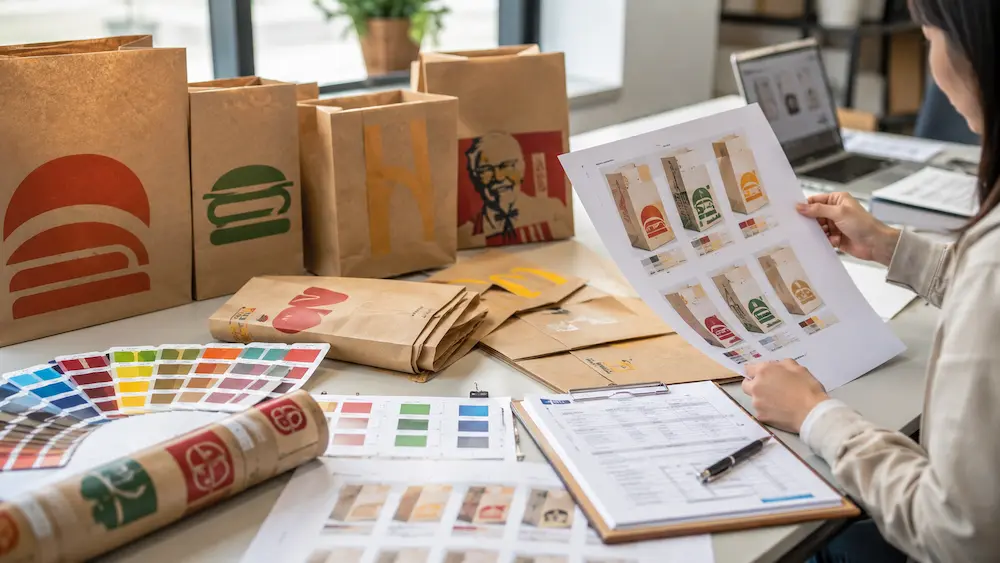
For many food brands sourcing food paper bags from China, printing usually begins with one simple request:
“We need our logo on the bag.”
However, professional packaging printing requires much more planning than placing a logo on paper.
The right printing choice affects:
- Brand recognition
- Customer experience
- Production efficiency
- Long-term packaging consistency
- Cost management
Food businesses such as restaurants, coffee chains, bakeries, takeaway brands, and supermarkets use printed packaging every day.
A customer may only interact with a food paper bag for a short time, but the design, colour, and printing quality can leave a lasting impression.
For international buyers, choosing suitable printing options during China sourcing helps avoid:
- Colour differences
- Unclear logos
- Production delays
- Unexpected costs
Successful printed food paper bags projects usually begin with understanding business needs before selecting a printing method.
A small local bakery and a large restaurant chain may require completely different printing strategies.
The best option depends on:
- Order quantity
- Artwork complexity
- Brand requirements
- Production schedule
- Target customers
Food packaging printing is not only about adding a logo.
It helps customers recognise the brand and creates a consistent purchasing experience across restaurants, cafés, bakeries, and retail channels.
Many growing food brands also develop custom printed paper bags for strong brand recognition when they need packaging that supports daily customer interaction and long-term marketing value.
A professional food paper bags manufacturer in China should help buyers choose printing solutions based on real business goals, not only appearance.
Why Printing Strategy Matters for Food Brands
Food packaging works differently from many other retail products.
Customers often see food packaging:
- On takeaway counters
- During delivery
- In public spaces
- Through social sharing
This creates additional opportunities for brand exposure.
A well-planned printed food paper bag can communicate:
- Brand personality
- Product quality
- Professional image
- Customer care
For food companies, packaging consistency is especially important because customers usually purchase repeatedly.
A coffee chain, for example, expects the same packaging appearance every day across different locations.
This requires:
- Stable printing colours
- Controlled production standards
- Clear artwork management
Understanding Artwork Before Choosing Printing Methods
Before selecting a printing option, buyers should prepare professional artwork files.
Many printing problems happen before production begins because artwork information is incomplete.
A good artwork preparation process helps factories achieve accurate printing results.
Vector Artwork Preparation
Professional printing usually requires vector artwork files.
These files help maintain:
- Logo sharpness
- Clear edges
- Accurate scaling
Common file formats may include:
- AI
- EPS
High-quality artwork preparation reduces printing errors.
Colour Standard Confirmation
Colour control is one of the biggest challenges in packaging production.
A colour displayed on a screen may look different after printing.
Professional buyers often provide:
- Pantone colour references
- Brand colour standards
- Approved samples
This helps manufacturers maintain consistency during repeat production.
Printing Area Planning
Not every part of a food paper bag is suitable for printing.
Before production, buyers should confirm:
- Logo position
- Printing coverage
- Design layout
- Bag structure
Good design planning improves both appearance and manufacturing efficiency.
Clear artwork preparation helps manufacturers achieve better printing results and maintain consistent visual standards across different production batches.
For brands focusing on simple but effective packaging communication, printed paper bags for clear brand presentation help maintain professional appearance while improving customer recognition.
Artwork Preparation Checklist
| Requirement | Purpose |
|---|---|
| Vector Logo File | Maintain clear printing quality |
| Colour Reference | Improve brand consistency |
| Printing Position | Ensure accurate production |
| Approved Sample | Reduce production risks |
| Final Artwork Confirmation | Avoid unnecessary changes |
Main Printing Options for Food Paper Bags
Different printing methods provide different advantages.
The best choice depends on:
- Design complexity
- Production quantity
- Budget planning
- Brand positioning
Understanding these differences helps buyers choose the most suitable solution.
Flexographic Printing for Food Paper Bags
Flexographic printing is one of the most commonly used methods for large-volume food packaging production.
It is widely selected by:
- Restaurant chains
- Takeaway businesses
- Supermarkets
- Wholesale packaging buyers
Advantages of Flexographic Printing
Flexographic printing provides:
- Efficient production speed
- Stable repeat results
- Good cost control for larger quantities
For brands requiring regular packaging supply, flexographic printing can be an effective long-term solution.
When Should Buyers Choose Flexographic Printing?
It is usually suitable when:
- Designs use fewer colours
- Orders repeat regularly
- Cost efficiency is important
- Production volume is larger
Many food service companies choose this method because it supports continuous packaging needs.
Offset Printing for Premium Food Paper Bags
Offset printing is another popular option when food brands require more detailed visual presentation.
Compared with simple logo printing, offset printing is often selected for designs that need:
- Rich colours
- Detailed images
- Accurate gradients
- Premium appearance
For some food businesses, packaging is not only used for carrying products.
It becomes part of the overall customer experience.
Premium bakeries, chocolate brands, specialty food companies, and high-end restaurants often pay more attention to packaging details because customers connect packaging quality with product value.
Advantages of Offset Printing
Offset printing provides strong visual performance and excellent detail reproduction.
Main advantages include:
- High image quality
- Better colour expression
- Suitable for complex designs
- Professional brand presentation
For food paper bags with detailed artwork, offset printing can create a more refined appearance.
This method is especially useful when packaging includes:
- Product images
- Detailed illustrations
- Creative patterns
- Large printing areas
When Should Buyers Choose Offset Printing?
Offset printing is usually suitable for:
- Premium food packaging projects
- Retail food products
- Gift food collections
- Brand campaigns
For example:
A luxury bakery launching a seasonal collection may focus more on customer experience and packaging presentation.
In this case, printing quality may be more important than only reducing production costs.
Choosing the right printing method helps the brand create stronger visual communication.
Digital Printing for Flexible Food Packaging Projects
Digital printing provides a different advantage: flexibility.
Not every food packaging project requires large-scale production.
Some businesses need:
- Market testing
- Seasonal designs
- Promotional campaigns
- Limited editions
Digital printing can support these situations because it allows faster design changes compared with traditional methods.
Advantages of Digital Printing
Digital printing can provide:
- Shorter preparation time
- Easier artwork changes
- Flexible design testing
It is useful when brands are still developing their packaging direction.
For example:
A new food company may want to test several packaging designs before choosing one final version for larger production.
Digital printing allows more flexibility during early development.
When Should Buyers Choose Digital Printing?
Digital printing is commonly considered for:
- New product launches
- Event packaging
- Trial projects
- Seasonal promotions
However, for long-term large-volume food paper bags production, buyers should compare total production costs before making a decision.
Food Paper Bags Printing Method Comparison
Different printing technologies solve different business problems.
Professional buyers usually choose based on application instead of only comparing price.
| Printing Method | Suitable Application | Buyer Advantage |
|---|---|---|
| Flexographic Printing | Large-volume food packaging | Cost efficiency and stable production |
| Offset Printing | Premium food brands | High-quality visual presentation |
| Digital Printing | Short projects and testing | Flexible design development |
The best printing method depends on business goals.
A restaurant chain ordering regular takeaway packaging may make a different decision compared with a premium gift food brand.
Understanding these differences helps buyers avoid unnecessary costs.
How Food Brands Maintain Printing Consistency
Printing consistency is one of the biggest concerns for growing food companies.
As brands expand, packaging may be produced many times across different orders.
Customers expect the same visual experience every time.
To achieve this, buyers need a clear printing management system.
Create Approved Colour Standards
Colour should not depend only on computer screens.
Different screens show colours differently.
Professional food packaging buyers usually create:
- Pantone references
- Physical colour samples
- Approved production standards
These references help factories maintain stable results.
Keep Production Records
Repeat orders become easier when manufacturers keep accurate records.
Important information includes:
- Material specifications
- Printing settings
- Colour requirements
- Approved samples
A reliable China food paper bags supplier should manage these details carefully.
Confirm Samples Before Mass Production
Sample approval reduces misunderstanding between buyers and manufacturers.
Before large production, buyers should check:
- Logo position
- Printing clarity
- Colour accuracy
- Overall appearance
This step is especially important for brands with strict visual guidelines.
Printing Cost Optimisation for Food Paper Bags Buyers
Cost optimisation does not always mean choosing the cheapest printing method.
Professional buyers focus on creating the best balance between:
- Appearance
- Function
- Production efficiency
- Budget
Reduce Unnecessary Colour Complexity
More printing colours may increase production preparation.
Before confirming artwork, brands should consider:
- Which colours are essential?
- Can the design remain effective with fewer colours?
- Does complexity improve customer experience?
Simple and clear designs often create strong recognition.
Standardise Packaging Designs
Food companies with multiple locations or product lines can improve efficiency by standardising designs.
Examples include:
- Keeping the same logo position
- Using consistent brand colours
- Creating reusable artwork systems
This improves production planning and repeat-order management.
Plan Printing Requirements Long Term
A short-term packaging decision may affect future costs.
Growing brands should consider:
- Future product expansion
- Seasonal campaigns
- New store development
A flexible printing strategy allows easier growth.