Introduction
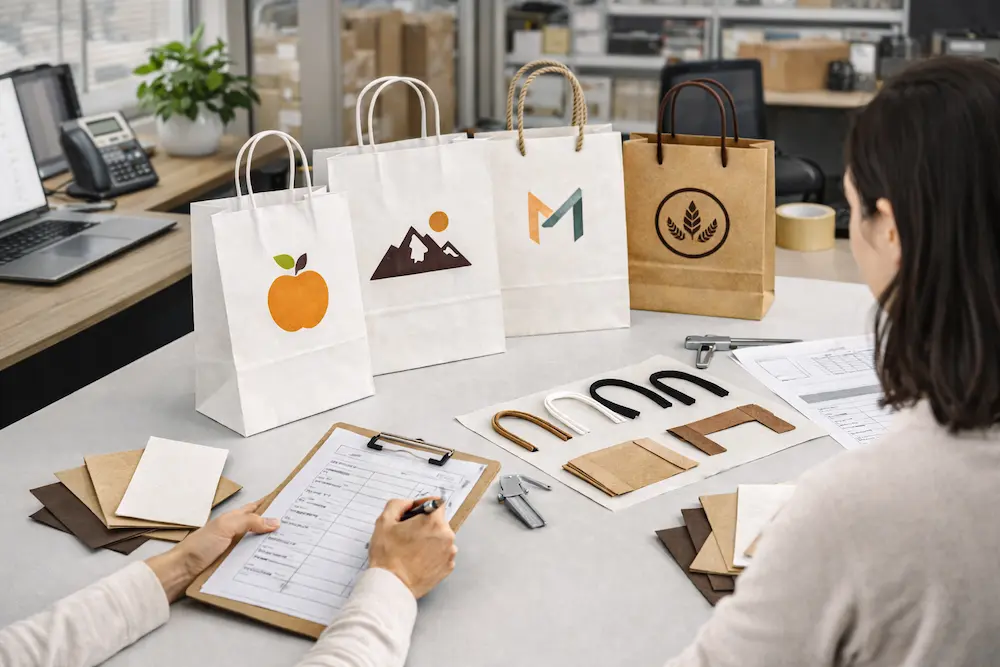
The best best practices for ordering custom printed paper bags in bulk for importers are not only about getting a lower price. They are about getting the right size, the right paper, the right print method, the right export packing, and the right production control before the order becomes too large to correct easily. Many buyers assume that custom printed paper bags in bulk are simple to source because the product looks familiar, but in real importing, small mistakes in size, artwork, paper stock, or carton planning can create expensive problems across the whole shipment.
For importers, custom printed paper bags in bulk should be treated as a full packaging program, not just a print purchase. A good bulk order needs to balance brand presentation, repeat quality, freight efficiency, and market fit at the same time. Buyers that are also evaluating stronger retail visibility often compare custom printed paper bags for strong brand recognition when assessing how printed paper bags in bulk can support both packaging performance and a more consistent brand image.
Start with the Real End Use Before Discussing Artwork
One of the most important best practices for ordering custom printed paper bags in bulk for importers is to define the real use case before discussing the artwork. A grocery bag, a bakery carry bag, a fashion shopping bag, a premium gift bag, and a takeaway bag may all be custom printed paper bags, but they do not need the same structure, paper direction, handle type, or print logic.
Importers should decide early whether the bag is mainly for product transport, premium presentation, food-related use, gifting, or high-volume daily retail. Once that is clear, it becomes much easier to choose the right dimensions, paper stock, handle construction, and print method. In more presentation-led projects, especially for seasonal launches and gifting programs, some buyers also compare custom printed gift bags for memorable brand presentation when evaluating how custom printed paper bags in bulk should support both practical packaging needs and a stronger branded customer experience.
For importers, this step matters because the wrong bag structure can never be fully fixed by better printing. If the function is wrong, the whole bulk order becomes less effective no matter how attractive the logo looks.
Lock the Finished Size Before Asking for Final Pricing
Bulk orders become risky when bag size is still vague. A supplier should never be quoting against descriptions such as “medium shopping bag” or “standard retail bag” only. One of the best best practices for ordering custom printed paper bags in bulk for importers is to lock the finished size early in width × gusset × height format and make sure every supplier is quoting against the same measurement logic.
This matters because finished size affects:
- product fit
- print balance
- carrying comfort
- carton efficiency
- freight volume
- final landed cost
A bag that is slightly too large may look harmless in a sample room, but in bulk paper bag orders it can waste paper, weaken brand presentation, and increase shipping cost. A bag that is slightly too small may create product-loading problems, visual distortion, or unnecessary strain on the handles.
For importers ordering custom printed paper bags in bulk, the safest approach is to test the real product inside the proposed bag size before approving production.
Match the Paper Stock to the Brand and the Print Method
Not all paper stocks behave the same way in bulk production. Brown kraft, white kraft, recycled-content papers, and specialty papers each create different results in print, stiffness, and perceived value. That is why paper choice should never be treated as a minor technical detail in custom printed paper bags.
Brown kraft often works well for everyday retail, grocery, takeaway, and more natural-looking brand programs. White kraft often supports cleaner contrast, brighter colors, and a more polished finish. Recycled-content paper may support sustainability positioning, but it still needs to be checked against print sharpness, stiffness, and carry performance.
The best practice here is not to ask only, “What paper is cheaper?” The better question is, “What paper supports the brand tier, print effect, carrying need, and sourcing story at the same time?” Buyers that want sustainability positioning and branded presentation to work together more clearly often also compare custom kraft bags for sustainable branding and packaging when assessing how custom kraft bags and other custom printed paper bags can support both practical use and stronger visual identity.
For importers, a strong paper choice improves not only the look of printed paper bags in bulk, but also their repeat performance in storage, shipping, and everyday customer handling.
Choose the Print Method by Production Reality, Not by Mockup Appearance
A digital mockup can make almost any bag look perfect. Real bulk production is less forgiving. One of the best best practices for ordering custom printed paper bags in bulk for importers is to choose the print method according to real production logic, not according to mockup appearance alone.
Flexographic, offset, and digital printing do not deliver the same result, setup cost, or production efficiency. The right print method depends on:
- artwork complexity
- color expectations
- paper surface
- order volume
- brand positioning
Brown kraft can soften lighter colors, while white paper usually supports cleaner contrast. A design that looks excellent in a presentation file may still be too detailed or too color-sensitive for the actual print method being quoted. That is why importers should ask the supplier directly whether the chosen paper and the chosen print method are realistic for custom printed paper bags in bulk.
Before confirming artwork, buyers should ask:
- Is this print method suitable for the final design?
- Will the logo still look balanced once the bag is opened?
- Does the paper surface change color clarity?
- Does the sample reflect real production quality?
This is one of the simplest ways to reduce artwork-to-production mismatch in bulk paper bag orders.
Treat MOQ as a Production Variable, Not Just a Negotiation Point
MOQ is not just a sales number. It usually reflects material purchasing, printing setup, handle preparation, carton planning, and machine efficiency. Importers should ask not only what the MOQ is, but also what drives it.
This matters because custom printed paper bags in bulk work best when the specification is already stable. If the size, print, or paper stock is still changing, a large order can lock the buyer into the wrong structure at the wrong time. Once the size, paper, and print direction are stable, bulk production usually becomes more efficient and more repeatable.
The smarter practice is to separate the development stage from the true bulk stage:
- use smaller controlled runs to test size and paper
- confirm print effect on the final stock
- check export packing logic
- move into higher-volume production only after approval is stable
For importers, this is one of the most practical ways to keep custom printed paper bags from turning into costly stock problems.
Sample for Production Accuracy, Not Just for Presentation
A beautiful sample is not always a production-representative sample. Importers should always ask whether the sample is a stock sample, a hand-made sample, or a sample that reflects actual mass-production conditions.
A good-looking hand sample can still hide issues such as:
- print variation
- handle inconsistency
- weak bottom shape
- glue variation
- paper stiffness differences
A bulk-order sample review should therefore focus on practical points: the real size, the paper feel, the loaded carry experience, the print alignment, and the handle attachment. For food-related programs, intended use should also be part of the review, which is why some buyers also compare custom food bags for fresh and secure packaging when assessing how custom food bags, custom printed paper bags in bulk, and food-use packaging security should work together in more demanding applications.
The best practice is to test the sample in real use. Fill it with the actual product. Carry it. Check how it opens. Look at the print once the bag is loaded. In printed paper bags in bulk, that real-use check often reveals more than a digital proof ever can.
Build Quality Control Around Repeatability, Not Only Final Inspection
Importers should always ask how the factory controls quality during production, not only what happens before shipment. The real commercial risk in bulk paper bag orders is usually not one imperfect sample. It is inconsistency across thousands of pieces.
A reliable paper bag supplier should be able to explain how they control:
- dimensions
- print registration
- color consistency
- handle attachment
- glue application
- bottom shape
- carton packing
One of the most useful best practices for ordering custom printed paper bags in bulk for importers is to make quality checkpoints explicit before production starts. That means agreeing on approved size tolerance, print expectations, handle standards, and packing details in advance. When both sides know exactly what “approved quality” means, custom printed paper bags become much easier to repeat successfully.
Treat Export Packing as Part of the Bag Specification
Importers often negotiate the bag and ignore the export packing until too late. That is a mistake. Export packing affects landed cost, cargo condition, warehouse handling, and freight efficiency.
A supplier should be able to explain:
- how many bags go into each carton
- carton dimensions
- gross weight per carton
- whether the shipment is palletized
- whether the packing is suitable for sea freight or air freight
This matters because a cheaper bag can become less attractive if it is packed inefficiently. One of the most practical best practices for ordering custom printed paper bags in bulk for importers is to compare quotations at the carton and shipping level, not only at the bag level. Importers who do this usually get a more realistic picture of total cost.
For custom printed paper bags in bulk, packing should never be treated as an afterthought. It is part of the product logic.
Check Destination-Market Relevance Before Approving a Large Order
A bulk order should never be approved as if every destination market works the same way. Importers need to understand the intended use, destination market, and sourcing claims before treating custom printed paper bags in bulk as a simple commodity purchase.
If the bags are for food-related applications, the full structure should be reviewed more carefully. If the bags are sold with sustainability claims, the paper source and claim language should be credible. If the order is going into markets with stronger packaging expectations, recyclability and packaging design logic should not be treated casually.
For importers, this is one of the most important best practices for ordering custom printed paper bags in bulk for importers: ask destination-market questions before the bulk order is confirmed, not after the goods are ready to ship.
Choose a Supplier That Can Explain Trade-Offs Clearly
The best bulk suppliers do more than say yes. They explain why a certain size makes sense, why a certain paper fits the bag better, why one print method is more realistic than another, and why a certain MOQ is commercially logical.
This matters because bulk paper bag orders magnify every weak decision. A factory that cannot explain trade-offs usually cannot help the importer reduce risk. A stronger paper bag supplier acts more like a packaging partner: they connect product fit, print reality, export packing, and repeat-order control into one sourcing program.
For importers, this is often the difference between a one-time transaction and a stable long-term packaging system.
Practical Table: Best-Practice Checkpoints Before Approving Bulk Production
| Area | Best practice | Why it matters |
|---|---|---|
| End use | Define the real sales channel and product use first | Prevents the wrong bag structure |
| Size | Lock finished size before final pricing | Avoids wasted material and poor fit |
| Paper | Match stock to brand, print, and carrying need | Improves performance and appearance |
| Choose method by production reality | Reduces artwork-to-production mismatch | |
| MOQ | Separate development stage from bulk stage | Avoids locking into the wrong spec |
| Samples | Test the actual bag with the actual product | Reveals real-use problems early |
| QC | Agree checkpoints before production | Improves repeat consistency |
| Packing | Compare carton logic, not just unit price | Gives a truer landed-cost picture |
| Compliance | Check intended use and market relevance early | Reduces import and claim risk |
| Supplier fit | Choose explanation and repeatability, not price only | Improves long-term sourcing reliability |
Conclusion
The best best practices for ordering custom printed paper bags in bulk for importers are simple in principle but important in execution. Importers should lock the real use case, confirm finished size, choose the right paper and print method, test samples honestly, define quality checkpoints, and treat export packing as part of the order rather than as an afterthought.
When custom printed paper bags in bulk are ordered with that level of discipline, they become a repeatable packaging program instead of a risky one-time purchase. That is how custom printed paper bags, printed paper bags in bulk, and larger bulk paper bag orders turn from a quote request into a more stable long-term sourcing system.
How Importers Should Think About Bulk Orders for Custom Printed Paper Bags
What the bulk order really means: Ordering custom printed paper bags in bulk is not only a print purchase. It is a sourcing decision that connects bag size, paper stock, print quality, export packing, and repeat-order control into one packaging program.
Why this matters for importers: Small specification mistakes become expensive when they scale. A slightly wrong bag size, a poor paper choice, or a weak packing plan can create avoidable freight cost, weak branding, or stock that does not work well in real use.
How buyers should compare options: Importers should compare suppliers by how clearly they explain the real use case, finished dimensions, paper direction, print method, MOQ logic, sample accuracy, and quality checkpoints before mass production starts.
What usually makes the strongest bulk order: The best bulk programs are the ones where the size is already proven, the paper matches the brand and print method, the sample reflects real production, and the export packing is planned as part of the order rather than as an afterthought.
What importers should watch most carefully: Product fit, print realism, handle and bottom performance, carton efficiency, food-use relevance where applicable, and repeat-order consistency are usually more important than chasing the lowest initial unit price.
The larger takeaway: The strongest custom printed paper bags in bulk are not the cheapest on paper. They are the ones ordered with enough discipline to perform well in production, shipping, and real customer use.
FAQ
1. What are the best practices for ordering custom printed paper bags in bulk for importers?
Importers should lock the real end use first, then confirm finished size, paper type, print method, MOQ, sample quality, export packing, and repeat-order quality control before approving mass production. For most buyers, the best bulk order is the one that balances branding, carrying performance, freight efficiency, and repeat consistency at the same time.
2. Why should importers confirm bag size before placing bulk paper bag orders?
Because finished size affects product fit, print balance, carton efficiency, carrying comfort, and final landed cost. If the size is unclear, different quotations for custom printed paper bags in bulk are usually not truly comparable.
3. How do buyers choose the right paper for custom printed paper bags?
Buyers should match the paper to the brand tier, print effect, carrying need, and sourcing story. Brown kraft, white kraft, and recycled-content papers do not create the same print result or market impression, so the right stock depends on the actual sales channel and brand use.
4. What should importers test before approving printed paper bags in bulk?
They should test the real size, the paper feel, the print alignment, the handle attachment, the bottom structure, and the loaded carry performance with the actual product inside. For food-related use, intended use and the full bag structure should also be reviewed more carefully.
5. How do importers choose the right paper bag supplier for bulk printed orders?
Importers should look for a supplier that can explain trade-offs clearly, provide realistic samples, support export packing, define quality checkpoints, and repeat the same bag consistently over multiple orders. For bulk paper bag orders, repeat-order stability is usually more valuable than a very low first quotation.
References
- Basic Importing and Exporting — U.S. Customs and Border Protection — CBP.
- Importing into the United States — U.S. Customs and Border Protection — CBP.
- Tips for New Importers and Exporters — U.S. Customs and Border Protection — CBP.
- Food Packaging & Other Substances that Come in Contact with Food: Information for Consumers — U.S. Food and Drug Administration — FDA.
- About the FCS Review Program — U.S. Food and Drug Administration — FDA.
- Packaging waste — European Commission — Directorate-General for Environment.
- Packaging & Packaging Waste Regulation — European Commission — Directorate-General for Environment.
- Regulation (EU) 2025/40 timing and guidance — European Commission guidance documents.
- What the FSC Labels Mean — Forest Stewardship Council — FSC.
- Paper & Packaging — Forest Stewardship Council — FSC.
- Paper, Print & Packaging — FSC US business resources.
Intellectual Property Notice:All original written content published here remains the intellectual property of Xiamen Youngpack Imp.and Exp.Co.,Ltd. Any unauthorized reuse is strictly prohibited.