The debate around tote bags is often far too simplistic. Some people assume any reusable bag is sustainable by default. Others assume tote bags are mostly environmental theatre. The truth is more practical than either position. A tote bag is not sustainable because it exists. It becomes more sustainable only when the material, product design, and actual user behaviour all work in the same direction.
That means the real question is not just are tote bags really sustainable. The real question is under what conditions a tote bag creates meaningful value compared with shorter-life packaging or poorly reused alternatives. That depends on how often it is used, what it is made from, how durable it is, and whether the customer actually integrates it into normal daily life.
A bag that sounds sustainable and stays in a drawer is a weak result. A bag that feels useful, survives repeated shopping or daily carry, and keeps replacing disposable options is a much stronger one.
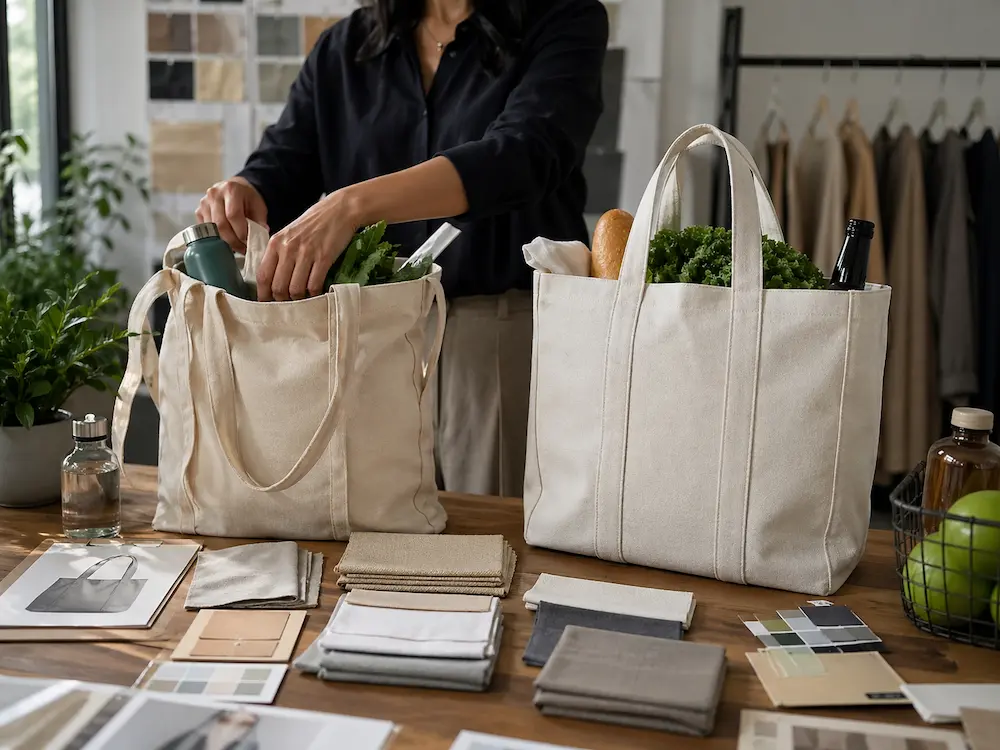
Sustainability Depends on Reuse, Not on Shape Alone
A tote bag is only a format. The format itself does not guarantee environmental value. What matters is whether the bag is used enough to justify the material and production resources that went into making it. A heavier reusable product usually needs a longer useful life to make practical sense than a very short-life product.
This is why buyers should be careful with easy sustainability claims. The bag has to do real work in real life. If the customer uses it only once or twice, the reusable logic weakens fast. If the customer keeps carrying it for shopping, books, work items, travel, or everyday errands, the practical sustainability argument becomes much stronger.
So the most important sustainability factor is not the fact that the bag is a tote. It is the fact that the bag is truly reused.
Material Matters, but Not in Isolation
Material clearly matters, but it should not be treated as the whole answer. Cotton, canvas, and other textile materials are common in tote bags because they support reuse and public carry well. But even a natural-looking material does not automatically create a better outcome if the product is badly matched to the use case or not reused enough.
A soft everyday-use product such as cloth tote bags may be a strong choice when the customer is likely to use the bag naturally and often. A stronger canvas tote may be a better answer when the bag needs to carry heavier items and survive repeated shopping or bookstore use. In both cases, the material only becomes meaningful environmentally if the bag stays in circulation long enough.
That is why material selection should be tied to customer behaviour, not only to sustainability language.
Why Durability Changes the Sustainability Answer
Durability is one of the most overlooked parts of the sustainability discussion. If the tote bag wears out too quickly, tears at the handle, loses shape badly, or becomes visually unacceptable after only light use, the product may not stay in use long enough to deliver the environmental value people assume it will.
This is where stronger canvas constructions often become important. Products linked to canvas tote bag printing often support more durable daily-use bag programs because the material and structure can better survive repeated carry. A bag that lasts longer usually has a better chance of making its reusable logic meaningful.
In simple terms, durability is not only a quality issue. It is a sustainability issue.
| Sustainability Factor | What Strengthens It | What Weakens It |
|---|---|---|
| Reuse frequency | Bag becomes part of daily routine | Bag used once or only occasionally |
| Material fit | Material matches actual carrying needs | Material chosen for image rather than function |
| Durability | Bag survives repeated real use | Bag wears out or feels weak too early |
| Brand honesty | Clear and realistic environmental claims | Vague green marketing with weak product logic |
| Commercial fit | Customer actually wants to keep carrying it | Bag is kept only as a symbolic freebie |
A Reusable Bag Must Be Wanted, Not Just Accepted
This is a commercial truth that environmental discussions often ignore. People do not keep using bags because a brand thinks they should. They keep using bags because the product is genuinely useful, comfortable, reasonably attractive, and appropriate for real life. If the bag is awkward, ugly, too flimsy, or too bulky, reuse drops fast no matter what claim was printed on it.
That is why sustainability depends partly on product design. A bag that feels natural to carry is much more likely to stay visible in public and continue replacing shorter-life alternatives. In many branding and retail programs, this is where the difference between average and strong products becomes obvious.
A sustainable tote bag is not only about fibre. It is also about user willingness.
Branding Can Either Strengthen or Weaken the Outcome
Branding matters because it affects whether the customer wants to keep the bag. A badly branded bag that screams promotion too aggressively may get used less often even if the product itself is physically fine. A cleaner, more attractive, more balanced branded tote may remain in everyday use much longer.
This is one reason why visible-use products such as promotional canvas tote bags with logo can work well when the logo treatment is strong but not overbearing. If the bag feels like something the customer is comfortable being seen with, the reuse life improves.
In other words, sustainability and design are not separate conversations. The better the bag fits public life, the stronger its practical sustainability case becomes.
Tote Bags Are Not All Solving the Same Problem
A supermarket shopping tote, a bookstore bag, an event giveaway, and a retail gift tote are not the same product in sustainability terms even if they all use a tote format. The intended use changes the right material, weight, size, and durability level. Some bags only need to be light and broadly useful. Others need to survive repeated grocery loads or heavier retail carry.
This is why a one-size-fits-all answer is weak. Some tote bag programs are genuinely more sustainable than others because they are built around real repeated use. Others are mostly sustainability-flavoured branding with much weaker long-term value.
Businesses that understand this usually build better products and make more honest claims.
Bulk Distribution Can Be Smart or Wasteful
Large-scale distribution of tote bags is not automatically a sustainability success. If the bags are useful, durable, and likely to be integrated into everyday life, then a bulk program can make sense. If the bags are underbuilt, generic, and distributed to people with no real reason to use them, the program may create far less value than expected.
This matters especially for big rollout programs. Products such as cotton tote bags bulk can support strong repeated-use initiatives when the bag model is right and the audience is right. But volume alone does not create sustainability. The bag still has to be wanted and used.
Scale only helps when the product logic is already sound.
Promotional Tote Bags Sit in a Grey Zone
Promotional tote bags often sit between genuine reusable value and image-driven distribution. Some perform well because they are strong enough and attractive enough to be reused often. Others become clutter quickly because they are too weak, too generic, or too obviously promotional.
This is why promotional formats need to be judged carefully. A bag like promotional canvas tote bags can absolutely be a stronger sustainability choice if the product quality supports repeated carry and the branding does not make the bag socially awkward to use. If those conditions are missing, the sustainability story weakens.
The lesson is simple: promotional distribution is not the same thing as sustainable product adoption.
Green Claims Need to Stay Honest
One of the biggest problems in this category is overclaiming. Tote bags are often described as eco, green, sustainable, and environmentally friendly with very little practical explanation behind those words. That kind of language may feel useful in marketing, but it weakens trust if the product itself is clearly not designed for long-term use.
Stronger brands say less and prove more. They explain the material. They explain the reuse logic. They build a bag that customers actually want to keep carrying. That kind of honesty is much more durable than broad environmental vocabulary.
A tote bag does not need exaggerated messaging if the product is already doing its job properly.
| Claim Type | Usually More Credible | Usually Less Credible |
|---|---|---|
| Product message | Reusable, durable, designed for everyday carry | Generic “green” language with no practical detail |
| Material story | Specific and linked to use case | Natural-looking language without explanation |
| Commercial promise | Bag built to stay in circulation | Bag distributed widely without clear user need |
How Buyers Should Think About the Question
The smartest way to answer “Are tote bags really sustainable?” is to judge the specific bag, not the category as a whole. Ask what material it uses. Ask how durable it is. Ask what it is designed to carry. Ask whether customers are realistically likely to use it often. Ask whether the environmental claim is specific and honest or broad and convenient.
If the bag is useful, durable, reasonably attractive, and matched to real daily behaviour, then yes, it can be a more sustainable option. If it is mostly symbolic or underused, then the answer becomes much weaker.
Sustainability is earned through use, not granted by shape.
Conclusion
Are tote bags really sustainable? Sometimes yes, sometimes not. They become more sustainable when they are designed for real repeated use, built well enough to last, and actually adopted into daily life. They become less convincing when they rely on vague environmental language but do not remain in circulation long enough to justify the claim.
The strongest tote bags are not the ones shouting the loudest about sustainability. They are the ones quietly doing the work for a long time.
How Buyers Should Think About Tote Bag Sustainability
What this question really asks: Asking whether tote bags are sustainable is not really asking about the bag shape. It is asking whether the bag stays in use long enough to justify the material, production, and branding decisions behind it. A tote bag becomes more sustainable through repeated real-life use, not through reusable language alone.
Why buyers often get the wrong answer: The most common mistake is treating all tote bags as if they create the same environmental outcome. They do not. A bookstore tote, a grocery bag, a promotional giveaway, and a retail gift bag all behave differently in the real world. Some are reused constantly. Others disappear after one event. That difference decides much of the sustainability result.
How businesses should compare options properly: The strongest way to compare tote bag sustainability is to evaluate material, durability, customer routine, and branding honesty together. A lighter cloth tote may work well in one program. A stronger canvas bag may be the better answer in another. The better environmental choice is the one that customers actually keep carrying because it fits their routine naturally.
Options businesses usually weigh: Most buyers compare lighter broad-distribution totes against stronger long-life totes, simple public branding against more durable merchandise-style products, and environmental messaging against real user behaviour. The better answer depends on whether the bag is likely to replace short-life packaging repeatedly or simply add another item to the market without enough reuse value.
Considerations before bulk approval: Before ordering, businesses should test the bag’s strength, comfort, size, print balance, and likely reuse appeal. They should also review whether the sustainability message still sounds honest once the product is in hand. That is often the fastest way to separate genuinely useful reusable totes from bags that only look sustainable in concept.
The broader takeaway: Tote bags can absolutely be a stronger sustainability choice, but only when product logic and customer behaviour support that result. That is also where Youngpack naturally fits as a B2B manufacturing and export partner for brands building tote bag programs that need better durability, clearer product fit, and more credible long-term reusable value.
FAQ
1. Are tote bags automatically more sustainable than disposable bags?
No. Tote bags are not automatically more sustainable just because they are reusable. Their real environmental value depends on how often they are used, how durable they are, and whether they actually replace shorter-life packaging often enough to justify their production. A tote bag that is used repeatedly in normal daily life can become a stronger sustainability choice. A tote bag that is used once and forgotten is a much weaker result.
2. Why does reuse matter more than the material claim?
Reuse matters more because sustainability in tote bags is strongly tied to behaviour. The material still matters, but if the customer does not keep using the bag, the product does not create much practical value regardless of how good the material sounds in marketing. A bag that becomes part of shopping, commuting, bookstore visits, or daily carry usually creates a more meaningful result than one that only looks environmentally responsible in the beginning.
3. Are canvas tote bags more sustainable than lighter cloth tote bags?
Not always. Canvas tote bags are often more durable and better suited to repeated shopping or heavier daily use, which can strengthen their sustainability case. Lighter cloth tote bags can still be a good option when the use case is lighter and the customer is likely to keep carrying the bag regularly. The better environmental choice depends on whether the bag’s material and construction match the real routine it is entering.
4. Can promotional tote bags still be sustainable?
Yes, but only when the product quality and design support repeated use. A promotional tote bag can become a strong sustainability choice if it is durable, attractive enough to keep carrying, and useful in real everyday routines. If it is too weak, too generic, or too obviously promotional to stay in use, then the sustainability value becomes much weaker. Promotion alone does not create environmental benefit.
5. What should businesses check before calling a tote bag sustainable?
Businesses should check the material, durability, intended load, likely reuse pattern, and whether the product genuinely fits customer life. They should also make sure the environmental message is honest and specific rather than exaggerated. A tote bag is easier to call sustainable when it is clearly built for long-term use and likely to stay in circulation, not when it only sounds good in a product description.
References
- Preferred Fiber and Materials Market Report — Textile Exchange — Textile Exchange.
- Textiles and the Environment — European Environment Agency — EEA.
- Green Guides for the Use of Environmental Marketing Claims — Federal Trade Commission — FTC.
- Sustainable Packaging Guidelines — Australian Packaging Covenant Organisation — APCO.
- Fashion on Climate — Global Fashion Agenda and McKinsey & Company.
- Retail Packaging and Reusable Bag Sourcing Best Practices — professional sourcing reference.
- Responsible Sourcing and Product Communication in Textile Supply Chains — industry trade reference.
- Guide to Reusable Bags and Long-Term Use Value — industry best-practice sourcing reference.
Intellectual Property Notice:
All original written content published here remains the intellectual property of Xiamen Youngpack Imp.and Exp.Co.,Ltd. Any unauthorized reuse is strictly prohibited.