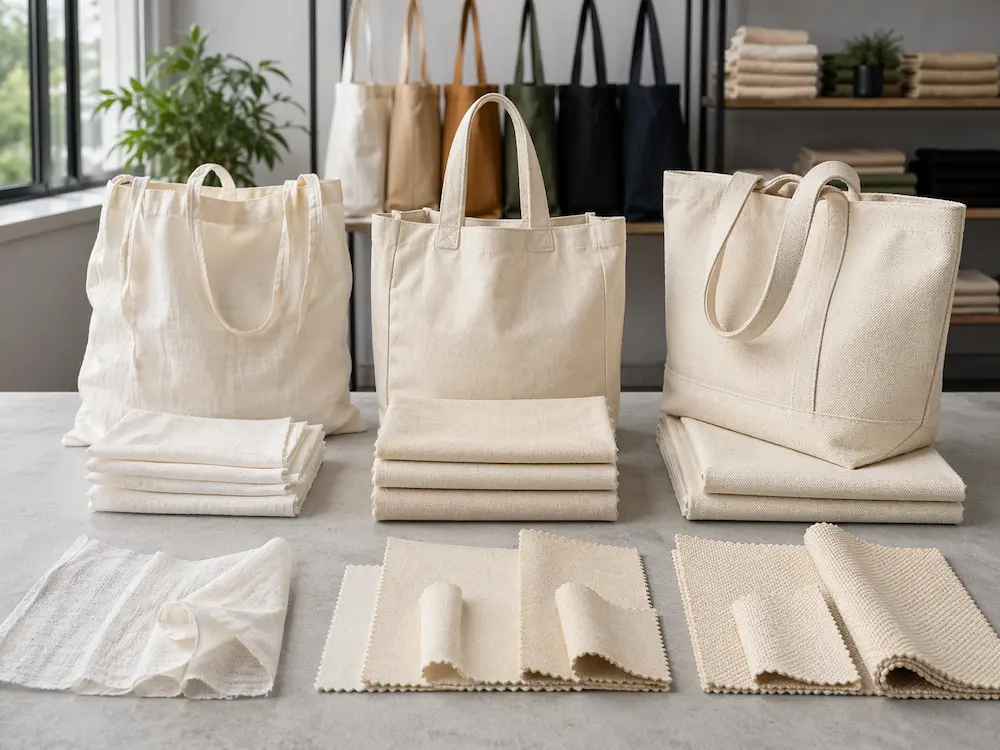
If you are buying tote bags for business, one of the first technical terms you will run into is GSM. Suppliers mention it constantly, buyers compare it in quotes, and product descriptions often use it without really explaining what it means. That creates confusion, because GSM sounds highly technical even though the core idea is simple.
GSM in tote bags means grams per square metre. It measures how much one square metre of fabric weighs. In practical terms, GSM tells you how light or heavy the bag fabric is. A lower GSM fabric is usually thinner and lighter. A higher GSM fabric is usually thicker, denser, and stronger-feeling. That does not automatically make high GSM “better,” but it does make the bag behave differently.
This is why GSM matters. It influences cost, carrying strength, print feel, bag structure, carton efficiency, and how long the product is likely to stay in use. If a buyer ignores GSM, they are often buying blind. If a buyer understands GSM but treats it as the only quality factor, they are also making a mistake. The smartest sourcing decisions treat GSM as important, but not isolated from the rest of the product.
What GSM Actually Measures
GSM is a fabric weight measurement, not a total bag weight. It tells you how heavy the raw material is per square metre before that material is cut and sewn into a finished product. This means two tote bags made from the same GSM fabric can still feel different if their dimensions, gussets, handle construction, or lining are different.
For example, a 140 GSM cotton tote and a 280 GSM canvas tote are not just different because one number is bigger. The higher-GSM bag usually has more body, more visible structure, and more carrying confidence. But the finished product still depends on sewing quality, reinforcement, and actual design.
That is why GSM should be read as a material-weight clue, not as the whole quality story. It helps you understand what direction the bag is going in, but not whether the final product is well made.
Why GSM Matters So Much in Tote Bag Buying
In tote bags, fabric weight has direct commercial consequences. It affects the bag’s feel in the hand, how it folds, how it prints, how much it costs to ship, and how likely it is to survive repeated use. A light bag can be perfect for exhibitions, schools, cafés, and simple promotions. A heavy bag can be ideal for supermarkets, bookstores, premium retail, and long-term reusable shopping.
The problem starts when buyers choose GSM without defining use case. A low-GSM fabric can feel weak if the bag is used for groceries or books. A high-GSM fabric can feel wasteful and expensive if the bag is only there to carry brochures at a one-day event. So GSM matters because it directly affects whether the bag specification fits the job or fights the job.
This is especially important in repeat-use product categories such as cotton tote bags, where the material must balance softness, practical durability, and long-term everyday usability rather than simply looking attractive in a quote sheet.
Low GSM vs High GSM: The Basic Difference
The easiest way to understand GSM is to separate it into lighter fabrics and heavier fabrics. Lower GSM fabrics are usually softer, lighter, easier to fold, easier to ship, and cheaper to produce. Higher GSM fabrics are usually thicker, stronger-feeling, more structured, and more durable-looking.
Neither one is automatically the right answer. It depends on the business objective. A conference giveaway tote does not need the same GSM as a reusable grocery bag. A museum gift tote does not need the same GSM as a supermarket checkout bag. The best tote bag GSM is always the one that fits the expected load, brand image, and reuse pattern.
| GSM Range | Typical Fabric Feel | Common Business Use | Main Trade-Off |
|---|---|---|---|
| 120–150 GSM | Light, soft, flexible | Events, giveaways, light retail | Lower strength for heavy repeated use |
| 150–220 GSM | Balanced, practical, everyday-friendly | General daily-use tote programs | Mid-range cost and structure |
| 220–320 GSM | Heavier, stronger, more structured | Shopping, bookstores, premium retail | Higher freight and material cost |
| 320 GSM and above | Dense, sturdy, premium-feeling | Heavy-duty and premium merchandise totes | Can feel bulky if the use case is light |
What Low GSM Tote Bags Are Good For
Lower GSM tote bags are usually the smarter answer when the bag is meant for light carrying and broad distribution. They are common in trade shows, conferences, schools, community campaigns, awareness promotions, cafés, and simple gift-with-purchase programs. These bags are cost-efficient, easy to pack in volume, and practical enough for lightweight contents such as leaflets, product samples, notebooks, or small retail purchases.
A low-GSM tote is not automatically poor quality. It is simply more appropriate for a lighter job. The mistake happens when businesses expect a thin tote to carry books, bottled drinks, or grocery loads repeatedly. That is where the product begins to feel underbuilt and the brand starts paying for the wrong savings.
For everyday promotions or softer natural branding, some buyers also compare low-GSM totes with adjacent lightweight products such as cotton drawstring bags when the real goal is low-cost portability rather than a stronger retail tote.
What Mid-Range GSM Tote Bags Are Good For
Mid-range GSM is often the safest zone for businesses that want a versatile reusable tote without overengineering it. This is where many everyday cotton and cloth totes sit because the fabric feels substantial enough for regular use but not so heavy that the product becomes stiff, bulky, or unnecessarily expensive.
These bags work well in bookstores, museums, cafés, lifestyle brands, office gifting, employee kits, and general retail programs where the tote should be reused often but does not need to function like a grocery haul bag every day. Mid-range GSM often creates the best balance between comfort, brand feel, and commercial efficiency.
For broader market use, this is also the zone where many businesses find success with custom tote bags because the product remains flexible enough for everyday carry while still feeling like something worth keeping.
What High GSM Tote Bags Are Good For
Higher GSM tote bags are usually the better choice when the bag must carry heavier items, maintain shape more clearly, or feel more premium in hand. These fabrics are common in canvas shopping totes, supermarket reusable bags, bookstore bags for multiple books, premium retail merchandise, and brand programs where the tote itself should feel like a durable product.
Heavier fabric usually gives the bag more structure and more load confidence, but it also adds freight weight and reduces packing efficiency. This is why high-GSM fabric should only be chosen when the user will genuinely benefit from the added strength and body.
For stronger brand-led retail programs, products such as custom canvas tote bags often rely on higher GSM because the tote is expected to function as long-life merchandise rather than a simple giveaway.
Does Higher GSM Always Mean Better Quality?
No. This is one of the biggest misunderstandings in tote bag sourcing. Higher GSM means heavier fabric. It does not automatically mean better bag quality. A poorly sewn 300 GSM tote can still fail. A well-constructed 140 GSM tote can still perform very well in the right use case.
Quality depends on more than fabric weight. It also depends on stitching, handle attachment, edge finishing, gusset design, print suitability, and whether the bag was honestly specified for the intended load. Buyers who treat GSM as the only quality signal usually end up either overpaying for unnecessary weight or underestimating other structural weaknesses.
So GSM is important, but it must be read together with the full product specification.
How GSM Affects Carrying Strength
In most cases, higher GSM improves the feeling of strength, but carrying strength is never only about the cloth. If a tote bag has weak handles, poor cross-stitching, no reinforcement, or badly finished seams, a heavier fabric alone will not save it. At the same time, a medium-GSM tote with proper sewing and sensible bag dimensions can often outperform a heavier-looking bag that was put together carelessly.
That said, GSM still matters a lot for carrying behavior. Low-GSM fabrics tend to sag more and may feel less reliable under dense loads. High-GSM fabrics tend to hold their shape better and feel more trustworthy in shopping or book-carry use.
The key point is this: GSM supports strength, but construction delivers it.
How GSM Affects Printing
Fabric weight also influences print result. Lower GSM fabrics may feel softer and absorb print differently, especially if the surface is thinner or more flexible. Higher GSM canvas and denser cotton often create a more stable print surface, which can make branding feel cleaner and more product-like.
This is one reason many brands prefer heavier canvases for strong visible retail branding. The bag does not only carry the print. It supports the print visually. That matters in promotional and retail programs where the tote bag itself is part of the perceived quality.
For more visible and durable artwork presentation, many buyers move toward custom printed canvas tote bags because the heavier fabric often creates a stronger overall product-and-print combination than a very light promotional tote.
How GSM Affects Cost and Freight
Heavier fabric uses more material, so higher GSM usually means higher unit cost. It also means higher freight weight and lower carton efficiency. That matters a lot in large export orders and high-volume campaigns. A bag that feels only slightly better in the hand can cost significantly more once production, shipping, and warehousing are all included.
Lower GSM fabric is usually more efficient in cost and shipping terms. This is why it remains so common in broad distribution programs. But that only creates good value when the bag is being used in the kind of light-duty context it was actually designed for.
| Factor | Lower GSM | Higher GSM |
|---|---|---|
| Material cost | Usually lower | Usually higher |
| Freight efficiency | Usually better | Usually lower |
| Print base stability | More variable | Usually stronger |
| Customer perceived value | More promotional | More durable and premium |
Common GSM Ranges Buyers Will See in Cotton and Canvas Totes
In tote bag manufacturing, buyers often see lighter cotton bags in the approximate 120–160 GSM range, medium everyday cotton and cloth styles in the 140–220 GSM range, and heavier canvas products from roughly 220 GSM upward. Some premium canvas products go far beyond that, especially if they are intended for strong retail use.
These are not hard rules, but they are useful as a commercial reference. A lighter giveaway tote will usually not be positioned like a premium canvas shopping tote, and the GSM is one of the clearest technical signs of that difference.
This is why comparing supplier quotes without comparing GSM can be misleading. Two bags that look similar in a photo may be very different products once the material weight is disclosed.
How to Choose the Right GSM for Your Business
The smartest way to choose GSM is not to ask for “the best GSM.” It is to ask what the bag needs to carry, how often it will be reused, what the customer expects, and what role the bag plays in the brand. If the bag is for a trade show, broad event distribution, or light-use awareness campaign, lower GSM usually makes sense. If the bag is for everyday city use, bookstores, museums, or mid-range retail, medium GSM often creates the best balance. If the bag is for groceries, shopping, or premium merchandise, higher GSM is usually the stronger answer.
The real mistake is choosing fabric weight as if every tote bag project is the same. It is not. GSM should follow use case, not general preference.
Questions Buyers Should Ask Suppliers About GSM
When a supplier quotes GSM, buyers should ask what exactly that GSM refers to, what the base material is, whether the bag includes gussets or reinforcements, what the expected carrying use is, and how the finished product behaves under real load. A good supplier should be able to explain not only the GSM number, but what that number means in the bag’s actual performance.
Buyers should also ask for samples. GSM on paper is useful, but the hand feel of a real bag reveals much more than a number alone. This is where strong suppliers separate themselves from weak ones. The good ones connect fabric weight to real commercial logic instead of simply offering heavier fabric as a default upsell.
This is where Youngpack-style sourcing judgment becomes valuable: the best recommendation is usually not the heaviest fabric, but the most commercially honest one.
Conclusion
GSM in tote bags is one of the most useful numbers in bag sourcing because it tells you how heavy the fabric is and therefore gives a strong clue about feel, structure, cost, and likely use. Lower GSM is usually right for light-use promotions and broad distribution. Mid-range GSM is usually strongest for everyday reusable use. Higher GSM is usually better for shopping, books, and premium retail totes.
But GSM is not the whole quality story. A tote bag should be judged by material weight, yes, but also by sewing, handles, print suitability, and whether the bag is actually fit for the customer’s real routine. Buyers who understand that usually choose much better products.
How Buyers Should Think About GSM in Tote Bags
What GSM really tells you: GSM is one of the clearest technical signals in a tote bag quote because it tells you how heavy the fabric is. That affects softness, structure, print behavior, freight cost, and how the bag will feel in actual use. It is not a full quality score, but it is one of the most commercially important starting points in tote bag sourcing.
Why buyers often misunderstand it: Many buyers assume that higher GSM automatically means better quality. That is not true. Higher GSM usually means heavier fabric, but the right tote bag still depends on stitching, handle strength, dimensions, and whether the bag is honestly matched to its intended job. A light event tote and a heavy supermarket tote should not be judged by the same GSM logic.
How buyers should use GSM properly: The strongest way to use GSM is to connect it to the real business scenario. Light GSM is usually right for event distribution, broad promotions, and low-load applications. Mid-range GSM is usually strongest for general everyday use. Higher GSM is usually better for shopping, books, and premium repeat-use programs. The bag should be specified from the carry routine outward, not from the number alone.
Options businesses usually weigh: Most buyers compare lower-cost lighter fabrics against stronger, more premium heavier fabrics. They are often deciding between distribution efficiency and long-term product value. The better answer depends on whether the bag must reach more people cheaply or stay in public use longer with more carrying confidence.
Considerations before ordering: Before approving a fabric weight, businesses should test real samples, confirm the intended load, compare print appearance, and ask how the bag behaves in normal use. They should also check freight and carton efficiency, because higher GSM affects the landed cost as well as the product feel. The right GSM usually becomes obvious once the user routine and campaign logic are defined clearly.
The broader takeaway: GSM is not the whole tote bag story, but it is one of the most important technical clues in it. That is also where Youngpack naturally fits as a B2B manufacturing and export partner for buyers comparing tote bag materials, fabric weights, and real-world product performance across promotional, retail, and reusable bag programs.
FAQ
1. What does GSM mean in tote bags?
GSM means grams per square metre. It measures how much one square metre of fabric weighs and is used to indicate the fabric weight of tote bag material. In practical terms, lower GSM usually means a lighter and thinner fabric, while higher GSM usually means a thicker and heavier fabric. It is one of the most useful technical numbers in tote bag sourcing because it helps buyers understand the likely feel, cost, and use level of the bag.
2. Is higher GSM always better for tote bags?
No. Higher GSM is not automatically better. It usually means the fabric is heavier and more structured, which can be useful for shopping, bookstore, and long-term reusable tote bags. But if the bag is only needed for conferences, brochures, or light promotional use, high GSM may add unnecessary cost and bulk. The right GSM is the one that matches the real use case, not simply the biggest number.
3. What GSM is good for everyday cotton tote bags?
For many everyday-use cotton tote bags, a mid-range GSM often works best because it balances comfort, practicality, and cost. It usually gives enough material body for regular use without making the bag feel too heavy or too rigid. The exact best GSM still depends on what the bag will carry, but many daily-use programs perform best in the medium fabric-weight range rather than at the very light or very heavy extremes.
4. Does GSM affect printing quality on tote bags?
Yes, it can. Heavier and more stable fabrics often create a more reliable surface for printing, especially for clearer logos and stronger retail presentation. Lighter fabrics can still print well, but the result may feel softer or less structured depending on the bag material and print method. GSM does not determine print quality by itself, but it affects how the print sits on the fabric and how the finished bag feels as a branded product.
5. What should buyers check besides GSM when ordering tote bags?
Buyers should also check stitching quality, handle reinforcement, bag dimensions, gusset depth, material type, print method, and how the bag performs under realistic load. GSM is important, but it does not tell the whole story. A well-designed medium-GSM bag can be better than a badly constructed heavy-GSM bag. The strongest tote bag choice usually comes from evaluating both fabric weight and actual finished-product construction together.
References
- Preferred Fiber and Materials Market Report — Textile Exchange — Textile Exchange.
- Textiles and the Environment — European Environment Agency — EEA.
- Green Guides for the Use of Environmental Marketing Claims — Federal Trade Commission — FTC.
- Sustainable Packaging Guidelines — Australian Packaging Covenant Organisation — APCO.
- Fashion on Climate — Global Fashion Agenda and McKinsey & Company.
- Responsible Sourcing and Product Communication in Textile Supply Chains — industry trade reference.
- Retail Packaging and Reusable Bag Sourcing Best Practices — professional sourcing reference.
- Guide to Reusable Bags and Long-Term Use Value — industry best-practice sourcing reference.
Source Credit Requirement:
If you would like to quote part of this article, please clearly credit Xiamen Youngpack Imp.and Exp.Co.,Ltd. as the original source. Full-text reproduction is not permitted.