Tote Bags for Promotional Giveaways — Quick Summary
Promotional tote bags can support trade shows, corporate events, product launches, retail campaigns, university programmes, and customer appreciation activities. Lightweight cotton can suit high-volume giveaways, medium-weight cotton provides a balance between cost and everyday usefulness, while structured canvas can support premium merchandise and customer gifts. Businesses should evaluate audience relevance, material quality, printing, logo placement, MOQ, landed cost, sampling, production schedules, distribution efficiency, and measurable campaign results. The most effective promotional tote bags combine practical value with attractive branding that encourages recipients to continue using them after the original campaign.
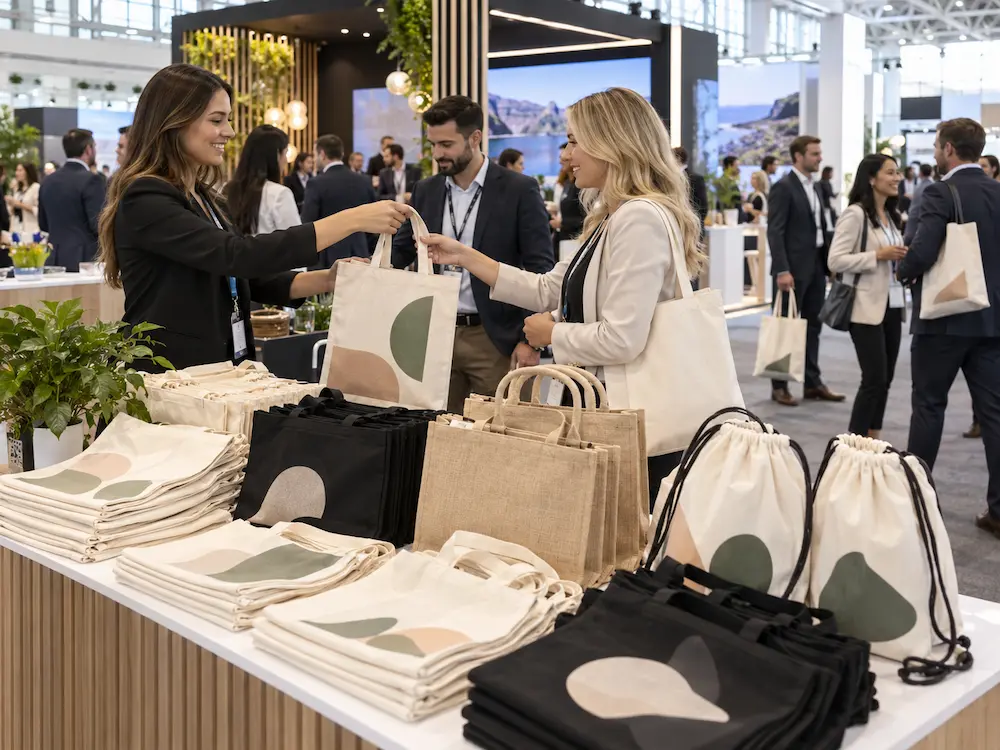
Why Tote Bags Work for Promotional Giveaways
Promotional giveaways are a familiar part of business marketing. Companies distribute branded products at trade shows, conferences, product launches, retail events, corporate gatherings, universities, community programmes, and customer appreciation activities.
The objective is usually straightforward: provide something useful while increasing awareness of the organisation behind it.
However, not all promotional products offer the same practical value.
Some are used briefly and then forgotten. Others remain part of a recipient’s routine.
Tote bags offer an opportunity to combine promotional communication with a functional carrying product.
A recipient may initially use a tote bag to collect brochures, samples, gifts, or event materials. After the campaign, the same bag may be used for groceries, books, work essentials, shopping, or everyday errands.
This potential for continued use makes promotional tote bags particularly interesting to marketing teams.
The bag also offers a relatively large surface for a logo, campaign illustration, slogan, or visual identity.
Unlike a small promotional accessory, a tote can display branding prominently without requiring complex packaging.
Nevertheless, distribution alone does not guarantee marketing success.
A promotional tote must be relevant to its audience, comfortable to carry, attractive enough to reuse, and durable enough for its intended purpose.
A company distributing 10,000 bags that recipients rarely use may achieve less lasting value than one distributing 3,000 carefully designed bags that become everyday accessories.
This is why promotional tote bag sourcing should begin with the campaign objective rather than the lowest available unit price.
The Main Marketing Benefits
Promotional tote bags can support several objectives:
- Brand awareness through visible graphics.
- Event participation and attendee convenience.
- Customer appreciation.
- Product launch communication.
- Retail promotion.
- Employee engagement.
- Reusable merchandise distribution.
- Continued brand visibility when recipients reuse the bags.
The strongest campaigns connect these benefits to a clearly defined audience and measurable objective.
| Promotional Objective | Tote Bag Application | Primary Benefit | Suggested Measurement |
|---|---|---|---|
| Brand Awareness | Public giveaway | Potential repeated visibility | Recall survey |
| Trade Show Marketing | Attendee bag | Carrying convenience | Distribution and lead capture |
| Product Launch | Limited-edition tote | Campaign recognition | Engagement |
| Customer Appreciation | Branded gift | Relationship building | Customer feedback |
| Retail Promotion | Gift with purchase | Purchase incentive | Redemption rate |
| Employee Programme | Welcome kit | Internal identity | Employee feedback |
| University Event | Student tote | Everyday utility | Continued use |
| Community Campaign | Reusable bag | Participation | Distribution and follow-up |
These benefits should be evaluated according to the actual campaign rather than assumed from the number of products ordered.
What Makes a Promotional Tote Bag Effective?
An effective promotional tote bag balances marketing value and everyday practicality.
A large logo may make the bag immediately recognisable, but a design that looks excessively promotional may discourage reuse.
A low-cost fabric may reduce procurement expenditure, but poor stitching or uncomfortable handles can shorten the bag’s useful life.
A premium canvas tote may create a strong impression, but its additional cost may be unnecessary for a short campaign targeting a very broad audience.
The right specification depends on the relationship between budget, distribution, audience, and intended use.
Practical Usefulness
The first consideration is whether recipients have a reason to use the bag.
For example, a trade show attendee may need to carry catalogues and product samples.
A university student may want a tote for notebooks and everyday belongings.
A retail customer may use it for shopping.
A corporate employee may carry lunch, documents, or personal items.
The bag should be designed around these realistic applications.
Attractive Design
Promotional bags do not need to resemble advertising posters.
A simple logo, tasteful illustration, coordinated colour palette, or minimalist design may create a more versatile product.
The design should remain recognisable without making the bag unsuitable for ordinary daily use.
Appropriate Durability
Promotional quality should match the expected load.
A lightweight tote may be sufficient for leaflets and small gifts.
A heavier cotton or canvas tote may be more appropriate for books, bottles, and frequent shopping.
Efficient Distribution
Promotional products should also be easy to store, transport, and distribute.
Oversized or unnecessarily heavy bags can increase carton volume, freight expenditure, and event handling requirements.
For large campaigns, these operational costs can become significant.
Understanding the Promotional Customer Journey
A promotional tote bag can interact with a recipient at several stages.
The first stage is distribution.
A visitor receives the bag at a booth, registration desk, retail checkout, or campaign event.
The second stage is immediate use.
The recipient places promotional materials, purchases, or personal belongings inside it.
The third stage is potential continued use.
If the bag is practical and visually appealing, it may become part of the recipient’s everyday routine.
The fourth stage is potential secondary exposure.
Other people may see the printed artwork when the bag is carried in public.
This process creates an opportunity for repeated visibility, but actual results depend on behaviour.
Marketing teams should not assume that every bag will generate a fixed number of impressions.
Instead, they can evaluate reuse through follow-up surveys, customer feedback, and campaign-specific measurement.
Best Applications for Promotional Tote Bags
Promotional tote bags can support many industries and campaign formats.
However, each application has different functional and branding requirements.
Trade Shows and Exhibitions
Trade shows are one of the most familiar settings for promotional bags.
Attendees collect:
- Product catalogues
- Brochures
- Business cards
- Samples
- Notebooks
- Promotional merchandise
A tote bag helps organise these materials.
For exhibitors, the bag also provides a surface for branding that may be visible while attendees move around the venue.
However, exhibition bags face several practical challenges.
They need to accommodate printed materials, remain comfortable throughout the day, and be easy for booth staff to distribute.
Recommended Trade Show Specifications
A medium cotton tote around 38 × 42 cm can be a practical starting point for many exhibition programmes.
Buyers may consider:
- Lightweight or medium-weight cotton.
- Long handles for shoulder carrying.
- A flat construction for brochures.
- A gusset when samples require additional depth.
- One- or two-colour screen printing.
The exact specification should be tested with representative event materials.
Avoiding Excessive Promotional Design
A trade show bag should remain useful after the exhibition.
Printing an enormous event date or temporary message may reduce its appeal once the event is over.
A more versatile design can feature the brand identity prominently while keeping event-specific information secondary.
Corporate Events and Employee Programmes
Companies use promotional tote bags for:
- Annual meetings
- Employee onboarding
- Training sessions
- Corporate conferences
- Team-building programmes
- Customer appreciation
- Internal brand campaigns
These programmes often benefit from a more professional design than mass-distribution giveaways.
A neutral fabric colour, restrained logo, and stronger construction can create a product that employees or customers feel comfortable using outside the workplace.
Employee Welcome Kits
A welcome tote may contain:
- Notebook
- Pen
- Reusable bottle
- Employee handbook
- Small technology accessories
- Company merchandise
The bag should be tested with the actual kit contents.
A lightweight promotional tote may be unsuitable when the welcome package contains several heavy items.
Customer Appreciation Gifts
For higher-value customers, a structured canvas tote can provide a stronger presentation.
The bag may be paired with other gifts, but the total package should remain consistent with the company’s brand positioning and budget.
Retail Promotions and Product Launches
Retailers can distribute tote bags as gifts with purchase or as part of product launch campaigns.
For example, a clothing retailer may offer a limited-edition tote when customers spend above a specified threshold.
A beauty brand may include a printed tote in a promotional set.
A lifestyle store may create a seasonal design that complements its products.
In these situations, the tote functions as both merchandise and a purchase incentive.
Gift-With-Purchase Campaigns
The promotional bag should have enough perceived value to encourage participation.
However, the cost must remain proportionate to the commercial objective.
Retail buyers should calculate the full promotional cost, including:
- Bag manufacturing.
- Printing.
- Freight.
- Storage.
- Distribution.
- Packaging.
- Campaign administration.
A gift that increases order value may be commercially useful, but its effectiveness should be measured rather than assumed.
Product Launch Merchandise
A product launch may benefit from stronger visual design.
Limited-edition graphics, artist collaborations, and coordinated colours can make the tote feel connected to the launch rather than like a generic giveaway.
Universities, Schools, and Community Events
Educational institutions frequently distribute reusable bags during:
- Orientation programmes
- Open days
- Recruitment events
- Student fairs
- Alumni activities
- Campus campaigns
Students may use tote bags for books, notebooks, lunch, and personal belongings.
This creates an opportunity for continued use when the product is designed appropriately.
Community organisations can also use promotional totes for volunteer programmes, awareness campaigns, and public events.
The material and construction should reflect the contents rather than simply the expected distribution quantity.
Choosing Materials for Promotional Tote Bags
Material selection is one of the most important procurement decisions.
It influences:
- Unit cost.
- Durability.
- Appearance.
- Printing.
- Carrying comfort.
- Product weight.
- Packing volume.
- Perceived value.
Promotional buyers should compare materials based on the actual campaign rather than choosing only by price.
| Material | Main Characteristics | Typical Promotional Application | Main Consideration |
|---|---|---|---|
| Lightweight Cotton | Soft, foldable | Mass giveaways | Load limitations |
| Medium Cotton | Balanced structure | General campaigns | Cost and durability |
| 8 oz Canvas | More substantial | Corporate merchandise | Higher material use |
| 10 oz Canvas | Structured | Premium giveaways | Freight weight |
| 12 oz Canvas | Heavy construction | Merchandise and gifts | Higher cost |
| Non-Woven Polypropylene | Lightweight, economical | High-volume distribution | Construction and intended reuse |
| RPET Textile | Recycled-content options | Campaign merchandise | Material verification |
No single material is suitable for every campaign.
Lightweight Cotton for High-Volume Giveaways
Lightweight cotton can be useful when the campaign involves large quantities and relatively light contents.
Typical applications include:
- Leaflet distribution.
- University orientation.
- Retail promotional events.
- Community activities.
- Trade show registration.
The main advantage is a balance between printability, foldability, and relatively low material weight.
However, lightweight cotton should not be selected for heavy loads without appropriate testing.
Medium-Weight Cotton for Everyday Use
Medium-weight cotton provides a useful balance between promotional cost and practical durability.
It can work for:
- Shopping.
- Books and notebooks.
- Work essentials.
- Everyday carrying.
- General corporate campaigns.
For businesses seeking a promotional product that recipients may continue using, cotton totes designed for everyday carry and brand expression can provide a relevant product direction.
The final weight, size, and construction should still match the expected contents.
Canvas for Premium Promotional Merchandise
Canvas can provide a more substantial feel.
For premium customer gifts, higher-value campaigns, and merchandise programmes, cotton canvas tote bags for durable brand carry can support stronger construction and a more structured appearance.
Common fabric options may include 8 oz, 10 oz, and 12 oz canvas.
These weights are useful starting points rather than guarantees of load capacity.
Stitching, handle attachment, bag proportions, and fabric construction also influence performance.
Cotton vs Canvas vs Non-Woven Promotional Bags
Material comparison should consider more than unit cost.
| Factor | Cotton | Canvas | Non-Woven PP |
|---|---|---|---|
| Appearance | Natural, soft | Structured, substantial | Lightweight, uniform |
| Foldability | High | Moderate | High |
| Printing | Strong | Strong | Process-dependent |
| Perceived Value | Moderate | Often higher | Budget-oriented |
| Typical Use | General promotions | Premium campaigns | Mass distribution |
| Weight | Variable | Often higher | Generally low |
| Durability | Specification-dependent | Often stronger construction | Specification-dependent |
| Cost | Variable | Often higher | Often economical |
A budget campaign may benefit from a lightweight construction.
A premium corporate programme may justify a heavier textile.
The decision should reflect campaign objectives and actual user needs.
Selecting Fabric Weight for Promotional Giveaways
Fabric weight affects both the physical product and the procurement budget.
For example, an 8 oz canvas tote and a 12 oz canvas tote may have similar dimensions but different material consumption and finished weight.
Across a large order, that difference can affect:
- Manufacturing cost.
- Carton gross weight.
- Freight expenditure.
- Storage.
- Handling.
The heaviest available fabric is not necessarily the most effective promotional choice.
A good specification provides enough strength and structure for the intended use without unnecessary material.
| Campaign Type | Possible Fabric Direction | Main Objective |
|---|---|---|
| Mass Public Giveaway | Lightweight cotton | Cost and distribution |
| Trade Show | Lightweight–medium cotton | Brochure carrying |
| University Campaign | Medium cotton | Everyday use |
| Corporate Event | Medium cotton/8 oz canvas | Presentation |
| Premium Customer Gift | 10–12 oz canvas | Perceived value |
| Retail Merchandise | Medium-heavy cotton/canvas | Repeated use |
These are indicative directions, not mandatory specifications.
Choosing the Right Promotional Tote Bag Size
Bag dimensions affect both functionality and brand presentation.
A medium tote around 38 × 42 cm can serve as a starting point for many promotional programmes.
However, the correct size depends on the contents.
A conference bag may need to hold A4 documents.
A retail gift bag may carry folded clothing.
A community campaign may only require enough space for a notebook and water bottle.
Flat Tote Bags
Flat totes can be appropriate for:
- Brochures.
- Catalogues.
- Documents.
- Lightweight merchandise.
- General promotional distribution.
They are often simple to manufacture, fold, and pack.
Gusseted Tote Bags
Gussets add depth and can improve capacity for three-dimensional items.
They may be useful for:
- Bottles.
- Gift boxes.
- Product samples.
- Apparel.
- Multiple promotional products.
A gusset around 10–15 cm may be considered when additional depth is required.
The sample should be tested with real campaign contents.
Handle Length and Reinforcement
Handles are among the most important functional components of a promotional tote.
A bag may have attractive printing and suitable dimensions but still be inconvenient if the handles are too short or uncomfortable.
Long handles allow shoulder carrying, which is useful for trade shows and everyday use.
A handle drop of approximately 26–30 cm can be a reference for many shoulder-carry designs, depending on the overall proportions.
For heavier loads, buyers may consider:
- Wider handles.
- Stronger handle materials.
- Box-X stitching.
- Cross-stitch reinforcement.
- Reinforced seams.
A promotional bag should be tested for its expected use rather than assuming that fabric weight alone determines strength.
Designing Promotional Tote Bags People Will Actually Reuse
One of the greatest challenges in promotional merchandise is encouraging continued use.
Businesses often focus heavily on logo visibility during the design process.
However, the recipient’s perspective is equally important.
Would the person carry this bag outside the original event?
Does it look appropriate for shopping, commuting, school, or casual everyday use?
Is the colour versatile?
Is the print attractive?
Is the bag comfortable?
These questions should guide design decisions.
Minimal Branding
A small or medium-sized logo can provide brand recognition without overwhelming the design.
This approach may work well for:
- Professional services.
- Corporate events.
- Lifestyle brands.
- Premium customer gifts.
Campaign Graphics
Large illustrations can create a stronger visual statement.
This may be suitable for:
- Product launches.
- Youth campaigns.
- University events.
- Cultural activities.
- Retail promotions.
Brand Colours
Custom fabric colours and Pantone-matched printing can reinforce visual identity.
However, custom colours may increase minimum quantities, sampling requirements, or cost.
For budget-sensitive programmes, standard fabric colours combined with controlled printing may provide a practical alternative.
Printing Methods for Promotional Tote Bags
Printing is central to promotional tote bag effectiveness.
The correct method depends on artwork complexity, material, quantity, budget, and required appearance.
| Printing Method | Best Suited To | Main Advantage | Consideration |
|---|---|---|---|
| Screen Printing | Simple logos and graphics | Efficient at volume | Colour/setup requirements |
| Digital Printing | Detailed artwork | Complex designs | Fabric compatibility |
| Heat Transfer | Multicolour designs | Flexible artwork | Transfer hand feel |
| Embroidery | Small premium logos | Textured appearance | Cost and detail limits |
| Woven Labels | Subtle branding | Refined presentation | Additional construction |
Screen Printing
Screen printing is commonly used for bulk promotional bags.
It is particularly suitable for:
- Logos.
- Simple illustrations.
- Typography.
- One- or two-colour artwork.
Setup costs can be spread across larger quantities.
This can make screen printing commercially attractive for repeatable designs.
Digital and Transfer Printing
Digital and transfer methods may be appropriate for:
- Detailed graphics.
- Multiple colours.
- Complex illustrations.
- Smaller design variations.
The chosen process should be tested on the actual fabric.
Embroidery and Premium Details
Embroidery can add texture and a premium appearance.
However, large embroidered areas may increase cost and affect the fabric.
It is often more suitable for smaller logos or decorative elements.
Logo Placement and Brand Visibility
The size of a tote bag provides several possible branding positions.
Common options include:
- Central front logo.
- Small upper-centre logo.
- Lower-corner logo.
- Double-sided printing.
- Full-width illustration.
- Woven side label.
The best position depends on how the bag is intended to be carried.
A large central logo may be useful for high-visibility event marketing.
A smaller logo may encourage continued use among recipients who prefer understated accessories.
The goal should be to balance recognition and desirability.
Tote Bags vs Drawstring Bags for Promotional Giveaways
Tote bags are versatile, but they are not always the best promotional format.
Drawstring bags can be useful for sports events, campus activities, outdoor promotions, youth campaigns, and situations where hands-free carrying is preferred.
| Promotional Application | Tote Bag | Drawstring Bag |
|---|---|---|
| Trade Shows | Excellent | Good |
| Corporate Conferences | Excellent | Good |
| Sports Events | Good | Excellent |
| University Orientation | Excellent | Excellent |
| Retail Gift With Purchase | Excellent | Good |
| Gym Promotions | Good | Excellent |
| Community Events | Excellent | Excellent |
| Premium Corporate Gifts | Excellent | Moderate |
| Youth Campaigns | Good | Excellent |
Drawstring Bags With Logo
For campaigns requiring compact, casual merchandise, drawstring bags with logo for branding and promotions can provide an alternative to conventional tote bags.
These bags may be appropriate for:
- Sports promotions.
- Gym events.
- University campaigns.
- Outdoor activities.
- Youth-oriented giveaways.
Personalised Drawstring Merchandise
Some campaigns require different artwork for individual teams, departments, events, or recipient groups.
In these situations, personalized drawstring bags for promotional merchandise programs can support more differentiated promotional merchandise.
Personalisation can increase production complexity, so artwork variations and quantities should be confirmed before manufacturing.
Bulk Ordering for Promotional Giveaways
Promotional campaigns often require large quantities within a fixed schedule.
A company may need 1,000 bags for a conference, 5,000 for a customer campaign, or 20,000 for a multi-location retail promotion.
Larger orders can improve manufacturing efficiency, but they also increase financial and inventory exposure.
Procurement teams should consider:
- Expected attendance.
- Distribution method.
- Reserve quantity.
- Campaign duration.
- Remaining inventory.
- Production lead time.
- Freight requirements.
For large-scale programmes, bulk cotton tote bags for large-scale brand distribution can provide a relevant sourcing direction when consistent specifications and volume production are required.
MOQ and Promotional Tote Bag Pricing
Custom tote bags commonly involve fixed preparation costs.
These can include:
- Material sourcing.
- Artwork preparation.
- Printing setup.
- Sampling.
- Production scheduling.
- Cutting preparation.
Many custom cotton and canvas programmes may begin at around 500 pieces, although exact MOQ depends on specifications.
Higher quantities may reduce unit price because fixed costs are spread across more bags.
However, lower unit cost does not automatically mean better overall campaign economics.
Ordering unnecessary inventory can increase storage, handling, and disposal costs.
Understanding Promotional Tote Bag Costs
Promotional buyers should compare total landed cost rather than factory unit price alone.
| Cost Factor | Potential Effect | Procurement Consideration |
|---|---|---|
| Fabric Type | High | Match campaign use |
| Fabric Weight | High | Avoid over-specification |
| Bag Dimensions | High | Optimise size |
| Gussets | Medium | Add only when useful |
| Handle Reinforcement | Medium | Match load |
| Print Colours | Medium | Simplify where appropriate |
| Print Coverage | Medium–High | Balance design and cost |
| Accessories | Variable | Evaluate value |
| Quantity | High | Compare volume tiers |
| Packing | Variable | Improve efficiency |
| Freight | High | Compare carton volume and weight |
A realistic quotation should identify the specification, quantity, packaging, and delivery basis.
Promotional Giveaway Budget Planning
The product cost is only one component of the marketing budget.
A more complete model includes:
Total Campaign Cost = Product Manufacturing + Printing + Freight + Duties + Storage + Distribution + Other Campaign Costs
Consider an illustrative campaign:
| Item | Example Amount |
|---|---|
| Quantity | 5,000 bags |
| Manufacturing and Printing | $1.80 per bag |
| Freight and Import Allocation | $0.35 per bag |
| Distribution and Handling | $0.25 per bag |
| Total Allocated Cost | $2.40 per bag |
| Total Programme Cost | $12,000 |
These figures are hypothetical and are not supplier quotations.
They demonstrate why a promotional bag with a factory price of $1.80 may cost substantially more once it reaches the recipient.
Measuring Promotional Tote Bag ROI
Return on investment should be connected to the campaign’s actual objective.
For a lead-generation event, useful measures may include:
- Qualified leads.
- Meetings booked.
- Follow-up conversions.
- Cost per qualified lead.
For a retail promotion, the measures may include:
- Redemption rate.
- Incremental purchases.
- Average order value.
- Repeat purchases.
For a brand awareness campaign, measures may include:
- Brand recall.
- Recognition.
- Participant feedback.
- Reported reuse.
A tote bag’s visual impressions should not be treated as verified results without an appropriate measurement method.
Cost Per Qualified Lead
For lead-generation programmes:
Cost Per Qualified Lead = Total Campaign Cost ÷ Qualified Leads
If a campaign costs $12,000 and produces 300 qualified leads, the cost per qualified lead is $40.
This is an illustrative calculation, not an industry benchmark.
The organisation must determine whether those leads justify the expenditure.
Cost Per Useful Distribution
Marketing teams can also distinguish between bags distributed and bags that recipients genuinely value.
A simple follow-up survey might ask:
- Have you used the bag since the event?
- How frequently do you use it?
- What do you carry in it?
- Would you recommend the product?
- Do you remember the organisation that supplied it?
This provides better information than distribution count alone.
Sampling and Artwork Approval
Sampling is essential for avoiding expensive bulk production mistakes.
A sample should allow buyers to evaluate:
- Fabric.
- Dimensions.
- Handle length.
- Stitching.
- Print colour.
- Logo position.
- Overall appearance.
- Expected load performance.
Artwork should be prepared at the intended print size.
Vector files are generally preferred for logos and line graphics.
Pantone references can help communicate colour requirements.
Buyers should not approve mass production solely from a low-resolution digital mock-up when physical characteristics are important.
Production Lead Time
Promotional campaigns often have fixed event dates.
The production schedule should work backwards from the date the bags must be available.
Typical stages include:
- Specification confirmation.
- Quotation.
- Artwork preparation.
- Sampling.
- Sample approval.
- Material preparation.
- Mass production.
- Quality inspection.
- Packing.
- Shipping.
- Final distribution.
Depending on specifications and quantity, mass production may require approximately 15–30 days.
Many standard projects should allow around 3–4 weeks after artwork approval for production planning, with additional time for shipping, customs clearance, and local distribution.
The actual schedule must be confirmed with the manufacturer.
Quality Inspection for Promotional Tote Bags
Promotional merchandise represents the organisation distributing it.
Visible defects can affect the recipient’s impression of the brand.
Quality control should therefore evaluate both function and appearance.
| Inspection Area | Main Requirement |
|---|---|
| Material | Correct fabric |
| Weight | Approved specification |
| Dimensions | Within tolerance |
| Handles | Secure attachment |
| Stitching | Consistent |
| Printing | Correct artwork |
| Colour | Approved reference |
| Cleanliness | Acceptable |
| Packing | Correct quantity |
| Carton Labels | Accurate |
For higher-volume programmes, buyers may also establish an agreed inspection sampling plan.
Packaging and Distribution Efficiency
Promotional tote bags are often shipped to event venues, warehouses, stores, or regional distribution centres.
Packing efficiency matters.
Buyers should request:
- Pieces per carton.
- Carton dimensions.
- Gross weight.
- Net weight.
- Folding method.
- Carton markings.
A compact packing method can reduce storage and transportation requirements.
However, bags should still be protected against damage, moisture, and contamination during transport.
Sustainability and Environmental Claims
Reusable tote bags are often associated with environmental marketing.
However, a cotton or canvas bag should not automatically be described as environmentally superior to all alternatives.
Environmental performance can depend on:
- Fibre production.
- Fabric weight.
- Manufacturing.
- Printing.
- Transportation.
- Product lifespan.
- Frequency of reuse.
- End-of-life treatment.
Buyers should avoid unsupported claims such as “zero impact” or “100% eco-friendly.”
More specific statements about verified fibre composition, certified organic material, or recycled content may be appropriate when supported by documentation.
A practical priority is to produce a bag that recipients actually want to reuse.
Common Promotional Giveaway Mistakes
| Mistake | Potential Problem | Better Approach |
|---|---|---|
| Choosing only by unit price | Poor quality | Evaluate total value |
| Oversized branding | Limited reuse | Balance design |
| Weak handles | Product failure | Test expected loads |
| Wrong dimensions | Poor usability | Test contents |
| Too many print colours | Higher cost | Simplify artwork |
| Skipping samples | Production errors | Approve physical sample |
| Ordering excessive quantities | Inventory waste | Forecast demand |
| Ignoring freight | Budget overruns | Compare landed cost |
| Late artwork approval | Missed deadline | Plan backwards |
| No campaign measurement | Unclear effectiveness | Define KPIs |
| Unsupported environmental claims | Credibility risk | Verify documentation |
Future Trends in Promotional Tote Bag Marketing
Promotional merchandise continues to evolve as businesses seek greater usefulness, more distinctive design, and better measurement.
Design-Led Giveaways
Brands may increasingly treat promotional bags as accessories rather than simple advertising surfaces.
More Targeted Distribution
Instead of distributing identical products to everyone, companies can match merchandise quality and design to specific audiences.
Campaign-Specific Artwork
Limited-edition graphics and creative collaborations can make promotional bags more desirable.
Multi-Format Promotional Merchandise
Businesses can combine totes and drawstring bags within a coordinated programme, selecting different formats for different activities.
Better Cost and Performance Measurement
Marketing teams can connect merchandise expenditure to campaign objectives such as qualified leads, redemption, engagement, or reported reuse.
More Specific Material Communication
Buyers can move towards documented material attributes rather than vague environmental claims.
Conclusion
Tote bags for promotional giveaways can provide a practical connection between a marketing campaign and everyday customer use.
They can carry event materials, support product launches, welcome employees, reward customers, and communicate brand identity beyond the original distribution setting.
However, the success of a promotional tote bag depends on more than the number of units ordered.
The bag should be useful to its intended audience.
Its fabric, dimensions, handles, construction, and printing should support realistic use.
Its design should make recipients comfortable carrying it again.
Its cost should fit the overall marketing budget, including freight and distribution.
For high-volume campaigns, lightweight or medium-weight cotton can provide an efficient starting point. For premium customer gifts or merchandise programmes, structured canvas may justify additional cost. Drawstring bags can complement traditional totes when hands-free carrying, compact storage, or a sportier appearance is required.
Procurement teams should also consider MOQ, production lead time, artwork approval, physical sampling, quality inspection, and carton packing.
Marketing teams should define success before distribution begins.
A trade show campaign may prioritise qualified leads. A retail promotion may measure redemptions or incremental sales. A brand awareness programme may evaluate recognition and reported reuse.
The strongest promotional tote bag programme combines practical product design, consistent branding, responsible procurement, and measurable campaign objectives.
Rather than treating tote bags as disposable advertising materials, businesses can develop them as useful branded products with the potential to remain relevant after the event or promotion has ended.Tote Bags
Creating Promotional Tote Bags That Deliver Value Beyond the Giveaway
Successful promotional tote bag programmes begin with a clear understanding of the intended audience and marketing objective. A trade show attendee may need a lightweight bag for brochures and samples, while a corporate customer may appreciate a more substantial canvas tote suitable for everyday use. Retail promotions, universities, community events, and employee programmes each require different combinations of size, fabric weight, construction, and branding.
Material selection and manufacturing specifications should support the actual campaign rather than simply minimise the initial quotation. Cotton, canvas, and drawstring formats can all be appropriate when their durability, carrying comfort, appearance, and cost match the intended application. Buyers should confirm artwork, print colours, handle construction, samples, packing requirements, and delivery schedules before approving bulk production.
Marketing performance should also be evaluated realistically. Distribution quantity alone does not establish brand awareness or return on investment. Businesses can use campaign-specific indicators such as qualified leads, customer engagement, redemption rates, brand recall, and reported reuse to understand whether promotional merchandise contributes to their objectives.
The strongest promotional tote bag is therefore not necessarily the cheapest or most elaborate option. It is a practical, appropriately specified product that fits the campaign budget, communicates the brand effectively, and gives recipients a genuine reason to continue using it beyond the original event.
FAQ
1. What type of tote bag is best for promotional giveaways?
The best promotional tote bag depends on the target audience, campaign objectives, budget, and intended use. Lightweight cotton bags can be suitable for large-scale giveaways, trade shows, and community events where recipients mainly carry brochures or small promotional items. Medium-weight cotton provides a balance between cost, appearance, and everyday functionality, while heavier canvas may be more appropriate for premium corporate gifts, retail merchandise, and customer appreciation programmes.
Buyers should consider fabric weight, bag dimensions, handle length, printing, and expected load capacity before selecting a specification. A practical design that recipients want to reuse can offer more opportunities for continued brand visibility than a bag selected solely for its low unit price.
2. How much do custom promotional tote bags cost in bulk?
Bulk promotional tote bag prices vary according to fabric type, fabric weight, dimensions, handle construction, printing method, number of print colours, accessories, packaging, and order quantity.
Lightweight cotton bags with simple screen-printed logos are generally more economical than heavier canvas bags with complex graphics or premium finishing. Larger orders may reduce the unit cost by spreading fixed setup expenses across more pieces.
However, buyers should compare total landed costs, including manufacturing, printing, freight, duties, storage, and distribution. Many custom programmes may begin around 500 pieces, although actual minimum order quantities depend on the manufacturer’s specifications and production requirements.
3. Are promotional tote bags effective for brand awareness?
Promotional tote bags can support brand awareness because they combine a useful carrying product with a visible branding surface. Recipients may use them during events and potentially continue carrying them for shopping, commuting, university, or everyday activities.
However, repeated brand exposure is not guaranteed. Marketing effectiveness depends on design, durability, audience relevance, distribution strategy, and actual reuse.
Businesses can evaluate results through brand recall surveys, recipient feedback, redemption rates, qualified leads, and other campaign-specific performance indicators rather than relying only on the number of bags distributed.
4. Should businesses choose tote bags or drawstring bags for promotional giveaways?
Tote bags are particularly suitable for trade shows, corporate events, retail promotions, conferences, and general shopping applications. Their open construction and broad printing area make them convenient for carrying brochures, merchandise, and everyday belongings.
Drawstring bags may be more appropriate for sports promotions, gym events, student activities, outdoor programmes, and youth-oriented campaigns where compact storage or hands-free carrying is preferred.
Businesses can also use both formats within a coordinated promotional merchandise programme, selecting each bag type according to the intended audience and activity.
5. What should buyers check before ordering promotional tote bags in bulk?
Before ordering, buyers should confirm material composition, fabric weight, finished dimensions, gussets, handle measurements, stitching, printing method, artwork size, logo position, colour references, packaging, and order quantity.
A pre-production sample should be evaluated for appearance, print quality, carrying comfort, and expected load performance.
Procurement teams should also confirm production lead time, quality inspection requirements, carton quantities, carton dimensions, freight arrangements, and the final delivery deadline. These details are particularly important when promotional bags must arrive before a fixed event or campaign launch.
References
The following authoritative resources provide background for textile performance, environmental claims, product quality, and promotional campaign measurement.
- ASTM International — Textile testing standards covering fabric performance, strength, and other relevant physical properties.
Website: astm.org - International Organization for Standardization (ISO) — Textile testing methods and quality management standards, including ISO 9001.
Website: iso.org - Global Organic Textile Standard (GOTS) — Requirements for certified organic textile processing, manufacturing, and chain-of-custody controls.
Website: global-standard.org - Textile Exchange — Resources on recycled materials, preferred fibres, and textile certification systems.
Website: textileexchange.org - OEKO-TEX® — STANDARD 100 textile testing and certification information.
Website: oeko-tex.com - U.S. Federal Trade Commission (FTC) — Guides for the Use of Environmental Marketing Claims, commonly known as the Green Guides.
Website: ftc.gov - Advertising Specialty Institute (ASI) — Promotional products industry research and advertising impressions resources.
Website: asicentral.com - Promotional Products Association International (PPAI) — Promotional merchandise industry research, buyer education, and marketing effectiveness resources.
Website: ppai.org
Original Article Statement:
This is an original article published by Xiamen Youngpack Imp.and Exp.Co.,Ltd. Any full or partial reproduction without permission is prohibited.