Quick Overview
Tote bags can serve as wedding welcome packaging, bridal party gifts, destination accessories, conference bags, corporate event kits, and reusable guest merchandise. Cotton works well for lightweight and medium event programmes, while heavier canvas provides additional structure for premium or heavier gift sets. Drawstring bags can organise smaller gifts, while dedicated garment bags help protect formal apparel. For B2B buyers, bag dimensions, fabric weight, gussets, handles, artwork, quantity, sampling, lead time, and post-event reuse should all be considered before mass production.
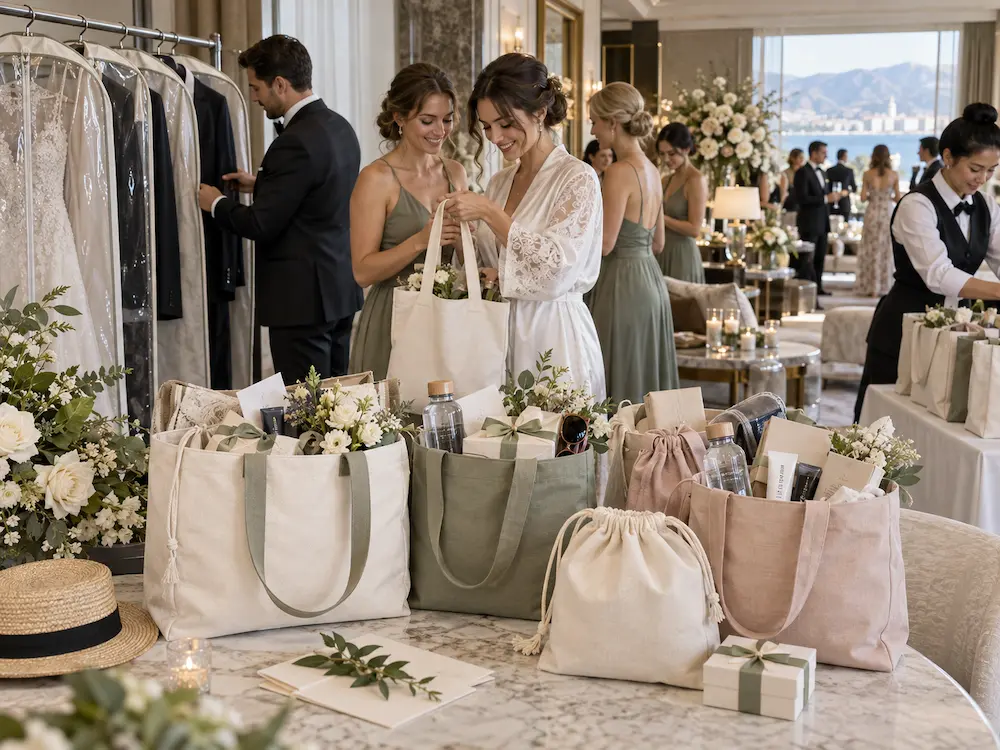
Why Tote Bags Work Well for Weddings and Events
Weddings and professional events involve far more packaging than many organisers initially expect.
Guests may receive invitations, programmes, gifts, bottled drinks, snacks, maps, promotional merchandise, hotel information, beauty products, stationery, souvenirs, and event materials. Bridal parties need additional space for clothing, accessories, cosmetics, shoes, and personal items. Corporate events may distribute catalogues, notebooks, product samples, sponsor merchandise, and welcome kits.
All these products need to be organised and presented.
Reusable tote bags provide a practical way to combine packaging, gifting, and event identity in one product.
Unlike conventional disposable gift bags, a well-designed cotton or canvas tote can continue to be used after the wedding, conference, exhibition, or celebration has finished. Guests may later use it for grocery shopping, travel, work, books, gym clothing, beach trips, or everyday errands.
This extended lifespan changes the role of the bag.
Instead of functioning only as packaging, it becomes part of the event experience and potentially part of the gift itself.
| Event Application | Recommended Bag Type | Main Priority | Typical Contents |
|---|---|---|---|
| Wedding welcome bag | Cotton or canvas tote | Presentation + reuse | Snacks, itinerary, gifts |
| Destination wedding | Large canvas tote | Capacity + durability | Travel essentials, gifts |
| Bridesmaid gift | Premium tote | Personalisation | Beauty products, accessories |
| Wedding favour | Small tote/drawstring bag | Presentation | Small gifts |
| Formalwear transport | Garment bag | Apparel protection | Dresses, suits |
| Conference | Cotton/canvas tote | Distribution + branding | Documents, merchandise |
| Corporate event | Structured canvas tote | Professional presentation | Gift sets |
| Exhibition | Lightweight tote | High-volume distribution | Catalogues, samples |
| VIP event | Premium canvas tote | Perceived value |
The most effective event bag programmes begin by identifying what each bag needs to do rather than selecting a design based only on appearance.
A destination wedding tote carrying towels, bottled water, sunscreen, and gifts requires different construction from a small wedding favour bag. Similarly, a conference tote distributed to thousands of attendees requires different cost and production considerations from a premium bag created for 100 VIP guests.
Different Roles of Bags Across a Wedding or Event
One event may require several types of bags.
Understanding these roles helps organisers avoid trying to make one bag perform every function.
Guest Welcome Bags
Welcome bags are often presented when guests arrive at a hotel, venue, resort, conference, or destination.
They may contain:
- Event schedules
- Venue maps
- Bottled water
- Snacks
- Local products
- Sunscreen
- Toiletries
- Souvenirs
- Gift cards
- Emergency kits
These bags need sufficient capacity while maintaining an attractive presentation.
Gift and Favour Bags
Smaller bags may be used for:
- Wedding favours
- Jewellery
- Candles
- Confectionery
- Small cosmetics
- Personalised gifts
- Event souvenirs
For these applications, presentation may matter more than maximum carrying capacity.
Bridal Party Bags
Bridesmaids and other wedding-party members often receive more substantial gift sets.
A bridal party tote might contain:
- Robes
- Cosmetics
- Jewellery
- Slippers
- Water bottles
- Makeup bags
- Personalised accessories
- Wedding-day emergency items
These totes frequently become keepsakes, so material quality and design deserve greater attention.
Garment Bags
Wedding dresses, suits, bridesmaid dresses, formalwear, and event uniforms require a completely different product.
Here, the primary objective is apparel protection rather than gift presentation.
Using dedicated garment bags for professional apparel protection can help bridal businesses, event organisers, hotels, performers, and formalwear suppliers keep important clothing organised during storage and transportation.
This illustrates why a complete wedding packaging programme may include several complementary textile products rather than only tote bags.
Choosing the Best Materials for Wedding and Event Tote Bags
Material selection influences appearance, durability, print quality, cost, and how recipients perceive the bag.
Cotton and canvas remain two of the most versatile choices, while drawstring constructions can be useful for lighter gifts and casual events.
| Material | Appearance | Durability | Typical Cost Level | Best Application |
|---|---|---|---|---|
| Lightweight Cotton | Soft, natural | Moderate | Lower | High-volume events |
| Heavy Cotton | Refined, natural | Good | Medium | Weddings, corporate gifts |
| Canvas | Structured, premium | High | Medium–High | Destination weddings, VIP gifts |
| Canvas Drawstring | Casual, natural | Good | Medium | Favour bags, event kits |
| Non-Woven | Functional | Moderate | Lower | Large promotional events |
The lowest-cost material is not necessarily the most economical option.
A wedding planner ordering 300 bags for a premium destination wedding may benefit from a more substantial fabric because the bags form part of the guest experience.
Conversely, an exhibition distributing 10,000 bags may need to prioritise weight, packing efficiency, and unit cost.
The specification should match the event.
Cotton Tote Bags for Weddings
Cotton works particularly well for weddings because it offers a soft, natural appearance that can complement many visual themes.
Common styles include:
- Natural unbleached cotton
- White cotton
- Pastel-coloured cotton
- Black cotton
- Dyed fabric matched to the event palette
Cotton totes can work with rustic weddings, garden weddings, beach celebrations, minimalist ceremonies, and contemporary hotel events.
They are also easy to fold and store, which matters when hundreds or thousands of bags must be shipped to a venue.
When Lightweight Cotton Works Best
Lighter cotton is appropriate when the contents include:
- Event programmes
- Small snacks
- Flat souvenirs
- Stationery
- Lightweight gifts
It can also reduce material and freight costs for large-volume programmes.
When Heavier Cotton Is Better
Heavier cotton may be more appropriate for:
- Bottled beverages
- Books
- Cosmetics
- Candles
- Multiple gift products
- Premium welcome kits
The additional structure can improve perceived quality and help the bag maintain its shape when filled.
Canvas Tote Bags for Premium Wedding and Event Programmes
Canvas generally provides greater structure and durability than lightweight cotton.
This makes it particularly suitable for premium events where the tote itself should feel like a gift.
Typical applications include:
- Destination wedding welcome bags
- Luxury hotel events
- Bridal party gifts
- VIP event packages
- Corporate retreats
- Product launches
- Premium conferences
For organisers sourcing larger quantities, customized tote bags bulk for large-scale brand distribution can support programmes where consistent dimensions, materials, printing, and packaging are required across hundreds or thousands of units.
Canvas can also handle larger artwork areas and heavier contents.
However, heavier fabric increases material consumption and can increase carton weight and shipping volume.
Buyers should therefore select fabric weight according to the intended contents rather than automatically choosing the heaviest available option.
Canvas Drawstring Bags for Informal Gifts and Event Kits
Not every event requires a conventional open-top tote.
Drawstring bags provide a different presentation style and can be useful for:
- Wedding favours
- Children’s activity kits
- Beach events
- Wellness retreats
- Sports events
- Festival merchandise
- Small guest gifts
- Travel accessories
A drawstring closure keeps the contents more contained while maintaining a relaxed appearance.
Natural canvas drawstring bags for natural brand carry solutions can be especially suitable for rustic weddings, outdoor celebrations, wellness events, hospitality programmes, and brands seeking a simple textile presentation.
Drawstring construction can also be useful when guests need to carry the bag hands-free.
However, buyers should consider the intended load. Thin cords may become uncomfortable with heavy contents, while thicker cotton cords or alternative straps may improve carrying comfort.
Wedding Welcome Bags
Wedding welcome bags have become particularly useful for multi-day and destination celebrations.
They help guests understand the event schedule while creating an immediate sense of hospitality.
A welcome bag may be placed:
- In hotel rooms
- At reception desks
- At welcome dinners
- At transportation pickup points
- At the wedding venue
The contents should reflect what guests are likely to need.
A practical destination wedding welcome tote might contain:
| Item | Purpose |
|---|---|
| Printed itinerary | Event information |
| Local map | Navigation |
| Bottled water | Guest convenience |
| Local snacks | Destination experience |
| Sunscreen | Outdoor events |
| Small toiletries | Travel convenience |
| Emergency kit | Practical support |
| Local souvenir | Keepsake |
| Thank-you card | Personal connection |
The tote needs to accommodate these products without appearing overfilled.
A gusseted bag is often more practical than a completely flat tote because bottles, boxes, and toiletries require depth.
Destination Wedding Tote Bags
Destination weddings create particularly strong demand for reusable bags because guests are already travelling.
A tote can serve several functions during the trip.
Guests may use it as:
- Beach bag
- Shopping bag
- Excursion bag
- Pool bag
- Carry-on organiser
- Souvenir bag
This makes secondary usability especially important.
Designing for the Destination
The environment should influence material and dimensions.
A tropical resort wedding may benefit from a larger tote that can hold sunscreen, towels, bottled water, and beach accessories.
A European city wedding may use a more compact canvas bag suitable for sightseeing and shopping.
A mountain wedding might emphasise durable construction and outdoor-inspired artwork.
Rather than printing only the couple’s names and wedding date, organisers can incorporate destination-inspired designs.
Examples include:
- Local architecture
- Coastlines
- Botanical illustrations
- Landscape graphics
- City maps
- Regional symbols
This can increase the likelihood that guests continue using the bag because the design functions as a travel souvenir rather than only as wedding memorabilia.
Bridal Party and Bridesmaid Tote Bags
Bridal party gifts often require more personalisation than general guest welcome bags.
A bridesmaid tote may contain several individually selected products.
Possible contents include:
- Robes
- Slippers
- Jewellery
- Makeup products
- Personalised cups
- Small bottles
- Candles
- Thank-you notes
- Wedding-day essentials
Because these bags are distributed to a smaller group, organisers may justify higher material or decoration costs.
Heavy cotton or canvas can create a more substantial feel.
Personalisation Options
Bridal party bags can use:
- Names
- Initials
- Small embroidered details
- Individual colour variations
- Role labels
- Decorative patches
However, long-term reuse should still be considered.
A bag displaying a person’s name or initials may remain useful after the wedding, while very large “Bridesmaid” graphics may limit secondary use.
The best design depends on whether the objective is primarily event photography, gifting, or long-term reuse.
Wedding Favour Bags
Small textile bags provide an alternative to disposable boxes or paper packaging for certain wedding favours.
They can hold:
- Candles
- Confectionery
- Jewellery
- Soap
- Fragrance samples
- Tea
- Coffee
- Small souvenirs
- Local products
Drawstring closures are particularly useful for this application.
The bag itself can become part of the favour.
For example, a small cotton or canvas pouch containing locally produced tea may later be reused for jewellery, travel accessories, or small personal items.
This creates a longer useful life than single-use decorative wrapping.
Tote Bags for Corporate Events
Wedding applications are highly personal, while corporate events have different branding objectives.
Companies may use reusable tote bags for:
- Conferences
- Trade shows
- Employee events
- Product launches
- Training programmes
- Customer appreciation events
- Corporate retreats
- Annual meetings
The bag often needs to carry documents, merchandise, samples, notebooks, and promotional products.
Brand consistency therefore becomes more important.
Businesses may specify:
- Pantone colour references
- Exact logo positioning
- Print dimensions
- Corporate typography
- Woven labels
- Packaging instructions
A custom canvas bag with logo for distinct brand visibility can be appropriate when event organisers want the bag to continue functioning as branded merchandise after the event.
The key is balancing visibility with usability.
A tote covered with sponsor logos may perform well as an event information carrier but may be less attractive for everyday reuse.
A more restrained design can potentially extend the promotional lifespan.
Conferences and Exhibitions
Conference and exhibition bags often operate at much larger volumes than wedding totes.
This changes procurement priorities.
For 5,000 or 10,000 bags, small differences in fabric weight, printing, packaging, and freight efficiency can significantly affect the total project cost.
Organisers should consider:
- Number of attendees
- Number of sponsors
- Printed materials
- Product samples
- Catalogue dimensions
- Event duration
- Distribution method
Avoid Oversized Conference Bags
A common mistake is choosing an unnecessarily large tote.
Oversized bags require more fabric and occupy more shipping volume.
They may also appear empty if attendees receive only a notebook and several brochures.
The ideal size should be based on actual contents.
A compact bag that fits the event kit properly can look more organised while reducing material consumption.
Product Launches and Brand Events
Product launches require a stronger connection between packaging and brand identity.
The tote may appear in photographs, influencer content, social media posts, press kits, and customer videos.
This makes visual presentation especially important.
Brands can coordinate:
- Tote colour
- Event graphics
- Product packaging
- Venue decoration
- Staff uniforms
- Printed materials
The result creates a consistent visual system.
For premium launches, the bag can also function as merchandise rather than simple packaging.
Higher-quality canvas, subtle printing, embroidery, woven labels, and carefully selected handles can increase perceived value.
Hotels, Resorts, and Hospitality Events
Hotels and resorts frequently support:
- Weddings
- Corporate retreats
- Conferences
- Wellness programmes
- Destination celebrations
- VIP stays
Reusable tote bags can therefore become part of the hospitality experience.
A resort may provide a welcome tote containing:
- Property map
- Spa information
- Bottled water
- Beach towel
- Sunscreen
- Local gifts
If designed well, the tote can remain useful throughout the guest’s stay.
This creates practical value while reducing reliance on multiple disposable bags.
Choosing the Right Tote Bag Size for Weddings and Events
Bag dimensions should be based on contents, not assumptions.
Before requesting a quotation, buyers should assemble the complete event kit and measure it.
Important dimensions include:
- Width
- Height
- Depth
- Largest boxed product
- Bottle dimensions
- Printed material size
The bag should provide sufficient clearance for loading without excessive empty space.
| Event Kit | Suggested Format | Design Priority |
|---|---|---|
| Small wedding favour | Small pouch | Presentation |
| Basic welcome kit | Medium flat tote | Convenience |
| Destination welcome kit | Medium-large gusseted tote | Capacity |
| Bridal party gift | Premium medium tote | Presentation |
| Conference materials | Medium tote | Document fit |
| Corporate gift box | Wide gusseted tote | Stability |
| Beach wedding kit | Large tote | Capacity |
| VIP gift programme | Structured canvas tote | Premium appearance |
Exact dimensions should ultimately be determined from the real products rather than generic size categories.
Why Gussets Matter for Event Bags
A flat tote can carry programmes, books, documents, and folded apparel effectively.
However, event gift kits frequently contain three-dimensional products such as:
- Water bottles
- Candles
- Cosmetic boxes
- Mugs
- Food products
- Gift boxes
A bottom or side gusset creates additional depth.
For many medium-sized event totes, a 10–15 cm gusset can provide considerably better packing flexibility than a completely flat construction.
A structured bottom can also improve presentation when bags are displayed in hotel rooms or arranged on event registration tables.
Fabric Weight and Construction
Fabric weight affects durability, appearance, print behaviour, and cost.
A lightweight promotional tote does not need the same construction as a destination wedding bag carrying bottles and towels.
| Fabric Level | Typical Application | Main Benefit |
|---|---|---|
| Lightweight cotton | Large events, lightweight kits | Lower cost |
| Medium cotton | Wedding welcome bags | Balance |
| Heavy cotton | Premium gifting | Better structure |
| 8 oz canvas | General event totes | Durability |
| 10 oz canvas | Premium welcome bags | Stronger feel |
| 12 oz canvas | Heavy gift kits | Higher load capability |
Fabric weight should be considered alongside stitching and handle reinforcement.
A heavy fabric does not automatically guarantee a strong bag if the handles or seams are poorly constructed.
Handles and Carrying Comfort
Handle design becomes particularly important when guests carry event bags for several hours.
Important variables include:
- Handle length
- Handle width
- Fabric type
- Attachment method
- Reinforcement
- Expected load
Shoulder-length handles can be convenient for conferences, destination weddings, and travel-oriented events.
Short handles can create a more traditional gift-bag appearance but provide less flexibility.
For heavier loads, wider handles can distribute pressure more comfortably.
Cross stitching or box-X reinforcement at the attachment points may be appropriate when bags are expected to carry substantial weight.
Closures and Pockets
Open-top totes are simple, economical, and easy to pack.
However, certain events may benefit from additional features.
Zipper Closures
Useful for:
- Travel
- Destination weddings
- Premium events
- Personal belongings
Snap Buttons
Provide basic closure while maintaining relatively simple construction.
Internal Pockets
Useful for:
- Phones
- Room keys
- Event cards
- Small personal items
External Pockets
Can hold programmes or schedules that guests need to access quickly.
Every additional feature increases manufacturing complexity, so accessories should be selected according to real use rather than added only for decoration.
Printing Methods for Wedding and Event Tote Bags
Printing is one of the most visible elements of an event tote.
Common options include:
| Method | Best Application | Main Advantage |
|---|---|---|
| Screen Printing | Logos, names, simple graphics | Cost-effective for volume |
| Heat Transfer | Multicolour artwork | Flexible design |
| Digital Printing | Detailed illustrations | High detail |
| Embroidery | Premium branding | Texture and perceived value |
| Woven Labels | Subtle branding | Professional appearance |
| Foil Details | Selected wedding designs | Decorative finish |
Screen Printing
Screen printing works particularly well for:
- Wedding logos
- Dates
- Venue illustrations
- Corporate logos
- Simple event graphics
It becomes cost-effective for larger quantities because setup costs can be distributed across the production run.
Digital Printing
Digital printing can support more detailed designs, including:
- Destination artwork
- Botanical illustrations
- Watercolour-style graphics
- Artist collaborations
- Complex event themes
This can help transform the tote into a visually desirable souvenir.
Embroidery
Embroidery is useful when organisers want a more premium tactile finish.
It can work well for:
- Initials
- Small logos
- Monograms
- Hotel branding
- VIP gifts
Because embroidery adds production time and cost, it is often better suited to premium programmes or smaller quantities than very large promotional distributions.
Personalisation Without Reducing Reusability
Personalisation is attractive for weddings because it makes guests feel recognised.
However, the most obvious wedding-specific design is not always the most reusable design.
Consider two approaches:
Design A:
“Sarah & James Wedding — 18 June 2027”
Design B:
A subtle destination illustration with small initials.
The first clearly commemorates the wedding.
The second may be more likely to become an everyday bag.
Neither is inherently better; they serve different objectives.
Organisers should decide whether the tote is primarily:
- Event packaging
- Wedding memorabilia
- Guest gift
- Long-term reusable merchandise
Once the purpose is clear, artwork decisions become easier.
Garment Protection for Weddings and Formal Events
Tote bags solve many wedding packaging needs, but formal apparel requires specialised protection.
Wedding dresses, suits, tuxedos, bridesmaid dresses, performance costumes, and formal uniforms can be vulnerable to:
- Dust
- Surface contamination
- Creasing
- Accidental contact
- Transportation damage
Dedicated garment bags help organise and protect these items during storage and movement.
For destination weddings or professionals travelling between venues, <a href=”/garment-bags-for-travel-and-professional-organization/”>garment bags for travel and professional organization</a> can complement tote bags by addressing a completely different part of the event logistics system.
For example, a bridal party packaging programme might include:
Garment bag → formalwear
Tote bag → shoes, cosmetics, accessories
Small drawstring bag → jewellery or personal items
This modular approach is more practical than attempting to fit every item into one large bag.
Turning Event Bags into Reusable Merchandise
One of the most valuable characteristics of a textile event bag is its potential second life.
After a wedding or event, a tote may become:
- Grocery bag
- Beach bag
- Book bag
- Work tote
- Travel organiser
- Shopping bag
- Gym bag
The longer it remains in use, the greater the functional value generated from the original product.
For corporate events, repeated use also extends brand exposure.
For weddings, it extends the emotional connection with the event.
This is why durability and design should be evaluated together.
A beautifully printed tote that tears after two uses provides limited long-term value.
A very durable bag with unattractive artwork may never be reused.
Successful event bags balance both.
Bulk Purchasing for Weddings and Events
Bulk customisation can reduce unit costs, but buyers should carefully estimate quantity.
The purchasing calculation should include:
Expected attendees + staff requirements + replacement allowance + samples + additional guests
For example, an event expecting 500 guests should not necessarily order exactly 500 bags.
Additional units may be required for:
- Last-minute attendees
- Damaged bags
- VIP gifts
- Photography
- Event staff
- Venue partners
At the same time, excessive over-ordering creates waste and unnecessary inventory.
The objective is to maintain a reasonable contingency rather than ordering a large surplus without a clear use.
Cost Factors for Custom Event Tote Bags
Custom tote bag pricing depends on more than quantity.
| Cost Factor | Typical Cost Impact |
|---|---|
| Fabric weight | Medium–High |
| Bag dimensions | High |
| Gusset | Medium |
| Handle construction | Low–Medium |
| Number of print colours | Medium |
| Print coverage | Medium–High |
| Embroidery | High |
| Zipper or closure | Medium |
| Internal pockets | Medium |
| Individual packaging | Medium |
| Order volume | High |
| Shipping method | High |
Buyers should compare quotations based on identical specifications.
A 140 GSM cotton tote and a 12 oz canvas tote are fundamentally different products even if their finished dimensions appear similar.
Choosing only the lowest unit quotation can therefore result in an unsuitable product.
Production Lead Time and Event Deadlines
Weddings and events have fixed dates.
This makes production planning particularly important.
A delayed retail product can sometimes launch a week later. A wedding cannot simply be postponed because the tote bags have not arrived.
A typical custom project may involve:
- Specification confirmation
- Artwork preparation
- Quotation
- Sampling
- Sample review
- Artwork approval
- Material preparation
- Mass production
- Quality inspection
- International shipping
- Venue distribution
Mass production may require approximately 15–30 days depending on the product, quantity, season, and complexity, while a broader planning window of roughly 3–4 weeks after artwork approval may be relevant for many standard projects before accounting for international transportation.
Complex customisation or peak production periods can require longer.
Buyers should therefore work backwards from the event date and include contingency time.
Sampling Before Mass Production
Sampling is one of the most important steps in event bag procurement.
The sample allows buyers to check:
- Fabric colour
- Fabric weight
- Dimensions
- Gusset
- Handle length
- Stitching
- Print size
- Print position
- Artwork colour
- Overall proportions
However, visual inspection alone is insufficient.
The sample should be packed with the actual event items.
If the welcome bag will contain two bottles, sunscreen, a map, and three gift boxes, those products should be placed inside the sample.
This confirms whether the bag is genuinely suitable before mass production begins.
Artwork Approval
Event artwork frequently contains details that are easy to overlook.
These may include:
- Names
- Dates
- Venue names
- Sponsor logos
- Event slogans
- City names
A spelling or date error becomes expensive once thousands of bags have been printed.
Buyers should therefore approve final artwork carefully.
Vector files are preferable for many logo-based printing processes because they can be resized without losing edge quality.
The approved artwork should clearly show:
- Print dimensions
- Print position
- Colour references
- Front/back orientation
- Number of print colours
Documenting these specifications reduces misunderstanding during production.
Quality Inspection
Event bags should be inspected before shipment.
Important areas include:
| Inspection Area | Key Check |
|---|---|
| Fabric | Correct material and weight |
| Colour | Consistency |
| Dimensions | Agreed tolerance |
| Handles | Position and reinforcement |
| Stitching | No major defects |
| Printing | Correct artwork and position |
| Gusset | Correct construction |
| Closures | Functional |
| Cleanliness | No visible contamination |
| Packing | Correct carton quantities |
Premium wedding and VIP event bags may require stricter cosmetic inspection than simple promotional giveaway bags.
The acceptable quality standard should therefore be agreed before production.
Packing and Event Distribution
Manufacturing is only part of the project.
Organisers also need to determine how the bags will reach guests.
Possible distribution methods include:
- Hotel-room placement
- Registration desks
- Welcome receptions
- Guest transportation
- Seat placement
- Gift tables
- Event exits
This affects how bags should be packed at the factory.
If event staff must assemble gift kits quickly, bags should be folded and packed in a way that allows efficient unpacking.
Cartons should also be labelled clearly where multiple bag designs or guest groups are involved.
For example:
Design A → General Guests
Design B → Bridal Party
Design C → VIP Guests
Good carton organisation can save substantial time during event preparation.
Sustainability and Reuse
Reusable tote bags can support efforts to reduce reliance on short-lived event packaging, but sustainability should not be reduced to a simple material label.
The complete lifecycle matters.
Relevant factors include:
- Fibre source
- Fabric weight
- Manufacturing
- Printing
- Transportation
- Durability
- Frequency of reuse
- Washing
- End-of-life management
The most practical sustainability strategy is often to design a bag people genuinely want to keep.
Useful dimensions, strong handles, attractive artwork, and durable stitching increase the likelihood of repeated use.
Businesses making environmental claims should also ensure those claims are appropriately supported rather than relying on vague terms such as “green” or “eco-friendly.”
Common Mistakes When Buying Wedding and Event Tote Bags
Several mistakes can reduce the success of an event bag programme.
| Mistake | Possible Consequence |
|---|---|
| Choosing bags before confirming contents | Incorrect size |
| Ignoring gusset requirements | Gift boxes do not fit |
| Selecting fabric only by price | Weak presentation |
| Using low-resolution artwork | Poor print quality |
| Over-personalising the design | Reduced future reuse |
| Skipping samples | Problems found too late |
| Ordering too close to the event | Delivery risk |
| Ignoring freight volume | Unexpected logistics cost |
| Ordering exact attendee quantity | No contingency stock |
| Approving artwork too quickly | Name/date errors |
The most important principle is to work backwards from the real event experience.
Ask:
Who receives the bag? What goes inside it? How will it be distributed? How will it be carried? What happens to it after the event?
Those questions lead to better specifications than selecting a tote purely from photographs.
Future Trends in Wedding and Event Tote Bags
Wedding and event packaging continues to evolve as organisers seek products that combine personalisation, presentation, and practical reuse.
Destination-Inspired Designs
Rather than printing only names and dates, more event bags can function as destination souvenirs through illustrations, maps, architecture, and regional artwork.
Packaging That Becomes Merchandise
Premium events increasingly treat bags as part of the gift rather than disposable packaging.
This encourages greater attention to fabric quality, handles, stitching, and decoration.
Modular Event Packaging
Different bags may be used for different functions rather than relying on one universal format.
A wedding programme, for example, can combine garment bags, guest totes, bridal party bags, and small drawstring pouches.
More Subtle Branding
Corporate events may move towards smaller logos and lifestyle-oriented designs that attendees are more willing to reuse publicly.
Greater Attention to Procurement Efficiency
Buyers are increasingly evaluating unit cost together with carton packing, freight, warehouse requirements, lead time, and inventory risk.
This broader approach can produce better total programme economics.
Conclusion
Tote bags for weddings and events can perform far more than a basic carrying function.
For weddings, they can serve as welcome packaging, bridal party gifts, destination accessories, wedding favour bags, and reusable keepsakes. For conferences, exhibitions, product launches, hotels, and corporate events, they can organise materials while creating an additional branded product that attendees may continue using afterwards.
The correct bag depends on the application.
Cotton provides flexibility and a natural appearance for many wedding and high-volume event programmes. Canvas offers additional structure and durability for premium welcome kits, destination weddings, VIP gifting, and heavier contents. Drawstring bags can provide a practical alternative for smaller gifts and casual event kits, while dedicated garment bags address the separate requirement of protecting dresses, suits, and other formal apparel.
For B2B buyers, successful procurement begins with the contents rather than the bag.
Product dimensions, expected weight, guest numbers, event environment, artwork, distribution method, event date, and desired post-event reuse should all be established before the final specification is approved.
From there, buyers can determine fabric weight, dimensions, gusset depth, handle construction, printing method, closures, accessories, packaging, and order quantity.
Sampling with the actual event contents is particularly important. It allows organisers to identify sizing, carrying, artwork, and presentation issues before mass production.
When these factors are considered together, a custom event tote can become more than packaging. It can support event logistics, improve guest presentation, provide a useful gift, preserve memories of the occasion, and continue carrying the wedding, venue, or brand identity long after the event itself has ended.
Creating Wedding and Event Bags Guests Will Continue to Use
Successful wedding and event tote bags combine presentation with practical function. Wedding planners, hotels, event agencies, corporate buyers, and hospitality businesses should begin by identifying who will receive each bag, what it needs to carry, how it will be distributed, and whether it should remain useful after the event.
Once these requirements are established, buyers can select appropriate cotton or canvas weights, dimensions, gussets, handles, closures, printing, embroidery, and accessories. Separate garment bags and smaller drawstring bags can complement the main tote where formalwear or small gifts require specialised organisation. Sampling with the actual event contents and planning production well ahead of the fixed event date can further reduce procurement risk.
When durability, artwork, carrying comfort, and everyday usability are considered together, an event tote can continue providing value after the celebration ends—functioning as a useful guest gift, a lasting reminder of the occasion, and, for commercial events, an ongoing form of brand visibility.
FAQ
1. What type of tote bag is best for weddings and events?
The best tote bag depends on the event type, contents, guest profile, and desired presentation. Medium-weight cotton totes work well for general wedding welcome bags, conferences, and lightweight gift kits, while heavier cotton or canvas bags are better suited to destination weddings, bridal party gifts, VIP events, and heavier gift sets. Small canvas drawstring bags can also be useful for wedding favours, accessories, and smaller guest gifts.
2. What size should a wedding welcome tote bag be?
The correct size should be based on the actual items placed inside the bag. Organisers should measure bottles, snacks, gift boxes, itineraries, toiletries, souvenirs, and other welcome products before confirming dimensions. Medium or large gusseted totes are often practical for destination wedding welcome kits because the additional depth accommodates boxed and bottled products more effectively than a completely flat bag.
3. How can tote bags be personalised for weddings without limiting future reuse?
Wedding tote bags can use subtle initials, small monograms, destination illustrations, botanical artwork, venue-inspired graphics, or understated event details instead of oversized names and dates. A more versatile design may encourage guests to continue carrying the bag after the wedding, extending its useful lifespan while preserving a connection to the event.
4. When should garment bags be used alongside wedding tote bags?
Garment bags are appropriate when wedding dresses, suits, tuxedos, bridesmaid dresses, uniforms, or other formal clothing need protection and organisation during storage or transportation. Tote bags can then carry shoes, cosmetics, jewellery, accessories, gifts, and personal items. Using specialised bags for different functions is generally more practical than trying to place formalwear and accessories into one large bag.
5. How early should businesses order custom tote bags for a wedding or event?
Buyers should work backwards from the fixed event date and allow sufficient time for specification confirmation, artwork preparation, sampling, sample approval, material preparation, mass production, quality inspection, and transportation. Production schedules vary according to quantity and customisation, and international freight adds additional time. Building contingency into the schedule is especially important because a wedding, conference, or launch usually cannot be delayed to accommodate late packaging.
References
- Global Organic Textile Standard (GOTS). Global Organic Textile Standard and Certification Requirements.
- OEKO-TEX®. STANDARD 100 by OEKO-TEX® — Textile Testing and Certification.
- Textile Exchange. Preferred Fiber & Materials Market Report.
- ASTM International. Standards and Test Methods for Textile Materials and Performance.
- International Organization for Standardization (ISO). ISO 14021 — Environmental Labels and Declarations: Self-Declared Environmental Claims.
- Sustainable Packaging Coalition. Sustainable Packaging Design and Circular Packaging Resources.
- International Trade Centre (ITC). Packaging and Export Resources for International Trade.
- European Commission. Circular Economy and Sustainable Product Policy Resources.
Copyright Notice:
All content on this page is the property of Xiamen Youngpack Imp.and Exp.Co.,Ltd. and is protected by copyright. Unauthorized use or reproduction is not permitted.