Food delivery businesses should choose bags according to the actual delivery workflow. Insulated cooler bags are appropriate when thermal protection is required, while cotton and cloth totes work better for packaged dry foods, bakery takeaway, merchandise and non-temperature-sensitive pickup. Container dimensions, insulation, closures, handle strength, cleaning, branding and realistic sample testing should all be evaluated before bulk production.
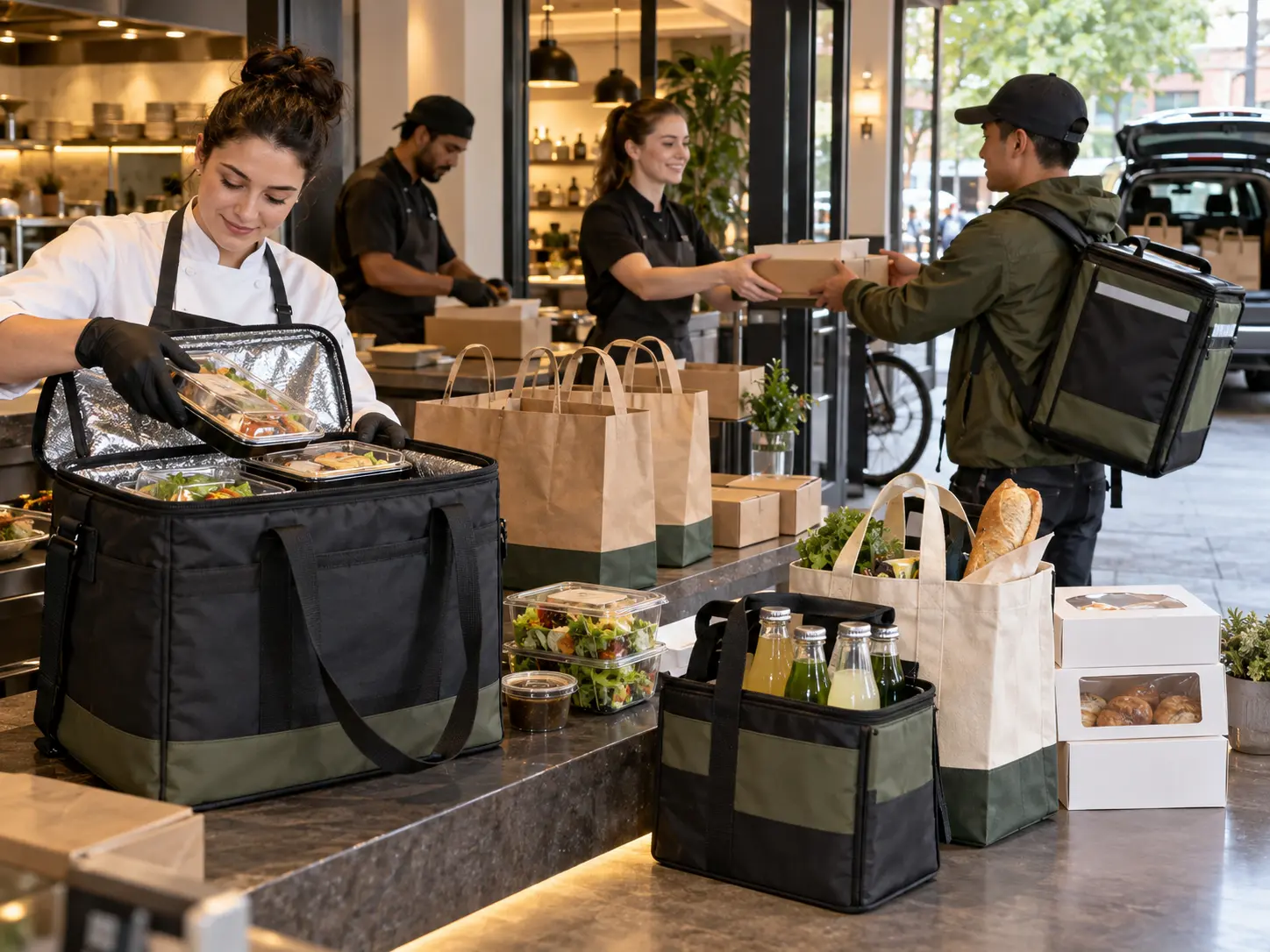
Understanding Tote Bags for Food Delivery Businesses
Food delivery packaging has become more complex as restaurants, cafés, grocery retailers, meal-prep companies, caterers, bakeries, and food brands expand beyond traditional in-store service.
A customer may now order through a restaurant website, collect a meal from a pickup counter, receive groceries at home, attend a catered corporate event, or purchase prepared food from a temporary retail location. Each situation creates different packaging requirements.
Reusable tote-style bags can play an important role across these channels, but businesses should not treat every tote bag as interchangeable.
The first question should be:
Does the food need thermal protection during transportation?
If the answer is yes, an ordinary cotton or cloth tote is generally not an appropriate substitute for an insulated delivery bag.
An insulated bag incorporates thermal materials designed to reduce the rate at which heat moves between the contents and the surrounding environment. Depending on the construction, this may include an outer fabric, insulating foam, and an inner reflective or food-contact-appropriate lining.
By contrast, a conventional cotton tote primarily provides carrying capacity and branding. It does not provide meaningful engineered temperature control.
This distinction is fundamental when purchasing bags for food businesses.
| Application | Recommended Bag Type | Insulation Needed? | Typical Use |
|---|---|---|---|
| Hot meal delivery | Insulated delivery bag | Yes | Restaurants |
| Chilled beverage transport | Insulated cooler bag | Yes | Cafés, catering |
| Meal-prep delivery | Insulated cooler tote | Usually | Meal subscription businesses |
| Bakery customer pickup | Cotton/cloth tote | Usually no | Bakeries |
| Packaged snacks | Cotton/cloth tote | Usually no | Food retailers |
| Catering events | Large cooler tote | Often | Caterers |
| Promotional food gift set | Depends on contents | Sometimes | Food brands |
| Branded merchandise | Cotton tote | No | Restaurants and cafés |
The appropriate bag therefore depends less on the word “delivery” and more on what is being transported, for how long, under what conditions, and whether temperature management is part of the operational requirement.
Food businesses should define those conditions before requesting quotations from manufacturers.
Insulated vs Non-Insulated Food Delivery Tote Bags
One of the most important purchasing decisions is choosing between insulated and non-insulated construction.
Although both products may have tote-style handles and similar external dimensions, their internal structures and intended functions are substantially different.
When Insulated Bags Are More Appropriate
Businesses should consider insulated construction when transporting products such as:
- Prepared hot meals
- Chilled meals
- Cold beverages
- Dairy products
- Desserts requiring cooler conditions
- Meal-prep containers
- Certain grocery orders
- Catering food and beverages
A typical insulated bag may use a polyester or other durable outer material, EPE or similar foam insulation, and an aluminium-film or PEVA-type internal layer depending on the specification.
For businesses transporting temperature-sensitive meals or drinks, insulated cooler bags for food and beverage cooling provide a more application-appropriate construction than ordinary textile totes.
However, buyers should avoid assuming that the word “insulated” automatically means a bag can maintain any food at a legally safe temperature for a specified number of hours.
Actual thermal performance depends on multiple variables:
- Initial food temperature
- Ambient temperature
- Insulation thickness
- Bag dimensions
- Closure design
- Frequency of opening
- Amount of empty internal space
- Use of ice packs or other cooling media
- Delivery duration
For commercial applications, businesses should validate the complete delivery system under their actual operating conditions rather than relying on the bag alone.
When Non-Insulated Totes Make More Sense
Not every food business needs insulated packaging.
Cotton and cloth bags can be practical for products such as:
- Packaged bread
- Dry bakery products
- Coffee beans
- Tea
- Sealed snacks
- Confectionery
- Packaged speciality foods
- Restaurant merchandise
- Promotional gift sets
- Customer pickup orders that do not require thermal protection
In these applications, appearance, carrying comfort, print quality, reusability, and brand presentation may matter more than insulation.
A cotton tote for everyday carry and brand expression can therefore be appropriate for cafés, bakeries, food retailers, and lifestyle-oriented restaurant brands that want customers to continue using their packaging after the original purchase.
Why Reusable Bags Matter to Food Delivery Businesses
Food packaging normally performs a short-term functional role: it protects a product until consumption.
Reusable delivery and takeaway bags have the potential to extend that relationship.
A customer may receive food once but reuse an attractive bag dozens or hundreds of times for grocery shopping, commuting, picnics, office lunches, or everyday errands.
That creates value in several areas.
Better Carrying Convenience
Food orders frequently contain multiple containers.
Customers may need to transport meal boxes, bottled drinks, sauces, desserts, cutlery, and other items simultaneously. A correctly sized reusable bag keeps these items together and can make pickup more convenient.
For delivery operators, structured bags can also make orders easier to organise during transportation.
Increased Perceived Value
Packaging contributes to the customer’s perception of the overall order.
A durable branded bag can make a premium catering package, meal subscription, or corporate lunch feel more carefully presented.
The effect is particularly relevant for businesses operating in premium segments where customers expect consistency between food quality and packaging quality.
Repeated Brand Exposure
Disposable packaging usually disappears quickly.
Reusable bags may continue circulating through offices, supermarkets, parks, campuses, and public transport.
This gives food businesses an opportunity to turn packaging into physical brand merchandise.
The marketing value, however, depends heavily on whether customers actually want to reuse the bag. Useful dimensions, comfortable handles, attractive graphics, and durable construction are therefore more important than simply printing a large logo.
Choosing the Right Construction for Food Delivery
The ideal construction depends on the operating environment.
A neighbourhood bakery may need a lightweight cotton bag. A meal-prep subscription service may need an insulated zippered tote. A caterer may require a large cooler capable of holding multiple food containers.
The table below provides a practical starting point.
| Business Model | Recommended Construction | Important Features |
|---|---|---|
| Restaurant delivery | Insulated bag | Closure, insulation, easy-clean lining |
| Meal prep | Insulated cooler tote | Structured base, thermal layer |
| Café takeaway | Small cooler or cotton tote | Portability, branding |
| Bakery | Cotton/cloth tote | Breathability, print quality |
| Grocery delivery | Large reinforced tote | Capacity, strong handles |
| Catering | Large insulated tote | Reinforcement, insulation |
| Food gift business | Premium reusable tote | Presentation, printing |
| Corporate events | Cooler tote | Capacity, reuse potential |
Rather than adapting one bag to every scenario, larger food businesses may benefit from maintaining two or three bag formats.
For example, a café could use small insulated bags for chilled takeaway products and cotton totes for coffee beans, mugs, merchandise, and promotional gift sets.
Insulated Cooler Bags for Food and Beverage Delivery
Insulated cooler bags are among the most relevant reusable bag formats for food delivery.
Their purpose is not to actively refrigerate or heat food. Instead, insulation slows heat transfer between the contents and the external environment.
A common construction may consist of three functional layers:
| Layer | Possible Material | Main Function |
|---|---|---|
| Outer Layer | Polyester or woven textile | Durability and branding |
| Insulation Layer | EPE foam | Reduces heat transfer |
| Inner Layer | Aluminium film or suitable liner | Interior surface and thermal support |
The precise specification should be selected according to the product being transported.
A thicker insulation layer may increase thermal resistance, but it also increases bag volume, material cost, shipping volume, and storage requirements.
This creates an important procurement trade-off.
The goal should not automatically be to specify the thickest possible insulation. The goal is to select construction appropriate for the expected delivery duration and operating environment.
Insulated Lunch Cooler Bags for Individual Meals
Not every delivery operation requires a large courier-style bag.
Smaller insulated lunch bags are particularly useful for:
- Individual meal orders
- Employee lunch programmes
- Corporate catering
- School meal programmes
- Meal-prep subscriptions
- Café takeaway
- Promotional food campaigns
Their compact dimensions make them easier for customers to reuse after the original transaction.
This secondary use can significantly increase perceived value.
For single-person meal programmes, insulated lunch cooler bags for daily use can bridge the gap between temporary takeaway packaging and reusable consumer merchandise.
A customer might initially receive the bag as part of a meal subscription but later use it for work lunches, picnics, or everyday food transport.
From a branding perspective, this extended lifespan is valuable because the restaurant or food brand remains visible long after the original order has been consumed.
Features to Consider
Useful specifications may include:
- Zipper closure
- Short carry handles
- Shoulder strap options
- Internal easy-clean lining
- Reinforced base
- External pocket
- Compact folding design
Businesses should avoid adding features simply because they are available. Every additional pocket, buckle, zipper, or strap increases manufacturing complexity and may affect cost.
Specifications should solve genuine customer or operational problems.
Reusable Cooler Tote Bags for Catering and Events
Catering presents another use case.
Caterers may need to transport food from kitchens to:
- Corporate offices
- Conferences
- Weddings
- Outdoor events
- Exhibitions
- Private parties
- Hospitality venues
Orders are frequently larger than individual restaurant deliveries, so capacity and reinforcement become more important.
Reusable cooler tote bags for events and catering can provide a useful format when businesses need larger reusable bags for food, drinks, event supplies, or packaged meal sets.
Compared with small lunch bags, catering totes may require:
- Wider gussets
- Stronger webbing handles
- Reinforced seams
- Larger zipper openings
- Structured bottoms
- Higher carrying capacity
A rectangular base can be particularly valuable because catering containers often need to remain relatively level during transportation.
If a bag is too narrow, containers may tilt or stack poorly, increasing the risk of spills.
Choosing the Right Size and Capacity
Bag dimensions should be determined by actual food containers rather than assumptions.
Before manufacturing a custom bag, buyers should measure the packaging system that will go inside it.
This includes:
- Meal container length
- Meal container width
- Container height
- Number of containers per order
- Drink dimensions
- Additional accessories
- Ice packs where required
A bag designed around real container dimensions generally performs better than a generic bag selected from a catalogue.
| Delivery Scenario | Example Bag Format | Design Priority |
|---|---|---|
| One-person lunch | Compact insulated bag | Portability |
| Two-person takeaway | Medium cooler tote | Container stability |
| Family meal | Large gusseted bag | Capacity |
| Grocery delivery | Large reinforced tote | Load strength |
| Catering | Extra-large insulated tote | Structure and handles |
| Bakery pickup | Medium cotton tote | Carrying comfort |
Buyers should also consider unused internal space.
Excessive space can allow containers to move during delivery and may reduce the effectiveness of a thermal system. Conversely, an overly tight bag can make loading difficult and place unnecessary stress on zippers.
Prototyping with actual food containers before mass production can identify these issues early.
Gussets and Flat Bottoms Matter More Than They Appear
A conventional flat cotton tote works well for lightweight retail products but may not be ideal for stacked takeaway containers.
Food packaging often benefits from a bottom gusset or boxed construction.
For example, a 10–15 cm gusset can provide additional depth, allowing containers to sit more naturally rather than being forced vertically against one another.
A structured base may also help reduce tipping.
These details are especially useful for:
- Meal-prep containers
- Bakery boxes
- Food gift boxes
- Beverage multipacks
- Catering trays
- Grocery orders
For a food business, bag shape can therefore be as important as total capacity.
Handles, Reinforcement, and Carrying Comfort
Food orders become heavy quickly.
Several meal containers combined with bottled beverages can create substantial stress on handles and seams.
Buyers should evaluate:
- Handle material
- Handle width
- Stitching pattern
- Seam construction
- Attachment area
- Expected carrying load
Cross stitching or box-X reinforcement at the handle attachment points can improve structural reliability.
Wider webbing handles may also be more comfortable for heavier loads because they distribute pressure across a larger area of the hand or shoulder.
The required strength should be determined through actual load testing rather than appearance alone.
A bag that looks substantial may still fail if stitching density, thread quality, or attachment construction is inadequate.
Closures for Food Delivery Tote Bags
Closures influence temperature retention, security, accessibility, and manufacturing cost.
Common options include:
| Closure | Advantages | Suitable Applications |
|---|---|---|
| Zipper | Secure, reduces open gaps | Insulated delivery |
| Hook-and-loop | Fast access | Frequent delivery use |
| Magnetic closure | Premium appearance | Food gifts |
| Drawstring | Flexible opening | Packaged products |
| Open top | Fast loading | Non-insulated pickup |
Insulated food bags commonly benefit from more complete closure because large openings allow air exchange.
For fast-paced operations, however, workers must also be able to load and unload orders efficiently.
The best design balances thermal considerations with operational speed.
Food Hygiene and Cleaning Considerations
Reusable food delivery bags introduce a responsibility that disposable packaging does not: they need appropriate cleaning and maintenance.
Food businesses should develop procedures based on what the bags carry and how they are used.
Important design considerations include:
- Smooth internal surfaces
- Limited hard-to-clean seams
- Removable inserts where useful
- Moisture-resistant lining
- Wide openings for cleaning access
- Materials compatible with the intended cleaning method
Delivery bags should be inspected regularly for:
- Food residue
- Spills
- Odours
- Damaged lining
- Broken closures
- Excessive wear
A reusable bag should be removed from service when damage makes effective cleaning difficult or compromises its intended performance.
The Bag Does Not Replace Food-Safety Controls
This distinction is essential.
An insulated bag can support a food transportation system, but it should not be treated as a substitute for appropriate food handling, temperature monitoring, sanitation, or applicable local food-safety requirements.
Businesses should establish their own validated operating procedures based on the foods being delivered, journey duration, local regulations, and transportation conditions.
This is particularly important for potentially hazardous or temperature-sensitive foods.
Cotton Tote Bags for Bakeries, Cafés, and Packaged Foods
Insulation receives considerable attention in food delivery, but conventional cotton bags still have an important role.
A bakery selling bread, packaged biscuits, coffee beans, or merchandise may not require a thermal bag for every transaction.
Similarly, cafés frequently sell:
- Packaged coffee
- Tea
- Reusable cups
- Bottled merchandise
- Gift sets
- T-shirts
- Dry snacks
For these purchases, a cotton tote may provide better long-term customer value than disposable packaging.
Cotton also offers an attractive printable surface that suits lifestyle-oriented food brands.
Businesses planning larger retail or promotional programmes can consider cotton tote bags bulk for large-scale brand distribution when the primary objectives are reusable carrying, consistent branding, and high-volume distribution rather than temperature management.
Fabric weight should still match the expected load. Lightweight cotton may be appropriate for promotional giveaways, whereas heavier cotton or canvas-like constructions are better for glass jars, packaged foods, or multiple products.
Cloth Tote Bags as Food Brand Merchandise
Restaurants increasingly operate as lifestyle brands.
Popular cafés, bakeries, food halls, and specialty restaurants sell merchandise alongside food, including mugs, apparel, coffee products, sauces, books, and reusable bags.
In this context, the tote bag itself becomes a product.
A cloth tote bag for everyday carry and brand display can work particularly well when customers value the restaurant’s visual identity and want merchandise they can use beyond the dining experience.
Successful merchandise designs tend to avoid looking like disposable advertising.
Instead, they may use:
- Small logos
- Illustrations
- Restaurant architecture
- Food-inspired artwork
- City references
- Limited-edition graphics
- Artist collaborations
The more desirable the bag is as an independent object, the more frequently customers are likely to reuse it.
Selecting Bags for Different Food Business Models
The phrase “food delivery business” covers many operational models.
A bag suitable for one may be unsuitable for another.
Restaurants and Takeaway Businesses
Restaurants need to consider order size, menu composition, average delivery duration, and whether delivery is handled internally or by third-party couriers.
For customer pickup, reusable branded bags may provide a premium experience.
For actual last-mile delivery, functionality usually takes priority. Secure closures, structured bases, cleanable interiors, and appropriate insulation can be more important than decorative features.
Meal-Prep Companies
Meal-prep businesses are particularly well suited to reusable cooler programmes.
Customers often receive multiple chilled meals simultaneously, creating predictable container dimensions and delivery patterns.
A custom bag can therefore be designed specifically around:
- Meal container dimensions
- Number of meals
- Cooling packs
- Delivery schedules
- Return logistics
Some businesses operate exchange systems where customers return bags during their next delivery.
This can reduce repeated packaging consumption, but it also introduces operational requirements for collection, inspection, cleaning, storage, and redistribution.
Bakeries
Bakeries have different priorities.
Fresh bread does not necessarily benefit from being sealed inside a highly insulated environment, while cakes, cream-based desserts, or chilled products may require more controlled handling.
The bakery should therefore segment packaging by product rather than using one universal bag.
Cafés
Cafés can use small cooler bags for food orders while offering cotton totes for retail merchandise.
This dual approach allows the business to optimise food transport without losing the marketing benefits of attractive reusable merchandise.
Grocery and Fresh Food Delivery
Grocery delivery creates some of the most demanding bag requirements because a single order may contain products with very different characteristics.
A customer could order:
- Fresh vegetables
- Frozen products
- Dairy
- Bottled drinks
- Dry groceries
- Bakery products
- Household items
Using separate bags or compartments can help organise these categories.
Heavy grocery orders also require stronger handles and seams than lightweight restaurant takeaway orders.
For repeated commercial use, buyers should test bags under realistic loading conditions before committing to large production quantities.
Catering and Corporate Food Programmes
Catering companies frequently manage larger orders with predetermined delivery schedules.
This makes reusable bags particularly attractive because the bags can become part of a repeatable operational system.
Corporate lunch programmes are another strong use case.
An employer ordering meals for dozens or hundreds of employees may use branded insulated bags for:
- Individual lunches
- Departmental meal distribution
- Conference catering
- Employee welcome programmes
- Company events
Reusable bags can serve both logistical and promotional functions.
After the event, recipients may continue using smaller cooler bags for personal lunches, increasing the useful lifespan of the product.
Customer Pickup and Last-Mile Delivery Require Different Thinking
One common procurement mistake is assuming that customer pickup and courier delivery require identical packaging.
They do not.
During customer pickup, the customer controls the bag after leaving the restaurant. Carrying comfort and visual presentation may therefore receive greater emphasis.
During courier delivery, the bag may be exposed to:
- Repeated opening
- Vehicle movement
- Rain
- Outdoor temperatures
- Frequent loading
- Multiple orders
- Daily cleaning
Commercial courier bags therefore require more robust construction.
| Requirement | Customer Pickup | Courier Delivery |
|---|---|---|
| Attractive branding | Very High | Medium |
| Carry comfort | High | High |
| Thermal insulation | Depends | Often High |
| Abrasion resistance | Medium | High |
| Easy cleaning | Medium | Very High |
| Structural reinforcement | Medium | Very High |
| Folding convenience | High | Medium |
Businesses should define which workflow they are designing for before finalising specifications.
Branding Food Delivery Bags Without Sacrificing Function
Branding is valuable, but functionality should remain the priority.
A beautifully printed bag that leaks, tears, or is difficult to clean will not create a positive brand experience.
The design process should therefore begin with construction and then integrate branding.
Common decoration methods include:
- Screen printing
- Heat transfer
- Digital transfer
- Embroidery
- Woven labels
- Rubber or silicone badges
The best method depends on the outer material.
Cotton provides an excellent surface for many traditional printing techniques. Synthetic cooler bag fabrics may require different inks or transfer processes.
Buyers should provide manufacturers with vector artwork and colour references whenever possible.
Pantone references can help improve consistency between production batches, although exact appearance may vary depending on fabric colour, texture, coating, and printing process.
Designing Food Delivery Bags Customers Want to Reuse
A reusable bag creates little sustainability or marketing value if customers immediately discard it.
Businesses should therefore design for secondary use.
A restaurant cooler bag might later become:
- A work lunch bag
- Picnic bag
- Grocery cooler
- Beach bag
- Road-trip food bag
A bakery cotton tote might become:
- A grocery bag
- Library bag
- Commuting tote
- Farmers market bag
- Everyday shopping bag
This means branding should be considered from the customer’s perspective.
An enormous advertisement covering the entire bag may generate visibility during the original transaction but reduce the likelihood of long-term reuse.
More restrained artwork can sometimes produce greater lifetime exposure because customers are more willing to carry it repeatedly.
Bulk Purchasing and Cost Factors
Custom food delivery bags contain multiple cost variables.
For buyers comparing supplier quotations, the unit price should be broken down conceptually into construction, decoration, accessories, packaging, and logistics.
| Cost Driver | Typical Impact |
|---|---|
| Outer material | Medium–High |
| Insulation thickness | Medium |
| Inner lining | Medium |
| Bag dimensions | High |
| Zippers and accessories | Medium |
| Handle reinforcement | Low–Medium |
| Printing coverage | Medium–High |
| Order quantity | High |
| Individual packaging | Medium |
| Shipping volume | High |
Insulated bags can occupy considerably more carton volume than flat cotton totes because foam layers add thickness.
This means freight efficiency should be evaluated alongside manufacturing cost.
A bag that costs slightly less at the factory may become more expensive after international transportation if its packing method is inefficient.
MOQ and Production Efficiency
Custom bag manufacturing typically involves fixed setup costs.
These may include:
- Artwork preparation
- Printing screens
- Material sourcing
- Pattern development
- Sampling
- Cutting setup
- Production scheduling
As order volume increases, these fixed costs are distributed across more units.
This explains why a 500-piece custom order usually has a higher unit cost than a substantially larger production run with the same specifications.
However, buyers should not order excessive quantities purely to achieve a lower unit price.
The correct quantity should balance:
unit cost + inventory risk + warehouse space + design lifespan + cash flow + expected demand.
For seasonal food campaigns, smaller planned batches may provide greater overall flexibility than one extremely large annual order.
Working with an OEM Food Delivery Bag Manufacturer
Custom manufacturing becomes valuable when standard stock bags do not match the food business’s operational requirements.
An OEM development process normally begins with a detailed specification.
Buyers should communicate:
- Required dimensions
- Intended contents
- Expected carrying weight
- Outer material
- Insulation requirements
- Lining requirements
- Closure type
- Handle design
- Print artwork
- Packaging requirements
- Expected quantity
If possible, send actual food-container dimensions rather than simply requesting a “large delivery bag.”
The manufacturer can then develop the pattern around the real packaging system.
Sampling Before Mass Production
A pre-production sample allows buyers to evaluate:
- Overall dimensions
- Container fit
- Zipper operation
- Handle comfort
- Stitching
- Print position
- Colour appearance
- Internal construction
For food delivery applications, the sample should ideally be tested in a realistic workflow.
Load it with the intended containers. Carry it. Open and close it repeatedly. Place it in the delivery vehicle. Test how easily the interior can be cleaned.
These simple evaluations can reveal problems that are difficult to identify from drawings alone.
Quality Inspection Before Shipment
Quality control is especially important when bags will be used commercially.
Inspection criteria may include:
| Inspection Area | What to Check |
|---|---|
| Dimensions | Within agreed tolerance |
| Stitching | No skipped or broken stitches |
| Handles | Secure attachment |
| Zippers | Smooth operation |
| Lining | Correct installation |
| Printing | Position and colour consistency |
| Interior | Clean and free from defects |
| Packaging | Correct quantity and carton protection |
Random load testing can also help identify structural weaknesses.
For repeat orders, maintaining approved reference samples provides a useful benchmark for future production batches.
Sustainability: Look Beyond the Word “Reusable”
A reusable bag is not automatically sustainable simply because it can be used more than once.
Its actual value depends on factors including:
- Material selection
- Manufacturing resources
- Product durability
- Frequency of reuse
- Cleaning requirements
- Transportation
- End-of-life management
A well-made bag that is reused hundreds of times may provide strong functional value. A poorly designed reusable bag discarded after one or two uses does not achieve the same objective.
Food businesses should therefore focus on useful lifespan rather than sustainability claims alone.
Designing bags that customers genuinely want to keep is one of the most practical ways to increase reuse.
Common Mistakes When Buying Food Delivery Tote Bags
Several procurement mistakes appear repeatedly in custom bag projects.
| Mistake | Potential Problem |
|---|---|
| Using cotton totes for temperature-sensitive delivery | Insufficient thermal function |
| Choosing bags before measuring containers | Poor fit |
| Ignoring bottom structure | Containers tip during transport |
| Choosing weak handles | Failure under heavy orders |
| Specifying excessive insulation without testing | Higher cost and shipping volume |
| Ignoring cleaning requirements | Operational hygiene problems |
| Approving artwork without checking print area | Incorrect branding |
| Skipping samples | Problems discovered after mass production |
| Buying only on unit price | Higher total operational cost |
The most important lesson is simple: design the bag around the delivery workflow, not the other way around.
Future Trends in Food Delivery Bags
Food delivery packaging will continue evolving as restaurants and consumers seek better combinations of convenience, branding, reusability, and operational efficiency.
Several trends are likely to influence future bag development.
More Reusable Delivery Systems
Meal subscriptions and repeat-delivery businesses are well positioned to experiment with returnable packaging because customers interact with the same delivery network regularly.
Reusable cooler bags can potentially become part of these systems when collection and cleaning logistics are properly managed.
Greater Focus on Modular Designs
Instead of one large empty compartment, future bags may increasingly use removable dividers or modular internal structures to separate containers and beverages.
This can improve organisation while allowing the same outer bag to support different order configurations.
Stronger Lifestyle Branding
Restaurants increasingly compete not only through food but also through visual identity and community.
Reusable bags provide another surface for that identity.
Limited-edition artwork, local artist collaborations, and seasonal designs can transform functional packaging into desirable merchandise.
Better Specification-Based Procurement
Commercial buyers are becoming more sophisticated about reusable packaging.
Rather than asking only for dimensions and price, procurement teams increasingly evaluate materials, reinforcement, insulation, cleaning, packing efficiency, and product lifespan together.
That approach helps businesses identify the bag that provides the best total value rather than simply the lowest initial quotation.
FAQ
1. What type of tote bag is best for a food delivery business?
The best bag depends on the food being transported. Temperature-sensitive meals, chilled beverages, meal-prep products, and catering orders generally require insulated bags designed to reduce heat transfer during transportation. Cotton or cloth tote bags are better suited to packaged dry foods, bakery products, merchandise, promotional kits, and customer pickup situations where temperature control is not required.
2. Are cotton tote bags suitable for hot or cold food delivery?
Cotton tote bags are not designed to provide meaningful thermal insulation. They can be useful for packaged foods and non-temperature-sensitive takeaway products, but businesses transporting hot, chilled, or other temperature-sensitive foods should use an appropriate insulated delivery system and follow applicable food-safety procedures.
3. What materials are commonly used in insulated food delivery bags?
Insulated bags commonly use a durable outer textile, an insulating layer such as EPE foam, and an internal lining such as aluminium film or another material selected for the intended application. The exact specification should depend on delivery duration, food type, cleaning requirements, operating conditions, and the business’s performance requirements.
4. How should a business choose the size of a food delivery bag?
Buyers should begin with the dimensions of their actual meal containers, beverage bottles, bakery boxes, ice packs, and other items carried in a typical order. The bag should provide enough capacity for efficient loading without leaving excessive space that allows containers to move or tip during transportation. Bottom gussets and structured bases can be particularly useful for food containers.
5. What should buyers check before ordering custom food delivery bags in bulk?
Buyers should confirm bag dimensions, materials, insulation construction, lining, closures, handle reinforcement, printing, cleaning requirements, packaging, and expected load. A pre-production sample should be tested with actual food containers and under realistic carrying conditions before mass production is approved.
References
- U.S. Food and Drug Administration (FDA) — Food Code.
- U.S. Department of Agriculture, Food Safety and Inspection Service (USDA FSIS) — food handling and transportation guidance.
- World Health Organization (WHO) — Five Keys to Safer Food Manual.
- Codex Alimentarius Commission — General Principles of Food Hygiene (CXC 1-1969).
- International Organization for Standardization — ISO 22000 Food Safety Management Systems.
- ASTM International — standards and test methods relevant to textiles, packaging, and material performance.
- Textile Exchange — resources concerning preferred and recycled textile materials.
- OEKO-TEX® — STANDARD 100 textile testing and certification framework.
Source Credit Requirement:
If you would like to quote part of this article, please clearly credit Xiamen Youngpack Imp.and Exp.Co.,Ltd. as the original source. Full-text reproduction is not permitted.