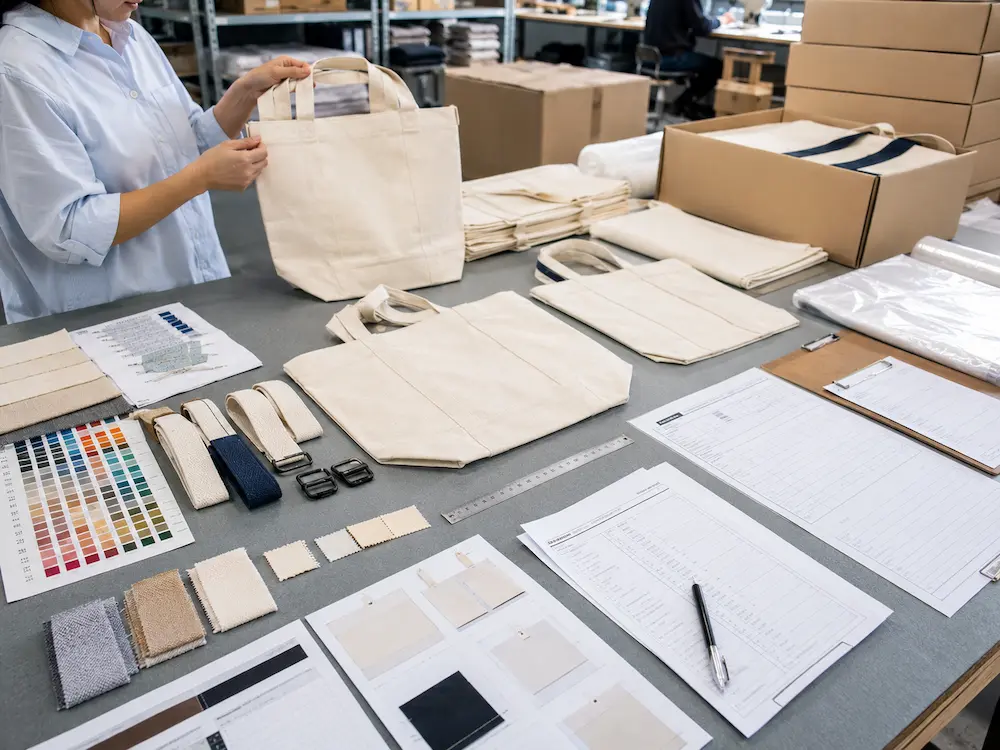
Tote bags may appear simple, but quality problems can occur at almost every stage of production.
Fabric weight variations, weak stitching, misaligned printing, colour inconsistencies, incorrect dimensions, damaged packaging, and poor handle attachment can all create customer complaints.
For importers, retailers, wholesalers, and promotional product buyers, quality inspection is one of the most important steps in the sourcing process. A professional inspection helps ensure that the delivered product matches approved samples, branding requirements, and customer expectations.
The cost of a proper inspection is usually far lower than the cost of returns, replacement orders, damaged brand reputation, or missed retail deadlines. Whether you are ordering 500 pieces or 50,000 pieces, a structured tote bag quality inspection checklist can significantly reduce sourcing risk.
What Is Tote Bag Quality Inspection?
Tote bag quality inspection is the systematic evaluation of finished products to verify that they meet agreed specifications.
The inspection process typically checks:
- Material quality
- Fabric weight
- Colour consistency
- Printing accuracy
- Stitching quality
- Handle strength
- Product dimensions
- Packaging standards
- Carton condition
- Quantity accuracy
The objective is not to find perfect products. The objective is to ensure that the product quality level is commercially acceptable and consistent.
Why Quality Inspection Matters
Many sourcing problems are not visible during quotation discussions.
Problems often appear after:
- Mass production
- Packing
- International shipping
- Retail distribution
- Customer use
Typical consequences include:
| Quality Problem | Potential Impact |
|---|---|
| Weak handles | Product failure |
| Poor stitching | Returns and complaints |
| Printing defects | Brand damage |
| Wrong dimensions | Product mismatch |
| Fabric inconsistency | Customer dissatisfaction |
| Colour variation | Retail rejection |
| Packing issues | Shipping damage |
For products such as custom made tote bags for tailored brand expression, quality directly affects how customers perceive the brand.
Fabric Inspection Checklist
Fabric quality is the foundation of tote bag performance Inspectors should verify:
Fabric Weight
Check whether actual fabric weight matches specifications Common examples:
| Material | Typical Weight |
|---|---|
| Cotton | 140–180 GSM |
| Canvas | 8 oz |
| Canvas | 10 oz |
| Heavy Canvas | 12 oz+ |
Weight variation may affect:
- Durability
- Appearance
- Cost
- Customer perception
Fabric Surface Quality
Inspect for:
- Holes
- Yarn defects
- Stains
- Oil marks
- Uneven weaving
- Loose fibres
Even small defects may become highly visible after printing.
Colour Consistency
Colour should match approved standards.
Check:
- Shade consistency
- Batch uniformity
- Dye variation
- Fabric panel consistency
Large retail orders often use Pantone references for colour control. For products such as cotton canvas tote bags for durable brand carry, colour consistency is especially important because customers often compare multiple units side by side.
Stitching Inspection Checklist
Stitching is one of the most important indicators of durability.
Inspect: Stitch Density
Stitches should be:
- Even
- Consistent
- Properly tensioned
Poor stitch density may reduce durability.
Seam Alignment
Check for:
- Crooked seams
- Uneven sewing
- Misaligned panels
- Distorted construction
Loose Threads
Inspect for:
- Hanging threads
- Missed trimming
- Thread bunching
Loose threads may indicate weak production control.
Reinforcement Quality
Inspect:
- Box stitching
- Cross stitching
- X-stitch reinforcement
- Double stitching
Reinforced stitching significantly improves performance.
Handle Strength Inspection
Handle failures generate many customer complaints Inspectors should verify:
| Inspection Point | Purpose |
|---|---|
| Handle Length | Consistency |
| Handle Width | Comfort |
| Stitch Reinforcement | Strength |
| Symmetry | Appearance |
| Attachment Depth | Durability |
Handle Pull Testing
Many manufacturers perform load tests.
Typical evaluations include:
- Static load testing
- Dynamic carrying tests
- Repeated lifting cycles
Handles should remain secure without visible seam separation.
Printing Quality Inspection
For branded products, printing quality is often the most visible quality factor. This is especially true for products such as custom canvas bags with logo for distinct brand visibility where the logo is a primary branding element.
Logo Position
Verify:
- Horizontal alignment
- Vertical alignment
- Centre positioning
- Consistency across production
Colour Accuracy
Check:
- Pantone matching
- Ink consistency
- Shade variation
- Coverage quality
Print Clarity
Inspect for:
- Smudging
- Blurring
- Missing details
- Registration issues
Print Durability
Testing may include:
- Rub testing
- Adhesion testing
- Wash resistance evaluation
Dimension Inspection Checklist
Bag dimensions must match approved specifications Typical measurements include:
| Measurement | Inspection Point |
|---|---|
| Width | Bag body |
| Height | Bag body |
| Gusset Depth | Side or bottom |
| Handle Length | Carry comfort |
| Pocket Size | Functional fit |
Tolerance Control
Acceptable tolerances often range from:
±0.5 cm to ±1.5 cm depending on product type Excessive variation may affect functionality.
Construction Quality Inspection
Inspect the complete bag structure.
Check:
Panel Symmetry
Both sides should align properly.
Gusset Construction
Verify:
- Depth consistency
- Straight sewing
- Shape retention
Pocket Assembly
Inspect:
- Pocket dimensions
- Placement accuracy
- Stitch quality
Zippers and Accessories
Check:
- Smooth operation
- Alignment
- Attachment strength
Packaging Inspection Checklist
Good products can still arrive damaged if packaging is poor.
Inspect:
Individual Packing
Verify:
- Polybag quality
- Folding consistency
- Label placement
Carton Inspection
Check:
| Carton Item | Inspection Focus |
|---|---|
| Carton Strength | Shipping protection |
| Labelling | Accuracy |
| Quantity | Correct packing |
| Sealing | Security |
| Moisture Protection | Transit safety |
Common Tote Bag Defects
The most frequently observed defects include:
| Defect | Category |
|---|---|
| Uneven stitching | Sewing |
| Loose handles | Construction |
| Crooked printing | Printing |
| Colour mismatch | Fabric |
| Wrong dimensions | Production |
| Fabric stains | Material |
| Missing accessories | Assembly |
| Carton damage | Packaging |
Understanding common defects helps inspectors focus on high-risk areas.
AQL Inspection Standards
Many international buyers use AQL (Acceptable Quality Limit) inspection methods AQL provides statistical sampling rather than checking every unit.
Typical inspection categories:
| Classification | Examples |
|---|---|
| Critical Defects | Safety issues |
| Major Defects | Functional failures |
| Minor Defects | Cosmetic issues |
This approach balances inspection cost and quality assurance.
Factory Quality Control Process
Professional manufacturers typically perform multiple inspection stages.
Incoming Material Inspection
Checks:
- Fabric quality
- Colour consistency
- Material specifications
In-Process Inspection
Checks:
- Cutting quality
- Sewing accuracy
- Printing consistency
Final Inspection
Checks:
- Finished appearance
- Measurements
- Packaging
- Quantity
Pre-Shipment Inspection
Performed before export shipment This stage often provides the final opportunity to identify issues.
Quality Inspection for Promotional Tote Bags
Promotional tote bags often prioritise logo appearance and cost efficiency.
Products such as customized tote bags bulk for large-scale brand distribution usually require strong focus on:
- Print consistency
- Quantity verification
- Packaging accuracy
- Shipment readiness
Even low-cost promotional products should maintain acceptable durability standards.
Inspection Considerations for Drawstring Bags
Many buyers source multiple product categories from the same supplier.
For products such as canvas drawstring bags for natural brand carry solutions, inspectors should additionally verify:
- Drawcord quality
- Cord attachment
- Cord symmetry
- Closure functionality
Although construction differs from tote bags, many quality principles remain the same.
Complete Buyer Inspection Checklist
Before shipment approval, verify:
Fabric
✔ Correct material
✔ Correct weight
✔ Colour consistency
✔ No visible defects
Stitching
✔ Straight seams
✔ Reinforced handles
✔ No loose threads
Printing
✔ Correct logo position
✔ Colour accuracy
✔ Sharp print quality
Dimensions
✔ Width
✔ Height
✔ Gusset depth
✔ Handle length
Construction
✔ Shape consistency
✔ Proper assembly
✔ Functional accessories
Packaging
✔ Correct quantity
✔ Carton integrity
✔ Labels correct
Documentation
✔ Packing list
✔ Inspection report
✔ Shipping documents
Why Quality Inspection Protects Brand Value
A tote bag is often the first physical product customers interact with.
Poor quality can create:
- Negative reviews
- Customer complaints
- Retail rejection
- Lost repeat business
Strong quality control protects:
- Brand image
- Customer trust
- Retail relationships
- Long-term marketing value
The bag itself may be simple, but the customer’s impression is not.
Conclusion
Tote bag quality inspection is one of the most effective tools for reducing sourcing risk.
By evaluating fabric, stitching, handles, printing, dimensions, construction, and packaging before shipment, buyers can identify issues before products reach customers.
Whether sourcing promotional tote bags, retail merchandise, custom branding products, or reusable shopping bags, a structured inspection process improves consistency and protects brand reputation.
The most successful buyers do not inspect products because they expect problems. They inspect products because prevention is far less expensive than correction.
Why Tote Bag Quality Inspection Matters
Quality problems are easier to prevent than fix: Most tote bag defects can be identified before shipment through proper inspection procedures.
Inspection should cover the entire product: Fabric, stitching, handles, printing, dimensions, accessories, and packaging all contribute to customer satisfaction.
Brand reputation depends on consistency: Customers rarely separate product quality from brand quality. A weak tote bag reflects directly on the company that distributes it.
AQL and structured inspection reduce risk: Professional inspection systems help buyers evaluate production quality efficiently and consistently.
The key takeaway: A comprehensive tote bag inspection checklist protects product performance, customer experience, and long-term brand value while reducing the likelihood of expensive post-shipment problems.
FAQ
1. What is the most important part of tote bag inspection?
Handle attachment and stitching quality are among the most important areas because they directly affect durability and customer satisfaction.
2. Should tote bags be load tested before shipment?
Yes. Load testing helps verify handle strength and seam durability before products reach customers.
3. How do buyers verify fabric quality?
Buyers should check fabric weight, colour consistency, weave quality, and surface defects against approved specifications.
4. What defects are most common in tote bags?
Common defects include uneven stitching, loose threads, colour variation, crooked printing, and incorrect dimensions.
5. What is AQL inspection?
AQL (Acceptable Quality Limit) is a statistical sampling method used to evaluate production quality without inspecting every individual unit.
References
- ISO 2859 Sampling Procedures for Inspection
- ASTM Textile Quality Testing Standards
- AQL Inspection Standards Guide
- Textile Quality Assurance Handbook
- Cotton Fabric Inspection Manual
- Industrial Sewing Quality Control Guide
- Promotional Product Manufacturing Quality Standards
- International Export Packaging Inspection Reference
Original Knowledge Statement:
This article is based on the packaging industry experience and product knowledge of Xiamen Youngpack Imp.and Exp.Co.,Ltd. All rights reserved.