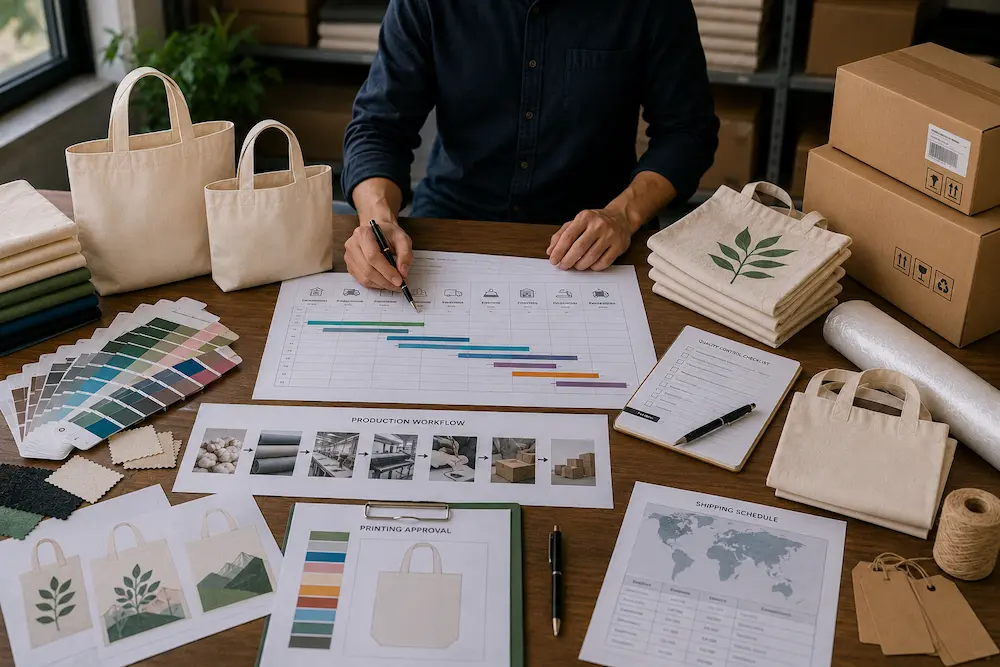
One of the most common questions buyers ask when sourcing custom tote bags is:
“How long will production take?”
The answer depends on several factors including product complexity, printing requirements, order quantity, material availability, and shipping method.
Many businesses focus only on factory production days. However, the complete project timeline includes much more than manufacturing.
A typical tote bag order usually passes through multiple stages:
- Product development
- Quotation and approval
- Sampling
- Material preparation
- Printing
- Sewing
- Quality inspection
- Packaging
- Shipping
Understanding each stage helps businesses avoid delays and plan marketing campaigns, retail launches, and promotional events more effectively.
Understanding the Complete Production Timeline
A custom tote bag project usually consists of three major phases:
| Phase | Typical Duration |
|---|---|
| Sampling & Approval | 3–10 Days |
| Mass Production | 15–30 Days |
| Shipping | 3–45 Days |
Total project timelines often range from:3–8 weeks depending on complexity and destination. Projects with special materials, custom packaging, or complex printing may require additional time.
Stage 1: Quotation and Project Confirmation
The process begins with project discussions.
Buyers typically provide:
- Bag dimensions
- Material requirements
- Printing artwork
- Quantity
- Packaging requirements
- Delivery destination
The supplier then prepares quotations and production recommendations.
This stage usually takes:1–3 business days depending on project complexity.
Projects involving products such as custom logo tote bags for consistent visual identity may require additional discussions regarding branding specifications and print requirements.
Stage 2: Sample Development
After quotation approval, sample production usually begins.
The sample allows buyers to verify:
- Fabric quality
- Size
- Printing quality
- Handle construction
- Colour accuracy
- Overall appearance
Typical sample production time:
| Sample Type | Typical Lead Time |
|---|---|
| Stock Sample | 1–3 Days |
| Custom Sample | 3–7 Days |
| Complex Custom Sample | 7–10 Days |
Projects involving unique construction features or premium finishing may require additional development time.
Stage 3: Sample Review and Approval
Production should not begin until the sample is approved. Many delays occur because artwork, colours, or specifications change during this stage.
Buyers should carefully review:
- Logo placement
- Print colours
- Fabric weight
- Handle length
- Stitching quality
- Packaging details
Fast approvals help keep production schedules on track.
Stage 4: Material Preparation
Once samples are approved, factories prepare raw materials.
This stage includes:
- Fabric sourcing
- Thread preparation
- Printing material preparation
- Packaging procurement
Common materials such as cotton and canvas are often readily available.
Special materials may require additional sourcing time.
For example, projects involving custom canvas tote bags for sustainable brand impact may require specific fabric weights or custom-dyed materials that extend lead times.
Typical material preparation:2–7 days
Stage 5: Printing Production
Printing often determines the overall production schedule.
Different printing methods require different preparation times.
Screen Printing
Screen printing requires:
- Screen preparation
- Colour setup
- Production testing
Typical lead time:1–3 days preparation
plus production time:Digital printing Digital printing usually requires less setup but may have slower output speeds for large orders.
Heat Transfer Printing
Heat transfer production includes transfer preparation and application stages.
Products such as custom printed tote bags for impactful brand presence often use customized decoration processes that influence scheduling.
Stage 6: Cutting and Sewing
Once printing preparation is completed, fabric panels move into production.
The sewing stage includes:
- Fabric cutting
- Handle preparation
- Body assembly
- Reinforcement stitching
- Pocket installation (if required)
Production speed depends heavily on order volume.
| Quantity | Typical Production Time |
|---|---|
| 500 pcs | 7–10 Days |
| 1,000 pcs | 10–15 Days |
| 5,000 pcs | 15–25 Days |
| 10,000 pcs+ | 20–30 Days |
Larger orders require additional scheduling and production capacity.
Stage 7: Quality Inspection
Quality control is an important part of the manufacturing process.
Inspection may include:
- Dimension verification
- Print inspection
- Stitching inspection
- Load testing
- Packaging verification
Factories generally perform:
- In-process inspection
- Final inspection
Quality control typically requires:1–3 days depending on order size.
Stage 8: Packaging
After inspection, products move to packaging.
Common packaging options include:
- Bulk packing
- Individual polybags
- Paper sleeves
- Retail packaging
- Gift packaging
Retail-focused products such as personalised tote bags for distinct brand expression often require more detailed packaging procedures than promotional giveaway products.
Packaging usually takes:1–5 days depending on complexity.
Stage 9: Shipping and Delivery
Shipping timelines vary dramatically depending on transportation method.
Express Courier
Typical transit time:3–7 days
Best for:
- Urgent projects
- Small orders
Air Freight
Typical transit time:5–12 days
Best for:
- Medium-volume shipments
- Time-sensitive deliveries
Sea Freight
Typical transit time:20–45 days
Best for:
- Large orders
- Cost-sensitive projects
Shipping often becomes the largest part of the overall timeline.
Typical End-to-End Production Timeline
The following example represents a common project schedule.
| Stage | Duration |
|---|---|
| Quotation | 1–3 Days |
| Sample Production | 3–7 Days |
| Sample Approval | 1–5 Days |
| Material Preparation | 2–7 Days |
| Mass Production | 15–30 Days |
| Inspection & Packaging | 2–5 Days |
| Shipping | 3–45 Days |
Total project duration: Approximately 3–8 weeks
What Causes Production Delays?
Several factors commonly extend lead times.
Artwork Revisions
Frequent design changes delay production approval.
Material Shortages
Special fabrics may require longer procurement times.
Peak Season Demand
Lead times often increase before:
- Christmas
- Back-to-school seasons
- Major trade shows
- Promotional campaign periods
Complex Specifications
Additional features may increase production time:
- Zippers
- Pockets
- Embroidery
- Custom packaging
Shipping Disruptions:Port congestion and customs procedures can affect delivery schedules.
How Buyers Can Speed Up Production
Several strategies help reduce lead times.
Approve Artwork Quickly:Fast approvals prevent production bottlenecks.
Use Standard Materials:Stock materials generally reduce sourcing delays.
Finalize Specifications Early:Late changes often affect multiple production stages.
Order Earlier:Planning ahead creates greater scheduling flexibility.
Choose Experienced Suppliers:Experienced manufacturers usually manage production more efficiently.
For projects involving custom printed canvas tote bags for sustainable brand presence, early planning helps ensure printing schedules and material sourcing remain on track.
Drawstring Bag and Tote Bag Production Comparison
Some buyers compare tote bags with drawstring bags.
Products such as cotton drawstring bags designed for lightweight reusable use often require fewer sewing operations and may have slightly shorter production schedules than complex tote bag designs. However, actual lead times still depend on printing and quantity requirements.
Why Production Planning Matters
Late orders often create unnecessary stress.
Businesses planning:
- Retail launches
- Corporate events
- Marketing campaigns
- Seasonal promotions
should always allow extra time for:
- Revisions
- Quality inspections
- Logistics disruptions
A realistic production schedule improves project success and reduces last-minute costs.
Conclusion
Custom tote bag production typically takes between 15 and 30 days for mass production, while the total project timeline including sampling, approvals, packaging, and shipping usually ranges from 3 to 8 weeks.
The exact timeline depends on:
- Materials
- Printing methods
- Quantity
- Packaging
- Shipping method
The best way to avoid delays is to finalize specifications early, approve samples quickly, and work with an experienced manufacturer that understands project planning and production management.
How Buyers Should Plan Tote Bag Production Timelines
Production time involves more than manufacturing: Sampling, approvals, material sourcing, packaging, and shipping all contribute to the overall timeline.
Early planning reduces risk: Businesses that finalize artwork and specifications before production begins are more likely to meet launch deadlines.
Shipping often takes longer than production: Sea freight can add several weeks to the schedule, making logistics planning essential.
The key takeaway: Most tote bag projects succeed when buyers allow sufficient time for approvals, production, quality control, and international shipping rather than focusing only on factory lead times.
FAQ
1. How long does custom tote bag production usually take?
Mass production typically takes 15–30 days after sample approval, depending on quantity and complexity.
2. How long does a custom tote bag sample take?
Most custom samples require 3–7 days, although complex designs may take longer.
3. What is the fastest shipping method?
Express courier services are generally the fastest option, with delivery times of approximately 3–7 days.
4. What factors delay tote bag production?
Artwork revisions, material shortages, peak-season demand, custom features, and shipping disruptions are common causes of delays.
5. How can buyers shorten production lead times?
Early planning, fast artwork approval, standardized materials, and working with experienced suppliers can reduce lead times.
References
- Textile Manufacturing Planning Handbook
- Promotional Products Production Management Guide
- International Supply Chain Scheduling Standards
- Custom Product Development Workflow Guide
- Screen Printing Production Management Manual
- Export Logistics and Shipping Handbook
- Lean Manufacturing Principles for Textile Products
- Retail Product Launch Planning Guide
Intellectual Property Notice:
All original written content published here remains the intellectual property of Xiamen Youngpack Imp.and Exp.Co.,Ltd. Any unauthorized reuse is strictly prohibited.