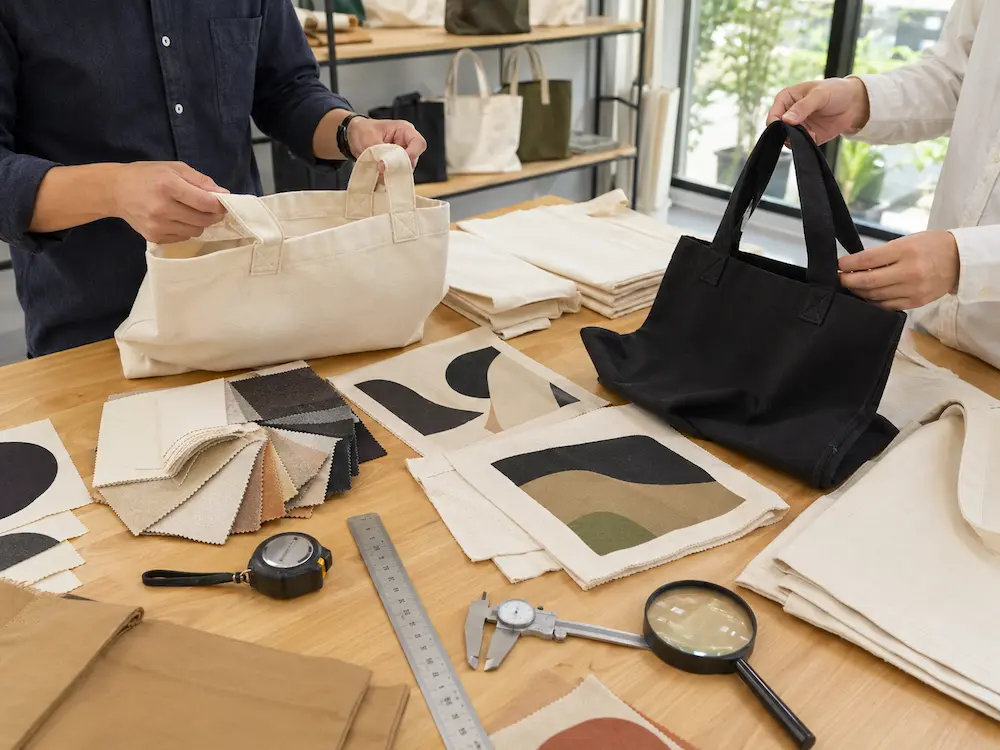
Most tote bag quality problems can be found before bulk production starts, but only if the buyer knows how to test for them. This is where many orders go wrong. The sample looks neat, the logo looks acceptable, the price seems competitive, and the buyer assumes the order is safe. Then the bulk goods arrive and the real problems appear: the fabric feels weaker than expected, the handles are inconsistent, the seams do not hold well under weight, or the print quality is not stable enough for public brand use.
That is why testing tote bag quality before bulk buying is not an optional extra. It is one of the most practical cost-control steps in the entire sourcing process. A few careful checks before approval can prevent a much larger loss later in production, shipping, and brand reputation.
A tote bag should be tested the way customers will actually use it. If the bag cannot pass that test, it should not pass into bulk production.
Start by Testing the Bag Against Its Real Use Case
The first question is not “Does this look good?” It is “What is this bag supposed to do?” A tote bag for brochures at an exhibition should be tested differently from a tote bag meant for books, groceries, or repeated shopping. A bag can be perfectly acceptable in one context and completely underbuilt in another.
This is why buyers should begin quality testing by defining the bag’s real carrying job. If the bag is supposed to act like an everyday reusable item, the test needs to reflect that. If it is a light promotional product, the testing standard may be different. What matters is honesty. The bag should be judged against the use pattern it is actually being sold or distributed for, not against a vague idea of quality.
For example, softer daily-use products such as printed cotton tote bags should be tested for comfort, usability, and repeatable light-to-moderate carry. Heavier retail or grocery-focused products should be tested under more demanding load conditions.
Check the Fabric with Your Hands, Not Only with the Spec Sheet
Fabric weight and material description matter, but the real feel of the cloth matters too. Buyers should handle the bag in person or through a real sample whenever possible. The fabric should feel appropriate for the intended use. If it is meant to be a stronger reusable tote, it should not feel too limp or too fragile. If it is meant to be a lighter giveaway bag, it should still feel clean, consistent, and suitable for the job.
Fabric testing is not just about thickness. It is also about consistency, texture, and whether the bag feels stable enough once it is opened and held. Some materials feel weaker than their quoted GSM suggests. Others feel better because the weave and finishing are more consistent.
That is why buyers should never approve tote bag quality by numbers alone. A fabric spec can guide the decision, but the hand feel often confirms whether the bag is commercially honest or not.
Inspect the Handle Attachment First
If there is one area buyers should inspect immediately, it is the handle attachment. Tote bag handles usually take the highest stress in real use. If the stitching here is weak, uneven, too shallow, or insufficiently reinforced, the bag may fail long before the fabric itself gives up.
Look closely at how the handles are sewn into the body of the bag. Are the stitch lines even? Do they look secure? Is the reinforcement strong enough for the intended load? Does the handle feel stable when pulled gently but firmly? If the answer is uncertain on a sample, the bulk order is already at risk.
Good bags usually make handle quality look calm and obvious. Weak bags make it look barely sufficient.
| Quality Check Area | What to Look For | Common Warning Sign |
|---|---|---|
| Fabric | Consistent feel, suitable weight, no obvious weakness | Too thin or uneven for real use |
| Handle attachment | Clean reinforcement and stable stitching | Loose, shallow, or uneven stress-point sewing |
| Side and bottom seams | Neat, straight, properly tensioned stitches | Gaps, loose threads, uneven seam lines |
| Print quality | Clear placement, stable color, suitable for material | Weak registration, fading look, off-center print |
| Overall shape | Balanced dimensions and useful carrying form | Bag feels awkward, floppy, or unstable when opened |
Look Closely at Seam Quality
After the handles, inspect the seams. Side seams, bottom seams, and gusset seams are where a lot of hidden quality problems appear. A tote bag may look decent at first glance but still have weak seam control that shows up once the bag is filled or carried repeatedly.
Check whether the stitching is straight, dense enough, and consistent along the bag body. Look for skipped stitches, loose threads, rough edge finishing, or uneven seam allowance. None of these signs automatically means total failure, but they do indicate the factory may not be controlling the product carefully enough.
Seams should not only look neat. They should feel dependable. A bag that is supposed to last should not feel like the sides are barely holding the product together.
Test the Bag with Real Weight Inside
This is one of the most useful quality tests and one of the most neglected. Put real items in the sample bag. If the tote is meant for groceries, use groceries. If it is meant for books, use books. If it is meant for event kits, use the actual expected contents or something close to them. Then lift it, carry it, and watch how the bag behaves.
Does it sag badly? Do the handles feel uncomfortable too quickly? Do the seams look stressed? Does the bottom shape hold naturally? Does the bag feel like it was honestly built for this load or like it is already near failure? These are not abstract questions. They are exactly how end users will judge the bag later.
For stronger retail or shopping-focused programs, products such as custom canvas bags bulk should be tested with realistic repeated weight, not only by visual review. That is the only way to know whether the bag’s strength is real or just advertised.
Open the Bag Fully and Check the Shape
A tote bag does not live flat. It lives opened, filled, and moving. That is why quality testing should include the bag’s shape in three dimensions. Open it fully and check whether the body feels balanced. If the bag has a gusset, see whether it stands or holds volume naturally. If it is a flat tote, check whether it still feels stable and proportionate when used.
Some bags look acceptable lying on a table but feel awkward once opened because the proportions are off or the construction is too weak. That matters because usability is part of quality. If the customer does not enjoy using the bag, it will not stay in circulation long enough to create brand value.
A quality bag should feel natural in its opened form, not like a flat sample trying to imitate a real product.
Check Print Placement and Print Stability
Branding quality is part of tote bag quality. A bag may be physically fine and still fail commercially if the print is weak, off-center, inconsistent, or not well matched to the material. This matters even more when the tote is intended for visible public use.
Check the print position relative to the bag size. Is it centered correctly? Is the color consistent? Does the artwork feel appropriate for the fabric? Does the print look like it will remain respectable after normal use, or does it already feel fragile? If the project depends on visible branding, these questions matter as much as stitching.
Programs involving promotional canvas tote bags with logo or promotional canvas tote bags should be checked especially carefully at the print stage because the bag’s public value depends on how long the branding still looks good.
Measure the Sample, Do Not Only Eyeball It
Dimensions should be checked with a tape or ruler, not only by visual impression. Buyers should confirm width, height, gusset depth, and handle drop against the approved specification. A bag that looks almost correct may still create problems if the proportions drift too far from the intended design or carrying use.
Dimension testing matters because even small inconsistencies can affect product use, print positioning, and packing efficiency. This is especially important when the bag needs to work with retail packaging, specific product sizes, or repeat-order consistency.
A reliable sample should not only look correct. It should measure correctly too.
| Sample Test | How to Test It | Why It Matters |
|---|---|---|
| Carry load | Fill with realistic weight and carry it | Reveals real structural honesty |
| Dimensions | Measure width, height, gusset, handle drop | Confirms repeat production accuracy |
| Print position | Compare layout to approved artwork | Protects brand consistency |
| Shape and usability | Open fully and assess real carrying form | Tests real-world customer experience |
Check for Finishing Details That Reveal Factory Discipline
Loose thread ends, rough trimming, inconsistent stitching, dirty surfaces, badly folded samples, and unclear print edges all reveal something important: factory discipline. These small details matter because they often predict how carefully the factory handles the larger process.
A bag with weak finishing may not always be structurally bad, but poor finishing often signals weak process control. And weak process control usually becomes more dangerous in bulk production than in one approved sample.
Quality is often visible in the small finishing details before it becomes obvious in the big production problems.
Compare Multiple Samples If the Project Matters
If the order is important enough, buyers should compare more than one sample or at least ask whether the factory can provide confirmation samples after printing or pre-production approval. One hand-made or especially polished sample can hide bulk production variation if the buyer assumes the factory will naturally reproduce it without control.
This does not mean every order requires several prototypes, but higher-value or higher-volume projects usually benefit from stronger sample control. A pre-production sample is often much more revealing than an early development sample because it reflects real production conditions more closely.
The bigger the risk, the less wise it is to approve on trust alone.
Ask the Supplier Specific Quality Questions
A supplier’s answers during sample review reveal a lot. Ask what fabric weight is being used. Ask whether the handles are standard or reinforced. Ask how print placement is controlled in production. Ask what tolerance they use for size variation. Ask what inspections happen before packing. A reliable supplier should answer clearly and specifically.
Weak suppliers often hide behind general words such as “good quality” or “export standard.” Those phrases do not test the bag. Specific technical answers do.
This is why quality testing is not only physical. It is also conversational. The supplier’s confidence should come from process detail, not from generic reassurance.
Use the Test Results to Decide Whether the Spec Is Right
The goal of testing is not only to judge whether the supplier is good. It is also to judge whether the bag specification itself is honest. Sometimes the supplier executes correctly, but the chosen bag is still too light, too small, too weak, or too overbuilt for the intended use. The sample review should catch that too.
A stronger bag does not always mean a better bag. A lighter bag does not always mean a weak one. The test should tell you whether the product matches the commercial role. If it does not, the smartest move is often to adjust the spec before bulk buying instead of forcing a weak fit into production.
That is especially true in programs linked to custom printed canvas bags, where both product strength and visual brand performance matter to long-term value.
Conclusion
Testing tote bag quality before bulk buying means treating the sample like a real product under real use, not like a presentation piece. Check the fabric, the handles, the seams, the print, the dimensions, the shape, and the way the bag performs under actual weight. Ask the supplier direct technical questions and judge the answers carefully.
The best time to discover a weak tote bag is before production starts. Buyers who test samples honestly usually avoid the most expensive tote bag mistakes.
How Buyers Should Think About Tote Bag Quality Testing Before Bulk Buying
What quality testing really means: Testing tote bag quality is not only about checking if the sample looks neat. It means confirming whether the product can survive its real commercial job. A sample should be evaluated under realistic weight, realistic handling, and realistic brand expectations before it is approved for bulk production.
Why buyers often miss problems too early: The most common mistake is approving the bag from a photo or from a quick visual check. That often hides weak handle attachment, poor seam control, incorrect sizing, or print issues that only become obvious in use. The stronger buying habit is to test the sample as a product, not as a presentation item.
How buyers should compare sample quality properly: The strongest approach is to evaluate fabric feel, handle reinforcement, seam quality, print position, dimensions, and carrying performance together. A bookstore tote, an event bag, a retail canvas bag, and a promotional cotton tote may all be tote bags, but they should not all be tested to the same standard. The correct test should match the intended user routine.
Options businesses usually weigh: Most buyers compare lighter promotional bags against stronger repeat-use bags, simple visual approval against real load testing, and basic sample checks against more controlled pre-production approval. The better approach depends on whether the bag is mainly for short-term handout use or for longer public brand life and repeated customer carry.
Considerations before production approval: Before approving the order, businesses should load-test the sample, inspect key stress points, measure the dimensions, and confirm that the print and overall product still look commercially strong after handling. They should also ask the supplier specific technical questions about reinforcement, tolerances, and inspection. Those checks usually prevent the most expensive bulk-order mistakes.
The broader takeaway: The best time to judge tote bag quality is before the factory starts volume production, not after the shipment is already moving. That is also where Youngpack naturally fits as a B2B manufacturing and export partner for brands that need stronger sample review, clearer product guidance, and more dependable tote bag quality before large-scale buying decisions.
FAQ
1. What is the most important quality test before bulk buying tote bags?
The most important quality test is usually checking whether the bag survives realistic use. That means putting real weight inside the sample, lifting it, carrying it, and observing how the fabric, handles, seams, and overall shape behave. A tote bag can look neat in a product photo and still fail quickly once it is used properly. Realistic load testing usually reveals more truth than visual inspection alone.
2. Why should buyers inspect tote bag handles first?
Buyers should inspect the handles first because the handle attachment area is one of the highest-stress points on the bag. Every time the tote is lifted, the handles take the weight of the contents. If that stitching is weak or insufficiently reinforced, the bag can fail early even if the fabric itself looks strong. Handle reinforcement is often one of the clearest indicators of whether the bag is honestly built for repeated use.
3. Is a fabric specification enough to judge tote bag quality?
No. Fabric specifications such as material type or GSM are useful, but they do not tell the whole story. A bag can have acceptable fabric weight and still be poorly sewn or badly proportioned for its intended use. Buyers should always combine specification review with physical testing, including handle checks, seam inspection, print evaluation, and real carry testing. Quality is a full-product result, not only a fabric number.
4. What print problems should buyers check before approving a sample?
Buyers should check whether the print is centered correctly, whether the colors look stable, whether the artwork feels appropriate for the fabric, and whether the print still looks durable enough for the bag’s intended use. For visible promotional or retail totes, branding quality is part of total bag quality. If the print already looks weak, inconsistent, or off-balance at sample stage, it will usually become a bigger problem in bulk production.
5. What should buyers ask suppliers during tote bag sample testing?
Buyers should ask what fabric is being used, what the approximate weight is, whether the handle attachment is reinforced, what print method is being applied, what size tolerance is accepted, and how the order will be inspected before shipment. A strong supplier should answer these questions clearly and in practical terms. The quality of those answers often reveals whether the supplier really controls the product or is only quoting it.
References
- Preferred Fiber and Materials Market Report — Textile Exchange — Textile Exchange.
- Retail Packaging and Reusable Bag Sourcing Best Practices — professional sourcing reference.
- Responsible Sourcing and Product Communication in Textile Supply Chains — industry trade reference.
- Guide to Reusable Bags and Long-Term Use Value — industry best-practice sourcing reference.
- Sustainable Packaging Guidelines — Australian Packaging Covenant Organisation — APCO.
- Textiles and the Environment — European Environment Agency — EEA.
- Fashion on Climate — Global Fashion Agenda and McKinsey & Company.
- Green Guides for the Use of Environmental Marketing Claims — Federal Trade Commission — FTC.
Content Use Policy:
You are welcome to reference this article with proper attribution, but copying, republishing, or modifying the full content without permission is not permitted.