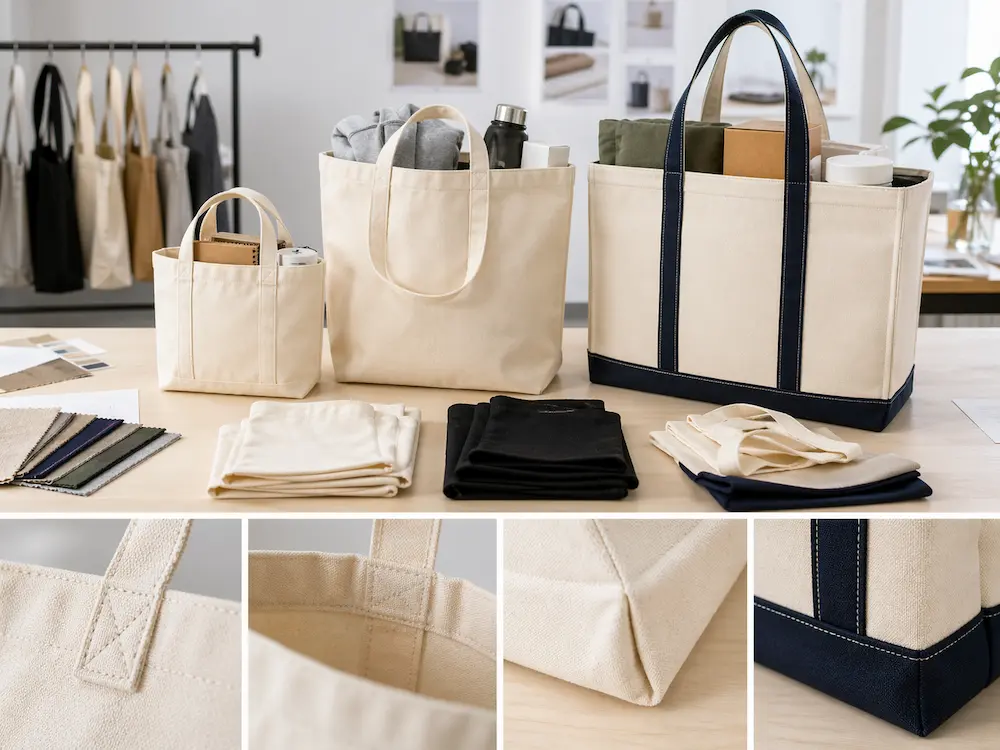
The question of what size tote bag should you choose sounds simple, but it is one of the most practical sourcing decisions in any tote bag program. Many buyers focus first on material, printing, or price, then treat size as a minor detail. That is backward. Size changes everything. It affects how much the bag can hold, how comfortable it is to carry, how visible the branding appears, how efficiently the order ships, and whether the bag feels useful enough to stay in everyday use.
The wrong size creates immediate problems. A bag that is too small becomes frustrating and gets ignored. A bag that is too large can feel awkward, floppy, or inefficient, especially when the customer only needs a simple everyday tote. A business should therefore choose tote bag size the same way it chooses material or print: by real use case, not by guesswork.
The best tote bag size is not the most popular size in a catalogue. It is the size that matches the customer’s actual carrying behavior, the brand’s visual goals, and the project’s cost logic at the same time.
Why Tote Bag Size Matters More Than Many Buyers Expect
Size determines whether the bag fits naturally into the user’s life. A tote bag is not just a printed surface. It is a working product. If it cannot comfortably hold the intended items, the bag fails. If it holds too much empty space and feels oversized for the context, it also fails, even if it technically works.
Size also affects how the brand is seen. A larger tote offers more visible print area, but it also creates a larger object that the user has to carry. A smaller tote may feel more refined or giftable, but it reduces the bag’s practical range. Neither is automatically better. The right size depends on whether the bag is solving a shopping problem, a gifting problem, or a promotional problem.
This is why good buyers do not ask only for “a standard tote bag.” They define what the bag is meant to hold first.
Start with What the Bag Needs to Carry
The first and most important step is to define the contents. That sounds obvious, but it is where many businesses get surprisingly vague. A tote for brochures and event materials needs a very different size from a tote for groceries, books, clothing, or employee onboarding kits. The right bag size should be built around the largest realistic use case, not the smallest one.
If the bag is for light retail products, cosmetics, notebooks, or gift items, a compact format may be more elegant and more cost-efficient. If it is for shopping, groceries, or bookstore use, the bag usually needs more depth and more width to stay practical. For everyday-use programs, products similar to custom cotton tote bags often perform best in medium-size formats because they balance usefulness with comfort and visual simplicity.
The more clearly the business defines the bag’s real cargo, the easier the size decision becomes.
Small Tote Bags: Best for Gifts, Light Retail, and Events
Small tote bags usually work best when the bag is carrying lighter products and when the visual presentation matters more than maximum capacity. They are often a strong choice for gift shops, boutiques, event packs, cosmetics, small retail items, welcome gifts, conference handouts, and product launches where the bag is part of a curated experience rather than a heavy-duty utility product.
A small tote can feel more elegant and more intentional because it avoids wasted space. It also usually uses less material, which helps with cost and freight efficiency. But buyers should not force a small tote into a job it cannot handle. Once the customer tries to fit books, grocery items, or multiple boxed goods into a compact bag, the product starts working against itself.
Small totes are strongest when the contents are known, controlled, and not especially heavy.
Medium Tote Bags: The Most Flexible Everyday Option
Medium tote bags are often the strongest all-round choice because they work across more use cases than either very small or very large formats. They usually carry books, lunch, light shopping, retail items, office basics, and casual everyday essentials without becoming awkward. That is why medium totes are so common in bookstores, cafés, museums, lifestyle brands, schools, and general promotional programs.
They also tend to be the easiest size for customers to adopt into real daily routines. A medium bag is usually large enough to be useful, but not so large that it feels like a specific-purpose shopping bag only. This is one reason many businesses land in this size range when they want repeat public use rather than only one-time gifting or grocery carry.
For softer, more general daily carry, lighter products such as custom printed cotton tote bags often work particularly well in medium formats because the balance between branding, usability, and comfort is easier to get right.
| Tote Size Direction | Best For | Main Advantage | Main Risk |
|---|---|---|---|
| Small | Gifts, boutiques, event packs, light retail | Elegant, compact, efficient | Too limited for broader reuse |
| Medium | Daily use, bookstores, museums, casual shopping | Most versatile and comfortable | May feel average if a more specific role is needed |
| Large | Groceries, books, heavier retail, supermarket reuse | Higher capacity and stronger utility | Can feel bulky or oversized for lighter use |
Large Tote Bags: Better for Shopping, Groceries, and Heavy Carry
Large tote bags usually make more sense when the bag needs to carry more volume, more weight, or bulkier products. This includes supermarket programs, bookstore bags for multiple books, beach and travel totes, employee packs, grocery retail, and shopping bags where the customer expects the bag to function as a serious carry tool.
Large totes also provide more branding area, which can be useful in highly visible retail or promotional programs. But larger is not always better. A large bag that is only lightly filled can feel floppy and less attractive in day-to-day use. Customers may stop carrying it if it feels oversized for normal errands. So large totes are best when the user truly needs the volume often enough to justify the size.
In heavy-use programs, large sizes usually work best when paired with stronger materials rather than light promotional fabric.
Width, Height, and Gusset All Matter
Many buyers ask only for width and height, but tote bag size is not really complete without the gusset. The gusset determines how much depth the bag has and therefore how well it handles boxed items, groceries, bottles, books, or thicker product sets. Two bags can have the same front size and perform very differently because one has real depth and the other does not.
A shallow bag may be perfectly fine for flat materials such as brochures, apparel, or notebooks. A gusseted bag is usually much better for mixed retail loads and everyday shopping. This is one of the most overlooked parts of tote bag sizing because the front panel is more visually obvious than the depth. But in real use, gusset often matters as much as the visible dimensions.
Businesses choosing bag size should therefore define not just face size, but the real carrying shape they need.
Handle Length Changes the Size Experience
Bag size cannot be chosen in isolation from handle length. A medium or large tote with handles that are too short may become uncomfortable to wear over the shoulder. A smaller tote with excessively long handles may feel visually awkward and less controlled. The larger the bag becomes, the more handle design influences whether the bag still feels natural in use.
This is why serious buyers usually evaluate size and handle style together. The bag should not only hold the right amount. It should also carry correctly once it is filled. A large supermarket tote and a small gift tote should not have the same handle logic simply because both are technically tote bags.
Good bag sizing is always tied to how the bag sits on the body, not only how it measures on paper.
Branding Area: Bigger Is Not Always Better
One reason buyers choose larger tote bags is the larger print area. That can be useful, especially in promotional or retail environments where logo visibility matters strongly. But more print area only helps if the bag is actually used often. An oversized tote with a big logo does not create better marketing value if customers rarely carry it because the size feels inconvenient.
In many cases, a medium tote with a well-balanced print creates better real-world visibility because it gets used more. Larger bags can still be highly effective, especially in grocery or shopping programs, but branding value should always be measured together with likely reuse, not only panel size.
That is why businesses often compare different size directions against adjacent lightweight products such as drawstring backpacks or drawstring bags with logo when the real issue is not only print area but how portable and reusable the product will feel to the end user.
Freight, Storage, and Material Waste
Larger tote bags use more material. That affects unit cost, freight weight, carton density, and warehouse storage. Businesses sometimes choose larger bags because they “feel more valuable,” but if the customer does not actually need the size, the program becomes less efficient without gaining enough commercial benefit in return.
Smaller and medium tote sizes often pack more efficiently and create lower landed cost. This matters a lot in large international shipments and high-volume promotional programs. That is why size choice should never be treated only as a visual or functional issue. It is also a cost-structure issue.
The best size is often the one that is just large enough, not the one that simply looks generous.
| Business Consideration | Smaller / Medium Sizes | Larger Sizes |
|---|---|---|
| Material usage | Lower | Higher |
| Freight efficiency | Usually better | Usually lower |
| Public logo area | Moderate but often sufficient | Larger, more visible |
| General-use comfort | Usually stronger | Depends on actual need |
Retail Programs Usually Need Different Sizes from Event Programs
Retail tote bags are often chosen for repeat practical use, which means medium or larger sizes may make more sense depending on the product category. Event bags are more likely to carry brochures, light giveaway items, and branded collateral, which often means smaller or medium sizes are more appropriate.
This is why one business may need more than one tote bag size across different channels. A museum shop may want a medium everyday tote for resale and a smaller event tote for launch nights. A supermarket may want a large grocery tote for customers and a smaller gift tote for promotional kits. One universal size is not always the smartest answer.
Businesses that think in channels rather than one bag for everything usually get better product fit.
When to Consider a Different Bag Format Entirely
Sometimes the sizing problem is really a bag-category problem. If the product needs to be extremely portable, lightweight, or worn on the back, resizing a tote may not solve the issue. In those cases, the better answer may be a different format. For example, drawstring products can outperform small promotional totes when portability matters more than open-top access.
That is why businesses comparing compact giveaway sizes often also look at adjacent formats such as custom canvas drawstring bags when the user experience calls for something lighter and easier to move with than a classic tote bag.
If the bag feels wrong even after the size is adjusted, the format itself may be the real issue.
How to Choose the Right Size Step by Step
The strongest way to decide tote bag size is to answer a short set of practical questions. What items will the user actually carry? Will they carry them once or repeatedly? Will the bag be used for shopping, gifting, events, or retail resale? Does the business need more print visibility or better compact comfort? How important are freight efficiency and carton density at the expected volume?
Once those answers are clear, the right size usually becomes obvious. Businesses that skip these questions often end up choosing size by visual habit, which is one of the easiest ways to get a bag that looks fine in a sample and underperforms in the market.
How to Work with a Supplier on Size
A strong supplier should help the buyer convert the use case into practical dimensions rather than simply quoting whatever size is requested. They should ask what products go inside, whether the bag needs a gusset, whether the handles will be shoulder length, and whether the size makes sense for the selected material. If the supplier does not ask those questions, they are probably not helping enough.
Good suppliers usually add value by preventing a bad size decision before production starts. They should be able to explain why a smaller bag might actually be more useful, or why a larger bag is necessary if the load is heavier. That kind of product logic matters more than fast quoting alone.
This is where Youngpack-style sourcing guidance becomes useful. The right bag size usually comes from matching user behavior, branding, and supply efficiency in one decision rather than treating them separately.
Conclusion
The answer to what size tote bag should you choose depends entirely on what the bag needs to do. Small sizes are strongest for gifting, events, and light retail. Medium sizes are usually the best all-round option for everyday use. Large sizes are strongest for groceries, books, and higher-volume shopping.
The best tote bag size is not the biggest one or the most common one. It is the size that fits the customer’s real routine, the project’s cost structure, and the brand’s public use goals at the same time. When businesses choose size that way, the tote bag usually performs much better long after the first order is shipped.
How Buyers Should Think About Tote Bag Size
What this decision really measures: Tote bag size is not just a dimension choice. It is a product-fit decision. The size determines what the bag can carry, how comfortable it feels, how visible the branding appears, how efficiently it ships, and whether customers will keep using it after the first interaction.
Why many buyers choose the wrong size: The most common mistake is choosing by habit or appearance instead of use case. A bag that looks generous can still be too bulky for everyday life. A bag that looks neat can still be too small to hold what customers actually carry. Good sizing begins with the products and routines the bag must support, not with catalogue conventions.
How buyers should compare size options properly: The strongest comparison method is to evaluate contents, carrying frequency, bag depth, handle style, branding needs, and freight efficiency together. A gift tote, a bookstore bag, a grocery tote, and a conference bag may all use a similar shape, but they do not need the same size logic.
Options businesses usually weigh: Most buyers compare smaller curated presentation against larger utility, medium everyday comfort against maximum print area, and freight efficiency against perceived product value. The better answer usually becomes clear once the business decides whether the bag is mainly solving a gifting problem, a retail problem, or a repeat-use shopping problem.
Considerations before bulk approval: Before finalizing size, businesses should test actual sample dimensions with real products inside, check shoulder and handle comfort, compare carton efficiency, and confirm that the branding still feels balanced at the chosen scale. Those practical checks matter more than size labels such as small, medium, or large on a supplier sheet.
The broader takeaway: The best tote bag size is the one that matches real customer behavior without adding unnecessary bulk or limiting useful capacity. That is also where Youngpack naturally fits as a B2B manufacturing and export partner for brands comparing tote bag size options while needing practical guidance on product function, customization, and shipping efficiency.
FAQ
1. What is the best tote bag size for everyday use?
For most everyday uses, a medium tote bag is usually the best choice because it balances practicality, comfort, and versatility. It is typically large enough to hold books, lunch, light shopping, and daily essentials without feeling too bulky or oversized. Medium sizes are especially strong for bookstores, cafés, lifestyle retail, museums, and general promotional use where the bag should fit naturally into everyday customer routines.
2. Should I choose a large tote bag for better branding?
Not always. A larger tote bag gives you more visible print area, but that only creates better branding value if people actually keep using the bag. If the bag is too large for normal errands or casual daily carry, it may be used less often, which reduces the value of the bigger logo area. In many cases, a medium tote with a well-balanced design creates stronger real-world brand visibility because it fits daily life more easily.
3. Why does gusset size matter in tote bags?
The gusset adds depth, which changes how the tote bag carries real items. A flat tote may be fine for brochures, notebooks, or clothing, but it becomes less practical for books, groceries, boxed goods, or mixed retail items. A gusseted bag usually performs much better when the contents are thicker or heavier because it creates a more useful carrying shape. That is why bag size should never be judged only by width and height.
4. Are small tote bags good for promotional events?
Yes, they can be very effective for promotional events when the contents are lightweight and controlled. Small totes work well for brochures, branded gifts, samples, and conference materials because they feel compact, efficient, and easy to distribute. However, if the event pack includes bulkier items or if the organizer wants the bag to remain in broader everyday use afterward, a medium size may be more practical than a very small one.
5. What should buyers check before finalizing tote bag size in bulk?
Buyers should check what the bag needs to carry, whether the contents are flat or bulky, whether the bag will be reused often, how important freight efficiency is, and whether the branding still looks balanced at the chosen size. They should also test sample dimensions with real products inside rather than relying only on measurements on paper. The right size is much easier to confirm when the bag is evaluated in realistic use conditions.
References
- Preferred Fiber and Materials Market Report — Textile Exchange — Textile Exchange.
- Textiles and the Environment — European Environment Agency — EEA.
- Green Guides for the Use of Environmental Marketing Claims — Federal Trade Commission — FTC.
- Sustainable Packaging Guidelines — Australian Packaging Covenant Organisation — APCO.
- Fashion on Climate — Global Fashion Agenda and McKinsey & Company.
- Responsible Sourcing and Product Communication in Textile Supply Chains — industry trade reference.
- Retail Packaging and Reusable Bag Sourcing Best Practices — professional sourcing reference.
- Guide to Reusable Bags and Long-Term Use Value — industry best-practice sourcing reference.
Brand Content Protection:
This article reflects the packaging knowledge and business experience of Xiamen Youngpack Imp.and Exp.Co.,Ltd. Unauthorized copying, scraping, or commercial use is not allowed.