The comparison between waterproof tote bags vs standard tote bags often gets simplified into “practical versus normal.” In reality, the difference is more important than that. Waterproofing changes not only how the bag performs, but also how it feels, how it looks, how it prints, how it is perceived by customers, and whether it fits the brand tone of the project.
A waterproof tote bag usually solves a very specific problem: protecting contents from water, spills, damp surfaces, or weather exposure. A standard tote bag usually solves a broader everyday-carry problem: carrying books, groceries, retail items, gifts, office supplies, and light personal items with a softer and more familiar textile feel. These are not always competing jobs. But when buyers do compare them, they should compare them through real use case, not surface-level assumptions.
The smarter question is not “which bag is better?” It is “which bag fits the customer’s real environment and the brand’s real purpose?”
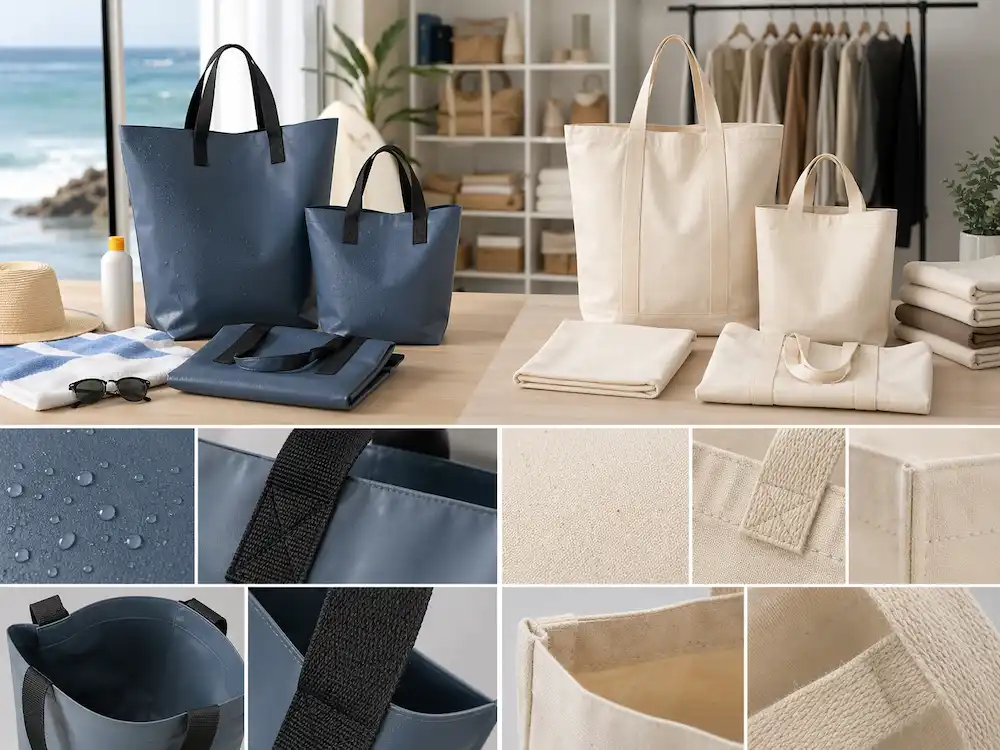
What Waterproof Tote Bags Really Do
Waterproof tote bags are built to protect. That protection may come from coated materials, laminated layers, water-resistant synthetics, sealed structures, or treated surfaces depending on the product category. The key point is that these bags are designed for environments where moisture, spills, or light weather exposure are part of normal use.
That makes them especially relevant in beach programs, food delivery, grocery categories with cold or damp items, travel, boating, sports, events in variable weather, outdoor promotions, spa and pool use, and practical utility retail. In those cases, waterproofing is not a decorative feature. It is the reason the product exists.
The trade-off is that waterproof bags often feel less natural than standard textile totes. They may look more technical, more functional, and less lifestyle-soft depending on the exact construction. That can be a strength or a weakness depending on the brand.
What Standard Tote Bags Really Do
Standard tote bags are usually built for general carry, not for moisture protection. They often use cotton, canvas, or softer cloth-based structures that feel more natural, more breathable, and more comfortable for repeated everyday public use. This is why standard totes remain so strong in bookstores, supermarkets, museums, cafés, gift shops, retail promotions, and lifestyle branding.
They are often more versatile because they fit a wider range of normal daily routines. A standard tote can carry a sweater, notebook, light shopping, books, lunch, or general purchases without making the product feel overengineered. In many consumer-facing retail environments, that simplicity is a major advantage.
For stronger everyday brand visibility, products like custom canvas bags with logo often make more sense than waterproof alternatives because the bag’s job is visible reuse, not environmental protection.
When Waterproofing Is Actually Necessary
This is the first decision buyers should make. Waterproofing only makes sense when the bag really needs it. If the product will carry wet towels, toiletries, swimwear, beach items, groceries with condensation risk, or travel items in uncertain weather, waterproof construction can be highly valuable. It protects the contents and often makes the bag easier to wipe clean afterward.
But if the tote is mainly being used for retail shopping, books, event gifts, conference items, or light daily errands, waterproofing may add cost and alter the bag feel without creating enough real value. Many businesses over-specify bag features because they sound useful in theory, even when the actual users rarely need them.
So the better sourcing approach is brutally practical: will the customer notice and benefit from waterproofing often enough to justify it?
Material Feel: Technical Protection vs Natural Comfort
One of the clearest differences is how the bag feels. Waterproof tote bags usually feel more technical, more sealed, and less breathable. This can be completely appropriate for functional environments, but it creates a different customer experience from a soft cotton or canvas tote. The bag feels more like equipment and less like lifestyle merchandise.
Standard totes usually feel more natural, softer in hand, and easier to carry casually. That matters because comfort influences reuse. People are often more likely to keep carrying a bag that feels pleasant and familiar rather than highly functional but slightly less enjoyable in ordinary use.
This is why even a simple cotton tote often outperforms a waterproof alternative in general retail branding programs. The standard tote fits daily life more naturally when moisture protection is not the real issue.
| Comparison Area | Waterproof Tote Bags | Standard Tote Bags |
|---|---|---|
| Main strength | Protection from moisture, spills, and damp surfaces | Comfort, versatility, and everyday use |
| Typical feel | More technical and sealed | More natural and textile-like |
| Best use setting | Outdoor, travel, beach, food, wet-use environments | Retail, gifting, shopping, casual day-to-day use |
| Brand tone | Functional and utility-led | Lifestyle, retail, and reusable branding-led |
| Wipe-clean behavior | Usually stronger | Usually weaker |
Brand Perception: Product Role Changes the Story
Waterproof totes often communicate practicality, movement, travel, and readiness. They can make the brand feel functional, useful, and prepared for real-world conditions. This is valuable in some industries, especially outdoor events, tourism, leisure products, gym and swim contexts, and utility-oriented campaigns.
Standard totes communicate something different. They often signal everyday ease, retail friendliness, and brand familiarity. They fit better in bookstores, cafés, sustainable retail, museum shops, and customer gifting because they feel more like part of daily life rather than part of a specific problem-solving kit.
So the question becomes: does the brand want the bag to feel like practical equipment, or like a natural reusable lifestyle item? The answer usually decides the category.
Printing and Visual Finish
Standard tote bags usually offer more familiar and more flexible branding opportunities, especially on cotton and canvas. The surface often supports clean screen printing, understated logo application, and a more integrated visual relationship between bag and brand. This is one reason why many identity-led programs favor standard textile totes.
Waterproof bags can still be branded effectively, but the base material and surface treatment may affect how the print looks and feels. Depending on the material, the finish can look more commercial, more technical, or slightly less organic than a textile tote. This is not necessarily a drawback. It simply means the visual tone shifts.
For stronger natural-looking reusable branding, custom made tote bags or structured textile formats often outperform waterproof products when the goal is visual identity rather than protective performance.
Durability: Different Kinds of Performance
Buyers should distinguish between water resistance and overall durability. A waterproof tote may protect against moisture very well, but that does not automatically mean it is better built for heavy daily loads. Likewise, a standard canvas tote may not resist water, but it can still be structurally stronger and more durable in normal shopping or retail use.
This is why product evaluation should separate environmental resistance from carry durability. Waterproofing solves one set of problems. Fabric weight, seam quality, handle reinforcement, and bag structure solve another set. Businesses that confuse those two usually end up choosing bags for the wrong reasons.
In many repeated-use retail programs, stronger textile products such as cotton canvas tote bags are often the smarter choice because the key challenge is weight and long-term daily wear, not splashes or dampness.
Cleaning and Maintenance
Waterproof tote bags usually have an advantage in wipe-clean maintenance. If the environment involves food, drinks, beach sand, toiletries, or outdoor mess, being able to wipe the surface can be genuinely useful. This makes waterproof bags attractive in leisure, family, travel, and some food-service settings.
Standard totes usually require more conventional textile care. They may absorb spills more quickly and show marks more easily depending on the fabric and color. But in ordinary retail or lifestyle use, that may not matter enough to justify a more technical bag construction.
So maintenance value is real, but only in environments where mess and moisture are frequent enough to matter.
Cost and Bulk Buying Logic
Waterproof tote bags usually cost more when the material system or coating is more complex. They may also change packaging efficiency, depending on how structured or treated the bag is. That extra cost can be easy to justify in the right environment, but harder to justify when the bag only needs to carry dry retail products in normal city life.
Standard totes usually have broader sourcing flexibility and are often easier to scale for larger retail and branding programs. This is especially true in repeat-use campaigns where supply stability and natural consumer familiarity matter more than specialist function.
That is why broad rollout programs often favor cotton tote bags bulk when the goal is repeated visible use at sensible cost. The product fits more scenarios with fewer trade-offs.
| Commercial Factor | Waterproof Tote Bags | Standard Tote Bags |
|---|---|---|
| Typical cost logic | Higher value in wet-use environments | Higher value in broad everyday use |
| Best distribution model | Utility-led targeted programs | Retail, event, and general reusable programs |
| Customer reuse driver | Functional need | Comfort and daily habit |
Best Use Cases for Waterproof Tote Bags
Waterproof totes make the most sense in beach retail, tourism programs, swim and spa environments, food and drink carry, travel retail, boating, outdoor events, gym use, and promotional campaigns where the bag will likely face wet conditions or messy environments. They are also useful where the bag must protect valuable contents such as tablets, paperwork, spare clothing, or personal items from moisture.
In these cases, waterproofing is not a theoretical upgrade. It is product logic with a clear customer benefit.
Best Use Cases for Standard Tote Bags
Standard totes make more sense in bookstores, supermarkets, museums, cafés, gift shops, trade events, retail promotions, everyday shopping, and broader brand programs where the bag should feel natural, reusable, and easy to integrate into normal life. They are especially strong when the bag’s public visibility matters more than its resistance to rain or spills.
That is why standard textile totes remain the stronger choice in most visible brand-distribution projects. The bag needs to be used often, and comfort usually drives that better than water protection.
How Buyers Should Choose
The smartest way to choose is to ask four questions. Will the bag often face moisture, spills, or damp surfaces? Are the contents sensitive enough that protection matters? Does the brand benefit more from practical utility or lifestyle-style carry? And will customers use the bag often enough in wet conditions to notice the difference?
If the answers point strongly toward moisture exposure and protective function, waterproof bags usually make sense. If the answers point toward general shopping, daily use, gifting, or reusable visibility, standard totes usually make more sense.
The right answer becomes clear very quickly once the product’s real environment is defined honestly.
Conclusion
The real difference in waterproof tote bags vs standard tote bags is not only technical. It is strategic. Waterproof totes usually win when moisture protection, wipe-clean use, and functional environments matter most. Standard totes usually win when comfort, visible brand life, retail fit, and general daily reuse matter more.
The better bag is the one that solves the right problem. Buyers who define that problem clearly usually avoid both overengineering and underperforming their bag program.
How Buyers Should Think About Waterproof Tote Bags vs Standard Tote Bags
What this comparison really measures: Waterproof and standard tote bags are not just two feature levels of the same product. They usually represent two different product strategies. Waterproof bags are built around protection and environmental resistance. Standard totes are built around everyday comfort, visible reuse, and broader lifestyle compatibility.
Why buyers often get this wrong: The most common mistake is assuming that waterproofing is always a useful upgrade. In many retail and promotional settings, it is not. It can add cost, change the feel, and make the bag less natural without solving a real customer problem. The opposite mistake is ignoring waterproofing in environments where spills, dampness, or weather really do shape how the bag is used. The right answer depends entirely on the real use environment.
How buyers should compare the two properly: The strongest comparison method is to evaluate moisture exposure, carry contents, customer routine, and brand tone together. A beach promotion, a bookstore tote, a food-delivery retail bag, and a museum gift bag may all use tote formats, but they should not all follow the same product logic. Some need protection. Others need comfort and visible reuse.
Options businesses usually weigh: Most buyers compare wipe-clean practicality against softer textile feel, utility-led function against lifestyle-led branding, and weather resistance against broader everyday usability. The better option becomes much clearer once the business decides whether the bag is mainly there to protect contents or to support normal public carry and long-term brand visibility.
Considerations before placing the order: Before approving a larger run, businesses should test whether the waterproof surface actually improves the user experience in real conditions, check how the bag feels in hand, compare print presentation, and confirm whether the added cost still makes sense once the bag reaches the intended customer. A bag should not be upgraded in theory if it does not solve a real use problem in practice.
The broader takeaway: The strongest tote bag program is the one that fits the environment honestly. That is also where Youngpack naturally fits as a B2B manufacturing and export partner for brands comparing waterproof and standard tote bag programs while needing practical guidance on product positioning, customization, and long-term reuse value.
FAQ
1. Are waterproof tote bags better than standard tote bags?
Not always. Waterproof tote bags are better when the bag will often be used in wet, messy, outdoor, beach, food, or travel-related environments where contents need protection from moisture. Standard tote bags are usually better for shopping, gifting, retail promotions, bookstores, and everyday carry because they feel more natural and fit more general lifestyles. The better option depends on whether the bag’s main role is protection or ordinary reusable carry.
2. What are waterproof tote bags best used for?
Waterproof tote bags are usually best used for beaches, travel, boating, spa and pool environments, food-related carry, gym programs, and outdoor events where spills, damp conditions, or weather exposure are likely. They are also useful when the customer may carry wet clothing, toiletries, documents, or personal items that need some protection from moisture. Their strongest value appears when water resistance solves a real problem in daily use.
3. Why do many brands still choose standard tote bags instead of waterproof bags?
Many brands choose standard tote bags because most retail and promotional use does not actually require waterproofing. Standard totes feel softer, look more natural, print more flexibly, and usually integrate into everyday shopping and lifestyle use more easily. For bookstores, cafés, supermarkets, museums, and general brand visibility, standard cotton or canvas totes usually create stronger repeat use because they feel more familiar and comfortable.
4. Are waterproof tote bags more durable than standard tote bags?
Only in terms of moisture protection, not necessarily in total carry strength. Waterproof bags may resist water and surface dirt better, but overall durability still depends on material weight, seam construction, handle strength, and bag design. A heavy canvas tote can be structurally stronger for repeated shopping use than a waterproof tote built mainly for splash resistance. Buyers should compare environmental resistance and carry durability as two separate things.
5. What should buyers check before choosing waterproof or standard tote bags in bulk?
Buyers should check whether the bag will really face wet conditions, what the bag needs to protect, how important wipe-clean maintenance is, what kind of brand feeling they want, and whether customers are likely to use the bag in environments where waterproofing matters. They should also test the bag’s actual feel, print result, handle comfort, and pack-out efficiency. The right choice usually becomes obvious once the real use environment is defined clearly.
References
- Preferred Fiber and Materials Market Report — Textile Exchange — Textile Exchange.
- Textiles and the Environment — European Environment Agency — EEA.
- Green Guides for the Use of Environmental Marketing Claims — Federal Trade Commission — FTC.
- Sustainable Packaging Guidelines — Australian Packaging Covenant Organisation — APCO.
- Fashion on Climate — Global Fashion Agenda and McKinsey & Company.
- Responsible Sourcing and Product Communication in Textile Supply Chains — industry trade reference.
- Retail Packaging and Reusable Bag Sourcing Best Practices — professional sourcing reference.
- Guide to Reusable Bags and Long-Term Use Value — industry best-practice sourcing reference.
Intellectual Property Notice:
All original written content published here remains the intellectual property of Xiamen Youngpack Imp.and Exp.Co.,Ltd. Any unauthorized reuse is strictly prohibited.