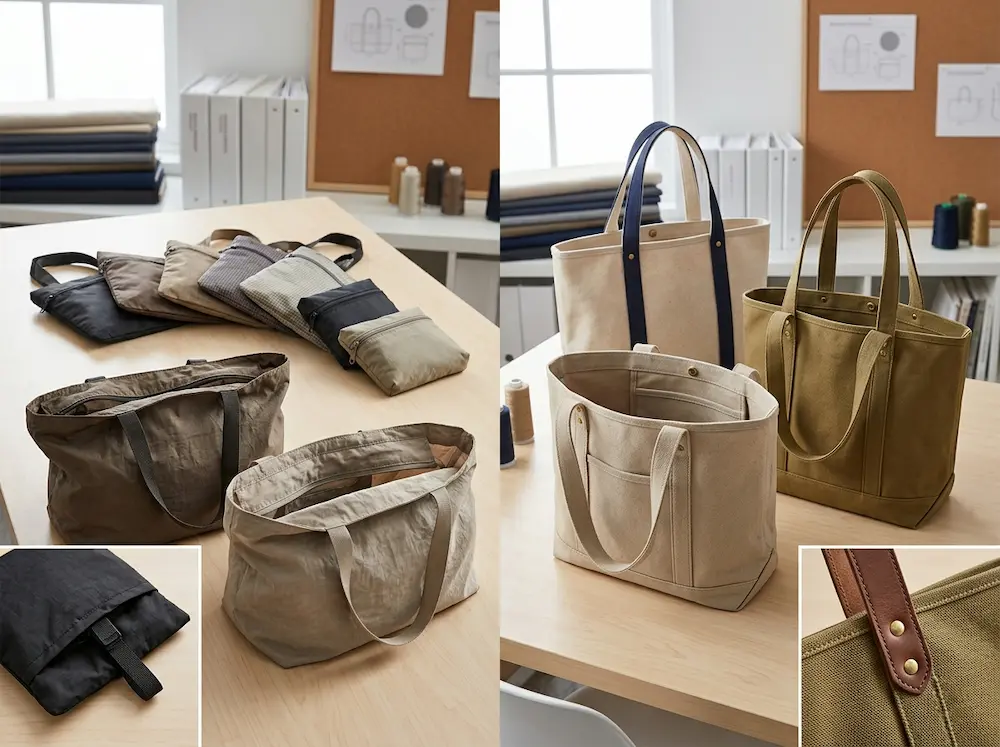
The comparison between foldable tote bags vs traditional tote bags matters because these two bag types often look similar in product photos but serve very different commercial purposes. Both are reusable. Both can be branded. Both can be used for retail, travel, giveaways, or merchandising. But once customers actually start using them, the differences become obvious.
A foldable tote bag is designed to disappear when it is not needed and become useful when extra carrying space is suddenly required. A traditional tote bag is designed to behave like a stable everyday carry product from the start. That difference changes how the bag should be sourced, branded, packed, and sold. Buyers who treat them as interchangeable usually end up choosing the wrong product for the job.
The smarter comparison is not “Which tote bag is better?” It is “Which tote bag is better for this use case?” Once that is clear, the decision becomes much easier.
What Foldable Tote Bags Really Do
Foldable tote bags are built around convenience. Their main value is that they can be stored compactly inside a handbag, backpack, suitcase, glove box, desk drawer, or travel pouch until they are needed. When the user suddenly needs extra carry capacity for shopping, documents, snacks, travel items, souvenirs, or light purchases, the foldable tote becomes useful immediately.
This makes foldable totes especially relevant in travel, airport retail, hospitality promotions, tourism merchandise, event kits, portable gifting, and everyday emergency carry. A product like foldable tote bags is valuable because it solves a space problem as much as a carrying problem. The bag is there without being in the way.
The weakness is obvious too. Foldability often requires lighter construction, simpler structure, and less stable body shape once the bag is opened. That trade-off is not a flaw. It is part of the product logic. But buyers need to understand it before sourcing.
What Traditional Tote Bags Really Do
Traditional tote bags are usually built as primary-use bags rather than backup bags. They are designed to be carried regularly, packed repeatedly, and used as visible everyday products. They may be used for groceries, books, retail shopping, commuting, conference items, lunch, work essentials, or general day-to-day carry.
Unlike foldable totes, traditional tote bags are not mainly trying to save storage space. They are trying to deliver better shape, stronger structure, more comfortable handles, and more stable everyday performance. That is why they often feel more dependable under repeated load and more natural in daily brand visibility.
When the bag is expected to stay in active circulation rather than hidden away until needed, traditional totes usually make more sense. They are often the better answer in bookstores, supermarkets, premium retail, corporate gifting, branded merchandise, and repeated-use shopping programs.
Portability: Where Foldable Tote Bags Win Clearly
If portability is the priority, foldable tote bags usually win without much debate. They are easier to store, easier to travel with, and more useful as just-in-case carry products. This matters a lot for travel, conferences, airport retail, tourism promotions, hotel merchandising, and compact everyday backup use.
A traditional tote bag may be more comfortable as a main-use bag, but it is rarely something people pack purely “in case they need it later.” A foldable tote is designed exactly for that moment.
This also explains why foldable totes sometimes overlap with other compact promotional products. Buyers comparing lightweight travel and event carry may also look at formats such as drawstring backpacks or drawstring bags with logo because the real question is often about portability and compact distribution rather than tote shape alone.
Structure and Carry Confidence: Where Traditional Tote Bags Usually Win
Traditional tote bags usually win on structure. They open more naturally, stand more comfortably when packed, and tend to feel more stable when carrying books, groceries, apparel, or day-to-day items. This is especially true when the bag uses stronger cotton, canvas, or other more substantial textile construction.
Foldable totes can still be useful, but many of them trade away some body strength and stability to achieve compact storage. That means they may not feel as reliable when fully loaded or used as a daily main bag. The bag is doing a different job, so the design compromise is understandable. But buyers should not expect the same experience from both product categories.
| Comparison Area | Foldable Tote Bags | Traditional Tote Bags |
|---|---|---|
| Storage efficiency | Very high | Lower |
| Travel convenience | Very strong | Moderate |
| Shape retention | Usually lower | Usually stronger |
| Everyday carry comfort | Depends on design and load | Usually stronger for repeated use |
| Heavy-use suitability | More limited | Usually better |
| Brand visibility life | Good if reused often | Usually stronger in daily public use |
Best Use Cases for Foldable Tote Bags
Foldable tote bags work best when the bag is expected to solve a storage problem first and a carrying problem second. That means travel retail, hotels, tourism shops, conference welcome kits, lifestyle gifting, airport promotions, compact event merchandise, and backup everyday shopping use.
They also work well when the customer is likely to appreciate the ability to pack the bag away. Someone carrying a foldable tote in luggage, a handbag, or a daypack is using it differently from someone reaching for a larger traditional tote every morning.
Foldable totes are especially good when the bag is a secondary tool. They are usually not the strongest answer when the bag is supposed to become the user’s main daily carry product.
Best Use Cases for Traditional Tote Bags
Traditional tote bags work best when the bag is expected to stay in regular visible use and carry a more substantial load or stronger brand role. That includes supermarket reuse, bookstores, daily shopping, office carry, employee kits, museum shops, school use, and branded merchandise designed for repeat visibility.
They are usually stronger when the bag itself needs to feel dependable and product-like rather than compact and temporary. This is particularly true when the bag is part of a larger retail or brand experience. A traditional tote is often not the most compact option, but it is often the stronger long-term use option.
Branding and Product Perception
Foldable and traditional tote bags also communicate different brand messages. A foldable tote often feels practical, portable, and travel-oriented. It suggests convenience, utility, and movement. A traditional tote often feels more stable, lifestyle-driven, and brand-visible in everyday routines.
This matters because the same logo printed on two different bag types can create very different product impressions. A compact foldable bag may work beautifully for tourism or airport gifting. The same logo on a structured everyday tote may work much better in a bookstore, café, or sustainable retail setting.
When the brand wants the bag to feel like a daily-use product rather than an emergency-use accessory, traditional totes usually offer stronger perception value. When the brand wants portability and practical convenience to lead the story, foldable totes often make more sense.
Cost and Freight Differences
Foldable tote bags can be economical in some shipping contexts because they are designed to pack efficiently, but that depends heavily on fabric and folding structure. Some foldable bags use lightweight materials that reduce freight weight and carton volume. Others add pouches, zips, or folding mechanisms that partially offset that advantage.
Traditional tote bags are often less efficient in compact storage because they are bulkier and more structured. But they can justify that cost if the product is stronger, more visible, and more likely to stay in use. The better landed-cost decision depends on what the business expects the bag to do after arrival.
In broad promotional merchandise planning, buyers sometimes compare both tote types against adjacent formats such as personalized drawstring bags or custom drawstring bags bulk because the real question is not always which tote is better, but which compact textile carry format creates the most useful balance of portability, visibility, and cost.
Which Is Better for Travel and On-the-Go Lifestyles?
For travel and on-the-go use, foldable tote bags usually win. They are easier to carry in reserve, more useful in last-minute shopping situations, and better matched to the unpredictable needs of trips, airports, tourism, and portable daily routines.
A traditional tote can still be used while travelling, but it is rarely as easy to keep “just in case” because it takes more space and feels more like a full-time bag. Foldable totes solve a temporary need with minimal inconvenience. That is exactly why they exist.
So when portability is the main criterion, the answer is usually clear. The foldable tote is doing the more relevant job.
Which Is Better for Main Everyday Use?
For main everyday use, traditional tote bags usually win. They are easier to load, more stable in hand, and more likely to feel comfortable and reliable over repeated daily use. If the bag is expected to carry books, groceries, lunch, work items, or retail purchases regularly, traditional construction usually makes more sense.
Foldable totes can still serve daily use in some light-carry contexts, but they are usually strongest as secondary bags rather than the bag someone chooses every day as their main carry product.
How Buyers Should Choose Between the Two
The smartest way to decide is to start with one practical question: is this bag meant to be a primary-use tote or a backup-use tote? That single distinction usually clarifies the rest of the sourcing logic.
If the bag needs to live in luggage, handbags, backpacks, or travel retail environments, foldable is usually the stronger answer. If the bag needs to handle routine daily use, stronger customer attachment, and repeated visible brand carry, traditional is usually the better choice.
Buyers should also ask whether the bag is being sold as a product, given away as a convenience item, or used as part of a larger merchandise system. Foldable totes often suit compact utility programs. Traditional totes often suit stronger, longer-life brand programs.
How to Choose the Right Supplier
A good supplier should not only ask what size bag you want. They should ask how the bag will be stored, how often it will be used, what it needs to carry, and whether portability or long-term carry performance matters more. A foldable bag sourced like a traditional tote can disappoint. A traditional tote sourced like a lightweight event giveaway can also disappoint.
The supplier should be able to explain folding method, fabric choice, handle strength, pack-out efficiency, and where the bag’s performance limits are likely to appear. That kind of guidance is much more useful than a simple catalogue answer.
This is where Youngpack-style product logic matters. The better manufacturing partner is usually the one that helps the buyer choose the right bag role first and the right tote construction second.
Conclusion
The difference in foldable tote bags vs traditional tote bags comes down to product role. Foldable totes usually win when compact storage, travel convenience, and emergency-use portability matter most. Traditional totes usually win when structure, everyday comfort, and long-term repeated carry matter more.
Neither is better in every situation. The better one is the bag that fits the real-life routine it is being asked to support. Buyers who choose based on that routine usually get a much stronger product result than buyers who compare only price or appearance.
How Buyers Should Think About Foldable Tote Bags vs Traditional Tote Bags
What this comparison really measures: Foldable and traditional tote bags do not only differ in how they look. They represent two different product roles. Foldable totes are built around compact storage and occasional-use convenience. Traditional totes are built around steadier structure, repeated daily use, and longer visible product life.
Why buyers often choose the wrong one: The most common mistake is comparing the two only by size or price. That misses the point. A foldable tote can be excellent if the user needs a bag that stays packed away until needed. A traditional tote can be excellent if the user needs a reliable, comfortable, everyday carry product. Problems usually begin when buyers expect one type to behave like the other.
How buyers should compare them properly: The strongest comparison method is to evaluate storage pattern, load expectation, reuse frequency, portability need, and branding role together. A travel retail bag, a hotel gift, a bookstore tote, and a supermarket reusable bag may all be called tote bags, but they should not all follow the same product logic.
Options businesses usually weigh: Most buyers compare compact convenience against stronger everyday performance, backup-use portability against main-use carry confidence, and event-friendly storage efficiency against longer-term visible reuse. The better choice depends on whether the bag’s main value is “easy to keep nearby” or “easy to keep using every day.”
Considerations before ordering: Before approving a bulk order, businesses should test real folding behavior, handle comfort, open bag size, packing efficiency, and whether the bag still feels right in actual use. They should also decide whether the product is solving a storage problem, a carry problem, or both. That answer usually settles the sourcing direction quickly.
The broader takeaway: The better tote bag is the one that fits the user’s real routine. That is also where Youngpack naturally fits as a B2B manufacturing and export partner for brands comparing foldable and traditional tote bag programs and needing practical guidance on portability, product positioning, and repeat-use value.
FAQ
1. Are foldable tote bags better than traditional tote bags?
Not always. Foldable tote bags are usually better when portability, compact storage, and travel convenience matter most. Traditional tote bags are usually better when the bag is expected to be used every day, carry heavier loads more comfortably, or stay in visible regular use. The better option depends on whether the bag is meant to be a backup carry solution or a main-use tote.
2. What is the main advantage of foldable tote bags?
The main advantage is storage efficiency. Foldable tote bags can be packed into luggage, handbags, backpacks, or drawers and kept ready until extra carrying space is needed. That makes them especially useful for travel, events, tourism, hotel promotions, and everyday “just in case” use. Their strongest commercial value comes from convenience and portability rather than from heavy-duty everyday performance.
3. Are traditional tote bags more durable than foldable totes?
In many cases, yes. Traditional tote bags are usually built with stronger structure, better shape retention, and more stable carry performance. That often makes them better for repeated daily use, groceries, books, and regular shopping. Foldable tote bags can still be durable enough for light and moderate carry, but they are usually designed with compact storage in mind, so they often trade away some structure and load confidence.
4. Which tote bag type is better for promotions?
It depends on the campaign. Foldable totes are often better for travel promotions, compact event gifts, and portable branded merchandise. Traditional totes are often better for daily-use promotional bags, retail gift-with-purchase, bookstores, supermarkets, and brand programs where the bag is meant to stay in public use longer. The right choice depends on whether the campaign needs convenience-first distribution or longer-term reuse visibility.
5. What should buyers check before choosing foldable or traditional tote bags in bulk?
Buyers should check how the bag will be stored, what it needs to carry, how often it will be reused, whether travel portability matters, and whether the brand wants the bag to feel like a compact utility item or a main-use product. They should also test samples for handle comfort, folding ease, real carrying behavior, and packing efficiency. The right choice becomes much clearer once the bag’s actual use pattern is defined.
References
- Preferred Fiber and Materials Market Report — Textile Exchange — Textile Exchange.
- Textiles and the Environment — European Environment Agency — EEA.
- Green Guides for the Use of Environmental Marketing Claims — Federal Trade Commission — FTC.
- Sustainable Packaging Guidelines — Australian Packaging Covenant Organisation — APCO.
- Fashion on Climate — Global Fashion Agenda and McKinsey & Company.
- Retail Packaging and Reusable Bag Sourcing Best Practices — professional sourcing reference.
- Responsible Sourcing and Product Communication in Textile Supply Chains — industry trade reference.
- Guide to Reusable Bags and Long-Term Use Value — industry best-practice sourcing reference.
Content Use Policy:
You are welcome to reference this article with proper attribution, but copying, republishing, or modifying the full content without permission is not permitted.