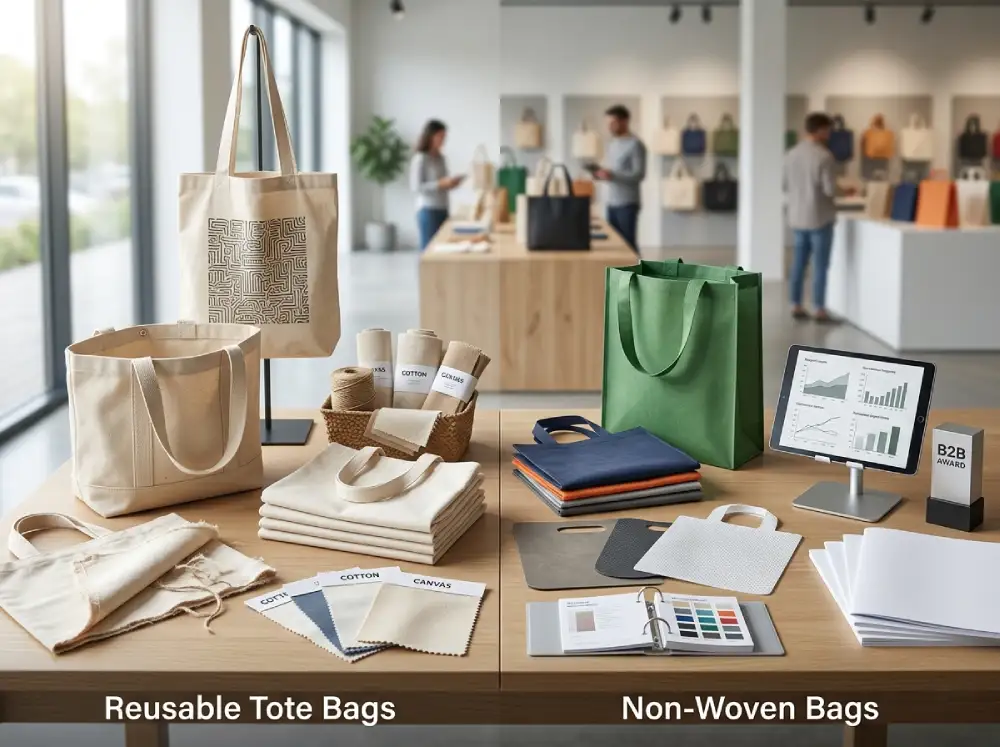
The comparison between reusable tote bags vs non woven bags is one of the most practical sourcing decisions facing retailers, promotional buyers, event organizers, and consumer brands. On paper, both options are reusable. Both can be branded. Both can be distributed in large volume. But in real commercial use, they behave very differently. They create different customer impressions, different carrying performance, different shipping logic, and very different long-term brand outcomes.
This is why buyers should not reduce the decision to a simple “cheap versus premium” mindset. Non woven bags are often chosen because they are lightweight, economical, and efficient for broad distribution. Reusable tote bags made from cotton, cloth, or canvas are often chosen because they feel more natural, more durable, and more likely to stay in everyday use. Neither option is automatically better in every project. The right answer depends on what the business is actually trying to achieve.
If the goal is only short-term reach at the lowest practical cost, non woven bags can still make commercial sense. If the goal is stronger product perception, better reuse quality, and more visible brand life after the first handout or purchase, reusable textile tote bags usually have a clear advantage. The smarter decision always begins with use case, not with assumptions about materials.
What Reusable Tote Bags and Non Woven Bags Really Are
Reusable tote bags in this comparison usually mean cloth-based, cotton-based, or canvas-based carry bags designed for repeated public use. They tend to feel softer, more natural, and more product-like. They are often used in retail, supermarkets, bookstores, cafés, conferences, gift programs, and daily lifestyle settings.
Non woven bags are typically made from non woven polypropylene or similar synthetic sheet material. They are not woven like fabric in the usual textile sense. Instead, they are bonded into sheet form, which allows them to be lightweight, low-cost, and highly efficient for printing and bulk manufacturing. They are widely used in exhibitions, supermarkets, events, conferences, and large promotional campaigns because they can deliver practical bag function at a lower short-term cost.
The most important thing to understand is that these two categories do not compete only on material. They compete on product role. One often behaves more like lightweight promotional packaging. The other often behaves more like a reusable everyday product.
Why Buyers Compare These Two Bag Types So Often
Buyers compare reusable tote bags and non woven bags because both solve the same basic carrying problem while sitting at different points on the cost-value spectrum. They are both used in retail and promotional settings, both can be branded, and both can be produced in volume. On the surface, they appear interchangeable. In practice, they are not.
A business that wants a one-time event bag, a supermarket carry option, a branded gift bag, and a long-life reusable bag program might look at both categories before deciding. That is sensible. The mistake is assuming they deliver the same result once they leave the warehouse. They do not.
For example, a softer reusable textile bag such as cloth tote bags may create a much stronger everyday carry impression than a non woven bag, even if both are technically reusable. That difference is exactly why the comparison matters.
Material Feel and Customer Perception
One of the biggest differences between these bag categories is how they feel. Reusable cotton, cloth, and canvas totes usually feel more familiar and more natural in the hand. They often align better with lifestyle-oriented retail, sustainable branding, bookstores, cafés, gift shops, and daily personal use. A well-made tote bag feels like something the user might continue carrying even when the original campaign or purchase is over.
Non woven bags feel more functional. They can still look professional and useful, but they usually signal utility first rather than product value. In many business contexts that is completely acceptable. A conference bag, an exhibition giveaway, or a supermarket promotional bag does not always need to feel premium. But buyers should be honest about the difference. The emotional and brand experience is not the same.
This is especially important when the bag is expected to act as visible brand media. A more carefully developed textile tote can support stronger brand expression, especially in projects that lean toward products like custom made tote bags where the bag is expected to reflect more than just a printed logo.
Durability and Load Performance
Durability is another key difference. Non woven bags can be surprisingly practical for moderate carry use, especially when made at suitable weight and with proper stitching or heat-sealed construction. But they usually do not create the same long-life carry confidence as stronger cotton or canvas structures.
Reusable tote bags, especially heavier cotton or canvas styles, generally perform better under repeated loading, daily use, and longer service life expectations. This matters in grocery retail, bookstore use, recurring shopping trips, and any situation where the bag is expected to stay in circulation for a long time.
For stronger reusable programs, products such as cotton canvas tote bags usually offer better long-term structural performance than standard non woven bags, especially when the bag will carry denser items or be used frequently over time.
| Comparison Area | Reusable Tote Bags | Non Woven Bags |
|---|---|---|
| Hand feel | Softer, more natural, more product-like | Lighter, more functional, more synthetic |
| Load confidence | Usually stronger over repeated use | Good for light to moderate carry |
| Long-term durability | Usually higher with proper construction | Moderate, depending on GSM and finishing |
| Retail perception | Higher perceived value | More campaign or utility-oriented |
| Shipping efficiency | Lower, especially in heavier materials | Higher for bulk distribution |
| Best use style | Longer-life reusable carry and brand programs | Large-scale promotions and practical event use |
Cost: Where Non Woven Bags Usually Win
If the main question is immediate unit price, non woven bags usually have the advantage. They are generally lighter, easier to pack densely, and more economical for very large distributions. That is why they remain popular in exhibitions, conferences, supermarkets, community campaigns, education programs, and broad event merchandise.
They also tend to create stronger freight efficiency because the material is lighter and the finished bag is less bulky than many textile totes. This can matter a lot in high-volume international shipping and warehouse operations.
But businesses should not confuse lower unit price with better total value. A cheaper bag that is discarded quickly or that creates weak brand perception may not be the stronger commercial answer in all cases. Lower cost is only better when it fits the actual purpose of the bag program.
Long-Term Value: Where Reusable Textile Tote Bags Usually Win
Reusable tote bags usually cost more, especially once the project moves into heavier cotton or canvas constructions. But they often create better long-term value when the bag is intended to stay in real public use. This is where textile totes often outperform non woven bags most clearly.
A reusable tote bag that people actually keep using becomes moving brand media. It carries the logo, store identity, or campaign message through daily routines rather than only through the original event or purchase moment. That kind of visibility is much harder to achieve with a bag that feels temporary or too utilitarian.
For everyday-use brand programs, even a simple cotton tote can create better commercial value over time than a cheaper non woven alternative if the user is much more likely to carry it repeatedly.
Branding and Print Considerations
Both categories can be printed well, but the result is different. Non woven bags often support very practical, high-contrast branding at scale. They work well for trade shows, event identity, supermarket promotions, and campaigns where the goal is immediate visibility at low cost. The print is usually judged as part of the campaign, not as part of a long-life product.
Textile reusable totes often support stronger brand positioning because the bag itself feels more intentional. Even simple printing on cloth or cotton can look more lifestyle-driven and less temporary. That is why brands that care about repeat public visibility often prefer reusable textile bags when the bag is expected to behave more like merchandise than packaging.
The better branding surface therefore depends on the role of the bag. If the bag is a short-term campaign tool, non woven can work very well. If the bag is expected to continue representing the brand long after distribution, reusable textile totes usually have more upside.
Environmental Positioning and Real-World Reuse
This comparison is often oversimplified. Many buyers assume cloth or cotton tote bags are automatically more environmentally responsible than non woven bags. That is not always true in practice unless the textile bag is genuinely reused enough times to justify its higher material input and freight weight.
At the same time, non woven bags are often marketed as reusable alternatives to single-use bags, but their environmental value depends heavily on whether they are actually reused and how long they remain in service. A non woven bag that is used only once or twice does not create a very strong reusable logic. A textile tote that is kept in circulation for months or years usually creates a stronger long-term sustainability story.
The real answer comes back to behavior. The bag that gets used repeatedly and appropriately is usually the one with the better practical environmental outcome. That is why product design and customer fit matter more than green language alone.
Best Use Cases for Reusable Textile Tote Bags
Reusable cotton, cloth, and canvas tote bags work best when the bag is expected to stay in regular use and contribute to customer experience, not just product carry. They are especially strong in bookstores, cafés, premium retail, organic food stores, museums, lifestyle brands, tourism merchandise, employee kits, and gift-with-purchase programs.
They are also strong when the bag is part of an everyday-use brand strategy. The more naturally the tote fits daily shopping, commuting, carrying books, or general errands, the more likely it is to remain visible over time.
For businesses building long-term branded bag systems, reusable tote bags usually make the most sense when the product is meant to feel like a reusable asset, not a one-time distribution tool.
Best Use Cases for Non Woven Bags
Non woven bags usually work best when the bag must be produced economically at scale and the campaign does not require deep lifestyle or product value. They are widely used in exhibitions, trade shows, conferences, retail promotions, seasonal campaigns, schools, supermarkets, and mass community distribution.
They are also practical when the bag needs to carry a defined set of contents once or a few times without requiring premium perception. If the buyer needs a lightweight, brandable, and affordable reusable-style bag for broad exposure, non woven can still be a highly effective commercial answer.
The key is to use non woven where utility and reach matter more than premium feel or long-term everyday adoption.
How Bulk Ordering Changes the Decision
Order volume changes the economics significantly. At very large volumes, non woven bags usually become even more attractive because they offer strong unit-price efficiency and easier freight control. This is why they are so common in large-scale promotional and supermarket programs.
Reusable tote bags become more compelling when the order is part of a repeat-use strategy rather than a pure distribution strategy. Once the design is stable and the product is expected to be reordered over time, programs such as cotton tote bags bulk can make more sense because the higher per-piece cost is balanced by better long-term product value, repeat visibility, and stronger customer retention.
| Program Type | Better Fit | Main Reason |
|---|---|---|
| Trade shows and mass events | Non woven bags | Lower cost and easy large-scale distribution |
| Supermarket reusable bag programs | Depends on strategy | Non woven for economy, textile totes for longer reuse value |
| Bookstores and lifestyle retail | Reusable tote bags | Stronger product feel and higher reuse appeal |
| Corporate gifts and premium kits | Reusable tote bags | Better perceived quality and longer brand life |
| School, campaign, or community distribution | Non woven bags | Efficient volume economics |
How to Choose the Right Supplier for Either Option
A good supplier should not simply ask whether you want cotton or non woven. They should ask how the bag will be used, who will receive it, how long it is expected to stay in use, what it needs to carry, what the budget logic is, and how important the bag is to overall brand presentation.
For reusable textile totes, the supplier should be able to explain fabric weight, stitching, handle reinforcement, print behavior, and pack-out efficiency. For non woven bags, they should explain GSM range, shape stability, sewing or sealing method, and whether the bag is intended for one-time, moderate, or longer reuse. A supplier that cannot connect the bag type to the commercial use case is usually not giving enough real guidance.
This is where Youngpack-style supplier logic matters. The stronger partner is usually the one that helps define the right bag system for the project rather than simply selling whichever category is cheapest or easiest to quote.
Conclusion
The comparison between reusable tote bags vs non woven bags is not about one material winning in every situation. Non woven bags are usually better when cost efficiency, lightness, and mass distribution matter most. Reusable textile tote bags are usually better when the project depends on stronger everyday use, higher perceived value, and longer-term brand visibility.
So which is better? The better option is the one that matches the real purpose of the bag. If the business wants fast reach and economical promotion, non woven bags often make sense. If the business wants a bag that people keep using and that keeps representing the brand in public, reusable tote bags usually offer more. Buyers who define that purpose clearly usually make the right decision.
How Buyers Should Think About Reusable Tote Bags vs Non Woven Bags
What this comparison really measures: Reusable tote bags and non woven bags do not only represent two different materials. They represent two different commercial strategies. Non woven bags are usually optimised for efficient high-volume reach, while reusable textile totes are usually optimised for stronger carry life, better customer perception, and more visible long-term brand value.
Why the answer is not automatic: A non woven bag can be a smart decision when the campaign needs affordable scale, moderate reuse, and easy logistics. A reusable cotton or canvas tote can be a smarter decision when the bag is expected to stay in public use and carry the brand for much longer. The better option depends on how the bag will be used after distribution, not just on how it looks in a sample room.
How buyers should compare the two: The strongest comparison method is to evaluate cost horizon, likely reuse rate, customer perception, print role, and carrying requirements together. A supermarket promotion, a bookstore tote, a corporate gift bag, and a trade show giveaway may all need reusable bags, but they should not all be sourced through the same logic.
Options businesses usually weigh: Most buyers compare lower-cost high-volume non woven distribution against stronger but more expensive textile reuse, utility-first programs against brand-first programs, and short campaign visibility against longer public circulation. The right answer becomes much clearer once the business decides whether the bag is mainly a functional carrier or a reusable branded product.
Considerations before placing the order: Before approving either option, buyers should verify sample feel, stitching or sealing quality, print behavior, handle comfort, freight logic, and whether the product still makes sense at the intended volume. They should also check whether the bag is likely to be reused enough to support the business case being made for it.
The broader takeaway: The best bag program is not automatically the cheapest or the most premium. It is the one that matches the real job of the bag most honestly. That is also where Youngpack naturally fits as a B2B manufacturing and export partner for both reusable tote and non woven bag programs that need clearer product positioning, practical sourcing logic, and dependable repeat quality.
FAQ
1. Are reusable tote bags better than non woven bags?
Not in every case. Reusable textile tote bags are often better when the bag is expected to stay in long-term everyday use, create stronger brand visibility, and feel more like a product than a giveaway. Non woven bags are often better when the project needs lower unit cost, lighter weight, and high-volume promotional distribution. The better option depends on whether the business is optimising for long-term reuse or short-term scale.
2. Are non woven bags really reusable?
Yes, they can be reusable, but their real value depends on how often they are actually reused. Non woven bags are often stronger than single-use bags and work well for moderate repeat use, especially in promotions, supermarkets, and events. However, they do not usually create the same long-life carry appeal as well-made cotton or canvas totes. Their reuse potential is practical, but often more limited in lifestyle and long-term product terms.
3. Which is cheaper, reusable tote bags or non woven bags?
Non woven bags are usually cheaper upfront because they use lighter material, are easier to ship in bulk, and are designed for cost-efficient mass production. Reusable cotton, cloth, and canvas tote bags usually cost more per piece. However, textile totes can create better long-term value when they are reused more often and provide stronger brand visibility over time. The cheaper option depends on whether the buyer is looking only at immediate unit cost or overall product value.
4. Which bag type is better for branding?
Both can support branding, but in different ways. Non woven bags are often better for large-scale promotional reach and short-term event visibility. Reusable tote bags are usually better for long-term public brand presence because they are more likely to stay in everyday use. If the brand wants the bag to feel like a reusable lifestyle product, textile tote bags usually offer stronger branding value than non woven bags.
5. What should buyers check before choosing between tote bags and non woven bags?
Buyers should check how the bag will be used, what it needs to carry, how long it is expected to stay in use, how important brand perception is, what the unit-cost target is, and whether the bag is for one-time distribution or a repeat-use program. They should also test samples for print quality, handle comfort, material feel, and carrying performance. The right choice is the one that matches the real commercial job of the bag.
References
- Preferred Fiber and Materials Market Report — Textile Exchange — Textile Exchange.
- Textiles and the Environment — European Environment Agency — EEA.
- Green Guides for the Use of Environmental Marketing Claims — Federal Trade Commission — FTC.
- Sustainable Packaging Guidelines — Australian Packaging Covenant Organisation — APCO.
- Fashion on Climate — Global Fashion Agenda and McKinsey & Company.
- Responsible Sourcing and Product Communication in Textile Supply Chains — industry trade reference.
- Retail Packaging and Reusable Bag Sourcing Best Practices — professional sourcing reference.
- Guide to Reusable Bags and Long-Term Use Value — industry best-practice sourcing reference.
Content Use Policy:
You are welcome to reference this article with proper attribution, but copying, republishing, or modifying the full content without permission is not permitted.