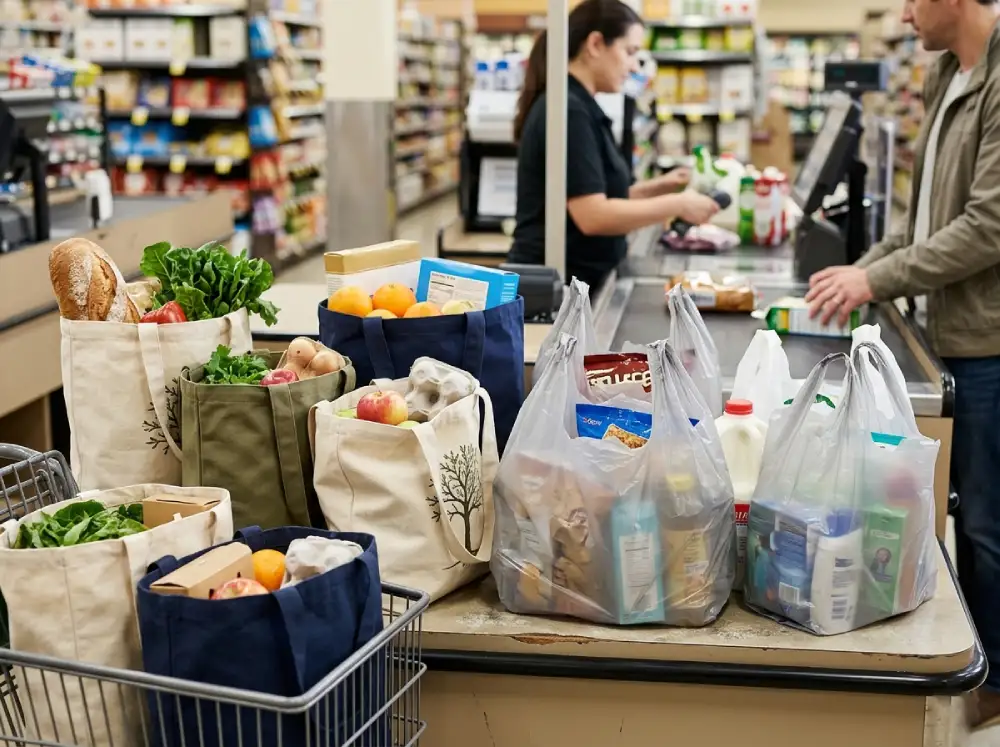
The debate around tote bags vs plastic bags is often framed too narrowly. Many businesses ask which option is cheaper, while consumers and regulators often ask which option is better for the environment. Both questions matter, but neither can be answered honestly with one short slogan. Plastic bags are usually cheaper at the moment of purchase. Tote bags usually carry more potential for reuse, stronger brand visibility, and lower dependence on disposable packaging over time. The problem is that those benefits only matter if the tote bag is actually useful enough to stay in circulation.
This is why the comparison should not be treated as “plastic bad, tote good” or “plastic cheap, tote expensive.” Real decisions depend on the use case, the store model, the distribution scale, the expected reuse rate, and whether the bag is acting as packaging, merchandise, or long-term brand media. A bag that is reused for months creates a very different commercial and environmental outcome from a bag that is discarded after one trip, even if both are technically reusable.
For retailers, supermarkets, cafés, and consumer brands, the smarter question is not simply which bag is better in theory. It is which bag creates the best balance between cost, function, regulation pressure, customer experience, and long-term product logic.
Why Businesses Still Compare Tote Bags and Plastic Bags
Businesses continue comparing these two categories because both solve the same basic problem: helping customers carry purchased goods. But the commercial role of each is different. Plastic bags are still often treated as low-cost functional packaging. Tote bags increasingly sit between packaging, reusable product, and branding tool.
That difference matters because the business objective may not be the same. A convenience store offering emergency carry for a few items is solving a different problem from a supermarket building a reusable bag strategy. A premium retailer is solving a different problem from a low-cost discount chain. A tote bag program that supports repeated brand visibility may justify itself very differently from a basic disposable carry option.
This is why many businesses now compare standard carry options against reusable textile formats such as cloth tote bags when they want something that supports both everyday use and more visible long-term brand presence. The point is no longer only to move goods from checkout to car. It is also to reduce disposable dependence and strengthen customer-facing identity.
Upfront Cost: Where Plastic Bags Usually Win
If the question is only immediate unit price, plastic bags usually win. They are lightweight, cheap to produce at scale, easy to store, and simple to distribute. For high-volume retail environments with cost pressure and low customer expectations around bag quality, that matters. A plastic bag usually solves the carry problem at the lowest immediate transaction cost.
Plastic bags also tend to take up less storage space and lower freight cost per unit because they are thin, compact, and highly efficient in volume terms. For businesses that focus heavily on short-term operating expense, this is the strongest argument in their favor.
But this advantage should not be overstated. Low upfront cost does not automatically mean low total cost if the business is also facing customer pressure, regulatory risk, brand perception issues, or sustainability expectations that plastic bags do not address well. Cheap at checkout does not always mean commercially better across the full product and customer cycle.
Long-Term Cost: Where Tote Bags Can Gain Ground
Tote bags usually cost more per piece, sometimes much more depending on fabric, construction, and print. But they can create better long-term value when the bag is reused often enough and when the brand benefits from that reuse. A tote bag can carry a logo, store identity, or campaign message into public spaces repeatedly. A plastic bag usually has much shorter life and weaker perception value.
Tote bags can also reduce the need for repeated distribution if customers bring them back or keep reusing them. This is particularly relevant in supermarkets, bookstores, organic retail, and lifestyle-driven consumer brands where the bag is part of a broader reusable shopping culture rather than just a one-time packaging item.
For businesses planning larger repeat-use systems, products such as cotton tote bags bulk become commercially relevant because the economics improve once the bag is part of an ongoing distribution model instead of a one-off premium extra.
| Cost Perspective | Plastic Bags | Tote Bags |
|---|---|---|
| Unit price | Usually lower | Usually higher |
| Storage efficiency | Very high | Lower, especially for heavier fabrics |
| Freight efficiency | Very high per unit | Lower per unit due to fabric bulk |
| Reuse value | Usually low | Potentially high if the bag is useful |
| Brand visibility life | Usually short | Potentially long |
| Total value over time | Strong only in short-term low-cost logic | Stronger when reuse and brand carry matter |
Environmental Impact: Why the Comparison Is Not Simple
The environmental comparison between tote bags and plastic bags is often simplified in public discussions, but the real picture depends on use frequency, material type, and disposal behavior. A plastic bag is a disposable product with very low immediate material weight, but it also contributes to a single-use culture and often performs poorly in public sustainability perception. A tote bag uses more material upfront, especially in cotton or canvas formats, so it generally needs repeated use to justify that initial production footprint.
That is the key point. A tote bag does not become environmentally stronger just because it is made of fabric. It becomes stronger when it is reused enough times to spread that material cost over a longer service life. If the tote bag is barely used, the environmental benefit becomes much weaker. If it is used regularly for shopping, commuting, work, or daily carry, the balance shifts significantly.
This is one reason why a simple cotton tote can be more credible than an overdesigned but rarely reused bag. Everyday practicality matters more than sustainability slogans when the product’s real environmental impact is tied to actual behavior.
Reuse Is the Real Turning Point
Reuse is where the comparison changes most dramatically. Plastic bags are often reused informally for trash, storage, or household purposes, but their design intention and lifespan are still usually short. Tote bags are built to remain in public use much longer, but only if the bag is comfortable, useful, and durable enough.
This means businesses should not treat any reusable tote bag as automatically better. The product still needs to be designed around likely customer behavior. If the bag is too weak, too awkward, or too generic to keep using, its environmental and commercial value drops fast. The strongest reusable bag programs are usually based on products that fit into real everyday routines naturally.
That is why product design matters just as much as material. A bag that people genuinely want to carry is more likely to deliver both lower disposable dependence and stronger brand carry over time.
Brand Value: Tote Bags Usually Offer More
Plastic bags can carry branding, but their life in public is usually too short to deliver deep recall. Tote bags, by contrast, can keep carrying the brand for months or years if the product remains useful. This is one of the biggest reasons tote bags have become more strategic for modern retailers and consumer brands.
A tote bag acts as moving media. It travels through stores, streets, public transport, campuses, cafés, and offices. That kind of visibility is much harder to create with a disposable plastic bag. If the bag is also visually appealing, its branding becomes even more durable because customers keep using it willingly rather than only out of convenience.
In higher-control product programs, some businesses move toward more developed branded products such as custom made tote bags when they want the tote bag to behave like part of the brand identity rather than a generic replacement for plastic packaging.
Performance in Grocery and Retail Use
Plastic bags can work reasonably well for light or moderate purchases, but their carrying comfort, structure, and repeat-use value are limited. In grocery settings, they often struggle with heavier mixed loads, especially when products have sharp edges or uneven weight distribution. Tote bags, particularly stronger cotton or canvas formats, usually perform better in repeated grocery and retail use because they are designed for more load confidence and longer service life.
This is why many businesses that move away from plastic for practical reasons eventually compare stronger reusable options such as cotton canvas tote bags. These bags are usually better suited to repeated shopping behavior, especially when customers are expected to bring them back or continue using them for everyday carry.
That does not mean tote bags should replace every plastic carry format in every context. It means that where repeated use is realistic, tote bags often offer better product performance as well as stronger brand logic.
Customer Perception and Modern Retail Expectations
Customer perception has shifted. In many markets, plastic bags increasingly signal low-cost convenience rather than responsible or modern brand behavior. Tote bags, especially those made from cotton or cloth, often communicate more thoughtful, reusable, and lifestyle-oriented values. This matters even when the customer is not consciously calculating environmental impact. The bag still shapes how the retail experience feels.
For lifestyle brands, organic retailers, bookstores, cafés, and design-led consumer businesses, tote bags often align better with customer expectation simply because they feel more consistent with reusable daily habits. In contrast, plastic bags can increasingly feel out of place in these environments unless the format serves a very narrow convenience role.
That perception gap is not universal, but it is commercially significant in many categories. Buyers should therefore consider not only operational cost, but also whether the chosen bag still matches where the brand wants to sit in the market.
Where Plastic Bags Still Make Commercial Sense
Plastic bags still make sense in some situations. Very low-cost retail formats, convenience-based distribution, short-duration carry needs, and emergency single-trip use can still favor plastic from a narrow cost-efficiency standpoint. In highly price-sensitive environments, the move away from plastic can also require customer education or pricing adjustments that not every retailer is ready to manage immediately.
Plastic can also remain relevant where regulations still allow it and where the customer relationship is more functional than brand-led. But even in those cases, the business should be honest about the trade-off. The decision is usually about cost convenience, not stronger long-term product logic or better visible sustainability positioning.
Where Tote Bags Make More Strategic Sense
Tote bags make more sense when the business wants longer product life, stronger customer reuse, lower reliance on disposable packaging, and more visible brand carry. They are especially strong in supermarkets, bookstores, premium retail, community programs, tourism, event merchandising, and any business model where the bag itself can become a repeated-use asset.
The strongest tote bag strategy is not necessarily the most expensive one. It is the bag that fits actual customer behavior. A simple reusable cotton tote can sometimes be more effective than a heavy premium bag if it suits the customer’s routine better. The right answer is the one that maximizes realistic reuse rather than symbolic positioning alone.
How Businesses Should Decide
The best decision usually begins with four questions. First, how often will the bag really be reused? Second, is the business optimizing for lowest immediate cost or stronger long-term brand value? Third, what are customers likely to expect in this retail environment? Fourth, does the product logic align with the company’s broader positioning on packaging and sustainability?
If the answers point toward short-term cost efficiency and low brand sensitivity, plastic may still remain the functional answer in some markets. If the answers point toward stronger public visibility, customer reuse, and more credible sustainability direction, tote bags are usually the better long-term choice. The more reusable the customer behavior becomes, the stronger the tote bag case gets.
Conclusion
The comparison between tote bags vs plastic bags is not a simple winner-takes-all question. Plastic bags usually win on immediate price and compact operational efficiency. Tote bags usually win on long-term brand value, reuse potential, and stronger alignment with modern retail expectations when the product is designed well enough to stay in use.
So which is better? If the business is measuring only short-term transaction cost, plastic often looks stronger. If the business is measuring total product value, customer perception, and reusable brand carry over time, tote bags usually offer more. The smarter choice depends on the time horizon and the honesty of the commercial objective.
How Businesses Should Think About Tote Bags vs Plastic Bags
What this comparison really measures: Tote bags and plastic bags do not only represent two materials. They represent two different packaging models. Plastic bags are usually optimized for immediate low-cost convenience, while tote bags are optimized for repeat use, stronger customer-facing value, and more visible long-term brand presence.
Why the answer is not one-dimensional: A plastic bag can still make sense in narrow cost-sensitive situations, and a tote bag is not automatically the better environmental choice unless it is genuinely reused. The more useful and reusable the tote becomes, the stronger its environmental and commercial case becomes. The less it is used, the weaker that case becomes.
How buyers should compare the two: The strongest way to compare them is to evaluate upfront cost, real reuse rate, customer perception, freight and storage efficiency, and public brand visibility together. A business focused on the cheapest one-trip carry solution will reach a different conclusion from a business focused on long-term reusable brand value.
Options businesses usually weigh: Most retailers compare disposable convenience against reusable identity, short-term operating cost against longer-term marketing value, and simple carry function against product programs that support sustainability positioning. The right answer depends on whether the business wants a bag that disappears quickly or one that keeps representing the brand over time.
Considerations before switching strategy: Before moving from plastic to tote bags, businesses should check how customers actually carry products, how likely they are to reuse the bag, how much extra landed cost the new program creates, and whether the brand gains enough value from stronger public visibility and more responsible positioning to justify the change.
The broader takeaway: Tote bags are usually the stronger long-term choice when the business wants real reuse, stronger customer perception, and more credible movement away from disposability. Plastic bags are usually the stronger short-term choice when immediate cost and minimal complexity dominate the decision. That is also where Youngpack naturally fits as a B2B manufacturing and export partner for businesses that want reusable bag programs built around real product logic rather than generic sustainability claims.
FAQ
1. Are tote bags really better for the environment than plastic bags?
They can be, but only when they are genuinely reused enough times to justify their higher material input. A tote bag is not automatically better just because it is made from fabric. Its environmental value comes from repeated use over time. If the bag is durable, practical, and actually used in daily life, it can offer a stronger environmental outcome than a disposable plastic bag. If it is barely used, the benefit becomes much weaker.
2. Why are plastic bags still cheaper than tote bags?
Plastic bags are usually cheaper because they use very little material per unit, are easy to produce at large scale, and pack and ship very efficiently. Tote bags use more material, require sewing or more complex fabrication, and take up more space in cartons and storage. That is why the immediate price comparison almost always favors plastic, especially in very high-volume retail environments.
3. Do tote bags create better branding value than plastic bags?
In most cases, yes. Tote bags usually stay in circulation longer and continue carrying the brand in public spaces such as streets, shops, cafés, offices, and public transport. Plastic bags generally have a much shorter visible life. If the tote bag is useful enough to keep using, it becomes a stronger long-term brand surface than a disposable plastic bag ever can.
4. When should a business still choose plastic bags?
A business may still choose plastic bags when immediate unit cost, storage efficiency, and simple one-trip convenience matter more than long-term brand visibility or reusable product value. This is more common in low-cost retail or purely functional carry situations. However, the business should recognize that this choice usually prioritizes short-term efficiency rather than stronger sustainability positioning or customer reuse behavior.
5. What should buyers consider before switching from plastic bags to tote bags?
Buyers should consider real customer reuse habits, bag design quality, intended retail environment, total landed cost, storage space, and whether the brand benefits from longer public visibility. They should also consider whether the tote bag is actually practical enough to remain in use. A well-designed tote bag can create strong long-term value, but only if it fits customer behavior and is not treated as a symbolic replacement with little real utility.
References
- Preferred Fiber and Materials Market Report — Textile Exchange — Textile Exchange.
- Textiles and the Environment — European Environment Agency — EEA.
- Green Guides for the Use of Environmental Marketing Claims — Federal Trade Commission — FTC.
- Sustainable Packaging Guidelines — Australian Packaging Covenant Organisation — APCO.
- Fashion on Climate — Global Fashion Agenda and McKinsey & Company.
- Retail Packaging and Reusable Bag Sourcing Best Practices — professional sourcing reference.
- Responsible Sourcing and Product Communication in Textile Supply Chains — industry trade reference.
- Guide to Reusable Bags and Long-Term Use Value — industry best-practice sourcing reference.
Content Use Policy:
You are welcome to reference this article with proper attribution, but copying, republishing, or modifying the full content without permission is not permitted.