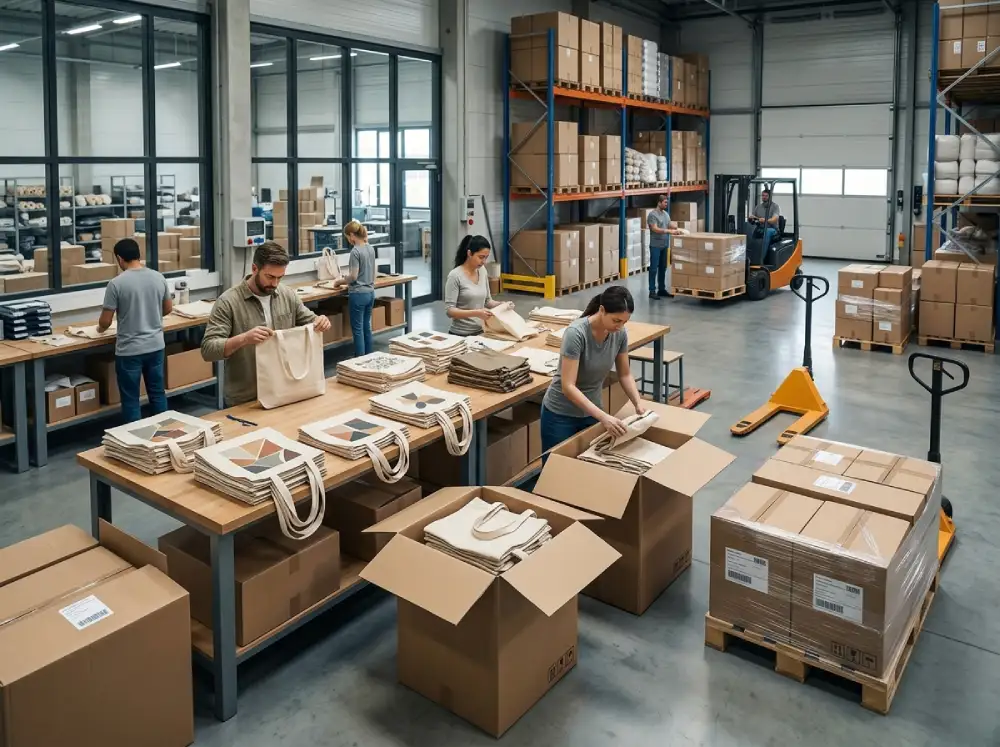
A tote bag order only looks simple until it reaches the export stage. A product that appears easy to produce can still run into problems with packing efficiency, shipping timing, customs documentation, label compliance, or shipment damage if the supply chain is not handled properly. That is why a real tote bag export guide must begin long before the goods leave the factory. The export result is shaped by decisions made during development, sampling, production, inspection, and packing just as much as by freight booking itself.
For importers, distributors, retail buyers, and promotional merchandise companies, the biggest export mistake is treating manufacturing and shipping as separate topics. They are not separate. A weak specification can create production delays. Poor pack-out can inflate freight cost. Inconsistent material can complicate inspection. Bad carton planning can cause warehouse problems after arrival. The strongest export programs come from managing all these points as one connected system.
This is especially true for custom tote bags, where size, print, material, handle construction, and packing method all affect how the product behaves in production and how efficiently it moves through international shipping. Export success is usually less about one dramatic issue and more about avoiding a chain of smaller preventable mistakes.
Why Tote Bag Export Planning Starts Before Production
Many buyers wait until the order is nearly finished before they start asking export questions. That is too late. By the time the goods are ready, the product design has already shaped carton count, shipping volume, compliance requirements, and possible customs risk.
For example, a lightweight general-purpose tote and a more structured premium tote do not export the same way. A simple cotton tote may fold compactly and ship efficiently. A heavier branded canvas bag may consume more space, require stronger cartons, and need more careful quality control because print and sewing defects are more visible. If the buyer wants a product with stronger brand presence, such as custom canvas bags with logo, then production and shipping planning should reflect that from the beginning rather than treating the bag like a basic commodity item.
Export planning also depends on market, season, and urgency. A standard replenishment order for a regular distributor follows a different timeline from a holiday promotional order, a retail launch program, or a conference deadline. Buyers and suppliers should therefore align shipment timing with the commercial purpose of the order, not just factory completion.
Step 1: Define the Product Properly Before Sampling
Export stability begins with specification clarity. A tote bag order should define fabric type, weight, bag size, gusset, handles, stitching expectations, print method, artwork placement, labels, packing method, and target market before sampling moves too far forward. If those points stay vague, problems usually appear later in either production or customs preparation.
This matters because unclear bag specs create chain reactions. If size changes late, packing count changes too. If material changes late, print behavior and lead time can shift. If the bag is intended for long-term branded reuse rather than simple giveaway use, buyers may need to move toward more tailored formats such as custom made tote bags, which usually require stronger coordination between artwork approval, sample confirmation, and export timing.
The smarter the product definition is at the start, the less correction is needed later. In export work, correction is expensive because it affects not only production but also booking windows, warehouse planning, and customs timelines.
Step 2: Sampling Is Also an Export Control Stage
Sampling should never be treated as only a visual approval step. In export-oriented tote bag projects, the sample stage also helps confirm whether the product can be manufactured consistently, packed efficiently, and shipped without avoidable surprises.
At sample stage, buyers should check more than look and feel. They should verify real dimensions, handle comfort, stitching strength, print quality, color accuracy, and whether the bag fits the intended products or end use. If the bag is meant for grocery-style reuse or heavier retail carry, the sample should be load-tested under realistic use rather than approved purely as a display piece.
This is especially important for stronger reusable structures like cotton canvas tote bags, where small sewing or reinforcement weaknesses can become much more visible once the goods reach the customer. Export buyers should use sampling to reduce mass-production risk, not just to confirm artwork.
Step 3: Production Planning and Lead Time Control
Lead time is not one number. It is usually a sequence: material procurement, sample revision if needed, artwork confirmation, pre-production setup, sewing and printing, quality inspection, final packing, and shipment readiness. Buyers who only ask for “lead time” without breaking down the stages often misunderstand where the real schedule pressure sits.
Tote bag production lead times vary by order size, material, print complexity, and season. Simpler cotton bags with basic printing are often easier to schedule. Heavier canvas bags, special trims, large volume runs, or multiple SKUs need more coordination. Rush promises are often a warning sign if they are not supported by detailed planning.
Export-oriented buyers should ask suppliers for realistic milestone timing, not only final completion date. That means knowing when fabric will be ready, when pre-production samples will be approved, when bulk printing starts, when inspection can happen, and when the shipment can actually be booked.
Step 4: Quality Control Before Packing and Shipping
Quality control is not just about whether the bag looks acceptable. It also affects whether the shipment moves smoothly. If the goods fail inspection late, the whole shipping schedule can slip. If defects are found after container loading, correction becomes much more expensive.
The most common tote bag export issues are usually practical rather than dramatic: inconsistent fabric tone, stitching variation, print misalignment, dirty marks, wrong size tolerance, weak handle attachment, and packing count mistakes. These are the problems that create disputes after arrival if they are not caught before shipment.
Buyers should therefore agree in advance on inspection standards. That includes acceptable size variance, artwork position tolerance, carton count accuracy, and whether random pull testing for seam and handle strength is required. A clear pre-shipment QC process reduces both logistics risk and commercial disagreement later.
Step 5: Packing Method and Carton Efficiency
Packing has a bigger effect on export cost than many buyers realize. Tote bags are textile products, so folded packing method, bag count per carton, carton size, and whether the bag contains gussets or heavier structures all influence freight efficiency and warehouse handling after arrival.
A bag that is easy to produce but poorly packed can still become expensive to import. Oversized cartons increase freight volume. Weak cartons create transit damage risk. Loose or inconsistent fold methods slow warehouse receiving and store distribution. These problems are especially common when buyers focus heavily on unit price but spend too little attention on pack-out planning.
| Packing Factor | Export Impact | Buyer Focus |
|---|---|---|
| Fold method | Affects carton density and presentation | Use a repeatable compact fold |
| Bags per carton | Affects freight cost and warehouse handling | Balance density with carton stability |
| Carton strength | Affects damage risk in transit | Match carton grade to bag weight and load |
| Labeling and marks | Affects customs and receiving accuracy | Keep shipping marks clear and consistent |
| Inner poly or protections | Affects moisture and print protection | Use only when commercially justified |
Well-planned packing also helps importers downstream. The easiest export shipment to manage is usually the one that arrives in cartons sized for real warehouse movement and clear inventory control, not simply maximum stuffing.
Step 6: Choosing the Right Shipping Method
Tote bags are usually shipped by sea freight for larger orders because the product is relatively low in value per cubic meter compared with urgent retail goods. But sea is not always the right answer. Smaller urgent orders, sample runs, retail launches, or event-driven deadlines may require air freight or courier support for part of the shipment.
The shipping method should be chosen by balancing urgency, volume, and landed cost. Sea freight is usually the most economical for larger repeat orders. Air is useful when deadlines are tight and the order size is still manageable. Courier is typically best for samples, not for serious bulk economics.
Importers should also think about split-shipment logic. Sometimes a smaller urgent quantity ships by air while the balance follows by sea. This can be useful for event dates, retail launches, or initial merchandising while the main stock continues in standard freight flow.
Step 7: Customs Documentation and Compliance Basics
Export shipping is only as smooth as the paperwork behind it. For tote bags, basic export documentation usually includes commercial invoice, packing list, and transport documents. Depending on the market and buyer requirements, there may also be origin-related documents, testing records, or specific labeling instructions.
Buyers and suppliers should align early on HS coding, invoice description wording, brand labeling, material description, and whether any customer-specific compliance documents are needed. This does not mean overcomplicating the shipment. It means making sure the paperwork reflects the actual goods clearly enough that customs and receiving teams are not left guessing.
Material declaration also matters here. A cotton tote bag and a mixed textile product may be treated differently in documentation. If the product includes special labels, retail packaging, or customer-specific carton marks, all of that should be finalized before final invoice preparation.
Step 8: Import Side Planning Matters Too
Many export problems are actually import-side problems that were not discussed early enough. Warehouse appointments, inland delivery timing, retailer intake windows, pallet preferences, barcode needs, and carton label format may all affect whether the shipment is truly ready.
This is especially true when the goods are not going to one simple warehouse but into retail distribution, event logistics, or franchise programs. The supplier may have manufactured the product correctly, but if the pack-out and documentation do not fit the buyer’s downstream system, the shipment still becomes inefficient.
Importers should therefore treat the supplier as part of the wider flow, not just the production endpoint. The best export suppliers usually ask about receiving requirements before the goods are packed, not after the shipment is already closed.
How MOQ and Order Volume Affect Export Efficiency
MOQ is often discussed only in manufacturing terms, but it also affects export efficiency. A very small custom tote bag order can be expensive not only because of production setup, but also because it ships inefficiently. The fewer cartons the buyer has, the harder it becomes to optimize freight and customs cost per unit.
That is why larger, stable programs often make more commercial sense for export buyers. Once the specification is proven, sourcing cotton tote bags bulk usually improves not only production cost but also freight efficiency, repeat-order stability, and warehouse planning. Larger runs are easier to standardize, easier to pack predictably, and easier to book around regular import schedules.
That does not mean every order should be large. It means the buyer should understand how size changes the economics beyond the ex-factory unit price.
How Everyday-Use Bag Design Changes Export Decisions
Tote bag export planning should always connect back to the bag’s final use. A soft everyday retail tote, a heavier grocery-use bag, and a premium branded canvas tote do not move through production and shipping with the same logic.
For example, a lighter cotton tote may pack more efficiently, cost less to freight, and allow higher carton density. A heavier, more structured canvas bag may justify itself through better longevity and higher perceived value, but the export plan should account for the extra material weight, stricter QC, and lower packing density. Buyers who ignore these differences often compare products too simplistically and then wonder why landed cost moved more than expected.
How to Choose the Right Export-Oriented Tote Bag Supplier
A strong tote bag supplier for export work should do more than make the bags. They should be able to discuss production logic, shipping readiness, carton planning, documentation discipline, and realistic lead times. The more export-oriented the buyer is, the more important this broader capability becomes.
Buyers should compare suppliers across five areas: specification clarity, sample discipline, production control, packing logic, and export communication. A good export supplier should be able to explain how the bag should be produced and how it should move internationally without creating avoidable friction.
This is where Youngpack-style supplier logic matters. The stronger partner is usually the one that can connect custom product requirements, repeat production control, and export readiness into one stable process instead of treating manufacturing and shipping as separate conversations.
Common Tote Bag Export Mistakes to Avoid
The first mistake is defining the bag too loosely at the start. The second is treating sampling only as artwork approval. The third is underestimating packing and carton planning. The fourth is leaving shipping decisions too late. The fifth is assuming the cheapest production quote will also create the best landed result.
Another common mistake is separating factory quality from export performance. A tote bag order is only successful when the product is right, the timing is right, and the shipment arrives in a condition the buyer can actually use immediately.
Conclusion
A successful tote bag export program is built in stages, not at the port. Product definition, sample discipline, production control, QC, pack-out, documents, and freight planning all shape whether the shipment arrives smoothly or becomes more expensive and complicated than expected.
The strongest importers and suppliers understand that tote bag export is not just about getting goods out of a factory. It is about getting the right bags, packed the right way, shipped at the right time, with the right paperwork, into the buyer’s system without avoidable disruption. Once that mindset is in place, export becomes far more predictable and repeatable.
How Buyers Should Think About Tote Bag Export
What export really involves: Tote bag export is not only a freight decision. It is a chain of connected decisions covering product definition, sample approval, production discipline, quality control, packing efficiency, documentation, and shipment timing. If one stage is weak, the pressure usually shows up later in cost, delay, or receiving problems.
Why manufacturing and shipping should never be separated: A tote bag that is specified badly is usually harder to inspect, harder to pack, and harder to ship efficiently. That is why the strongest export programs begin by defining the product and the shipping logic together rather than treating the factory and the freight forwarder as two unrelated parts of the order.
How buyers should compare export programs: The strongest comparison method is to evaluate bag type, order size, carton logic, lead time, and end-market requirements together. A lightweight everyday cotton tote does not export under the same commercial logic as a premium branded canvas bag or a large-scale repeat distribution program, even if all three are technically tote bags.
Options buyers usually weigh: Most importers compare sea freight against air for urgency, compact cotton formats against heavier canvas products for freight efficiency, and small custom runs against larger standardized repeat programs for landed-cost control. The best answer depends on whether the bag is solving a one-time deadline or becoming part of a longer supply cycle.
Considerations before booking shipment: Before shipping, buyers should confirm sample approval, bulk QC standards, carton count, fold method, shipping marks, invoice wording, and whether the supplier understands the receiving requirements on the import side. These details usually make the difference between a smooth shipment and an avoidable downstream problem.
The broader takeaway: The strongest tote bag export program is built around repeatability. Buyers who standardize the right bag, the right carton method, and the right supplier workflow usually reduce risk and improve landed performance over time. That is also where Youngpack naturally fits as a B2B manufacturing and export partner for tote bag programs that need customization, production discipline, and dependable shipping coordination.
FAQ
1. What is the most important step in tote bag export planning?
The most important step is defining the product properly before production begins. Fabric, size, print method, handle structure, labels, and packing expectations all affect not only manufacturing but also shipping efficiency, carton planning, and customs documentation. Many export problems begin because the bag specification was too vague early in the process, which then creates confusion later in production and freight coordination.
2. Why does packing matter so much in tote bag exports?
Packing matters because tote bags are textile products and their shipping cost depends heavily on carton efficiency. Fold method, bag count per carton, carton size, and carton strength all affect freight cost, warehouse handling, and damage risk during transit. A bag program that looks economical on unit price can become less efficient if the goods are packed badly or if cartons are oversized and difficult to handle after import.
3. Should tote bags be shipped by sea or air?
For most bulk orders, sea freight is usually the more economical option because tote bags are relatively low in value compared with the shipping volume they occupy. Air freight is more useful for urgent shipments, smaller runs, launch deadlines, or event-based orders where timing matters more than freight cost. The right choice depends on urgency, volume, and the total landed-cost logic rather than on one method always being better.
4. What documents are usually needed for tote bag exports?
Most tote bag export shipments require at least a commercial invoice, packing list, and transport documents. Depending on the target market and buyer requirements, there may also be origin-related paperwork, labeling instructions, or customer-specific compliance documents. The exact paperwork can vary by market, but the most important point is that the documents should match the actual goods clearly and consistently to avoid customs or receiving problems.
5. How can buyers reduce export risk in repeat tote bag orders?
Buyers can reduce export risk by stabilizing the product specification, agreeing on packing standards, using structured sample approvals, confirming QC expectations before mass production, and working with suppliers that understand both production and export logic. Repeat orders usually become smoother when the bag design, carton method, and shipping process are standardized rather than reinvented each time.
References
- Preferred Fiber and Materials Market Report — Textile Exchange — Textile Exchange.
- Responsible Sourcing and Product Communication in Textile Supply Chains — industry trade reference.
- Retail Packaging and Reusable Bag Sourcing Best Practices — professional sourcing and merchandising reference.
- Guide to Reusable Bags and Long-Term Use Value — industry best-practice sourcing reference.
- Sustainable Packaging Guidelines — Australian Packaging Covenant Organisation — APCO.
- Green Guides for the Use of Environmental Marketing Claims — Federal Trade Commission — FTC.
- Textiles and the Environment — European Environment Agency — EEA.
- Fashion on Climate — Global Fashion Agenda and McKinsey & Company.
Brand Content Protection:
This article reflects the packaging knowledge and business experience of Xiamen Youngpack Imp.and Exp.Co.,Ltd. Unauthorized copying, scraping, or commercial use is not allowed.