Introduction
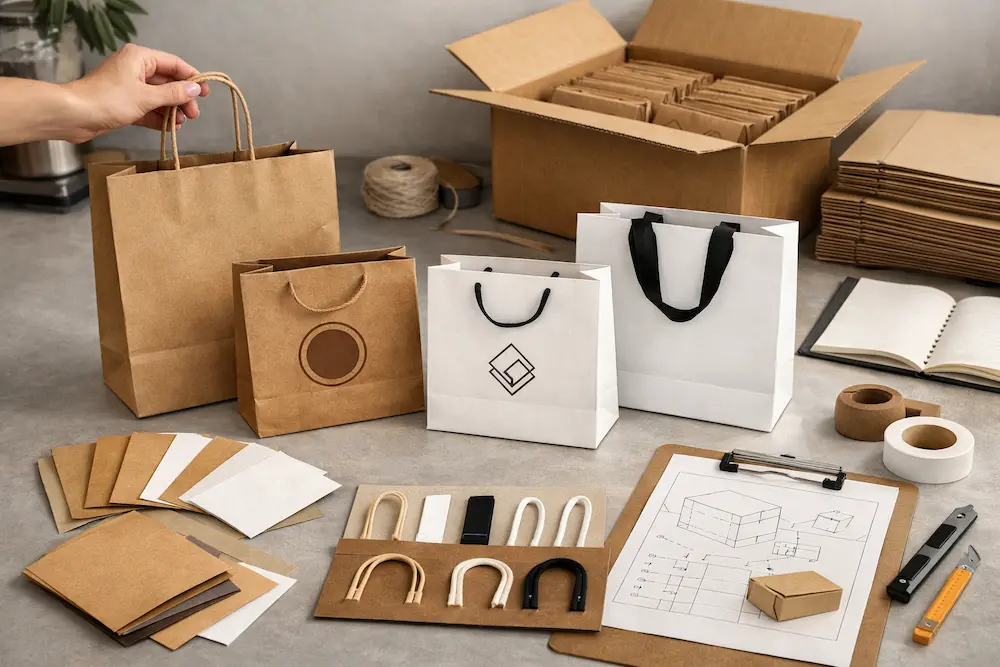
Buying paper bags with handles for your brand for importers is not a simple logo-printing job. For importers, it is a sourcing decision that affects brand presentation, landed cost, freight efficiency, repeat quality, and destination-market fit. U.S. Customs and Border Protection says importing is a shared responsibility, which is one reason buyers should define specifications clearly before they place an order.
That matters even more now because packaging expectations are tightening. The European Commission says the Packaging and Packaging Waste Regulation, Regulation (EU) 2025/40, entered into force on 11 February 2025 and will generally apply from 12 August 2026. For importers buying paper bags with handles, that means the bag should be chosen with more discipline around structure, material choice, and packaging logic rather than appearance alone.
A strong paper bags with handles for your brand for importers program usually starts with five decisions: the sales channel, the handle structure, the paper direction, the branding plan, and the supplier’s ability to produce consistently. When those five parts work together, custom paper bags with handles become useful brand assets instead of expensive stock problems.
Start with the Channel, Not the Artwork
Many buyers begin with logo placement or color, but that is usually the wrong starting point. The first question should be where the paper bags with handles will actually be used.
A bag for supermarket checkout, bakery carry, takeaway food, or pharmacy retail has a very different job from paper shopping bags with handles used in boutique retail, gifting, cosmetics, or fashion. In more general sourcing discussions, many buyers also compare paper bags with handles for easy carry and brand display when they want a broader reference point for how handled paper bags can combine convenience with everyday brand visibility.
A practical rule is simple. Grocery, bakery, pharmacy, and takeaway usually prioritize function, price control, and repeat volume. Boutique retail, premium gifting, fashion, and cosmetics usually prioritize customer experience, brand feel, and print presentation. The more premium the channel, the more the bag becomes part of the brand itself.
Choose the Right Handle Structure
For most importers, the first technical choice is the handle. Flat handles and twisted handles may both work, but they do not create the same commercial result.
Flat handle bags usually fit daily-use retail, grocery, bakery, and takeaway better. They are practical, efficient, and usually more economical. Twisted handle bags usually feel more polished and are more often used in paper shopping bags with handles, premium retail, gifting, and presentation-led packaging.
Comfort matters as well. Twisted handles usually feel better in the hand when the customer carries the bag longer. Flat handles are usually more than adequate for short-distance carry and fast-moving service use. For importers, this means the right handle is not the one that looks nicest in isolation. It is the one that fits the customer journey and the market price level.
A useful buying question is this: is the bag mainly for transport, or is it also part of the brand experience? If it is mainly for transport, simpler handled paper bags often make more sense. If it is part of a premium shopping moment, more polished custom paper bags with handles usually perform better.
Select the Right Paper Direction
Not all paper bags with handles should use the same paper. Paper choice affects print result, carry feel, perceived quality, and sustainability positioning.
Brown kraft usually supports a natural, functional, and cost-conscious image. It is common in grocery, bakery, takeaway, and practical retail channels where the bag still needs to look clean and dependable. Importers evaluating this direction sometimes also compare brown paper bags with handles for natural and reliable carry when they want brown paper bags with handles that feel straightforward, trustworthy, and well matched to everyday brand use.
White kraft usually supports a cleaner, brighter, and more premium look. It is often better when print contrast matters or when the brand wants a more polished presentation.
Recycled-content papers can support a stronger environmental message, but they should still be checked against stiffness, print quality, and carry performance. FSC says every FSC label stands for sustainable sourcing that puts forests and people first, which is why more brands now treat paper sourcing as part of the brand story rather than as a back-office detail.
For importers, the paper should not be selected only by look. It should be selected by the combination of carry need, print requirement, and brand position.
Decide What the Bag Needs to Do for the Brand
A branded handled paper bag usually does three jobs. It carries the product. It reinforces brand recognition. It shapes how premium the purchase feels.
If the main job is reliable carry at controlled cost, simpler structures usually make more sense. If the main job is presentation, then print placement, paper feel, handle style, and proportion matter more. If the bag needs to do both, then importers should avoid overdesign and focus on coherence: the paper, handle, size, and print should all support the same brand tier.
Where visual identity is a stronger priority, some buyers also compare paper bags with logo for clear brand recognition when assessing how paper bags with logo should work together with handle choice and overall bag structure. For many buyers, that is the real buying challenge: not making the bag louder, but making the bag more consistent with the brand.
Confirm the Core Specifications Before Asking for Price
Importers should not request quotes for paper bags with handles in vague terms. A good quotation needs a clear technical base.
At minimum, the supplier should quote against:
- finished bag size
- paper type
- paper weight
- handle style
- bottom structure
- print method
- finish requirements
- export packing method
The standard size format is width × gusset × height. Buyers should confirm whether the supplier is quoting finished size or nominal size, whether handle height is measured separately, and whether the bag is intended for one product or multiple products.
This matters because many sourcing problems are not really “quality issues.” They are specification issues that started too early with vague bag descriptions.
Match Printing to the Brand Tier
Printing is where many importers make paper bags with handles either stronger or weaker for the brand.
Brown kraft usually works well for one-color, simple, or more natural-looking branding. White kraft supports stronger contrast and a more refined finish. Larger logo areas, multi-color layouts, or premium retail graphics need more careful planning around paper surface, bag proportion, and print method.
For importers buying custom paper bags with handles, good printing is not only about visual quality. It is also about whether the final bag truly works as branded paper bags in the target channel. A bag that looks good in a mockup can still feel wrong in real use if the artwork scale, surface, and bag size are not aligned.
Before approving artwork, buyers should ask:
- Is the print method suitable for the design?
- Will the logo still look balanced once the bag is opened?
- Does the print area fit the bag proportion?
- Will the paper color affect the final result?
- Does the sample reflect real production quality?
Treat MOQ and Freight as Part of the Brand Decision
Brand buyers often focus on visuals and forget order planning. That is a mistake. MOQ, carton efficiency, and freight volume all affect the real cost of a handled bag program.
A slightly cheaper bag may become less attractive if it packs inefficiently, needs more setup cost, or does not support repeat ordering well. A slightly more expensive bag may be the better choice if it supports stronger market fit and cleaner replenishment planning.
For paper bags with handles for your brand for importers, the most practical approach is to avoid locking into large branded volume until three things are stable:
- the size set
- the paper direction
- the print design
Once those three are stable, custom paper bags with handles usually become much easier to source at better unit economics.
Check Food-Use Relevance Before Assuming Suitability
If the bag will be used for bakery, takeaway, deli, or another food-related application, importers should not assume that any printed paper bag is automatically suitable. FDA says a food contact substance includes food packaging and its components, and this includes substances applied on packaging surfaces such as adhesives and colorants. FDA also explains that food-contact substances that are food additives must be authorized through the relevant regulatory pathway.
For dry-food carry, standard kraft structures may be perfectly suitable. For warm, greasy, or food-contact-adjacent use, the bag specification may need closer review. For importers buying paper bags with handles into food-related channels, intended use matters just as much as appearance.
Use Samples to Test the Real Bag, Not Just the Design
A handled paper bag should be tested the way it will actually be used. That means checking more than the print.
Importers should test:
- handle attachment
- bottom shape
- print alignment
- paper stiffness
- loaded carry feel
- size fit with the real product
A bag that looks good empty may fail when filled. A bag that looks plain in a mockup may perform much better in daily retail use than a more decorative option. That is why samples are not just visual checkpoints. They are buying tools.
The most useful sample questions are simple. Does the bag fit the actual product? Does it feel right for the brand tier? Does the handle remain comfortable under load? Does the print still look balanced in real use?
Choose a Supplier That Can Explain the Trade-Offs
A reliable paper bag supplier should do more than quote. They should explain why one handle type, paper direction, or print method fits the application better than another.
A weak paper bag supplier only says yes. A strong paper bag supplier can explain:
- why the bag size fits the product
- why the handle style fits the market
- why the paper direction supports the brand
- how MOQ affects cost
- how export packing affects freight efficiency
CBP strongly recommends that importers familiarize themselves with policies and procedures before importing, which reinforces the value of grounded supplier communication instead of guesswork.
For importers, the best supplier is usually not the one promising everything at the lowest price. It is the one that can maintain size, print, and handle consistency over repeat orders.
Quality Checks Importers Should Not Skip
Before confirming a bulk order, importers should check:
- whether handle attachment is even and firm
- whether the top fold is consistent
- whether the base holds shape properly
- whether the print stays aligned
- whether the cartons are packed correctly for export
- whether the bag remains balanced when loaded
These checks matter because paper bags with handles represent the brand in the customer’s hand. If the handle twists unevenly, the bag opens badly, or the print looks inconsistent, the brand impression becomes weaker immediately.
Conclusion
For importers, buying paper bags with handles for your brand for importers should start with function and finish with brand coherence. The bag needs to fit the real channel, the real customer experience, the real shipping plan, and the real sourcing standards of the destination market.
The strongest paper bags with handles program is not the one with the most decoration. It is the one with the right size, right paper, right handle, right print logic, and right paper bag supplier. When those parts work together, custom paper bags with handles become commercially useful, repeatable, and genuinely helpful to the brand over time.
How Importers Should Think About Buying Branded Paper Bags with Handles
What the buying decision really means: Buying handled paper bags for a brand is not just a print order. It is a sourcing decision that connects bag structure, customer experience, export efficiency, and long-term packaging consistency.
Why the decision matters: The wrong handled bag can create weak brand presentation, avoidable freight cost, poor carrying comfort, or a bag structure that does not fit the real sales channel. The right handled bag improves both visual impact and commercial usefulness.
How buyers should compare options: Importers should compare paper bags with handles by real use case, handle type, paper surface, print area, MOQ logic, carton packing, and whether the supplier can explain why one option fits the application better than another.
What options usually make the most sense: Brown kraft handled bags often fit grocery, bakery, takeaway, and practical retail. More refined shopping-style handled bags usually fit gifting, boutique retail, fashion, and cosmetics better. Logo printing works best when the bag size, paper surface, and brand tier are aligned.
What buyers should check most carefully: Handle attachment quality, bag balance under load, print consistency, size fit with the actual product, and whether the supplier can support repeat orders at stable quality are usually more important than chasing the lowest initial quote.
The larger takeaway: The best branded handled paper bag is not the one with the most decoration. It is the one that fits the real product, the real customer journey, and the real sourcing logic of the importer’s business.
FAQ
1. How should importers buy paper bags with handles for their brand?
Importers should begin with the real sales channel and end use, then confirm bag size, paper type, handle style, print method, MOQ, export packing, and whether the supplier can maintain repeat quality. The best buying decision is usually the one that matches the product, the customer experience, and the freight plan together.
2. What should buyers check before ordering custom paper bags with handles?
Buyers should confirm finished size, paper direction, paper weight, handle type, bottom structure, print area, print method, sample quality, carton packing, and intended-use suitability. For food-related use, they should also review whether the full bag structure is appropriate for that application.
3. Are brown paper bags with handles better for everyday retail programs?
Often yes. Brown kraft handled bags usually fit grocery, bakery, takeaway, and other volume-driven retail uses because they support a practical look and efficient daily use. They are often a strong choice when the bag needs to balance function, familiarity, and cost control. This is a commercial judgment rather than a regulatory rule.
4. Why do paper bags with logo matter for brand packaging?
Because handled paper bags are often one of the first branded objects the customer physically carries. A well-sized, well-printed bag can improve recognition, reinforce brand consistency, and make the purchase feel more complete. For many importers, the bag is not only a transport item but also a repeat brand touchpoint. This is commercial reasoning based on packaging use.
5. How do importers choose the right paper bag supplier?
Importers should look for a supplier that can explain material and handle trade-offs clearly, provide realistic samples, support export packing, communicate about MOQ and compliance, and maintain size and print consistency in repeat production. CBP explicitly recommends that importers familiarize themselves with procedures and requirements before importing.
References
- Basic Importing and Exporting — U.S. Customs and Border Protection — CBP.
- Tips for New Importers and Exporters — U.S. Customs and Border Protection — CBP.
- Importing into the United States — U.S. Customs and Border Protection — CBP.
- Food Packaging & Other Substances that Come in Contact with Food: Information for Consumers — U.S. Food and Drug Administration — FDA.
- Understanding How FDA Regulates Substances that Come into Contact with Food — U.S. Food and Drug Administration — FDA.
- Packaging & Food Contact Substances (FCS) — U.S. Food and Drug Administration — FDA.
- Packaging waste — European Commission — Directorate-General for Environment.
- Packaging & Packaging Waste Regulation — European Commission — Directorate-General for Environment.
- Paper & Packaging — Forest Stewardship Council — FSC.
- What the FSC Labels Mean — Forest Stewardship Council — FSC.
- Paper, Print & Packaging — FSC US business resources.
Copyright Notice:All content on this page is the property of Xiamen Youngpack Imp.and Exp.Co.,Ltd. and is protected by copyright. Unauthorized use or reproduction is not permitted.