Personalized tote bags for events are easy to underestimate. They are often treated as simple giveaways, but in practice they influence much more than event packaging. A good tote bag can improve guest experience, keep materials organized, make the event feel more professional, and continue carrying the brand long after the event ends. A poor tote bag does the opposite. It feels forgettable, looks cheap, or fails to match the quality of the event itself.
That is why event buyers should not choose tote bags only by price or by whether a logo can be added. Event bags need to be designed around purpose. A registration bag for a conference has different requirements from a branded welcome bag for a retail activation. A tote bag for a sustainability-themed event needs a different material story from a luxury product launch gift bag. The right choice depends on who will carry the bag, what it needs to hold, how long it is expected to stay in use, and how strongly the brand wants to remain visible after the event.
For many brands, the value of a tote bag begins after the event, not during it. A bag that participants reuse for shopping, commuting, work, or travel keeps the event identity alive in public. That is why event planners increasingly compare not only basic giveaways, but also stronger long-life bag options that behave more like branded merchandise than temporary packaging.
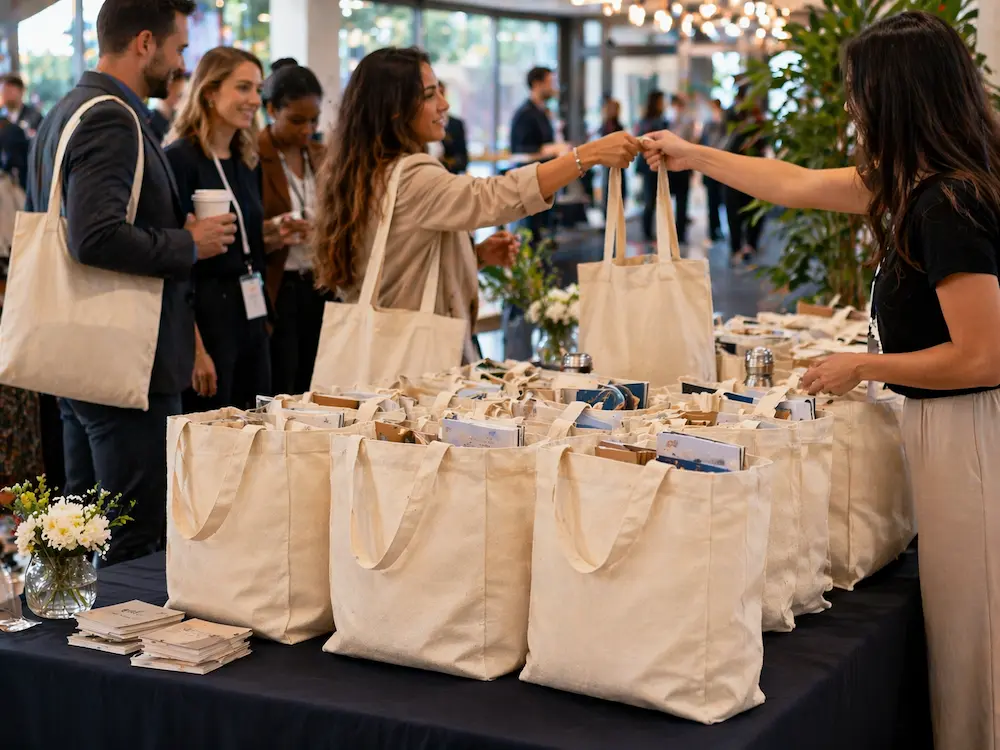
What Personalized Tote Bags for Events Really Need to Do
Event tote bags must solve two problems at the same time. First, they need to work during the event. That means carrying brochures, samples, notebooks, product packs, merchandise, gifts, or attendee materials without feeling awkward or underbuilt. Second, they need to continue making sense after the event if the organizer wants stronger long-term visibility.
Not every event needs the same type of tote bag. A trade show bag may need larger capacity and lower unit cost because it is mainly used for collecting materials. A conference welcome bag may need a cleaner layout and better handle comfort because attendees will carry it all day. A premium retail event may need better fabric, better printing, and more careful finishing because the tote bag is part of the brand experience. A sustainability-led event may prioritize natural materials and understated design rather than louder promotional styling.
This is where personalization becomes more important than simple customization. Adding a logo is easy. Designing the bag to match the event audience, tone, and expected reuse is the real commercial decision. In many cases, brands that want a softer and more authentic event story begin by evaluating custom cotton tote bags because the material itself already helps shape the message before anyone reads the print.
Why Material Choice Matters in Event Tote Bag Design
Material is one of the first things people notice about a tote bag, even before they consciously think about it. A thin synthetic-feeling bag gives one impression. A natural cotton bag gives another. A structured canvas tote gives yet another. For events, that first material impression matters because it tells attendees whether the bag feels temporary, useful, premium, or worth keeping.
Lighter cotton is often suitable for simple event distributions where the bag only needs to carry brochures, flyers, or small gifts. Standard cotton works well when the organizer wants a balance between cost, softness, and reuse value. Canvas is stronger and more structured, so it is better when the bag is expected to hold heavier items or when the event wants a more premium feel. Recycled cotton blends may support sustainability messaging, but they should still be assessed for print appearance, fabric feel, and consistency rather than selected only for the environmental story.
| Material Type | Best Event Use | Main Strength | Main Limitation |
|---|---|---|---|
| Light cotton | Trade shows, brochures, light giveaways | Lower cost and easy distribution | Less structure and lower perceived value |
| Standard cotton | Conferences, welcome packs, general event use | Balanced comfort and reuse value | Less premium than heavier canvas |
| Canvas | Premium events, merchandise-style bags, retail activations | Better durability and stronger visual presence | Higher unit and freight cost |
| Recycled cotton blend | Sustainability-focused event programs | Supports responsible event positioning | Possible variation in texture and shade |
Material also shapes the kind of branding that feels appropriate. A natural cotton bag usually works better with simple, softer brand expression. A heavier canvas bag can support stronger graphic treatment and more merchandise-like value. That is why event buyers should never choose the print direction first and the fabric second. The material and the visual message need to work together.
Best Tote Bag Designs for Different Event Types
The best design for an event tote bag depends on how the bag will be used. A large exhibition bag needs enough space for collected handouts and samples. A seminar or workshop bag may need to hold notebooks, folders, pens, and drink bottles. A retail launch or premium customer event may need the bag to feel more curated and brand-specific. An outdoor event may need stronger construction and more comfortable handles because attendees could carry the bag for longer periods.
Trade Shows and Exhibitions
These usually require larger bag openings, practical capacity, and a design that supports high-volume distribution. Cost efficiency matters, but the bag still needs enough strength to carry brochures, samples, and product literature without distorting too easily.
Conferences and Corporate Events
These often benefit from cleaner structure, medium-weight fabric, and better comfort because the bag may be carried all day. The design should look organized and professional rather than overly promotional.
Retail Launches and Brand Activations
These usually require stronger visual identity and better material feel. The tote bag may be part of the brand experience itself, not just a container. In these cases, the event buyer may compare more refined branded options against simpler event distributions.
Community, School, and Nonprofit Events
These often prioritize accessibility, practicality, and broad reuse. A simple cotton tote bag with clear messaging can work very well if the bag is comfortable and useful enough to stay in daily circulation.
Printing and Personalisation Options
Personalised event bags are only effective when the print and the bag work together. A logo placed on a weak bag does not create strong branding. A beautiful design on the wrong fabric can also feel inconsistent. Buyers should think about print in terms of readability, durability, audience fit, and how the bag will be perceived after the event.
For many event programs, simple one-color or two-color printing is the most practical route because it keeps artwork clear and commercially efficient. More detailed prints can work well when the event wants a stronger visual identity, but buyers should always compare artwork ambition against budget, lead time, and how the print behaves on the chosen fabric.
When the goal is wider event recall and stronger post-event reuse, tote bags printed for clear brand visibility are often more valuable than overdesigned layouts that look impressive in mockups but feel less practical in real use. Event branding works best when the design remains legible and attractive once the bag leaves the venue.
Some event programs also need the bag to align with a broader branded merchandise or retail strategy. In that case, buyers may move beyond basic event artwork and compare options such as custom tote bags that are intended to support stronger brand reach and recognition over a longer period than the event itself.
Size, Capacity, and Handle Design
Size is one of the most misjudged parts of event bag ordering. Buyers often choose larger bags because they seem more useful, but oversized bags can create higher fabric cost, more empty space, lower perceived usability, and poorer storage efficiency. The best size is usually the one that fits the actual contents closely without looking cramped.
Handle length matters too. Short handles may be fine for light welcome packs, but longer handles are usually more comfortable for events where attendees carry the bag for hours. Wider handles or better reinforcement may be necessary if the bag includes books, bottled drinks, sample packs, or other heavier items.
The correct bag dimensions should be built around what the guest will really carry, not around a visual guess. Event buyers should define content first, bag second.
How Ordering Quantity Changes the Buying Strategy
Order planning for event tote bags should begin with realistic attendance logic, not just target budget. The buyer needs to know whether the bag is for all attendees, only VIP guests, only paying participants, or for selected activations inside a larger event. This changes the quantity strategy immediately.
Small runs can work for private events, product launches, or highly curated brand programs, but they often carry higher per-unit costs. Larger event programs usually benefit from better unit pricing once the specification is stable. This is especially true for roadshows, multi-city campaigns, franchise events, university recruitment events, or recurring conference programs.
When the bag design is already proven and the event scale is large, buyers often move toward customized tote bags bulk programs because large-scale distribution has a different cost structure from one-off small event orders. Bulk planning usually makes more sense when the bag is part of an ongoing brand system rather than a single isolated event.
| Order Stage | Typical Quantity Logic | Best Use | Main Risk |
|---|---|---|---|
| Small run | Pilot volume, limited event audience | Product launches, VIP events, testing | Higher unit cost |
| Mid-volume run | Regional campaign or structured event program | Conferences, workshops, retail activations | Forecast accuracy becomes more important |
| Large-scale run | Stable event format or broad distribution | Recurring events, large campaigns, multi-location use | Storage and logistics must be planned properly |
Lead Time, Sampling, and Approval Process
Event tote bags often fail because buyers leave the decision too late. Personalized bag programs need enough time for artwork review, sampling, specification adjustments, production, and shipping. This becomes even more important when the order includes custom sizing, reinforced handles, gussets, inside labels, premium finishes, or multiple print positions.
Sampling should never be treated as a quick visual approval only. The sample should verify size, handle comfort, material feel, print appearance, stitching quality, and whether the bag actually fits the event contents. If the tote bag is supposed to hold catalogues, branded gifts, water bottles, or event packs, those should be tested in the sample bag before mass production approval.
Short deadlines usually increase risk. A supplier that rushes too quickly may reduce print control, construction consistency, or packing quality. Buyers should ask for realistic production logic, not optimistic promises.
How Sustainability Changes Event Tote Bag Decisions
Sustainability has become one of the strongest reasons brands choose tote bags for events, but it also creates new expectations. If the event positions the bag as an eco-conscious choice, the product needs to feel genuinely reusable. A bag that looks environmentally themed but feels weak or short-lived does not support the message well.
That is why many brands prefer cotton and canvas options that feel more durable and more natural in use. In stronger event programs, custom printed canvas tote bags are often used when the organizer wants a more substantial reusable product that supports both sustainability positioning and longer-term brand presence after the event.
Still, buyers should avoid making broad environmental claims without clear material support. A realistic message about reuse, durability, and practical everyday value is often more credible than exaggerated sustainability language.
How to Choose the Right Supplier for Event Tote Bags
The right supplier should ask better questions than “How many pieces?” and “What logo file?” They should want to know the type of event, the expected contents, the target audience, the branding level, the desired material, and the delivery timing. Event bags are context-driven products. Suppliers that ignore context usually create weaker outcomes.
Buyers should evaluate suppliers by material clarity, printing capability, sample quality, communication speed, lead time realism, and repeat-order reliability. A good supplier should be able to explain why a certain bag size, fabric, or print method suits the event use case. A weaker one often just quotes quickly without helping the buyer shape the right product.
For B2B programs, this is also where Youngpack-style supplier logic matters. The best manufacturing partner is usually the one that can connect design, branding, production, and event timing into one workable tote bag program rather than treating the order as a generic custom print request.
Common Event Tote Bag Ordering Mistakes
The first common mistake is choosing the bag before defining what it needs to carry. The second is overestimating how much design complexity the bag really needs. The third is ordering too late and forcing rushed approvals. The fourth is focusing only on cost without thinking about guest experience and reuse value. The fifth is using a bag that suits one event style but not the actual audience.
Another common mistake is treating every event the same. A startup conference, a charity fundraiser, a product launch, a university open day, and a premium retail activation may all need personalized tote bags, but they do not need the same bag. Better event outcomes come from matching the bag to the event behavior, not from reusing the same generic specification every time.
Conclusion
The best personalized tote bags for events are not chosen by logo placement alone. They are chosen by how well they fit the event, the audience, the carrying purpose, and the brand message. Material, print, bag size, handle comfort, and quantity planning all need to work together if the bag is meant to be useful during the event and relevant afterward.
For event buyers, the real objective is not simply to hand out bags. It is to create a tote bag that supports organization, improves perceived value, and keeps the brand visible after the event is over. That is what turns a simple event accessory into a lasting branded product.
When those decisions are made properly, a personalized tote bag becomes more than packaging. It becomes part of the event experience and part of the brand memory that participants take home with them.
How Event Buyers Should Think About Personalized Tote Bags
What these bags really are: Personalized tote bags for events are not just branded containers. They are part of the attendee experience, part of event organization, and part of the brand memory guests take away. Their value comes from how well they work during the event and how likely they are to remain useful after it.
Why design choices matter: A tote bag is often one of the few event items that continues traveling after the venue closes. That means material, print, size, and handle comfort all affect whether the bag becomes a long-life brand asset or a short-life event extra. Better design usually creates better post-event visibility.
How buyers should compare options: The strongest comparison method is to evaluate event type, expected contents, audience profile, reuse value, and budget together. A conference bag should not be sourced the same way as a premium retail launch bag or a community event giveaway, even if all three use the same general tote bag format.
Options event organizers typically weigh: Buyers often compare lighter cotton versus stronger canvas, simple logo bags versus more tailored brand expression, and small-run event orders versus larger repeated bulk programs. The right answer depends on whether the tote bag is mainly solving an event logistics need or supporting a longer-term brand presence strategy.
Considerations before ordering: Before placing the final order, buyers should verify sample quality, confirm what the bag needs to hold, assess artwork readability on the actual fabric, and make sure the supplier can deliver within the event schedule without sacrificing consistency. Event success depends on timing as much as it depends on design.
The bigger commercial takeaway: The most effective event tote bags are not chosen because they are easy to brand. They are chosen because they fit the event, the audience, and the long-term brand objective. That is also where Youngpack naturally fits as a B2B manufacturing and export partner for event bag programs that need customization, dependable quality, and scalable ordering support.
FAQ
1. What is the best material for personalized tote bags for events?
The best material depends on the event type, the expected contents, and the brand positioning. Light cotton works well for brochures and lower-cost event giveaways, while standard cotton is often better for general conference and welcome-bag use. Canvas is usually the stronger choice when the event wants a more premium feel, better durability, or a bag that is more likely to stay in long-term use after the event. The best option is the one that fits both the event function and the expected brand impression.
2. How many personalized tote bags should an event order?
The right quantity depends on attendance planning, redemption logic, and whether the bag is for all attendees or selected guests only. Some events order for all registered participants, while others limit bags to VIP packs, paid ticket holders, or promotional activations. It is usually better to plan from realistic event behavior than to choose a number only based on price breaks. A stable recurring event may eventually move into larger bulk programs once the bag design is already proven.
3. Should event tote bags be cotton or canvas?
Cotton is often the better choice for softer everyday use, lighter event contents, and broader distribution where cost control matters. Canvas is usually better when the bag needs stronger structure, heavier carrying performance, or a more premium branded look. The better material depends on whether the tote bag is meant to function mainly as a giveaway, a useful event carry bag, or a longer-life branded product that stays in circulation after the event ends.
4. What should buyers check before approving an event tote bag sample?
Buyers should check size, material feel, handle comfort, print quality, stitching, proportions, and whether the bag fits the actual event contents properly. If the tote bag is meant to hold folders, merchandise, welcome kits, bottles, or giveaways, those items should be tested in the sample before approval. A sample should be treated as a functional event test, not only as a visual mockup.
5. Are personalized tote bags good for event branding?
Yes, they are often one of the most effective event branding tools because they continue working after the event ends. A tote bag that guests reuse in daily life keeps the event or brand visible in public settings such as offices, shops, transport, and campuses. Their value is strongest when the material, design, and print are good enough that people genuinely want to keep using the bag rather than discarding it after the event.
References
- Green Guides for the Use of Environmental Marketing Claims — Federal Trade Commission — FTC.
- Preferred Fiber and Materials Market Report — Textile Exchange — Textile Exchange.
- Textiles and the Environment — European Environment Agency — EEA.
- Sustainable Packaging Guidelines — Australian Packaging Covenant Organisation — APCO.
- Fashion on Climate — Global Fashion Agenda and McKinsey & Company.
- Responsible Sourcing and Product Communication in Textile Supply Chains — industry trade reference.
- Retail Packaging and Reusable Bag Sourcing Best Practices — professional sourcing and merchandising reference.
- Guide to Reusable Bags and Long-Term Use Value — industry best-practice sourcing reference.
Intellectual Property Notice:
All original written content published here remains the intellectual property of Xiamen Youngpack Imp.and Exp.Co.,Ltd. Any unauthorized reuse is strictly prohibited.