Introduction
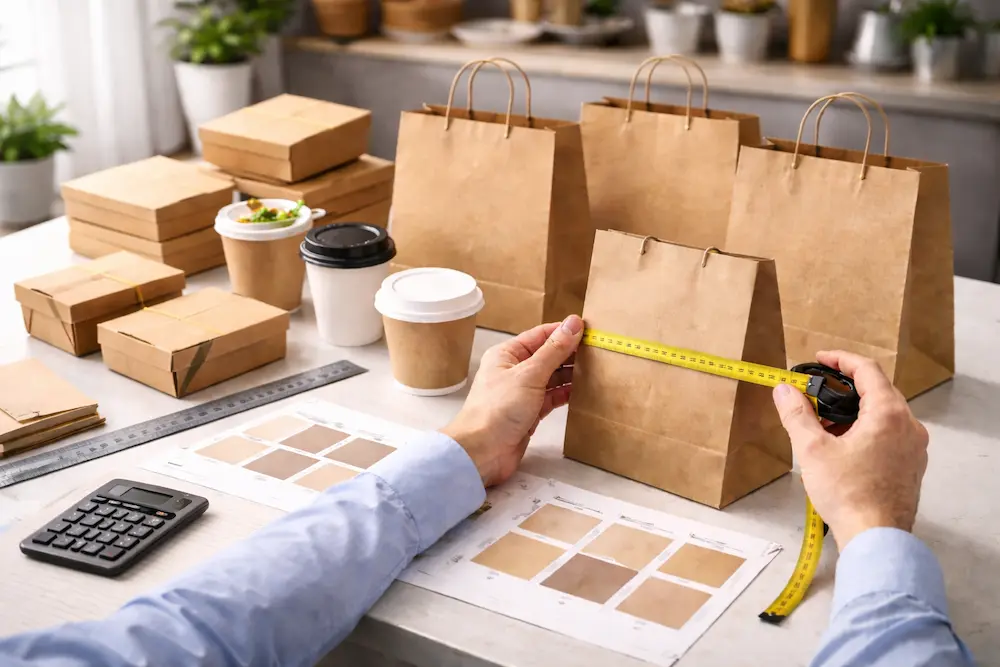
Understanding how to measure takeaway paper bags correctly is one of the most important steps before sampling, quoting, or placing an order. Many buyers look at a takeaway bag and assume the size is simple, but in real use, the wrong bag dimensions can cause packing delays, unstable carrying, wasted material, and poor presentation. For restaurants, cafés, bakeries, dessert shops, and food retailers, correct takeaway paper bag dimensions affect daily efficiency just as much as material quality or print design.
For B2B buyers, measuring takeaway paper bags is not only about writing down three numbers. It is about making sure the bag fits the actual food packaging, supports the counter workflow, and remains practical for customers to carry. A bag that is too narrow can squeeze food boxes. A bag that is too shallow can make bowls or trays impossible to insert smoothly. A bag that is too tall can waste paper and look oversized. A bag that is too short may leave food packaging exposed or make multi-item orders difficult to pack.
That is why buyers should always learn how to measure takeaway paper bags correctly before choosing stock sizes or developing custom takeaway paper bags. In lighter meal and snack applications, many buyers also compare formats such as paper lunch bags for convenient and fresh meal carry when deciding whether a simpler paper bag structure is enough for the intended takeaway use.
Why Correct Measurement Matters
Correct measurement matters because takeaway paper bags are used in fast-moving foodservice environments where speed and fit both matter. Staff need to insert products quickly, customers need to carry them comfortably, and the bag must hold the packed food without distortion, tipping, or wasted space. When takeaway paper bag dimensions are wrong, problems appear immediately. Food containers may lean, takeaway drinks may press against the side wall, the bottom may become unstable, and the bag may feel awkward in the hand.
For paper bags for takeaway food, even a small measurement error can create repeated operational problems. If the width is wrong, boxes may scrape against the opening. If the gusset is too narrow, the bag may bulge and lose shape. If the height is too short, taller food packaging may not fit fully inside. These problems affect not only function, but also brand perception. A poorly sized bag makes the food business look less organized, even when the product itself is good.
Correct measurement also improves sourcing decisions. It helps buyers compare quotations more accurately, reduce wasted material, control unit cost, and communicate more clearly with a paper bag manufacturer. For custom takeaway paper bags, correct measurement also supports better artwork placement, more balanced logo size, and more efficient repeat production.
The Three Main Dimensions of Takeaway Paper Bags
To understand how to measure takeaway paper bags correctly, buyers should always begin with the three main body dimensions:
- Width
- Gusset
- Height
These three measurements define the usable internal space of the bag. If one of them is wrong, the bag may fail even when the other two look acceptable. In more general retail and food-carry scenarios, some buyers also compare paper carrier bags for reliable carry and brand visibility when the bag needs to work not only for takeaway loading but also for broader customer-facing carry use.
The common size format for takeaway paper bags is:
Width × Gusset × Height
For example:
26 × 15 × 29 cm
This means:
- 26 cm front width
- 15 cm side gusset
- 29 cm height from bottom to top edge
This standard format should always be used when discussing takeaway paper bag dimensions with suppliers because it reduces confusion and makes quotations easier to compare.
How to Measure Width Correctly
Width is the measurement across the front opening of the bag. It is measured from left to right across the front face when the bag is laid flat. Width is one of the most important measurements for paper bags for takeaway food because it determines whether the main food container can enter the bag smoothly.
To measure width correctly:
- Lay the takeaway bag flat on a clean surface.
- Smooth the front panel gently without stretching it.
- Measure straight across the top front opening from one side to the other.
Width matters especially for clamshell boxes, burger boxes, pastry boxes, meal trays, and flat takeaway containers. If the width is too small, loading becomes difficult and the bag may press against the food packaging. If the width is too large, the bag may look loose, waste paper, and reduce overall carrying stability.
For many takeaway packaging bags, width should be slightly larger than the widest part of the packed food item, leaving enough room for quick packing without creating unnecessary empty space.
How to Measure Gusset Correctly
The gusset is the side depth of the bag. It allows the bag to expand and hold volume. For takeaway paper bags, gusset is one of the most important and most often misunderstood dimensions. Many buyers focus on width and height but underestimate how important gusset is when packing boxed meals, takeaway bowls, desserts, or multi-item orders.
To measure gusset correctly:
- Lay the bag flat.
- Identify the folded side panel.
- Measure straight across the side fold from front fold line to back fold line.
Gusset determines how much depth the bag has. If the gusset is too small, food boxes or bowls may not fit even if the width appears correct. If the gusset is too large, the bag may feel too bulky for the product and may lose shape during carrying.
For paper bags for takeaway food, gusset often determines whether the bag can carry one meal neatly or whether it can handle stacked containers, side items, or a drink without distortion.
How to Measure Height Correctly
Height is measured from the bottom of the bag to the top edge. It determines how much vertical space is available for the takeaway product inside the bag.
To measure height correctly:
- Lay the bag flat or stand it upright.
- Measure from the bottom base to the top opening edge.
- Do not include handle rise in the main bag height.
For takeaway paper bag dimensions, height is especially important when the order includes upright food boxes, drink cups, bakery packaging, or stacked trays. If the height is too short, products may remain exposed or difficult to load. If the height is too tall, the bag may look oversized, use more material than necessary, and become less stable for smaller items.
The right height for takeaway paper bags is usually slightly taller than the highest point of the packed order, leaving enough space for insertion and practical movement.
How to Measure Takeaway Paper Bags With Handles
For takeaway paper bags with handles, buyers should measure not only the body dimensions, but also the handle-related dimensions. These include:
- Handle height
- Handle clearance
Handle height is the distance from the top edge of the bag body to the highest point of the handle. Handle clearance is the usable inner space inside the handle loop where the customer’s hand passes through.
This is especially important for multi-item meals, boxed lunch orders, and takeaway combinations that need easier carrying. In projects where convenience and presentation both matter, some buyers also review paper shopping bags with handles for easy carry and brand display to compare how handle structure, bag proportion, and carrying comfort work together.
To measure handle height:
- Place the bag upright.
- Measure from the top edge of the bag body to the top of the handle arch.
To measure handle clearance:
- Measure the open inner space inside the handle loop.
- Check whether a hand can grip comfortably when the bag is fully loaded.
For takeaway paper bags, handle measurement matters because a bag can have correct body size but still perform poorly if the handle space is too tight or the handle rise is too low.
Practical Measurement Table for Takeaway Paper Bags
| Measurement Area | How to Measure | Why It Matters |
|---|---|---|
| Width | Across the front opening when the bag is laid flat | Determines whether the food box or tray fits side to side |
| Gusset | Across the folded side panel | Gives depth for bowls, boxes, and multiple food items |
| Height | Bottom of the bag to top edge | Determines vertical fit for food packaging |
| Handle Height | Top edge of bag to top of handle | Affects carrying comfort |
| Handle Clearance | Inner space inside handle loop | Affects hand access and ease of carrying |
| Bottom Size | Measured when bag is fully opened | Helps assess stability for takeaway use |
How to Measure the Bottom of the Bag
The bottom of the bag is also important for takeaway packaging bags, especially when the bag carries rigid food containers or multiple takeaway items. A properly sized base helps the bag stand more evenly and improves stability during loading and carrying.
To measure the bottom correctly:
- Open the bag fully.
- Stand it upright.
- Measure the bottom width and bottom depth across the base.
In many takeaway paper bags, the bottom width is close to the front width and the bottom depth is close to the gusset. But buyers should still confirm the bottom shape, especially when the takeaway order includes square food trays, takeaway bowls, or stacked boxed meals.
How to Measure Based on Real Food Products
The most reliable way to learn how to measure takeaway paper bags correctly is to start with the real food packaging first, not the bag. Buyers should measure the actual food box, tray, bowl, or drink pack that will go inside the bag.
A practical process looks like this:
- Measure the food packaging itself.
- Record its width, depth, and height.
- Add realistic clearance for quick packing.
- Decide whether the bag is for one item or multiple items.
- Confirm whether customers will carry the order for a short or longer distance.
This is especially important for paper bags for takeaway food, because the bag should fit the real packed order rather than only the individual product components.
Practical Fit Table for Common Takeaway Orders
| Takeaway Item Type | What to Measure First | Bag Dimension Priority |
|---|---|---|
| Burger or sandwich box | Box width and depth | Width + gusset |
| Pastry or bakery box | Box width and stack height | Width + height |
| Rice or noodle bowl | Bowl diameter and height | Gusset + height |
| Two-cup takeaway order | Combined width and cup height | Width + gusset + handle clearance |
| Multi-box meal order | Total packed footprint | Width + gusset + height |
For example, if a takeaway meal box measures:
- 22 cm wide
- 14 cm deep
- 8 cm high
The bag should not match those measurements exactly. It should allow enough space for smooth insertion and stable packing. A bag around 24–26 cm width, 15–16 cm gusset, and 20–24 cm height may be more practical depending on whether extra items are included.
Common Measurement Mistakes
One of the most common mistakes in measuring takeaway paper bags is ignoring the gusset. Buyers often measure only the front width and assume the bag will fit, but if the food box or bowl has depth, the wrong gusset will make the bag unusable.
Another mistake is measuring the bag while it is partly open or distorted. The bag should be measured either flat in a controlled way or fully opened in a stable upright position depending on the specific dimension.
A third mistake is confusing bag body height with total height including the handles. For takeaway paper bags with handles, handle dimensions should always be measured separately.
A fourth mistake is choosing bag size by visual appearance. A bag that looks right in a product photo may be completely wrong for daily takeaway use if the actual packed food dimensions are not checked carefully.
Custom Sizing and Branding Considerations
Correct measurement is also essential for custom takeaway paper bags. If the takeaway paper bag dimensions do not match the actual takeaway product, even a strong design will not perform well in real use. Oversized bags may waste material and weaken visual presentation. Undersized bags may strain at the gusset, distort the printed layout, or make packing inefficient.
Buyers planning branded takeaway packaging often also compare custom paper bags with logo for distinct brand presentation when evaluating how size, structure, and print area should work together in a more polished food packaging program.
For custom takeaway paper bags, buyers should confirm:
- finished size
- usable print area
- handle position
- base structure
- actual packed food dimensions
- whether the bag is for single-item or multi-item takeaway use
Special Use Cases: Events, Catering, and Promotional Food Bags
Not all takeaway packaging bags are used the same way. Bags for daily takeaway meals usually prioritize speed and practical fit. Bags for event catering, dessert sets, party food, or promotional food packaging often place more emphasis on themed presentation or grouped-item packing.
In those cases, measurement should still begin with the real packaged food dimensions rather than with appearance alone. For more festive or event-related packaging programs, some buyers also compare paper party bags for cheerful celebrations and events when deciding whether the bag needs a more decorative structure in addition to correct food-product fit.
For catering or event takeaway orders, buyers often need to measure the grouped packed footprint rather than a single food item. A bag that works for one pastry box may fail for mixed party food, beverages, and takeaway extras packed together.
Practical Measurement Checklist Before Ordering
Before placing an order for takeaway paper bags, buyers should confirm:
- actual size of the food packaging
- whether the bag is for one item or multiple items
- required width, gusset, and height
- whether handles are needed
- handle height and handle clearance
- bottom support and stability
- whether the bag is plain or branded
- weight and structure of the packed takeaway order
This type of checklist makes it much easier to choose the right takeaway paper bag dimensions and reduce errors in sampling or production.
Conclusion
To understand how to measure takeaway paper bags correctly, buyers should always focus on five main factors: width, gusset, height, handle size, and actual food-product fit. Correct takeaway paper bag dimensions should be based on real takeaway packaging conditions, not on estimates or visual assumptions.
The strongest sizing decisions come from measuring the food packaging first and then choosing paper bags for takeaway food that support quick loading, stable carrying, efficient material use, and better customer experience. When buyers measure takeaway paper bags correctly, they improve supplier communication, reduce packaging mistakes, and build a more reliable takeaway packaging program.
How Buyers Should Think About Takeaway Paper Bag Measurement
What correct measurement really means: Measuring a takeaway paper bag is not just recording three numbers. It is the process of matching the bag to the actual packaged food so the bag works properly in loading, carrying, and presentation.
Why the measurement matters: A poorly sized takeaway bag can slow down service, increase packaging waste, reduce carrying comfort, and create visible inconsistency in daily operations. Correct sizing helps the bag support both function and customer experience.
How buyers should measure: Buyers should start with the food packaging first, measure its real packed footprint, and then confirm the bag’s width, gusset, height, and handle clearance. This is more reliable than choosing a bag only by appearance or copying a competitor’s size.
Options that make sense in practice: Small lunch items may fit simpler flat or lightly structured bags, while multi-item takeaway meals, drinks, and boxed combinations often require deeper gussets, stronger bottoms, and better handle clearance. The right size depends on the real use case, not on a visual guess.
Considerations that matter most: Buyers should pay attention to bag proportion, box depth, stacked item height, handle comfort, and how quickly staff can load the order at the counter. Strong bag measurement supports better ordering, lower waste, and more stable repeat production.
The bigger takeaway: The best takeaway paper bag is not the largest or the cheapest. It is the one measured around the actual food package and used in a way that improves service, protects the order, and supports practical sourcing decisions.
FAQ
1. How do you measure takeaway paper bags correctly?
You should measure the bag by checking the three main body dimensions: width, gusset, and height. If the bag has handles, you should also measure handle height and handle clearance. The best way to measure takeaway paper bags correctly is to start with the actual food packaging first and then compare it with the bag size.
2. What do takeaway paper bag dimensions mean?
Takeaway paper bag dimensions usually mean width × gusset × height. Width is the front opening, gusset is the side depth, and height is the distance from the bottom of the bag to the top edge. Together, these numbers define the usable space inside the takeaway bag.
3. Why is gusset important in takeaway paper bags?
Gusset is important because it provides the side depth of the bag. Without the right gusset, takeaway food boxes, bowls, or multi-item meal orders may not fit properly, even when the width looks correct.
4. Should handle height be measured for takeaway paper bags with handles?
Yes. For takeaway paper bags with handles, handle height and handle clearance should be measured separately from the bag body. These measurements affect carrying comfort and whether the loaded bag remains practical for the customer to hold.
5. Why should buyers measure food packaging before choosing paper bags for takeaway food?
Because the bag should match the real packed product, not a visual estimate. Measuring the food box, bowl, tray, or cup first helps buyers choose paper bags for takeaway food that load easily, carry safely, and avoid wasted material.
References
- Food Packaging & Other Substances that Come in Contact with Food: Information for Consumers — U.S. Food and Drug Administration — FDA.
- About the FCS Review Program — U.S. Food and Drug Administration — FDA.
- Regulatory Status of Components of a Food Contact Material — U.S. Food and Drug Administration — FDA.
- Packaging waste — European Commission — Directorate-General for Environment — European Commission.
- Regulation (EU) 2025/40 on packaging and packaging waste — European Union — EUR-Lex.
- Sustainable Packaging Guidelines — Australian Packaging Covenant Organisation — APCO.
- Packaging Sustainability Framework — Australian Packaging Covenant Organisation — APCO.
- Packaging 101 — Australian Packaging Covenant Organisation — APCO.
Editorial Rights Notice:The editorial content on this page was prepared by Xiamen Youngpack Imp.and Exp.Co.,Ltd. for our website visitors and business partners. Please do not reuse it without written approval.