Introduction
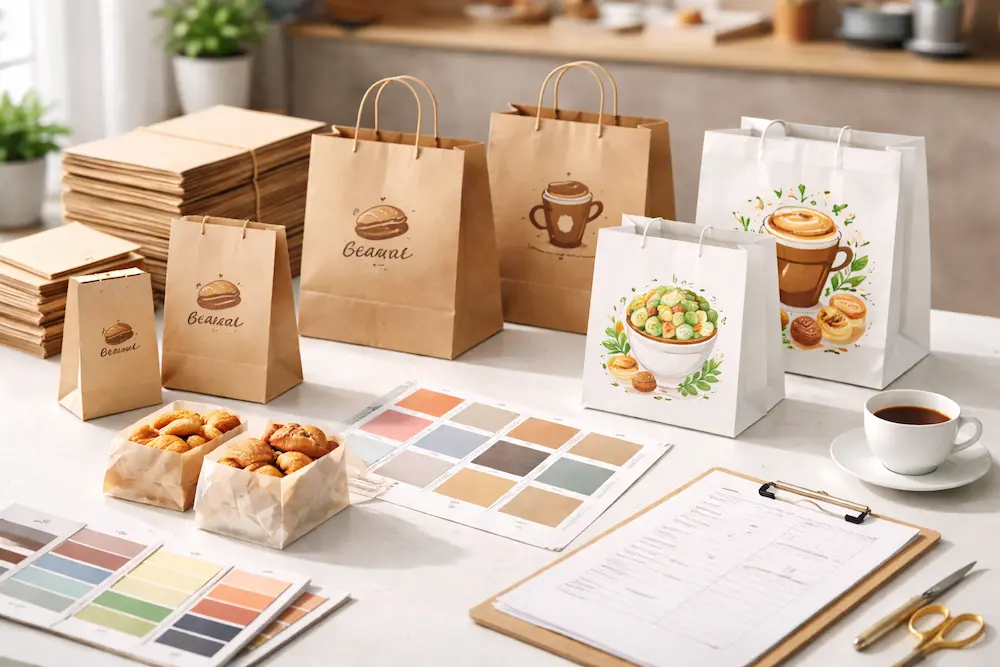
Choosing the best food paper bags printing options is not just a design decision. For food businesses, the right food paper bags printing options affect print clarity, bag appearance, grease resistance performance, lead time, minimum order quantity, and total packaging cost. A bakery choosing simple logo bags has very different needs from a takeaway chain ordering high-volume printed food paper bags, and both have different needs from a gourmet retailer using custom food paper bags for specialty packaged foods. That is why buyers should compare food paper bags printing options as part of a complete packaging decision rather than as an isolated artwork choice.
Food-related packaging also requires more care than general retail packaging. FDA states that food contact substances include food packaging and its components, such as adhesives and colorants, and that the regulatory status of a food contact material depends on the individual substances in the article. In practical terms, buyers choosing paper bags for food packaging should think about more than how attractive the print looks. Intended use, bag structure, inks, coatings, and related materials all matter when evaluating food paper bags printing options.
What Food Paper Bags Are and Why Printing Matters
Paper bags for food packaging are used across bakeries, cafés, takeaway counters, restaurants, grocery departments, delis, specialty food stores, and meal-carry programs. Some are simple bags for bread, pastries, sandwiches, dry snacks, or boxed foods. Others are branded carry bags used to hold takeaway containers, packaged meals, or specialty food products. Their job is not only to carry food. They also represent the brand, support service speed, and help create a consistent customer experience. In more everyday foodservice settings, many buyers also compare practical formats such as paper lunch bags for convenient and fresh meal carry when they want a simpler structure for light meals, snacks, or grab-and-go food packaging.
Printing matters because it changes what printed food paper bags can do commercially. A plain kraft bag may be functional and cost-efficient, but printed food paper bags can improve recognition, strengthen takeaway branding, and support repeat visibility after the customer leaves the counter. The right food paper bags printing options can also reduce unnecessary cost by matching the design to the bag’s actual role. A one-color bakery bag used for high turnover usually needs different food paper bags printing options from premium custom food paper bags used for gourmet gifting or higher-end food retail.
Main Printing Options for Food Paper Bags
Flexographic Printing
Flexographic printing is often one of the most practical food paper bags printing options for larger-volume orders. It works well for simpler graphics, logo-based layouts, repeated designs, and jobs where unit efficiency matters. Flexo is commonly used for printed food paper bags, bakery paper bags, sandwich bags, takeaway bags, and other paper bags for food packaging where the design is straightforward and the order volume is high enough to justify setup.
The main strengths of flexographic printing are efficiency, repeatability, and good performance on common kraft and food-service paper structures. For many bakery, café, and takeaway programs, flexo gives buyers a solid balance between commercial practicality and clear branding. The main limitation is that very refined artwork or premium retail-level visual sharpness may be less suitable depending on the paper surface and press conditions. Even so, flexo remains one of the strongest food paper bags printing options for businesses that need repeat runs and controlled cost.
Offset Printing
Offset printing is usually selected when custom food paper bags need better graphic detail, stronger color precision, or a more premium overall look. It is more likely to be used for specialty packaged-food retail, premium takeaway presentation, gourmet shops, confectionery packaging, and higher-end branded food bags where the visual quality of the bag matters more.
The advantage of offset printing is better reproduction of detailed artwork and a cleaner presentation for more design-driven packaging. The trade-off is that offset is usually less commercially suitable than flexo for highly cost-sensitive, simple, high-turnover food bag programs. Offset makes the most sense when the bag has a visible branding role and when the chosen paper surface supports the intended print quality.
Digital Printing
Digital printing can be useful for lower-volume branded runs, prototypes, short custom projects, seasonal campaigns, or visual testing before scaling production. For buyers exploring different food paper bags printing options, digital can be attractive because it offers flexibility without the same conventional setup structure as long-run flexo or offset jobs.
Digital printing is particularly useful when the buyer is still refining artwork, testing a new bakery brand, running an event-based campaign, or launching a limited-edition food packaging project. The limitation is that digital is not always the most economical choice for larger-volume repeat orders. Once the bag specification becomes stable and the order volume grows, flexo or offset may offer stronger long-run value.
Simple Logo Printing and Basic Branding
For many buyers, the real decision is not flexo versus offset in theory. The real decision is whether the bag needs a simple one-color logo, a repeated pattern, or a more complete branded print layout. A large share of printed food paper bags work very well with simple logo printing. In practice, some of the best food paper bags printing options are the most disciplined ones: clear branding, limited print coverage, good paper fit, and a structure that remains commercially sensible in daily use.
Materials, Structure, and Print Compatibility
The surface and structure of the bag strongly affect food paper bags printing options. Brown kraft paper is often used for bakery paper bags, takeaway bags, sandwich bags, and grocery paper bags because it offers a natural look and practical cost logic. White paper surfaces are more likely to be chosen when the buyer wants stronger color contrast, a cleaner visual finish, or more premium presentation. Some paper bags for food packaging also use grease-resistant or specially treated paper structures depending on the application. Buyers that want a more natural brand image and stronger sourcing message often also compare options such as kraft bags for responsible packaging and brand trust when evaluating how paper choice, print style, and sustainability positioning should work together.
Material choice matters because different food paper bags printing options behave differently on different substrates. A design that appears clean and sharp on white paper may look softer on brown kraft. A kraft food bag may suit simple one-color branding very well, while a premium specialty-food bag may need a surface that supports more detail. This is why buyers should not choose print method and paper separately. The best food paper bags printing options are chosen together with the bag material, end use, order volume, and brand objective.
Technical Reference Table: Print Compatibility for Food Paper Bags
| Area | What Buyers Should Check | Why It Matters |
|---|---|---|
| Paper surface | Brown kraft, white paper, treated or grease-resistant paper | Changes color appearance and print clarity |
| Design complexity | Logo-only, simple pattern, or detailed full design | Determines which print method makes sense |
| Volume | Trial run, mid-volume, or large repeat order | Affects cost efficiency and setup logic |
| Intended use | Dry food, packaged food, takeaway carry, bakery service | Influences structure and print suitability |
| Bag structure | Flat bag, SOS bag, handled food bag | Changes converting and branding logic |
| Component review | Inks, coatings, adhesives, and related materials | Important for food-contact-related evaluation |
Comparison Analysis for Buyers
Flexo vs Offset vs Digital
For many food paper bags printing options, flexo is the strongest choice for high-volume, simpler branding. Offset is usually better when presentation and artwork detail matter more. Digital is useful when the buyer wants short-run flexibility, seasonal testing, or prototype-level customization.
The strongest method depends on the channel. A bakery chain with standard logo bags may benefit most from flexographic printing. A gourmet retail brand may prefer offset because the bag is part of a premium visual experience. A short campaign or early-stage brand test may fit digital better. The best food paper bags printing options are channel-specific, not universal.
Simple Logo Printing vs Full Custom Coverage
Simple logo printing often performs better than buyers expect. It keeps the bag readable, supports volume efficiency, and usually lowers both print complexity and total cost. Full custom print coverage can make sense for premium brand storytelling, but only when the bag’s role in the customer experience is strong enough to justify it.
Comparison Table: Best Printing Options for Food Paper Bags
| Printing Direction | Best For | Main Strength | Main Trade-Off |
|---|---|---|---|
| Flexographic printing | High-volume bakery, takeaway, grocery, simple branded runs | Efficient and practical for repeat orders | Less suited to highly refined premium artwork |
| Offset printing | Premium food retail, gourmet packaging, higher-end branded bags | Stronger detail and presentation | Usually less cost-efficient for simple volume jobs |
| Digital printing | Short runs, prototypes, seasonal campaigns | Flexible and fast for lower-volume customization | Often less economical for long repeat runs |
| Simple logo printing | Everyday foodservice and retail packaging | Clear, efficient, cost-conscious branding | Less visually rich than full custom coverage |
Real Business Use Cases Across Food Packaging Segments
In bakery and café environments, simple branded kraft bags are often the strongest answer. These businesses usually need bags that work quickly, support clear logo presentation, and remain commercially sensible across daily volume. For many of these programs, flexo or simple one-color printing on kraft is one of the strongest food paper bags printing options.
In takeaway and fast-food packaging, buyers usually prioritize speed, repeat consistency, and cost efficiency. The print does not need to behave like luxury retail packaging. It needs to stay readable, efficient, and appropriate to the channel. That often makes simpler printed food paper bags more effective than overly decorative ones.
In grocery and deli programs, the bag may carry packaged foods, fresh bakery items, or food-related add-on products. Here, brand clarity matters, but so does structure and intended-use suitability. Buyers should make sure the print method, ink system, and bag components fit the actual food-related environment. In these broader retail food settings, some businesses also compare formats such as paper shopping bags for everyday carry and brand display when the bag needs to support both practical transport and stronger everyday brand visibility.
In premium food gifting and specialty packaging, stronger visual presentation may justify more refined food paper bags printing options. This is one of the cases where offset or more developed custom artwork can make commercial sense because the bag contributes more directly to product positioning and customer perception. For brands working on seasonal food gifting, confectionery launches, or premium presentation, some buyers also compare adjacent formats such as paper gift bags for thoughtful and elegant presentation when they want packaging that feels more polished and gift-oriented while still supporting brand recognition.
Cost Structure, MOQ, and Bulk Purchasing Strategy
Printing changes the cost of a food paper bag in several ways. It changes setup requirements, production speed, artwork handling, and sometimes the paper choice itself. Simpler branding usually reduces cost. More detailed artwork, more colors, and more demanding visual expectations usually increase it.
Order volume also changes which food paper bags printing options are commercially sensible. Higher-volume repeat jobs often justify flexographic efficiency. Smaller and more experimental jobs may justify digital flexibility even when the long-run cost per bag is not as strong. That is why buyers should compare food paper bags printing options by full program value, not only by design preference.
Custom printing makes the most commercial sense when the bag is part of a stable packaging program. If the design, bag size, and real-world use pattern are still changing, it is often safer to test with simpler branding before moving to a more complex printed structure.
Regulations, Sustainability, and Compliance Requirements
For buyers of paper bags for food packaging, intended use matters. FDA explains that food contact substances include packaging and packaging components, and that each individual substance in the article matters for regulatory status. FDA also provides guidance around paper and paperboard components, adhesives, and related food-contact materials. That means a buyer should not assume that a visually attractive bag is appropriate for every food-related use without checking the full composition and intended application.
In the EU, the European Commission states that the Packaging and Packaging Waste Regulation 2025/40 entered into force on 11 February 2025 and will generally apply from 12 August 2026. The Commission describes the regulation as part of the move toward stronger recyclability and clearer packaging rules. This makes it more important for buyers to evaluate the full structure of the bag, not only the face-paper material.
In Australia, APCO says its Sustainable Packaging Guidelines are used to support sustainable packaging design and manufacture, while the Packaging Sustainability Framework provides a consistent and transparent way to assess packaging sustainability. APCO also emphasizes evaluating packaging in context rather than relying on simplistic environmental assumptions. For food paper bags, that means printing choice, material choice, and real use case should be assessed together.
Responsible fibre sourcing is another layer of decision-making. FSC states that its labels stand for sustainable sourcing, and FSC US explains that responsibly sourced paper and packaging can help businesses demonstrate more credible choices. This is especially relevant for brands that want their custom food paper bags to support both environmental positioning and commercial credibility.
Industry Trends Shaping Food Paper Bag Printing
One major trend is the continued growth of paper-based food packaging where businesses want more recyclable or fibre-based solutions. A second trend is simpler, more disciplined packaging claims. Buyers increasingly want print, structure, and disposal messaging to align clearly with the actual bag.
A third trend is stronger branding in takeaway and foodservice packaging. More businesses now treat the takeaway bag as part of the customer experience rather than only as a transport item. That is why food paper bags printing options are getting more attention even in relatively practical channels.
A fourth trend is content-led supplier evaluation. Buyers increasingly use technical comparisons, sourcing articles, and structured buying guides to shortlist suppliers before asking for quotations. This is an inference from broader content-led procurement behavior, supported by the wider shift toward clearer sustainability and packaging evaluation frameworks.
How to Choose a Reliable Food Paper Bag Manufacturer
A reliable food paper bag manufacturer should be able to explain which printing option suits the job and why. That includes paper recommendation, print method, MOQ logic, intended-use caution, and realistic lead-time planning. A supplier that jumps straight to artwork without discussing the use case is usually not giving enough guidance.
Buyers should also check repeat quality. A strong supplier should be able to explain how it manages print consistency, bag dimension control, reinforcement quality, and packing for shipment. For food-related packaging, it is especially important that the supplier understands that intended use may change what materials are suitable.
Export readiness is another useful filter. Buyers serving Europe, North America, and Australia usually need a supplier that understands documentation, packaging discipline, and the commercial importance of repeatable output. For businesses that want structured custom development and export-oriented support, Youngpack can fit naturally into that sourcing conversation as a practical B2B packaging partner.
Conclusion
The best food paper bags printing options depend on the bag’s real commercial role. For high-volume bakery paper bags or takeaway paper bags, simple logo-based flexographic printing may be the strongest option. For premium custom food paper bags, more refined printing may justify offset-style execution. For short-run testing or seasonal changes, digital printing can be useful.
The strongest food paper bags printing options are the ones that match paper type, design complexity, order volume, intended use, and supplier capability at the same time. When buyers compare those factors together, they make better decisions and reduce both packaging risk and unnecessary cost.
How Businesses Should Choose the Best Printing Option for Food Paper Bags
What printing choice really means: Choosing a printing method for food paper bags is not only about graphics. It is a decision about how the bag will function in a food-related environment, how clearly the brand will appear, and how efficiently the packaging program can be produced and repeated.
Why the decision matters: The wrong printing option can increase cost, reduce print clarity, mismatch the paper surface, or create unnecessary complexity for a bag that only needs simple repeat branding. The right option helps the business balance appearance, practicality, and production efficiency.
How buyers should compare options: Buyers should review paper type, print coverage, bag structure, order quantity, and intended use together. Flexo, offset, and digital printing each make sense in different commercial situations, and the best result usually comes from matching the method to the channel rather than choosing the most elaborate-looking option.
Options that make sense in practice: High-volume bakery and takeaway bags often perform best with simple flexographic printing. Premium specialty-food bags may justify offset printing. Digital printing can support prototypes or short campaigns. This channel-based approach usually creates better cost control and better packaging logic than forcing one print method across every bag type.
Considerations that matter most: Buyers should look closely at print consistency, paper compatibility, grease or food-adjacent suitability, MOQ logic, and whether the supplier understands the actual food-related application. Strong packaging choices come from linking design, production, and intended use, not from judging the artwork alone.
The bigger takeaway: Food paper bags work best when printing supports the real role of the package. For businesses that want structured B2B packaging support and practical printing guidance, Youngpack can naturally fit into that sourcing conversation as an export-oriented packaging partner.
FAQ
1. What is the best printing method for food paper bags?
There is no single best method for every case. Flexographic printing is often the best choice for high-volume simple branding, offset printing works well for more premium visual quality, and digital printing is useful for shorter runs or design testing.
2. Are inks on printed food paper bags automatically food safe?
No. Buyers should not assume that all printed food paper bags are automatically appropriate for every food-related use. FDA explains that food contact substances include packaging components such as adhesives and colorants, and intended use matters.
3. Is flexographic printing better than offset for bakery paper bags?
Often yes for large-volume bakery paper bags, especially when the design is simple and the bag needs to remain cost-efficient. Offset may be better when the bag plays a stronger premium presentation role.
4. When should I choose digital printing for custom food paper bags?
Digital printing can be useful for prototypes, short custom runs, seasonal promotions, or early-stage brand tests where flexibility matters more than long-run cost efficiency.
5. What should buyers ask a food paper bag manufacturer before ordering?
Buyers should ask about print method, paper compatibility, intended-use suitability, MOQ, lead time, repeat quality control, packing method, and how the supplier recommends the most suitable printing option for the real application.
References
- Food Packaging & Other Substances that Come in Contact with Food: Information for Consumers — U.S. Food and Drug Administration — FDA.
- Regulatory Status of Components of a Food Contact Material — U.S. Food and Drug Administration — FDA.
- Code of Federal Regulations (CFR) Citations for Color Additives, Food Ingredients, and Packaging — U.S. Food and Drug Administration — FDA.
- Packaging waste — European Commission — Directorate-General for Environment — European Commission.
- Regulation (EU) 2025/40 on packaging and packaging waste — European Union — EUR-Lex.
- Sustainable Packaging Guidelines — Australian Packaging Covenant Organisation — APCO.
- Packaging Sustainability Framework — Australian Packaging Covenant Organisation — APCO.
- Paper & Packaging — Forest Stewardship Council — FSC.
Official Website Content:This article is original content from Xiamen Youngpack Imp.and Exp.Co.,Ltd. It was prepared for our official website and may not be reproduced or redistributed without prior consent.