Retailers buy tote bags for very different reasons, but the sourcing mistakes are often the same. One buyer chooses the lowest quote and receives bags that feel too thin for real shopping use. Another approves a beautiful sample, then finds the print quality and stitching change in mass production. A third orders too many oversized bags that look impressive in photos but waste storage space, increase freight cost, and do not fit everyday customer use. That is why Canvas Tote Bags bulk purchasing should be treated as a retail buying decision, not just a packaging purchase.
Canvas Tote Bags now play several roles at once. They can be reusable shopping bags, branded merchandise, gift-with-purchase items, event carry bags, loyalty program products, bookstore totes, supermarket reusable bags, or premium retail packaging. Because the bag sits between product, packaging, and brand media, retailers need to evaluate it from all three angles. A bag that looks good but wears out quickly weakens the brand. A bag that is strong but visually ordinary may miss merchandising potential. A bag that feels premium but is packed inefficiently may create avoidable logistics cost.
This guide is built for retailers who need to buy in volume without losing control of quality, margins, or brand presentation. The most useful questions are not “What is the cheapest bag?” but “What kind of bag fits our stores, our customers, our price point, and our reorder plan?” That is the real logic behind sourcing Canvas Tote Bags for retail.
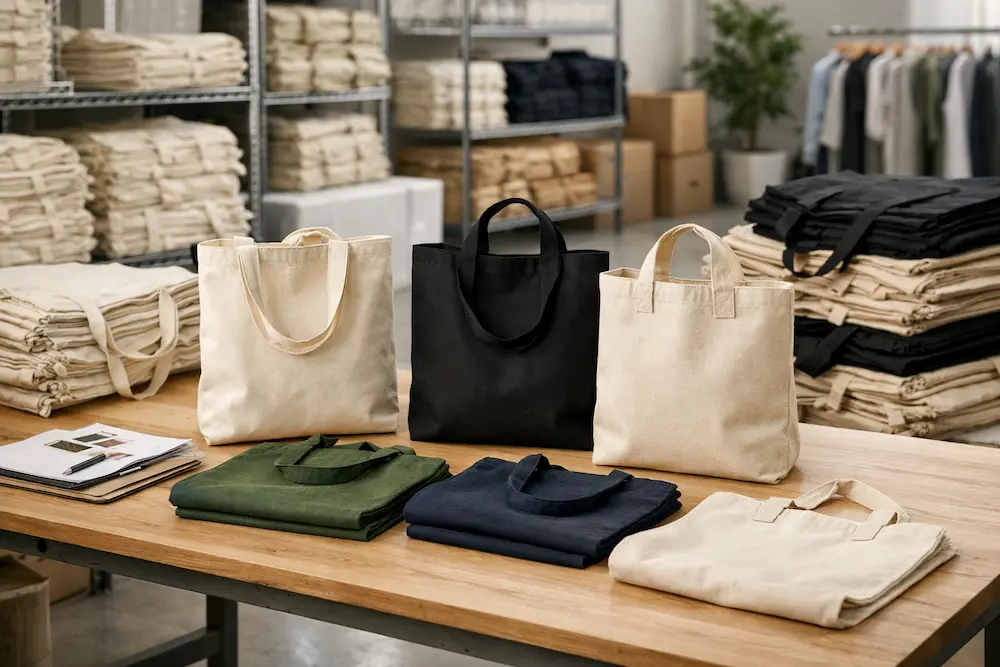
What Canvas Tote Bags Bulk Buying Really Means for Retailers
Canvas tote bags bulk buying means sourcing larger commercial quantities of tote bags for repeated store use, promotion, resale, gifting, or branded retail programs. For retailers, bulk buying is attractive because it can reduce unit cost, improve stock availability, and create stronger brand consistency across locations. But those advantages only appear when the product specification is disciplined and the supplier can maintain the same standard at scale.
Retail buyers often underestimate how many different bag types are hidden under the label “canvas tote bag.” Some are light casual carry bags meant for occasional use. Some are structured grocery-style bags designed for repeat loading. Some behave almost like merchandise, with stronger fabric, cleaner finishing, and better print presentation. Others are closer to event bags or promotional handouts. If the retailer does not define the purpose clearly, the supplier comparison becomes meaningless.
That is why successful bulk buying begins with retail function. Is the bag meant to be given away, sold, reused in store, used as premium packaging, or distributed during a promotion? Each purpose changes what the right bag should look like and how much the retailer should spend.
Why Retailers Choose Canvas Instead of Lighter Fabric Options
Retailers usually move toward canvas because it offers a stronger balance between durability, perceived value, and repeat-use potential. A standard lightweight cotton tote can work well for promotions, brochures, or casual campaigns, but canvas tends to perform better when the bag must carry real products, survive repeat shopping trips, and continue representing the store in public after purchase.
Canvas also gives better structure. It tends to hold shape more effectively, feels more substantial in hand, and can support stronger stitching and cleaner presentation. For retailers, that matters because customers do not evaluate a bag only as a bag. They interpret it as part of the store experience. A strong reusable canvas tote can make a retail purchase feel more premium, more intentional, and more aligned with current expectations around reusable shopping behavior.
That does not mean canvas is automatically the correct choice for every store format. Discount retail, short-term event distribution, or ultra-high-volume low-cost campaigns may still favor lighter bags. In those cases, alternatives such as cloth tote bags can still work well when the goal is simple everyday carry, softer branding, and lower distribution cost rather than heavier-duty retail performance.
Materials, Fabric Weight, and Construction Standards
Not all canvas tote bags are made to the same standard. Fabric type, weight, weave density, handle structure, reinforcement, and finishing all affect performance. Buyers should ask for exact measurable information rather than relying on vague phrases such as “heavy canvas” or “good quality bag.”
Common Canvas Material Options
Retail canvas bags are usually made from cotton canvas, recycled cotton blends, or mixed-fiber constructions depending on the price point and sustainability positioning. Cotton canvas remains the most common choice because it is familiar, printable, and commercially versatile. Recycled blends may suit retailers that want a clearer sustainability story, though texture and appearance can vary more from run to run depending on blend ratio and yarn quality.
Fabric Weight and Bag Performance
Fabric weight is one of the most important indicators of how the bag will feel and perform. Lighter canvas may suit event-driven use or light retail carry. Mid-weight canvas is often enough for general store use and moderate load expectations. Heavier canvas is better when the retailer wants a stronger grocery-style bag, resale-quality merchandise, or a product that stays in circulation longer.
| Canvas Tote Type | Typical Weight Range | Retail Use Case | Main Strength | Main Limitation |
|---|---|---|---|---|
| Light canvas tote | 180–220 gsm | Seasonal promotions, event carry, light retail use | Lower cost and easier distribution | Less structure for heavy repeat use |
| Standard canvas tote | 220–280 gsm | Bookstores, gift shops, fashion retail, general reusable bag programs | Balanced cost and durability | May feel less premium than heavier constructions |
| Heavy canvas tote | 280–340 gsm | Grocery, premium retail, resale-quality merchandise | Stronger body, longer service life | Higher material and freight cost |
| Recycled canvas blend | 220–320 gsm | Sustainability-led retail programs | Supports responsible brand narrative | Possible variation in texture and shade |
Construction Details Buyers Should Verify
Fabric weight alone does not guarantee quality. Retail buyers should verify handle attachment, cross-stitching, seam reinforcement, top fold finishing, gusset accuracy, base stability, and trimming quality. The most common failure point is still the handle, especially on bags intended for groceries, books, or repeated daily shopping use. A bag with strong fabric and weak handle attachment is not a strong retail product.
For buyers who want a product that sits between promotional use and long-term retail utility, cotton tote bags bulk programs are often used as a comparison benchmark, especially when the retailer is deciding whether the project needs softer everyday cotton or a stronger canvas structure for higher load performance and longer service life.
How Retail Use Case Should Shape the Bag Specification
The right specification depends on the store and the customer. A museum shop tote, a supermarket reusable bag, and an apparel boutique bag may all be canvas, but they should not be sourced the same way.
Bookstores and museum shops often benefit from medium to heavier canvas because customers may carry books, catalogs, or gift items. Grocery-oriented retailers need stronger load confidence, wider gussets, and reliable handle construction. Fashion retailers may prioritize shape, cleaner printing, longer handles, and softer finish. Gift shops may want more premium appearance even if the carrying load is moderate. The bag should be designed around the retail behavior it will actually support.
This is where many retailers overspend or underspecify. Overspending happens when they buy a heavy premium bag for a short-lived promotion that only needed light carry performance. Underspecifying happens when they choose a cheaper light bag for daily customer use and then deal with breakage, complaints, or poor brand impressions.
Printing, Branding, and Shelf Presentation
Canvas tote bags are not just functional products. They are also visible retail media. A bag with poor print clarity, inconsistent color, or weak visual balance can reduce the perceived quality of the whole program. Retailers therefore need to judge printing not only by whether a logo appears, but by whether the bag supports the store’s identity.
Screen printing is often the most practical solution for canvas because it works well for simple, bold graphics and repeat bulk production. More detailed artwork may require other methods depending on the fabric and finish. Buyers should confirm artwork positioning tolerance, print durability, and whether the supplier can maintain shade consistency across large production runs and repeat orders. For brands that care about a stronger sustainability-led look without sacrificing visual quality, canvas tote bag printing is often the most relevant technical subtopic because print method and material character need to work together, not against each other.
Retail presentation also includes bag proportions. A bag that is too deep, too narrow, or too soft may look less attractive in-store even if the material is strong. The printed bag should work as a retail object, not only as a flat sample on a table.
For more design-led retail programs, custom printed canvas bags are often chosen when the goal is not just logo placement, but a more natural and cohesive brand expression that fits premium or lifestyle-oriented store environments.
MOQ, Order Volume, and Real Cost Structure
MOQ exists for practical reasons. Fabric purchasing, cutting layout, print setup, sewing preparation, quality checks, and carton planning all create fixed costs before the full order begins. This is why smaller custom runs often seem expensive and why larger programs are more efficient once the retailer has a stable bag specification.
Retailers should think about volume in relation to store count, promotion calendar, stock turnover, warehouse space, and reorder frequency. A low MOQ may be useful during pilot programs or packaging trials. Larger bulk runs usually make more sense once the retailer knows the bag size, artwork, seasonal demand, and store distribution pattern.
Unit price is only one part of cost. Real landed cost is affected by fabric weight, bag dimensions, gusset depth, print coverage, finishing details, carton count, pallet efficiency, freight density, and damage risk. A better-structured bag can be more economical over time if it reduces complaints, improves repeat use, and stays visually attractive longer.
| Cost Driver | Effect on Retail Order | What Buyers Should Watch |
|---|---|---|
| Fabric weight | Higher weight raises material and freight cost | Use only as much strength as the store really needs |
| Bag size | Larger dimensions increase fabric use and carton volume | Avoid oversized bags for light retail items |
| Printing complexity | More colors and detail increase setup and QC demands | Keep art commercially realistic |
| Construction details | Gussets, inner pockets, labels, and zippers add labor | Use added features only where they create value |
| Pack-out method | Affects storage, handling, and freight efficiency | Confirm carton dimensions and bag count per carton early |
Packing Efficiency, Storage, and Freight Logic
Retail buyers often focus on bag quality but ignore packing efficiency until the goods are already on the water. That is a mistake. A bag program that looks economical in unit price can lose value quickly if it ships inefficiently or consumes too much warehouse space.
Canvas bags are bulkier than lighter fabrics, especially when they use heavier weights, wide gussets, or added structure. Retailers should confirm folded packing method, bag count per carton, carton dimensions, and pallet loading logic before approving mass production. These details affect freight spend, storage density, and in-store replenishment handling.
For multi-store retail networks, packing matters even more. Poor carton design can slow distribution or create unnecessary labor at store level. A strong supplier should be able to recommend pack-out methods that protect print quality while still keeping freight practical.
Sampling, QC, and Repeat-Order Stability
A sample is not just a preview. It is the first production test. Retailers should use sampling to confirm fabric feel, handle comfort, bag proportions, print quality, stitching, and how the product behaves with real store merchandise inside it. If the bag is for grocery or bookstore use, the sample should be tested with actual load conditions rather than approved only by appearance.
Quality control standards should also be discussed before mass production. Buyers should ask how the supplier checks fabric weight, print registration, seam quality, and carton packing accuracy. They should also ask how repeat orders are controlled so that a reorder six months later does not drift away from the original approved standard.
This repeat-order issue is one of the biggest long-term risks in canvas tote bag programs. Many suppliers can make a decent first sample. Fewer can maintain the same standard consistently across future runs.
Brand Visibility in Promotional and Retail Programs
Not every retailer uses canvas tote bags purely as packaging. Many also use them as a branded visibility tool in seasonal promotions, spend-threshold gifts, event activations, loyalty rewards, and store merchandise. In those cases, the tote bag needs to perform both as a useful product and as a long-term marketing surface.
For campaigns that need a stronger branded impression, promotional canvas tote bags with logo are often more effective than lower-value giveaway formats because they create a clearer connection between usefulness and brand recall. The logo remains visible only if the bag stays in circulation, which means durability and design both matter.
In broader store-led campaigns, exhibitions, or retail activations, promotional canvas tote bags can serve as a practical bridge between merchandising and marketing. That is especially true when the retailer wants the bag to keep carrying the campaign message after the original shopping or event moment has passed.
How Retailers Should Evaluate a Bulk Canvas Tote Supplier
The right supplier should act like a production partner, not only a quotation source. That means asking the retailer about use case, expected load, store type, target market, artwork, quantity planning, and reorder pattern before finalizing the recommendation.
Retailers should evaluate suppliers across six areas. First is material clarity: can the supplier explain fabric weights, canvas options, and which construction fits the retail use case? Second is construction control: can they show clear standards for sewing, reinforcement, and finishing? Third is print capability: can they manage brand consistency and realistic artwork requirements? Fourth is sampling: do they have an organized approval process? Fifth is export and logistics readiness: can they support carton planning, shipping logic, and repeat orders? Sixth is communication: do they answer commercially and precisely, or only with generic promises?
A reliable supplier should also know when not to oversell. If a lighter bag is enough, they should say so. If the retailer truly needs heavier canvas, stronger handles, or more structured packing, they should explain why in practical terms.
For B2B retail sourcing, this is also where Youngpack-style supplier logic becomes relevant. The better manufacturer is usually the one that can connect specification, printing, packing, and repeat-order control into one stable program rather than simply issuing a low quotation.
Common Bulk Buying Mistakes Retailers Should Avoid
The first mistake is buying only by price. The second is failing to define the real store use case. The third is approving a sample without agreeing on production tolerances. The fourth is ignoring freight and storage impact. The fifth is choosing a bag that flatters a concept board but does not fit daily customer behavior.
Another frequent mistake is treating every store format as though it needs the same tote bag. A premium concept store, a grocery chain, and an event-driven museum shop may all want canvas, but not the same canvas. Retailers should standardize where practical, but not by forcing one unsuitable product across all channels.
Conclusion
The best canvas tote bags bulk program is not built around the cheapest quote. It is built around the right balance of fabric strength, construction quality, print consistency, pack-out efficiency, retail presentation, and reorder reliability. For retailers, that balance matters more than any single headline price.
Canvas tote bags succeed when they fit real store behavior. They should be strong enough for the intended products, attractive enough to support the brand, efficient enough to ship and store sensibly, and consistent enough to reorder without unpleasant surprises. That is how a tote bag stops being a simple accessory and becomes a practical retail asset.
For serious retail buyers, the real goal is not just to buy bags in volume. It is to build a repeatable supply program that supports margin, merchandising, customer experience, and brand visibility over time. That is the standard a supplier like Youngpack should be judged against, and it is the standard retailers should expect before placing a large bulk order.
How Retailers Should Think About Canvas Tote Bags in Bulk
What bulk buying really means: Buying canvas tote bags in volume is not just a packaging decision. For retailers, it is part product sourcing, part branding, and part logistics planning. The right bag must support store operations, customer expectations, and repeat supply without losing consistency.
Why retailer requirements are different: Retailers usually need more than a simple promotional bag. They need a product that fits merchandise size, store image, customer carry habits, and often ongoing reorder needs. That makes fabric weight, handle construction, and pack-out efficiency more commercially important than many first-time buyers expect.
How buyers should compare options: The most reliable way to compare canvas tote bag options is to evaluate use case, durability, branding needs, freight logic, and reorder stability together. A bag for grocery use should not be judged by the same standards as a gift-shop tote or a seasonal event bag, even if the materials look similar at first glance.
Options retailers usually weigh: Buyers often compare lighter canvas versus heavier canvas, promotional-use bags versus resale-quality bags, and lower MOQ flexibility versus large-scale cost efficiency. The right answer depends on whether the retailer wants the bag to solve a short campaign need or become part of a longer-term reusable retail program.
Considerations before scaling up: Before placing a larger order, retailers should confirm sampling accuracy, printing expectations, construction tolerances, carton dimensions, warehouse fit, and whether the supplier can repeat the same quality months later. Those details matter just as much as initial price because they shape the total value of the program over time.
The larger takeaway: A strong bulk tote bag program is built around repeatable commercial logic. The most successful retailers do not simply buy more bags. They buy the right bag, from the right supplier, in the right volume, with a structure that supports long-term store use and brand value. That is also where Youngpack naturally fits as a practical B2B manufacturing and export partner for retailers that need customization, consistency, and scalable supply support.
FAQ
1. What fabric weight is best for canvas tote bags in retail bulk orders?
The best fabric weight depends on how the bag will actually be used in the store environment. Lighter canvas may work for event use, promotions, and light carry items, while standard canvas is usually more suitable for general retail use. Heavier canvas is often the better choice for grocery, bookstore, or premium resale applications where customers expect stronger daily performance. Retailers should match weight to real product load and customer behavior rather than assuming heavier is always better.
2. How do retailers decide between a promotional tote and a resale-quality canvas tote?
The difference usually comes down to durability, finishing, and customer expectations. A promotional tote may focus on cost efficiency, simple printing, and short- to medium-term use. A resale-quality tote usually needs stronger fabric, cleaner stitching, better print consistency, and a more premium hand feel. Retailers should decide whether the bag is being distributed as a marketing item, used as packaging, or sold as part of the store’s merchandise mix.
3. Why does MOQ matter in bulk canvas tote bag sourcing?
MOQ matters because bulk production involves setup costs for fabric sourcing, cutting, printing, sewing, and packing. Smaller runs carry higher unit costs because those setup costs are spread across fewer bags. Once the retailer has a stable bag specification and predictable demand, larger orders often improve unit economics and production consistency. MOQ should be evaluated together with storage capacity, campaign timing, and reorder planning.
4. What should retailers check before approving a canvas tote bag supplier?
Retailers should check material clarity, sewing standards, print capability, sample accuracy, pack-out efficiency, communication quality, and repeat-order control. A strong supplier should be able to explain why a certain fabric weight, handle style, or construction method suits the intended retail use case. They should also be able to support quality consistency in future orders rather than only producing one attractive sample.
5. Are canvas tote bags always the best option for retail programs?
Not always. Canvas is often a strong choice for reusable shopping, branded merchandise, bookstore carry, and premium retail presentation, but it may not be the most efficient option for every campaign. Some short-term promotions or ultra-high-volume programs may work better with lighter materials. The best option depends on store format, expected load, price point, distribution scale, and how long the retailer wants the bag to stay in use.
References
- Green Guides for the Use of Environmental Marketing Claims — Federal Trade Commission — FTC.
- Preferred Fiber and Materials Market Report — Textile Exchange — Textile Exchange.
- Textiles and the Environment — European Environment Agency — EEA.
- Sustainable Packaging Guidelines — Australian Packaging Covenant Organisation — APCO.
- Fashion on Climate — Global Fashion Agenda and McKinsey & Company.
- Retail Packaging and Reusable Bag Sourcing Best Practices — professional retail and sourcing reference.
- Responsible Sourcing and Product Communication in Textile Supply Chains — industry trade reference.
- Guide to Reusable Bags and Long-Term Use Value — industry best-practice sourcing reference.
Intellectual Property Notice:
All original written content published here remains the intellectual property of Xiamen Youngpack Imp.and Exp.Co.,Ltd. Any unauthorized reuse is strictly prohibited.