Introduction
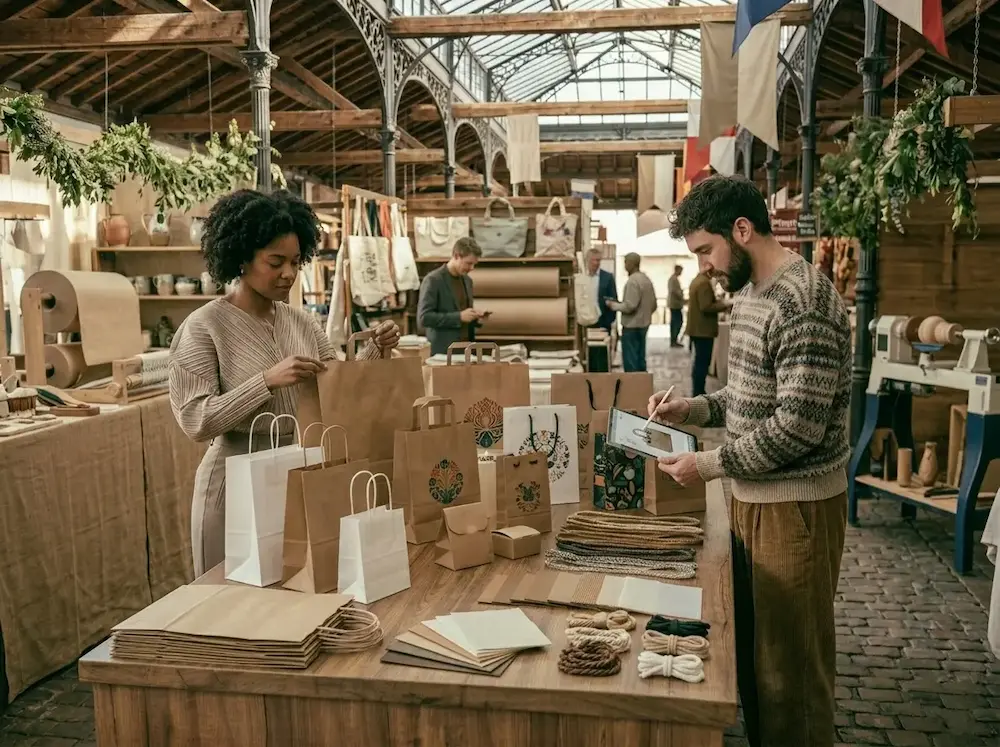
Sourcing custom printed paper bags is very different from buying plain stock packaging. A wholesale buyer is not only comparing bag size and price. They are comparing material choices, print consistency, bag structure, MOQ, lead times, export packing, and whether a printed paper bag manufacturer can reproduce the same result across repeat orders. For businesses buying custom paper bags wholesale, the real challenge is not finding the lowest quote. It is finding a paper bag supplier that can turn a packaging brief into a reliable long-term program.
This is why experienced wholesale buyers treat custom printed paper bags as a packaging program rather than a simple purchase item. A paper bag that looks good in a sample pack may still fail in bulk production if the reinforcement, printing accuracy, or export packing is not properly controlled. Buyers sourcing custom printed paper bags for retail stores, supermarkets, takeaway counters, and branded shopping programs usually care most about repeat quality, print consistency, and reliable communication from the paper bag supplier. For businesses where brand visibility is a major priority, many buyers also review solutions such as custom printed paper bags for strong brand recognition when comparing how different suppliers support retail presentation and long-term brand consistency.
Packaging expectations are also tightening in major markets. The European Commission states that the Packaging and Packaging Waste Regulation 2025/40 entered into force on 11 February 2025 and will generally apply from 12 August 2026. FDA explains that food contact substances include food packaging and its components, such as adhesives and colorants. APCO describes its Sustainable Packaging Guidelines as a comprehensive public resource used to support sustainable packaging design and manufacture in Australia.
What Custom Printed Paper Bags Are and Why Wholesale Buyers Use Them
Custom printed paper bags are paper-based carry bags produced with brand-specific artwork, selected sizes, defined handle styles, and chosen paper grades for retail, takeaway, gifting, grocery, and promotional use. Wholesale buyers choose custom printed paper bags because they want more than generic carry packaging. They want packaging that supports transport, brand visibility, and consistent customer presentation across stores or campaigns.
For wholesale buyers, custom printed paper bags are not only packaging products. They are also branded business tools. A strong printed paper bag manufacturer helps the buyer convert artwork, size requirements, and carry expectations into a repeatable packaging program. A weak paper bag supplier may only provide a quotation. A stronger supplier helps define what structure, paper type, handle style, and print method are actually suitable for the intended commercial use. In practical retail and takeaway programs, buyers often also compare formats such as paper bags with handles for easy carry and brand display when handle convenience and brand exposure need to work together.
For supermarkets, boutiques, cafés, beauty brands, and chain stores, the packaging does not end at the checkout counter. The bag stays in the customer’s hand, moves through public spaces, and keeps representing the brand after the sale. FSC states that its certification sends a clear message to businesses and consumers about responsible forest sourcing, which is one reason buyers increasingly assess paper-based packaging through both a performance lens and a sourcing lens.
Materials, Structure, and Technical Specifications
Wholesale buyers usually begin by evaluating the material system. Most printed paper bags are made in brown kraft, white kraft, or similar commercial paper structures. Brown kraft is often chosen for practical, natural-looking retail and takeaway programs. White kraft is often preferred where stronger print contrast, cleaner visuals, or more premium presentation is needed. Buyers that want to align sustainability with branding often also review options such as custom kraft bags for sustainable branding and packaging when comparing how material choice supports both environmental positioning and commercial presentation.
Paper type alone does not determine bag quality. Buyers should verify paper weight, width, gusset, height, top fold, bottom reinforcement, and handle construction together. A medium-weight bag with good reinforcement and balanced proportions can outperform a heavier bag with weak handle attachment or poor fold structure. This is why experienced wholesale buyers compare complete bag systems rather than only asking for thicker paper.
Print capability matters just as much. Some custom printed paper bags are better suited to efficient, repeatable graphics for large-volume retail or supermarket programs. Others need more refined print control because the bag plays a premium visual role in the customer experience. A capable printed paper bag manufacturer should explain what print method suits the order volume, the artwork, the bag material, and the retail channel.
Technical Reference Table: What Buyers Check Before Sampling Custom Printed Paper Bags
| Specification Area | What Buyers Confirm | Why It Matters |
|---|---|---|
| Paper type | Brown kraft, white kraft, recycled-content direction | Affects look, print result, and sourcing profile |
| Paper weight | Commercial range suitable for expected carrying use | Influences stiffness and confidence in use |
| Bag dimensions | Width, gusset, height based on real product mix | Prevents oversizing and poor product fit |
| Handle type | Flat handle, twisted handle, or approved alternative | Changes comfort, cost, and bag positioning |
| Reinforcement | Top fold, handle patch, and base structure | Reduces failure risk in real use |
| Print capability | Color control, registration, repeat accuracy | Determines brand consistency across runs |
Comparison Analysis for Buyers and Packaging Decision-Makers
Stock Bags vs Custom Printed Paper Bags
Stock bags are useful when demand is uncertain, timing is tight, or the program is still changing. Custom printed paper bags become more valuable when bag sizes, artwork, and volume are stable enough to justify approvals, MOQ, and repeat production. For structured retail programs, custom printed paper bags usually create stronger long-term value because they improve recognition, consistency, and packaging control.
Local Supplier vs Overseas Export Manufacturer
A local paper bag supplier may help with smaller urgent runs and easier communication. An overseas printed paper bag manufacturer often offers stronger OEM capability, broader structural options, and better long-run economics once the brief is stable. The better choice depends on forecast accuracy, landed cost, freight planning, and whether the buyer can manage approvals and reorders in a disciplined way.
Vendor vs Packaging Partner
A vendor mainly quotes. A packaging partner helps the buyer make better decisions. A stronger paper bag supplier should challenge weak assumptions, clarify actual use conditions, and explain trade-offs in size, material, printing, and MOQ before mass production begins.
For many businesses, the smartest sourcing choice is not simply the cheapest one. It is the supplier that can match packaging function, print control, delivery reliability, and repeat quality over time.
How Wholesale Buyers Source Custom Printed Paper Bags Step by Step
Step 1: Define the Use Case
The first step is to clarify what the custom printed paper bags must actually do. Buyers should define product type, carrying weight, channel use, target market, handle preference, size range, print expectations, and approximate annual volume.
Step 2: Shortlist Manufacturers
Once the brief is clear, buyers shortlist a printed paper bag manufacturer or paper bag supplier that appears suited to the project. At this stage, they should compare specialization, export experience, communication quality, and whether the supplier has experience with similar retail or takeaway programs.
Step 3: Review Samples and Print Quality
Sample review should focus on print sharpness, color accuracy, paper feel, handle attachment, fold quality, base stability, and product fit. A sample is useful only if it reflects likely production performance, not just one carefully prepared prototype.
Step 4: Confirm MOQ, Lead Time, and Export Readiness
After sample approval, buyers should verify MOQ, production timing, carton packing, pallet logic, and export discipline. This is where many mistakes happen. Buyers approve visually attractive custom printed paper bags but fail to confirm whether the supplier can reproduce them consistently at scale.
Step 5: Lock Specifications and Manage Repeat Orders
The strongest wholesale buyers standardize artwork approvals, dimensions, print tolerances, and packing rules before moving to routine reorders. This is the point where a supplier either becomes a dependable partner or remains just a transactional vendor.
Real Business Use Cases Across Packaging Markets
In supermarket and chain retail, custom printed paper bags are usually sourced for consistency. Buyers want stable sizes, dependable carry performance, and repeat branding across multiple stores. In these programs, custom paper bags wholesale often makes sense because annual volume is high enough to support a structured supply plan.
In takeaway, bakery, and café environments, custom printed paper bags often need to be practical first and branded second. The bag must support fast service, hold products securely, and still present the brand clearly. That is why many wholesale buyers in this category focus on balanced structure, efficient printing, and reliable reordering rather than decorative upgrades. FDA explains that food contact substances include packaging components such as adhesives and colorants, so buyers should evaluate intended use carefully in food-adjacent applications.
In boutique and premium shopping, wholesale buyers often prioritize print quality and handle feel more heavily. A bag in this category may act almost like an extension of the product presentation. Here, sample quality and repeat color control often matter more than squeezing every cent out of the unit price. For gifting, seasonal campaigns, and high-visibility retail events, some buyers also compare adjacent solutions such as custom printed gift bags for memorable brand presentation when they need packaging that supports both brand recall and a more polished customer experience.
Cost Structure, MOQ, and Bulk Strategy for Custom Paper Bags Wholesale
The cost of custom printed paper bags depends on several factors working together: paper type, bag size, handle style, print complexity, reinforcement, finish level, packing method, and freight. A bag that looks cheap per piece may create higher total cost if it packs inefficiently or produces more damage risk.
MOQ exists because paper bag manufacturing has fixed setup work. Printing setup, machine adjustment, material staging, and quality control create cost before the run becomes efficient. At higher volume, custom paper bags wholesale generally offers better economics and stronger repeat stability.
Bulk buying works best when the packaging brief is already stable. If the business is still changing sizes, graphics, or product mix, large orders can create obsolete stock and wasted budget.
Regulations, Sustainability, and Compliance Requirements
In the EU, packaging rules are moving toward stronger recyclable design and more structured packaging requirements. The European Commission states that PPWR 2025/40 is designed to reduce packaging waste and improve recyclability, and that it will generally apply from 12 August 2026. That means buyers should review the full bag structure, not just the main paper substrate. Handles, adhesives, inks, and finishes can all influence recycling performance and disposal clarity.
In Australia, APCO says the Sustainable Packaging Guidelines are used to support sustainable packaging design and manufacture, while its Packaging Sustainability Framework provides a consistent and transparent way to assess and track packaging sustainability. That pushes buyers to evaluate the actual packaging format rather than generic eco language.
In the United States, buyers sourcing custom printed paper bags for food-adjacent use should verify intended-use suitability rather than assume paper-based packaging is automatically acceptable. FDA states that substances contacting food through packaging that are food additives must be authorized through a food contact notification, food additive regulation, or Threshold of Regulation exemption where applicable.
Responsible fibre sourcing is another filter. FSC says certification sends a clear message about protecting forests and supporting responsible sourcing. That matters for procurement, ESG positioning, and retailer brand credibility.
Industry Trends Shaping Wholesale Sourcing Decisions
One major trend is the growing importance of fibre-based packaging as businesses review paper-based formats more closely under changing regulations and sustainability goals. Another is stronger demand for evidence-based claims. Buyers increasingly want suppliers that can explain recyclability, sourcing, and market-specific requirements clearly rather than rely on vague packaging language. These shifts make technical clarity part of commercial value.
A further trend is content-led supplier discovery. Procurement teams increasingly use technical comparisons, sourcing articles, and structured buying guides to shortlist suppliers before they ever ask for quotations. That means clear packaging knowledge now influences sales readiness as much as price sheets do.
How to Choose a Reliable Printed Paper Bag Manufacturer
A reliable printed paper bag manufacturer should be able to explain why a particular bag size, paper structure, print method, and handle style make sense for the intended use. If a supplier only asks for dimensions and logo files without discussing load, product fit, market use, or reorder expectations, that is usually a weak sign.
Repeatability matters more than a single attractive sample. Buyers should ask how handle attachment is controlled, how print consistency is maintained, how bags are packed for export, and how non-conforming product is handled. These are the questions that matter once the program moves beyond the sample stage.
Export experience is another useful filter. Suppliers serving Europe, North America, and Australia should understand documentation, freight planning, market-specific caution around packaging claims, and the importance of stable repeat production. This is one area where Xiamen Youngpack Imp. and Exp. Co., Ltd. can naturally fit the conversation as an export-oriented packaging supplier rather than only a general bag factory. Buyers that are reviewing broader product direction or comparing factory-style solutions can also refer to this paper bag product page as part of a wider internal sourcing and customization pathway.
Conclusion
Wholesale buyers source custom printed paper bags most effectively when they follow a structured process: define the use case, shortlist suppliers carefully, evaluate samples honestly, confirm MOQ and lead time, and scale only after repeat quality is proven. The right supplier is not simply the one with the lowest price. It is the printed paper bag manufacturer or paper bag supplier that can reproduce quality, communicate clearly, and support the packaging program over time.
For buyers building a long-term custom paper bags wholesale program, repeatability matters more than promises. A strong supplier turns custom printed paper bags into a stable packaging system that supports branding, retail presentation, and scalable purchasing.
How Wholesale Buyers Build Reliable Custom Printed Paper Bag Programs
What wholesale sourcing really means: Sourcing custom printed paper bags is not simply finding a low price for a paper product. It is a process of matching packaging structure, print requirements, compliance expectations, and repeat manufacturing capability to a real business need.
Why this process matters: A weak sourcing process can lead to inconsistent print, unstable handle performance, unclear recyclability claims, late deliveries, and costly reorders. A strong process creates a packaging program that is easier to repeat, easier to scale, and better aligned with the buyer’s operational and branding goals.
How strong buyers approach the market: Experienced wholesale buyers define the use case first, then compare suppliers on technical fit, sample quality, MOQ, lead time, and export discipline. They do not assume that a good sample guarantees a good bulk order. Instead, they test whether the supplier can reproduce that quality under real production conditions.
Options buyers typically compare: Most buyers compare stock versus custom programs, local versus overseas supply, simpler print systems versus more premium print execution, and smaller trial orders versus standardized volume runs. The right option depends on whether the business values flexibility, cost control, brand presentation, or long-term repeatability most.
Considerations that matter most: Buyers should pay special attention to handle construction, base reinforcement, print consistency, packing efficiency, food-contact caution where relevant, and whether environmental claims match the actual bag structure. They should also evaluate whether the supplier communicates clearly and challenges weak assumptions before production begins.
The bigger takeaway: The strongest wholesale sourcing decisions come from choosing a manufacturer that behaves like a packaging partner rather than just a vendor. For businesses that need structured customization, export readiness, and repeat production discipline, Youngpack can naturally fit that role as a practical B2B packaging supplier.
FAQ
1. How do wholesale buyers usually start sourcing custom printed paper bags?
They usually start by defining the use case first. Buyers clarify size, carrying needs, paper direction, handle type, print requirements, target market, and expected volume before shortlisting suppliers.
2. What should buyers check before approving custom printed paper bags?
They should check print sharpness, color accuracy, paper feel, handle attachment, fold quality, base stability, and whether the bag fits the real product mix.
3. Are custom printed paper bags always recyclable?
Not always. Many are widely recyclable, but actual recyclability depends on the full structure, including handles, coatings, inks, adhesives, and local recovery systems. Buyers should review the complete format before making claims.
4. Why do custom paper bags wholesale orders usually have MOQs?
MOQ exists because manufacturing includes fixed setup work such as print preparation, machine adjustment, material staging, and quality control. Once demand is stable, larger runs usually create better overall economics.
5. What should buyers ask a printed paper bag manufacturer before placing a wholesale order?
Buyers should ask about paper options, print method, handle reinforcement, MOQ, lead time, export packing, repeat quality control, compliance awareness, and how the supplier recommends the best structure for the intended market and use. For food-adjacent uses, they should also ask how food-contact conditions are evaluated.
References
- Packaging waste — European Commission — Directorate-General for Environment — European Commission.
- Regulation (EU) 2025/40 on packaging and packaging waste — European Union — EUR-Lex.
- Food Packaging & Other Substances that Come in Contact with Food: Information for Consumers — U.S. Food and Drug Administration — FDA.
- Understanding How FDA Regulates Substances that Come into Contact with Food — U.S. Food and Drug Administration — FDA.
- Food Ingredients & Packaging — U.S. Food and Drug Administration — FDA.
- Sustainable Packaging Guidelines — Australian Packaging Covenant Organisation — APCO.
- Packaging Sustainability Framework — Australian Packaging Covenant Organisation — APCO.
- Paper & Packaging — Forest Stewardship Council — FSC.