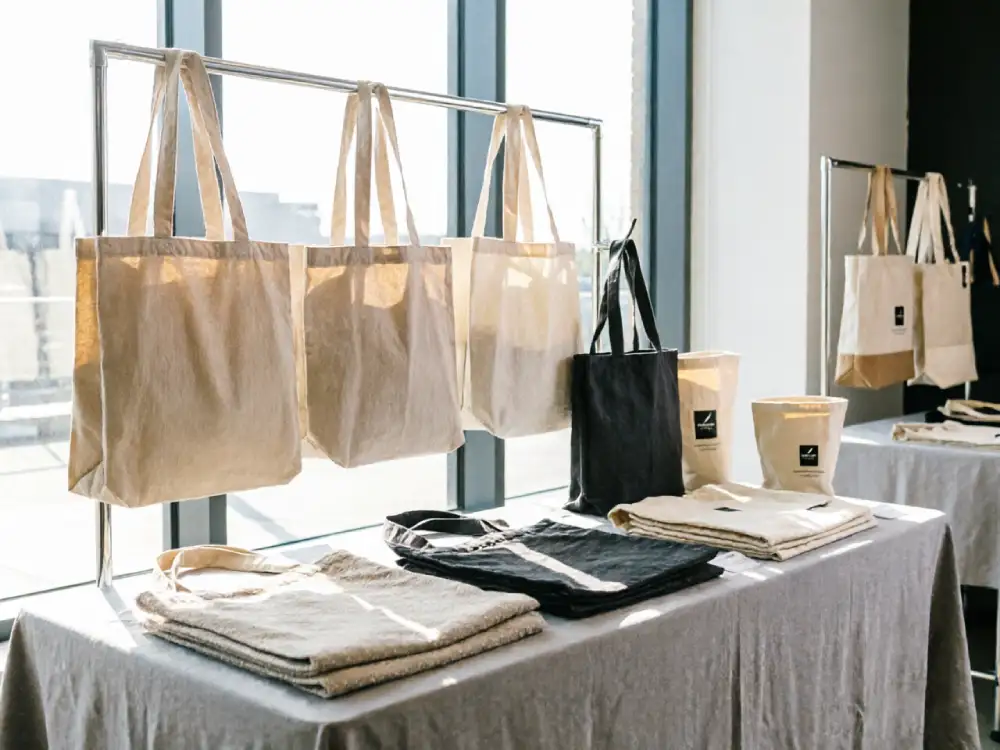
Introduction
Promotional tote bags have stayed relevant for one simple reason: they keep working after the event ends. A digital ad disappears in seconds, but a good tote bag can travel through offices, supermarkets, campuses, trade shows, cafés, and public transport for months or even years. That gives brands something many marketing channels struggle to provide at reasonable cost: repeated visibility tied to real-world use.
That practical value matters more today because branded merchandise is no longer treated as a throwaway extra. PPAI reported in late 2025 that roughly 83 percent of consumers said receiving a promotional product made them feel appreciated, and 90 percent said it improved their perception of the brand. In early 2026, PPAI also reported joint U.S.-European findings showing branded merchandise performs strongly on carbon impact per memorized impression, outperforming all channels except out-of-home in the combined results.
That does not mean every tote bag is a smart choice. A weak bag, an unhelpful size, poor print quality, or an empty “green” claim can damage brand perception instead of strengthening it. The best custom tote bags are chosen with campaign intent in mind. Some are designed for low-cost mass distribution. Some are built for premium retail-style brand expression. Some are meant for conferences, some for supermarkets, some for employee welcome kits, and some. For campaigns focused on repeat exposure rather than one-time distribution, custom canvas bags with logo can deliver stronger long-term brand visibility than lower-retention giveaway items.
What Promotional Tote Bags Are and Why They Work
Promotional tote bags are reusable carry bags branded with a company logo, message, graphic identity, or campaign artwork and distributed to support awareness, engagement, loyalty, or retail-style brand presence. They are commonly used at trade shows, corporate events, retail promotions, universities, nonprofit campaigns, hospitality activations, internal branding programs, and seasonal marketing launches.
What makes them different from cheaper promotional items is the combination of visibility and utility. A pen may carry a logo, but it has limited visual area and often stays in one place. A tote bag creates moving brand exposure. It is used in supermarkets, offices, airports, gyms, campuses, and shopping streets. It also offers a much larger printable area, which makes branding more legible from a distance and more expressive in design.
There is also a psychological reason tote bags perform well. People are more likely to keep and reuse a product that solves a small daily problem. A useful bag reduces the friction of carrying books, groceries, samples, cosmetics, or event materials. That repeated usefulness increases familiarity, and familiarity improves recall. Older but still widely cited PPAI research reported that nine in ten consumers recalled the branding on promotional products they had received, with recall substantially higher than several traditional advertising channels.
For marketing teams, that means tote bags can serve different strategic roles at once. They can be a giveaway, a brand carrier, a retail-style merchandise item, a customer appreciation tool, or even a signal of category positioning. A soft natural cotton tote suggests something different from a sharp, structured canvas bag with premium printing. A lightweight promotional bag for marketing campaigns may suit a trade show. A heavy branded tote bag may better suit a lifestyle brand, bookstore chain, organic retailer, or premium event.
Brands that want campaign merchandise to reflect a more specific visual identity often move beyond stock giveaways and invest in custom made tote bags that align with seasonal themes, product launches, or retail storytelling.
Materials, Construction, and Technical Specifications
The performance of a promotional tote bag starts with material selection. The most common options are cotton, canvas, recycled cotton blends, and non-woven polypropylene. Each has different cost logic, print behavior, handle strength, texture, and perceived value.
Cotton tote bags are widely used because they feel natural, fold easily, and support a clear reusable message. Typical lighter promotional cotton bags may fall around 4 oz to 6 oz, while more robust options often range from roughly 7 oz to 10 oz. Canvas is usually heavier and stronger than standard cotton sheeting, often chosen when the bag is expected to feel more durable or premium. Non-woven polypropylene remains popular for budget-driven bulk campaigns because it is lightweight, low-cost, and available in many colors, though it gives a different brand impression than natural-fiber bags.
GSM matters because it affects body feel, carrying confidence, and longevity. A 120–140 gsm cotton bag may be enough for simple leaflets, light retail items, and short-term event use. A 220–340 gsm canvas bag is more suitable when the bag is expected to carry books, groceries, welcome kits, or repeated daily-use loads. Stitch density, handle reinforcement, and gusset construction matter as much as fabric weight. A heavier fabric with weak stitching can still fail early.
Printing compatibility also varies. Cotton and canvas work well with screen printing, heat transfer, embroidery, and increasingly digital methods depending on artwork. Non-woven bags often work well for simpler logo-based prints but may not give the same premium finish for detailed art or high-end fashion branding.
For campaigns that expect the bag to stay in use well beyond the event itself, cotton canvas tote bags are often a stronger option because they combine better structure, higher perceived value, and longer carry life.
Technical Reference Table: Common Tote Bag Choices for Campaigns
| Tote Bag Type | Typical Weight Range | Visual Positioning | Typical Load Use | Best Printing Fit | Best Campaign Use |
|---|---|---|---|---|---|
| Lightweight cotton tote | 120–150 gsm | Natural, casual, cost-conscious | Flyers, brochures, light retail | Screen print | Events, mass giveaways, nonprofits |
| Standard cotton tote | 140–180 gsm | Reusable everyday bag | Books, cosmetics, mixed use | Screen print, transfer | Conferences, brand merch, retail promo |
| Canvas tote | 220–340 gsm | Premium, durable, lifestyle-oriented | Groceries, kits, repeated use | Screen print, embroidery, premium print | Premium campaigns, retail brands, employee gifting |
| Recycled cotton blend tote | 140–220 gsm | Sustainability-led, brand storytelling | Light to medium daily use | Screen print | ESG-themed campaigns, conscious branding |
| Non-woven tote | 80–120 gsm | Budget promotional, high-volume | Light retail and giveaway use | Simple logo print | Trade shows, supermarket promos, bulk campaigns |
These ranges are commercial reference points, not strict rules. Final performance depends on dimensions, gusset size, handle length, cross-stitching, edge finishing, and how the bag is actually used.
Which Promotional Tote Bag Type Works Best
The best tote bag is the one that matches campaign intent, not the one with the most fashionable material story.
Cotton vs Canvas vs Non-Woven
Cotton works best when a brand wants a soft, natural, approachable feel at moderate cost. It is versatile and familiar. Canvas works best when a brand wants a stronger impression of quality, durability, and reusability. Non-woven works best when budget and scale are the main priorities and the campaign needs large volume rather than premium perception.
A common mistake is using a very light cotton tote for a campaign that wants premium brand lift. Another mistake is overspending on heavy canvas for a one-day event where attendees only need to carry brochures and small samples. The bag should match how long the brand wants the item to stay in use.
Giveaway Bag vs Merchandise-Quality Bag
A giveaway tote is usually optimized for price, broad reach, and simple branding. A merchandise-quality tote is optimized for desirability, repeated reuse, and stronger association with the brand’s lifestyle or values.
If the campaign goal is maximum distribution, a simpler low-cost tote may make sense. If the goal is higher brand affinity, premium perception, influencer visibility, or employee pride, a better-made bag can deliver stronger long-term value.
Event Bag vs Retail Use Bag
Trade show bags need to carry papers, catalogs, and lightweight samples while staying affordable at large volume. Retail-use bags need to survive repeated shopping trips and public reuse. A conference tote can be lighter. A retail lifestyle tote should usually be stronger, more comfortable to carry, and better finished.
Comparison Table: Best Promotional Tote Bag Option by Campaign Goal
| Campaign Goal | Best Bag Direction | Why It Works | Main Trade-Off |
|---|---|---|---|
| Mass awareness giveaway | Lightweight cotton or non-woven | Low unit cost, easy bulk distribution | Lower perceived value |
| Premium brand campaign | Heavy cotton or canvas | Better retention, stronger brand feel | Higher cost |
| Sustainability storytelling | Recycled cotton or natural cotton | Supports responsible brand narrative | Claims must be substantiated |
| Trade show handout | Mid-light cotton or non-woven | Handles brochures and samples efficiently | May not feel premium |
| Retail brand merchandise | Canvas tote with quality finishing | Looks like a product, not a giveaway | Higher MOQ and stricter QC needed |
| Employee or VIP kit | Structured cotton/canvas tote | Higher perceived appreciation | Needs stronger design control |
Best Campaign Use Cases for Promotional Tote Bags
At trade shows and exhibitions, promotional tote bags work because attendees are actively collecting materials. A bag solves an immediate problem and turns the brand into part of the event experience. Here the best option is usually a moderately priced bag that is comfortable enough to carry, large enough for literature, and easy to print clearly.
In retail promotions, tote bags become more strategic. A supermarket chain may use them to reinforce reusability and encourage basket-building. A beauty brand may use them as part of a spend-threshold gift. A bookstore or museum shop may use them as both packaging and branded merchandise. In these cases, the bag is not only a giveaway. It becomes part of store identity.
For universities, nonprofits, and public campaigns, tote bags are effective because they align well with community participation and repeated everyday use. They travel across campuses, libraries, workshops, and volunteer events. The right choice here is often a practical cotton bag with clear messaging rather than a high-cost fashion-oriented style.
For employee onboarding kits, conference welcome packs, and corporate campaigns, tote bags work best when they feel useful rather than generic. A plain thin bag with a small logo feels disposable. A well-designed bag with suitable size, decent fabric weight, and a thoughtful print layout feels intentional. That difference changes how recipients interpret the brand.
A well-designed cotton tote works especially well in campaigns where repeated everyday use matters, because it keeps the brand visible in supermarkets, offices, campuses, and public spaces long after the original event.
For lifestyle, fashion, and premium food brands, branded tote bags can even become a soft form of wearable media. Consumers carry them in public because the design is attractive enough to keep. That is where premium canvas, better print registration, longer handles, inner pockets, or reinforced gussets may justify the higher spend.
Cost Structure and Quantity Planning
The cost of a tote bag is shaped by more than fabric choice. Material weight, bag size, gusset depth, handle style, stitching complexity, print colors, print coverage, finishing, packaging method, and order quantity all matter.
A large thin bag is not necessarily cheaper than a smaller but heavier bag. More fabric area can offset lighter weight. A two-color screen print may cost more overall than a one-color print on heavier fabric, depending on setup. Gussets increase usability but also change material consumption and sewing time. Inner labels, woven tags, zipper closures, bottom panels, and pockets all push the bag toward a merchandise-style product rather than a simple promo item.
MOQ exists because custom production has setup costs. Screens, artwork positioning, cutting layouts, fabric procurement, and sewing preparation all create fixed production logic. For that reason, a promotional tote bag manufacturer will usually price small pilot runs much higher per unit than repeated bulk production.
The smartest way to plan quantity is to work backward from campaign mechanics:
event attendance, expected redemption rate, geographic distribution, campaign duration, and whether the bag is a free handout, threshold gift, or resale-supporting item.
A rough planning model often looks like this:
Small campaign: 300 to 1,000 bags for pilots, local launches, PR drops, or small conferences
Medium campaign: 1,000 to 5,000 bags for regional promotions, multi-store programs, or recurring events
Large campaign: 5,000+ bags for nationwide retail, chain programs, mass events, or long-running branded merchandise strategies
For national promotions, conference programs, or multi-store rollouts, sourcing cotton tote bags bulk usually makes more commercial sense because it improves cost control, branding consistency, and campaign planning.
A cheaper bag is not always the cheaper campaign. If the bag tears early, looks weak in photos, or is discarded immediately, the marketing value falls sharply. A slightly stronger bag may create better total return because it stays in use longer and carries the brand more often.
Sustainability, Claims, and Compliance
Sustainability is one of the strongest selling points for tote bags, but it is also one of the easiest areas to get wrong. Too many campaigns still use vague words like “eco-friendly,” “green,” or “sustainable” without defining what those claims actually mean.
In the United States, the FTC’s Green Guides are designed to help marketers avoid environmental claims that mislead consumers. The FTC makes clear that environmental claims should be truthful and substantiated. In the EU, pressure around environmental marketing has also increased. The European Commission’s Green Claims initiative is aimed at setting stronger criteria to stop misleading claims, while Directive (EU) 2024/825 strengthens consumer protection against unfair commercial practices related to the green transition.
For eco friendly promotional tote bags, that means brands should be careful. A cotton bag is not automatically a compliant sustainability story. A recycled cotton bag should only be described as such if the content can be supported. “Reusable” is easier to defend than broad unqualified claims like “planet friendly.” If a bag uses recycled content, organic cotton, or specific certifications, the claim should be backed by actual material status and supplier documentation.
This is one reason B2B buyers increasingly ask suppliers for clearer material transparency. A serious custom tote bag supplier should be able to explain fabric composition, printing method, lead time, and any substantiated environmental attributes without relying on empty adjectives.
Industry Trends Shaping Promotional Tote Bags
The first clear trend is that useful merchandise is outperforming novelty merchandise. PPAI’s 2025 consumer findings show that promotional products are increasingly seen as experiences rather than extras, and emotional response matters. When recipients feel appreciated, brand perception improves. Tote bags benefit from this because they are both practical and visible.
The second trend is premiumization. More brands want custom tote bags that look closer to retail merchandise than event leftovers. Better handle drops, heavier canvas, stronger sewing, minimalist layouts, and limited-color premium design are increasingly common. The message is clear: if the bag is worth keeping, it becomes a better advertising medium.
The third trend is more disciplined environmental messaging. Brands are under more pressure to substantiate claims, especially when marketing to consumers in Europe or the United States. The days of casually printing “100% eco” on a bag with no supporting logic are fading.
The fourth trend is campaign efficiency. PPAI’s 2026 reporting on memorized impressions and carbon impact gives branded merchandise a more serious place in media planning discussions. That does not mean tote bags replace digital or out-of-home advertising, but it does strengthen their case as a complementary physical channel with durable recall value.
The fifth trend is supplier discovery through content. Buyers increasingly shortlist suppliers based on how clearly they explain materials, printing, compliance, and campaign fit. Technical clarity has become part of sales credibility.
How to Choose a Reliable Tote Bag Manufacturer
A reliable tote bag factory should do more than quote a price. It should be able to recommend material weights by campaign purpose, explain printing limits, flag unrealistic artwork choices, and discuss quantity planning honestly.
The first thing to check is material consistency. Can the supplier explain the difference between light cotton, canvas, recycled blends, and non-woven clearly? Can they suggest the right fabric range for a budget event bag versus a premium branded bag?
The second is print quality control. Promotional bags live or die by branding clarity. Buyers should ask how the supplier manages color consistency, print placement, pre-production proofs, and repeat orders. A bag with inconsistent artwork weakens campaign credibility fast.
The third is export and timing experience. Marketing campaigns usually have hard deadlines. A good promotional tote bag manufacturer should be able to discuss lead times, sample timelines, bulk production stages, and shipping planning in a realistic way.
The fourth is communication quality. Strong suppliers structure decisions well: material, size, handle, gusset, print method, packing, MOQ, and timing. Weak suppliers only say “we can do it” and leave the buyer to guess the rest.
This is where supplier standards matter more than slogans. A company such as Youngpack, or any supplier trying to serve serious B2B buyers, should be evaluated on manufacturing logic, printing control, export readiness, and honest material communication rather than generic claims about being “the best.”
Conclusion
The best promotional tote bags are not chosen by trend alone. They are chosen by campaign objective.
If the goal is mass reach at controlled cost, lighter cotton or non-woven bags may be the right answer. If the goal is premium brand lift, stronger retention, and repeated public visibility, canvas or better-constructed cotton bags usually perform better. If sustainability is part of the campaign story, claims must be specific and supportable. If the bag is expected to behave like merchandise, it must be built like merchandise.
For marketing campaigns, the most important questions are simple:
Will people actually use the bag?
Will the branding look clear and intentional?
Will the material match the brand position?
Will the supplier deliver consistent quality on time?
When those four questions are answered properly, tote bags stop being just another giveaway and become one of the most effective physical branding tools in the campaign mix. Youngpack and other serious B2B manufacturers should ultimately be judged on how well they help buyers make those choices with clarity, consistency, and real production understanding.
How Promotional Tote Bags Create Better Campaign Value
What promotional tote bags really do: A promotional tote bag is more than branded packaging. It is a mobile brand surface, a useful daily object, and a campaign asset that can continue generating impressions long after an event or giveaway ends. That makes tote bags different from lower-retention promotional items that are quickly ignored or discarded.
Why they work: Tote bags succeed because they sit at the intersection of usefulness and visibility. Recipients are more likely to keep a bag that helps them carry groceries, books, samples, or everyday items. Once the item becomes part of normal use, the brand gains repeated public exposure with relatively low friction.
How buyers should evaluate them: The best evaluation framework is practical rather than decorative. Buyers should compare material weight, handle strength, print clarity, expected reuse, campaign audience, and budget per impression. A bag that is slightly more expensive but used for months can easily outperform a cheaper one that is discarded after a single event.
Options that matter most: Light cotton and non-woven bags are usually suitable for mass distribution and event-scale campaigns. Medium-weight cotton works well for general branded promotions and reusable giveaways. Heavier canvas bags are more appropriate when the brand wants the product to feel premium, durable, and close to retail merchandise. Recycled-content options may support sustainability-oriented campaigns, but claims should be specific and supported by actual material evidence.
Considerations that separate strong campaigns from weak ones: The most common failure is choosing a tote bag only by unit price. Good campaign planning should also consider audience fit, design readability, carrying comfort, print consistency, campaign duration, and the credibility of any environmental message. Brands should be careful with broad “green” claims and work with suppliers that can explain material composition and production logic clearly.
Where the market is heading: Promotional tote bags are moving toward better usefulness, stronger visual quality, and more disciplined brand storytelling. Buyers now expect promotional items to create real emotional value, not just logo exposure. That shift favors suppliers and brands that treat tote bags as part of a broader marketing system rather than a last-minute event accessory. For B2B buyers, that is also where Youngpack-style manufacturing discipline, export experience, and customization support become commercially valuable.
FAQ
1. What are the best promotional tote bags for marketing campaigns?
The best promotional tote bags depend on campaign purpose rather than one universal material choice. Lightweight cotton or non-woven bags are usually better for high-volume giveaways and trade shows, while heavier cotton or canvas bags are usually better for premium brand campaigns, employee kits, retail promotions, and merchandise-style use. The right bag should match budget, expected reuse, audience profile, and brand image.
2. Are cotton tote bags better than non-woven tote bags for promotions?
Cotton tote bags are usually better when the brand wants a more natural look, stronger perceived quality, and better long-term reuse value. Non-woven bags are usually better when cost control, color variety, and large-volume distribution matter most. Cotton often supports stronger brand storytelling, while non-woven often supports lower-cost campaign reach. The better option depends on whether the campaign is optimizing for impression quality or distribution scale.
3. What printing method works best for branded tote bags?
The best printing method depends on material, artwork complexity, and campaign positioning. Screen printing is often the most practical option for cotton and canvas when the design is relatively simple and color count is controlled. More detailed or special-finish artwork may need different print approaches depending on the bag construction. Buyers should choose a method that supports both brand clarity and production consistency at the required order volume.
4. How many promotional tote bags should a campaign order?
The right quantity depends on campaign type, attendance forecast, gift redemption rate, sales threshold logic, and whether the bag is a simple giveaway or a longer-running branded merchandise item. Smaller campaigns may use a few hundred to one thousand bags, while multi-location or national campaigns often require several thousand pieces or more. It is better to estimate based on campaign mechanics than to choose a random volume just to reduce unit price.
5. Can brands make eco-friendly claims on promotional tote bags?
Yes, but they should be careful and specific. Environmental claims should be truthful, clear, and supported by evidence. In the United States, the FTC Green Guides are designed to help marketers avoid misleading environmental claims, and in Europe the regulatory environment is becoming stricter around green marketing. Brands should avoid vague wording and use claims that can be supported by actual material composition, sourcing, or certification status.
References
- Product Power 2026: What Consumers Want Next — PPAI Research Team — Promotional Products Association International — PPAI.
- Joint PPAI-ASI Study Finds Promo Among The Lowest Carbon-Impact Advertising Channels — PPAI Staff — Promotional Products Association International — PPAI.
- Tipping The Scales — PPAI Editorial Team — Promotional Products Association International — PPAI.
- PPAI Consumer Study: Why Promo Clicks With Gen Z — PPAI Staff — Promotional Products Association International — PPAI.
- Green claims — European Commission — European Commission Environment — European Commission.
- Directive (EU) 2024/825 — European Parliament and Council — EUR-Lex — European Union.
- Green Guides — Federal Trade Commission — FTC — Federal Trade Commission.
- Environmental Marketing — Federal Trade Commission — FTC Business Guidance — Federal Trade Commission.
Original Article Statement:
This is an original article published by Xiamen Youngpack Imp.and Exp.Co.,Ltd. Any full or partial reproduction without permission is prohibited.